The Silence of the Stones
The approach to Ochate is not merely a physical journey; it is a gradual stripping away of the modern world. You leave your car near the hamlet of Imiruri, where the tarmac ends and the silence begins. The path is deceptive—a muddy track winding through the lush, verdant heart of the Condado de Treviño, flanked by ancient oaks and fields that seem to hold their breath. As you walk, the sounds of civilization—the distant hum of highways, the buzz of phones—fade into a heavy, oppressive quiet, broken only by the crunch of boots on gravel and the wind moving through the high grass.
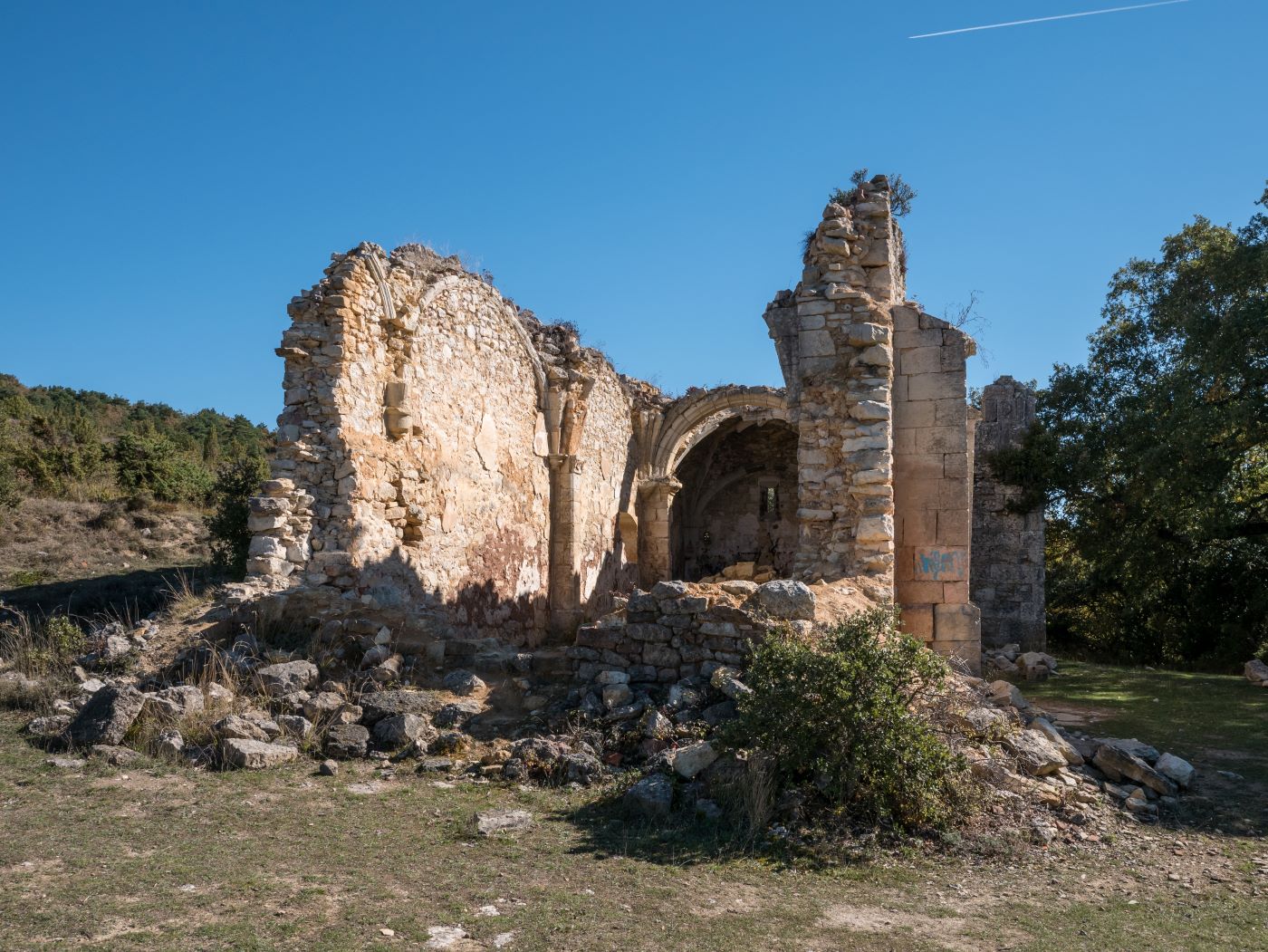
Then, you see it. Rising from a tangle of brambles and untamed vegetation like a skeletal finger pointing accusingly at the sky: the Tower of San Miguel. It is the first and most enduring sentinel of Ochate, a stone witness to centuries of rumored tragedy.
Walking toward the ruins, the air feels different—thicker, perhaps, or simply charged with the weight of expectation. This is not just an abandoned village; it is a scar on the landscape of Burgos. It is a place where the barrier between the past and the present, the living and the dead, feels dangerously thin. To stand in the shadow of the tower is to understand why this desolate patch of earth has been crowned the "capital of the paranormal" in Spain. The silence here is not empty; it is waiting.
An Island of Castile in a Sea of Basque Green
The village lies within the Condado de Treviño, a territory that is a historical and administrative paradox. It is an enclave of Castile and León (specifically, the province of Burgos), yet it is entirely swallowed by the Basque province of Álava.
Looking at a map, Treviño is an island of Castile drowning in a sea of Basque green. This oddity dates back to the complex feudal agreements of the Middle Ages, specifically the 12th century, when the Kingdom of Navarre and the Crown of Castile vied for dominance. The result is a land that belongs to neither world fully—a place of liminality.
This geographical severance has fostered a unique psychology in the region. For centuries, the inhabitants of the Condado lived in a state of administrative distance from their provincial capital, creating a sense of self-reliance and hermetic closure. Ochate, nestled deep within this enclave, was doubly isolated: cut off from Burgos by distance and cut off from its immediate neighbors by the rugged terrain. It was a perfect incubator for legends, a place where stories could fester and mutate without the intrusion of the outside world, turning a simple rural settlement into a theater of the macabre.
The Secret Door of the Wolves
The name itself carries a vibration of the arcane. "Ochate" is a Castilianization of the Basque Otxate, which etymologists and historians translate roughly as the "Secret Door" or, more evocatively, the "Wolf’s Door" (Otsoa meaning wolf, Ate meaning door or port).
Long before it was a ghost town, it was a thriving, strategic point. The village sits near the ancient route that connected the Rioja region with the Cantabrian coast, a path trodden by merchants, soldiers, and pilgrims. The settlement traces its origins back to the 11th or 12th century, a time when the Lordship of the Fernán González family held sway.
In its prime, Ochate was not a cursed place but a vital organ of the local economy. It had life, noise, and commerce. The "Wolf’s Door" suggests it was a threshold—a wild place on the edge of civilization where nature and humanity clashed. Today, looking at the crumbled walls claimed by moss and ivy, the name feels prophetic. It has become a door indeed—a secret entry point into a darker narrative that few are brave enough to open fully.
The Trinity of Death: A Cursed Narrative
The foundation of Ochate’s infamy lies in a specific, terrifying legend known as the "Three Plagues." According to the lore that circulated wildly in the late 20th century, Ochate was not simply abandoned; it was executed by divine wrath.
The story goes that in the mid-19th century, specifically between 1860 and 1870, the village was struck by three consecutive epidemics: smallpox, typhus, and cholera. The horror of the legend lies in its selectivity. The narrative claims that while the inhabitants of Ochate dropped dead in the streets, the neighboring village of Imiruri—mere kilometers away—remained entirely untouched.
It is said that the parish priest, overwhelmed by the unending funerals and the stench of death, eventually ceased ringing the bells, for there was no one left to hear them. The legend paints a picture of a "damned" geography, where a mysterious localized contagion wiped out the population in waves, leaving only the stones to bear witness. This idea of a biblical curse, a selective extinction event, became the bedrock upon which the paranormal claims of the 1980s were built. It transformed Ochate from a ruin into a necropolis of the unexplained.
Dust to Dust: The Slow Death of Reality
However, when one steps away from the campfire stories and into the dusty archives of the Diocese of Vitoria and the municipal records of Burgos, the "Three Plagues" narrative crumbles into dust.
Historical investigation, led by researchers who sought the truth behind the myth, revealed a far more mundane, yet equally tragic, reality. There are no death certificates indicating a mass die-off from smallpox, typhus, or cholera in the alleged years. The burial records show a normal mortality rate for a rural 19th-century village. The "curse" was a fabrication, likely embellished by word-of-mouth storytelling over generations.
The true death of Ochate was not sudden, but an agonizingly slow asphyxiation. The demise was driven by economics, not bacteria. As the 19th century turned into the 20th, the trade routes shifted. A new road was constructed that bypassed Ochate, rendering it obsolete. Coupled with the pull of industrialization in nearby Vitoria-Gasteiz, the families of Ochate simply packed up and left, one by one.
The village did not die screaming; it died in silence. The last inhabitant is said to have left in the 1930s. The "mystery" of its abandonment is actually a textbook case of rural depopulation in Spain (the phenomenon of La España Vacíada). Yet, the human mind abhors a vacuum. Where history offered a boring explanation of economic migration, the collective imagination inserted a curse, preferring a supernatural tragedy to a bureaucratic one.
Blood on the Soil: The Tragedy of 1947
While the plagues may be fiction, Ochate has tasted real blood. In 1947, years after the village was largely abandoned, a grim event occurred that permanently stained the location's reputation, lending a grain of truth to the rumors of darkness.
Antonio Villegas, a resident of the nearby village of Imiruri, was brutally murdered in the vicinity of the ruins. The crime was violent and, for the time, shocking in its cruelty. Although the perpetrator was caught and the motive was terrestrial, the murder seeped into the folklore of the area.
When locals warned children to stay away from the ruins in the mid-20th century, it wasn't because of ghosts; it was because the ruins were associated with crime, vagrants, and the memory of Villegas’s body. This real trauma acted as a primer. When the paranormal enthusiasts arrived decades later, the psychological soil was already fertilized with fear and the memory of violence. The ghost stories that would follow simply grew out of this very real seed of tragedy.
The Light in the Fog: The 1981 Contact
The metamorphosis of Ochate from a crumbled ruin into a national enigma has a precise birth date: 1981. This is the year the narrative shifted from rural folklore to cosmic mystery.
Prudencio Muguruza, a bank employee and amateur photographer, visited the ruins in search of solitude. According to his account, while wandering near the tower, he felt a strange sensation and saw a fog materialize out of nowhere. Reacting on instinct, he snapped a photograph.
When the film was developed, it purportedly showed a massive, glowing sphere—a classic UFO—hovering directly over the Tower of San Miguel. The object was solid, luminous, and undeniably strange. Muguruza’s photograph became the "Roswell" moment for the Treviño enclave. It suggested that Ochate was not just a place of earthly death, but a beacon for visitors from other worlds. The image was disseminated widely, and Muguruza’s story of the "fog that isolates" became a staple of the Ochate experience. This event bridged the gap between the Gothic horror of the past and the sci-fi fascination of the 1980s.
A Village Resurrected by the Press
Following the publication of the UFO photograph, the media floodgates opened. In the 1980s, Spain was experiencing a golden age of paranormal journalism, spearheaded by magazines like Mundo Desconocido and Más Allá. Ochate became the cover girl of Spanish mystery.
Journalists, parapsychologists, and dowsers flocked to the site. The village was branded "The Cursed Village" (El Pueblo Maldito). Every stone was turned, every shadow analyzed. It was during this media frenzies that the legends of the plagues were codified and amplified.
Ochate became a pilgrimage site for the curious. Busses of tourists would arrive on weekends. The solitude was shattered by the clicks of cameras and the static of tape recorders. The media created a feedback loop: the more they wrote about the mystery, the more people came, and the more "experiences" were reported. Ochate became a container for the national anxiety and fascination with the unknown, a Rorschach test made of stone where everyone saw their own fears reflected.
Voices from the Static
As the crowds grew, so did the catalog of phenomena. The most chilling aspect of the Ochate lore is the auditory experience. Researchers of Electronic Voice Phenomena (EVP), or psicofonías, claim that the ruins are incredibly active.
The most famous recording, captured during the height of the investigation fever, features the voice of a young girl or child. Amidst the white noise of the wind, a voice clearly whispers: "Kanpora" (Basque for "Get out"). Other recordings allegedly captured names like "Pandora" or sounds of rhythmic marching.
Visitors frequently report the "battery drain" phenomenon, where fully charged cameras and flashlights die instantly upon entering the perimeter of the church, only to work perfectly once they leave. Others describe sudden, localized drops in temperature—cold spots that move with intelligence. These reports suggest that while the physical village is dead, something energetic remains, trapped in a loop of rejection, constantly telling the living to leave.
The Lady in Black
Among the visual apparitions, one figure reigns supreme: The Lady in Black. Described by multiple unrelated witnesses over the decades, she is a tall woman, dressed in mourning clothes from a bygone era, her face often obscured by a veil or shadow.
She is usually sighted near the Tower of San Miguel or walking the overgrown path between the ruins and the necropolis. Skeptics argue this is a classic psychological projection—the "Woman in Black" is a staple of European gothic folklore, representing grief and unfinished business. However, the consistency of the reports in Ochate is unnerving. She is rarely described as aggressive; rather, she is a solemn observer, a guardian of the ruins who watches the parade of ghost hunters with a detached, sorrowful silence.
The Architecture of Fear
Why does Ochate scare us? Beyond the ghosts and UFOs, there is a psychological architecture at play. The village triggers a primal response known as pareidolia—the tendency of the human brain to see faces and patterns where none exist.
The ruins of Ochate are particularly conducive to this. The jagged walls of the houses, reclaiming by ivy, look like broken teeth. The windows are empty eye sockets. The isolation deprives the senses of normal stimuli, causing the brain to hallucinate sounds or movements to fill the void. The fog that frequently descends on the Treviño valley acts as a sensory deprivation tank. Walking through Ochate is a lesson in how the landscape itself can generate anxiety, manipulating the visitor's mind long before any ghost makes an appearance.
Walking into the Void
Visiting Ochate today requires physical effort and a willingness to get dirty. The car must be left behind, and the final kilometer is a pilgrimage on foot. The path is often thick with mud, twisting through fields that feel ancient and indifferent to your presence.
As you cross the invisible threshold into the village proper, the atmosphere shifts. It is not necessarily "evil," but it is profoundly heavy. The vegetation has grown wild and aggressive, stinging nettles and brambles guarding the remaining stones. You are walking on top of collapsed roofs and buried cellars. Every step feels intrusive. The silence is the loudest thing here. It is a vacuum that sucks in the noise of your thoughts, forcing you to be present, to listen to the wind, to watch the shadows. It is the feeling of walking into a void where the rules of the modern world do not apply.
The Stone Sentinel
The undisputed heart of the mystery is the Tower of San Miguel. It is the only structure that has retained its vertical dignity against the assault of time. The church attached to it has largely collapsed, but the tower stands defiant.
Standing beneath its stone arch is a rite of passage for any visitor. This is the "ground zero" of the paranormal claims—the spot where Muguruza saw the UFO, where the "Kanpora" EVP was recorded, and where countless Ouija boards have been deployed by thrill-seekers.
Looking up at the masonry, one notices the resilience of the construction. It was built to last, to watch over a community that believed in its permanence. Now, it watches over nothing but scrubland. The sensory experience of the tower is disorienting; the acoustics inside the archway amplify the wind, creating a constant, low-frequency moaning that resonates in the chest.
Graves in the Rock
A short distance from the tower, hidden in the landscape, lies a feature that predates the village and its curse: the medieval necropolis. These are anthropomorphic tombs carved directly into the bedrock, shaped to fit the human body.
Dating back to the High Middle Ages, these graves are a stark reminder of the deep time of this place. They are often filled with rainwater and dead leaves. Standing over them, looking at the outline of a head and shoulders carved into stone a thousand years ago, brings a different kind of chill. This is not the thrill of a ghost story; it is the somber realization of mortality. These tombs held real people—farmers, mothers, children—who lived and died under the same sky, long before the first camera or tape recorder arrived to exploit their memory.
The Desecration of Memory
There is a tragedy in Ochate today that has nothing to do with the paranormal. It is the tragedy of disrespect. The fame brought by the media has been a double-edged sword.
The walls of the tower and the remaining houses are scarred with graffiti—names, dates, and pentagrams spray-painted by "dark tourists" and bored teenagers. The ground is often littered with beer cans and the remnants of amateur séances.
The local farmers and the inhabitants of Imiruri have grown weary of the legend. To them, Ochate is not a mystery; it is a nuisance. It is a place where strangers trample their fields and disrespect their heritage. The real curse of Ochate today is not plague or aliens, but the commodification of its ruin. The mystery has been sold so many times that the dignity of the abandoned settlement has been eroded.
The Mirror of the Abyss
As you leave Ochate, walking back toward the safety of your car and the paved roads of the 21st century, the question lingers: Is it haunted?
Perhaps not by spirits, but certainly by us. Ochate acts as a mirror. We project our fears of isolation, of disease, and of the unknown onto its blank canvas. We need places like Ochate because we need to believe that there is something more—even if that something is terrifying.
The true ghost of Ochate is the memory of a way of life that has vanished. It represents the fragility of our own existence. If a village that stood for centuries can be erased from the map and turned into a campfire story, what does that say about our own cities? Ochate is haunted by the silence of the past, and that silence is deafening.
Sources & References
- El Correo: Ochate: La puerta del frío (Ochate: The Door of Cold) – Detailed article on the atmosphere and geography.
- El Correo: Donde lleva la imaginación: Ochate, el enigma de Treviño – A deep dive into the debunking of the plagues and the legend's origins.
- Turismo Burgos: Ochate, la escalofriante historia de un pueblo maldito – Official tourism page covering the legend and visiting information.
- Ayuntamiento de Condado de Treviño: Official municipal website with historical context on the enclave.
- Minube: Ochate Traveler Reviews & Photos – Real accounts from hikers and visitors.
- Eusko Ikaskuntza (Society of Basque Studies): Etymological and historical resources on the Basque country and the Treviño region.