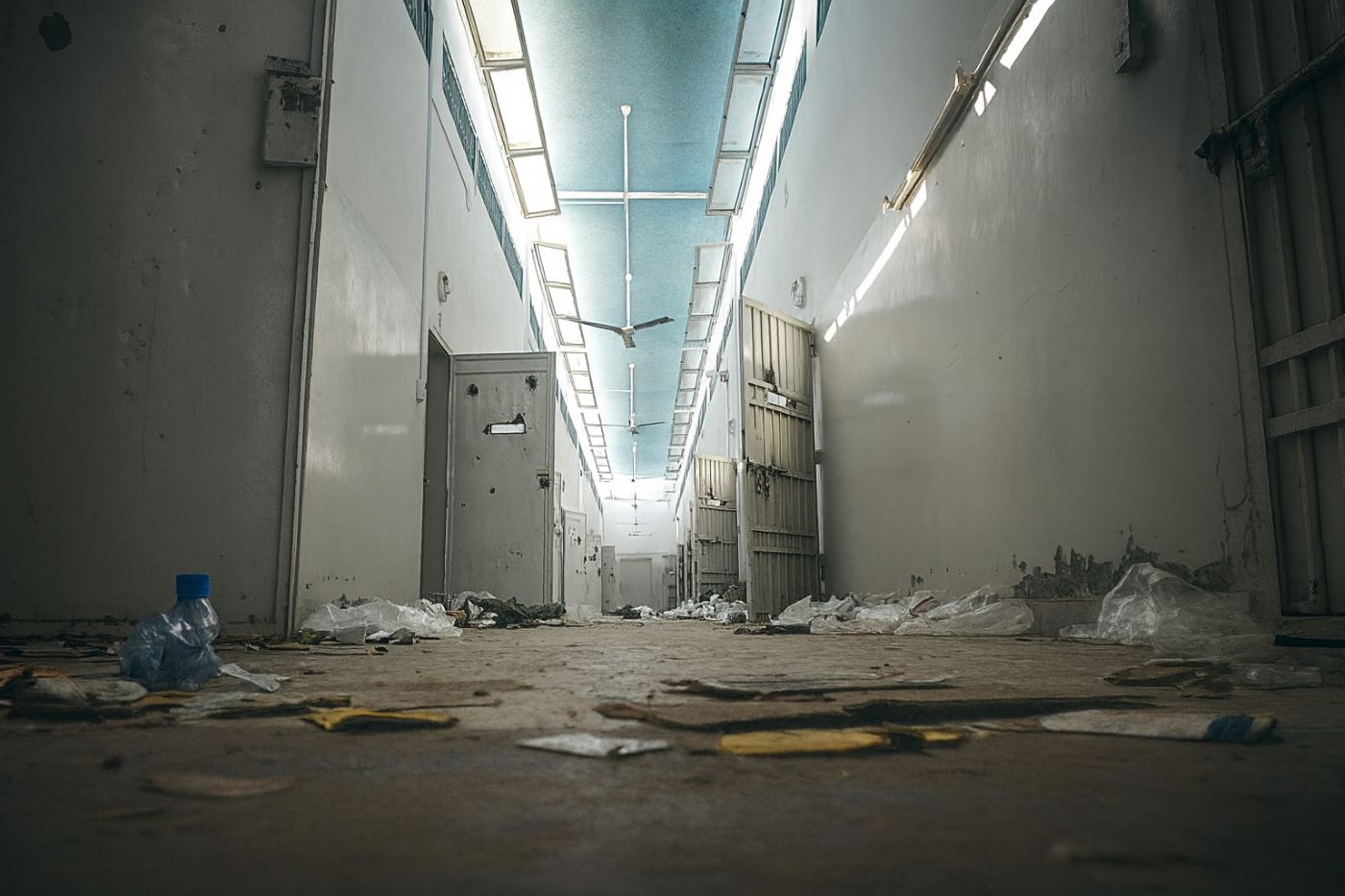
Introduction: The Silence and the Scream
Tripoli is a city of blinding light. The Mediterranean sun bleaches the white Italianate colonnades of the seafront and reflects off the turquoise waves, creating a facade of brilliance that, for forty-two years, hid a darkness so profound it became a national trauma. Just a few miles from the bustling Green Square (now Martyrs' Square), tucked away in a nondescript suburb, lay the epicenter of Muammar Gaddafi’s terror state: Abu Salim Prison.
For decades, locals whispered the name only in terrifying rumors. It was said that those who went in did not come out; that it was a place where people simply ceased to exist. It was the architectural embodiment of a regime that maintained power not just through violence, but through the weaponization of silence. Abu Salim was not merely a detention center; it was a black hole that swallowed fathers, brothers, and sons, leaving families in a suspended state of agonizing hope.
To understand the history of the Libyan Revolution, one must first understand the horror of this facility. It was here, within these high concrete walls, that the regime committed its greatest atrocity—the 1996 Abu Salim Prison massacre—and it was the ghosts of this massacre that eventually rose up in 2011 to tear the dictatorship apart. This is the definitive record of the slaughter, the cover-up, and the chilling legacy of Libya’s most notorious site.
The Morning of June 29: The 1996 Abu Salim Massacre Begins
The summer of 1996 in Tripoli was oppressive. Inside Abu Salim, the heat was lethal. The prison, designed to hold a fraction of its population, was bursting with roughly 1,700 inmates—mostly political prisoners, students, and Islamists arrested during the crackdowns of the early 1990s. The ventilation was non-existent, the food was inedible, and disease was rampant.
On June 28, the tension finally snapped. Inmates in Block 4, pushed to the brink of madness by the inhumane conditions, overpowered a guard during the food distribution. They took him hostage, seizing the keys to the cells. Hundreds of prisoners spilled into the courtyards. It was not an escape attempt; it was a desperate plea for survival. Their demands were tragically modest: they wanted clean water, the right to see their families, and fair trials.
By the morning of June 29, the regime had responded. Security forces surrounded the complex. But so did a glimmer of false hope. Abdullah Senussi, Gaddafi’s brother-in-law and the feared head of military intelligence, arrived at the prison gates. Known as the "black box" of the regime, Senussi’s presence signaled the highest level of government involvement.
Survivors recall Senussi standing before the prisoners, his tone oddly conciliatory. He listened to their grievances. He told them their demands were reasonable. He convinced the rioters to return the captured guard and go back to their cells, promising that negotiations would follow. The prisoners, exhausted and desperate, agreed. They returned the keys. The gates were locked. The illusion of diplomacy lasted only until the sun reached its zenith.
1,270 Dead: A Detailed Account of the Slaughter
Around 11:00 AM, the dynamics of the prison shifted abruptly. The "negotiation" was a trap.
According to the few survivors who were in the lower-security wings, the sound of heavy machinery echoed through the complex. Soldiers were positioning themselves on the rooftops of the cell blocks, looking down into the open-air courtyards where inmates had been herded under the pretense of a roll call.
Then, the firing began.
It was not a precision operation; it was an extermination. Special units from the security forces, armed with Kalashnikovs and heavy machine guns, opened fire on the defenseless men crowded below. Eyewitness accounts describe a scene of absolute bedlam. There was nowhere to run. The high walls that had kept them imprisoned now served as the sides of a kill box.
For over two hours, the gunfire was continuous. Hand grenades were tossed into the courtyards to finish off those huddled in corners. The noise was deafening, a relentless roar of automatic fire that could be heard in the surrounding neighborhoods, though residents were too terrified to look out their windows.
By the early afternoon, the screaming had stopped, replaced by the groans of the dying. The Abu Salim massacre had claimed an estimated 1,270 lives in a single day. To ensure the job was done, execution squads moved through the piles of bodies, firing "check shots" into the heads of anyone who moved. It was a methodical, industrial-scale slaughter of the regime's own citizens.
The Cleanup: Paving Over the Evidence of Genocide
The killing was the easy part for the regime; the disposal was a logistical nightmare. The sheer volume of corpses presented a problem that required days to solve.
Surviving inmates from other blocks—those who had not participated in the riot—were forced to undertake the gruesome task of cleanup. Under the barrel of guns, they dragged the bodies of their fellow prisoners out of the courtyards. The blood was so thick it had to be washed away with high-pressure fire hoses.
Initially, the bodies were buried in shallow mass graves in Libya, specifically in the loose soil around the prison and in the capital's Gargur cemetery. However, the paranoia of the regime soon set in. Gaddafi knew that 1,270 skeletons were undeniable evidence of a crime against humanity.
In a horrifying act of erasure, it is believed that years later, many of these bodies were exhumed. To destroy the DNA evidence, the regime reportedly used acid to dissolve the bones. The remaining fragments were crushed and scattered. Finally, to seal the secret forever, the courtyards where the massacre took place were paved over with concrete. The prison operated as if nothing had happened, literally built upon the bones of the murdered.
Architecture of Oppression: The Layout of Gaddafi’s Human Rights Abuses
To visit Abu Salim—or to study its plans—is to look into the mind of a dictator. The architecture was not designed for rehabilitation; it was engineered for psychological disintegration.
The facility was divided into two distinct zones: the Military Section and the Political Section. The Political Section was where the darkness was absolute. Cells were often no larger than 2 by 2 meters, crammed with multiple men. The design minimized natural light; many inmates developed vision problems after spending years in semi-darkness.
Ventilation was deliberately poor. In the scorching Libyan summer, where temperatures frequently exceed 45°C (113°F), the cells became ovens. In the winter, they were iceboxes. The plumbing was frequently broken, forcing men to live in their own filth.
This prison architecture served a specific purpose: sensory deprivation mixed with sensory overload. When they weren't being starved of light, prisoners were subjected to the screams of others. The acoustics of the concrete corridors amplified the sounds of torture from the interrogation rooms, ensuring that even those not currently being beaten were psychologically participating in the agony.
The Bus and the Refrigerator: Torture Methods
The physical violence within Abu Salim was creative in its cruelty. Interrogators utilized a lexicon of torture techniques that became infamous among human rights organizations.
One of the most feared methods was "The Bus". This involved the prisoner being contorted into a stress position, often inside a vehicle or a specialized frame, where they were left for days. The body would cramp, joints would dislocate, and the pain would become unbearable, yet there was no room to move.
Another was "The Refrigerator." Inmates were stripped naked and placed in cells cooled to near-freezing temperatures for extended periods. This thermal torture was often followed by sudden exposure to extreme heat, sending the body into shock.
Beyond these, the regime utilized falaka (beating the soles of the feet), electric shocks, and suspension from ceilings. But perhaps the most effective torture was the uncertainty. Prisoners were held incommunicado. They did not know if their families were alive, if they had been sentenced, or if they would be executed the next morning. It was a system designed to strip a man of his agency until he was nothing more than a biological entity awaiting pain.
The Great Deception: Feeding the Dead for a Decade
This is perhaps the most chilling aspect of the Abu Salim story, and a crucial element of the history. The massacre happened in 1996. The revolution didn't happen until 2011. In the fifteen years between, the regime perpetrated a psychological fraud of staggering cruelty.
For over a decade, the families of the 1,270 victims were not told their sons were dead.
Mothers would travel from Benghazi or misrata to Tripoli, carrying heavy bags of food, clean clothes, and money. They would arrive at the gates of Abu Salim, hand the care packages to the guards, and ask about their sons. The guards, knowing full well the men had been dead for years, would accept the goods. They would sometimes say, "He says thank you," or "He asked for cigarettes next time."
This enforced disappearance meant that thousands of Libyan families lived in a state of frozen grief. They could not mourn because they still hoped. They drained their savings to buy supplies for ghosts. It was not until the late 2000s that the regime, attempting to normalize relations with the West, began to notify families. Even then, they rarely returned bodies—only death certificates, often citing "natural causes" or "lung failure."
Breaking the Silence: The Courage of the Families of Abu Salim
The silence eventually broke, not because the regime confessed, but because the mothers refused to stay quiet. The "Association of the Families of Abu Salim Prison Martyrs" was formed, largely in the eastern city of Benghazi.
Every Saturday, the families would gather. In a police state where protest was punishable by death, these women stood in public squares holding grainy photographs of their missing sons and husbands. They demanded the truth. They demanded bodies.
The regime tried to silence them with money. They offered "blood money" (diyya) of 200,000 dinars (roughly $160,000 at the time) to families who would sign a document accepting that their relative was dead and waiving the right to pursue legal action. Many families refused. They didn't want the money; they wanted justice. These Saturday protests became the incubator for the revolution.
The Arrest of Fathi Terbil and the Start of the Arab Spring in Libya
The direct link between Abu Salim and the fall of Gaddafi is a man named Fathi Terbil. A human rights lawyer, Terbil was representing the families of the victims. He was the voice of the 1,270.
On February 15, 2011, emboldened by the revolutions in neighboring Tunisia and Egypt, Libyan security forces made a fatal calculation. They arrested Terbil in Benghazi, hoping to cut the head off the protest movement.
It had the opposite effect. The families of the Abu Salim victims—thousands of people who had been lied to and abused for decades—stormed the streets to demand his release. They gathered at the Katiba (security headquarters) and the courthouse. The police fired into the crowd.
This was the spark. The Arab Spring in Libya did not begin over bread prices or unemployment; it began specifically because of the unresolved trauma of the Abu Salim massacre. The ghosts of 1996 had finally come for the dictator.
August 2011: The Liberation of Abu Salim and the Empty Cells
The war that started in Benghazi swept west across the desert. By late August 2011, the rebels (thuwar) had breached the gates of Tripoli. One of their primary objectives was the liberation of Abu Salim.
Fighters and families rushed the complex, expecting to find thousands of emaciated prisoners. They used sledgehammers to break the locks. But when the heavy metal doors swung open, the Libyan Transitional Council fighters found a haunting scene: the prison was largely empty.
In the final days of the regime, guards had released some prisoners and transferred others, but the vast majority of the "disappeared" were simply not there. They had been dead for fifteen years.
Journalists who entered the site described a scene of frantic archaeology. Families were digging through piles of smoldering documents in the administration building, looking for a name, a mugshot, a transfer order—anything that proved their loved one had existed. Others wandered the cells, reading the graffiti scratched into the walls, hoping to find a final message left by a son or brother.
Literature of the Disappeared: Hisham Matar and The Return
The psychological weight of Abu Salim has been immortalized in literature, most notably in Hisham Matar’s Pulitzer Prize-winning memoir, The Return. Matar’s father, Jaballa Matar, was a prominent dissident kidnapped by the regime and imprisoned in Abu Salim. He was never seen again.
Matar’s work explores the "absent father" as a defining trauma of modern Libya. In his writing, Abu Salim is not just a building but a void that swallows history. He describes the specific texture of not knowing—the inability to grieve because there is no body, no funeral, no date of death.
For readers seeking to understand the emotional landscape of Libya, Matar’s work is essential. It moves the tragedy from the statistics of human rights reports into the intimate devastation of a single family, mirroring the experience of thousands.
The Search for Bones: DNA, Acid, and the Lack of Closure
Following the liberation, the new government and international forensic teams began the search for the bodies. It has been a grim and frustrating process.
In late 2011, bone fragments were discovered in the desert outside Tripoli and within the prison grounds. However, the regime’s efforts to destroy evidence were highly effective. Forensic experts found that many remains had been treated with chemicals, making DNA extraction almost impossible.
The forensic investigation in Libya is further complicated by the chaos of the post-Gaddafi era. Mass graves have been found, but matching the fragmented remains to the living families requires a stable government and sophisticated resources that Libya currently lacks. To this day, hundreds of mothers are still waiting for a bone to bury.
Visiting Tripoli Today: Geopolitics and Safety in a Failed State
For those interested in visiting Tripoli, a stark reality check is necessary. As of 2024-2025, Libya remains a fragmented and dangerous state. It is not a functioning tourist destination.
The U.S. Department of State and most European foreign ministries maintain "Do Not Travel" advisories due to crime, terrorism, civil unrest, and kidnapping. Tripoli is controlled by a patchwork of militias. Checkpoints are frequent, and the security situation can deteriorate in minutes.
Visiting Abu Salim is not like visiting Alcatraz or Auschwitz. It is an abandoned ruin in a conflict zone. There are no ticket booths, no audio guides, and no safety protocols. Access would require a local fixer, security detail, and permission from whichever militia currently controls the district. For the average traveler, the site remains inaccessible—a place to be understood through reading and documentation rather than visitation.
Inside the Walls Today: Graffiti, Ruins, and Ghosts
If one were to enter the prison today, they would find a crumbling monument to suffering. The complex stands largely abandoned. The sun beats down on the empty courtyards where the massacre took place, now overgrown with weeds cracking through the concrete.
The most powerful artifacts remaining are the walls themselves. Inmates left behind an archive of their existence scratched into the paint and stone. There are calendars counting down days that never ended. There are verses from the Quran: "God is sufficient for us, and He is the best Disposer of affairs." There are farewell letters written to wives and children who would never read them.
The site is occasionally used by local militias for their own purposes, continuing the cycle of incarceration, but for the most part, it sits silent—a scar on the geography of Tripoli.
Truth and Reconciliation in Post-Gaddafi Libya
The quest for justice has been as fractured as the country itself. Abdullah Senussi, the man who promised negotiations on that fatal morning in 1996, was captured after the revolution. He was tried in Libya and sentenced to death in 2015 for his role in the massacre, though the sentence has not been carried out, and legal wrangling continues.
However, a true Truth and Reconciliation process has failed to materialize. The country split into rival governments, and the shared trauma of Abu Salim, which once united the rebels, was overshadowed by new civil wars. The families of the victims find themselves in a new kind of limbo, where the dictator is gone, but the justice they were promised has been deferred by political chaos.
Conclusion: The Memory that Toppled a Regime
Abu Salim Prison was designed to be a tomb for the living. It was built to erase men, to turn them into non-entities, and to terrify a population into submission. For forty years, it succeeded.
But in the end, the prison failed. The regime’s attempt to hide the 1,270 bodies created a pressure cooker of resentment that eventually blew the dictatorship apart. The massacre of 1996 did not bury the opposition; it planted the seeds of the 2011 uprising.
Today, the physical walls of Abu Salim are rotting, but the memory of what happened there stands as a permanent warning. It serves as a testament to the fact that while a regime can kill men, dissolve bones, and pave over graves, it cannot assassinate the truth. The "Black Hole of Tripoli" is no longer dark; the light has flooded in, illuminating the horror for the rest of history to see.
Sources & References
- Human Rights Watch (2012): Libya: Abu Salim Prison Massacre Remembered – Link to Report
- Human Rights Watch (2006): Libya: June 1996 Killings at Abu Salim Prison – Link to Report
- Amnesty International: Libya: The 'disappeared' of the Abu Salim prison massacre – Link to Amnesty Report
- BBC News (2011): Libya: Abu Salim prison discoveries – Link to BBC Archive
- The Guardian (2011): Inside Abu Salim: the prison that sparked the Libyan revolution – Link to Article
- Al Jazeera: Libya's Abu Salim: The massacre that haunts the revolution – Link to Article
- Reuters: Libya confirms 1,200 killed in 1996 prison massacre – Link to Article
- Hisham Matar (Pulitzer Prize Website): The Return: Fathers, Sons and the Land in Between – Link to Book Info
- International Center for Transitional Justice: Libya: Seeking Truth for Abu Salim – Link to ICTJ
- US State Department: Libya Travel Advisory – Link to Travel Advisory
- CNN (2011): Bone fragments found at Libyan prison site – Link to Article
- The New Yorker: The Return of the Fathers (Review of Hisham Matar) – Link to Article