The Siege of the Senses: Life on the Edge of the Abyss
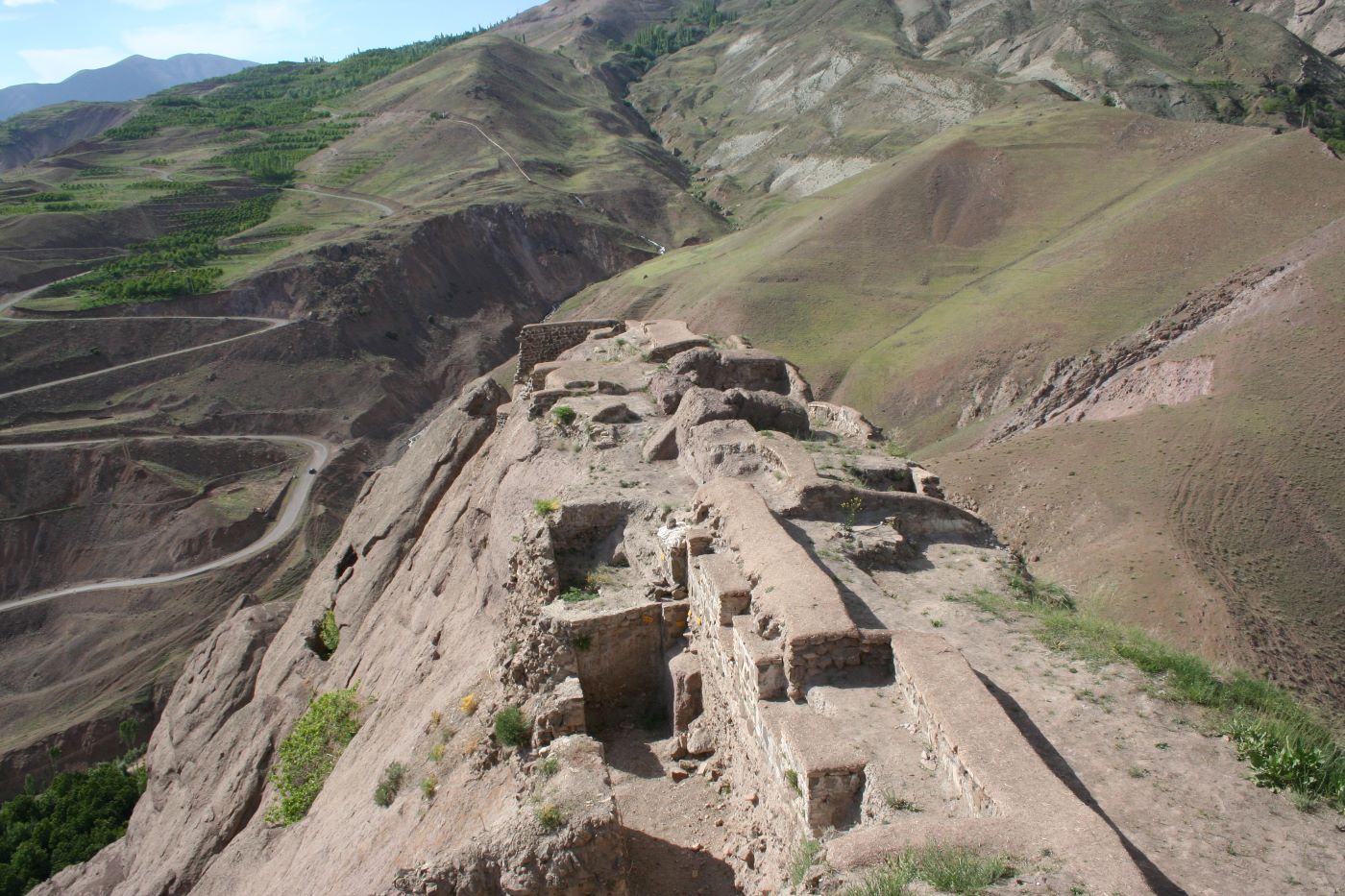
Alamut is not a place where humans were meant to live; it is a place where they went to be unreachable. To stand at the base of the rock today is to look up at a vertical shark’s tooth of stone, rising nearly 2,100 meters above sea level. The air here is thin, tasting of dry limestone and ancient cedar. In the 11th century, the only way up was a single, winding mule track that could be defended by two men against an army of thousands. The physical reality of the site is one of absolute isolation—a psychological pressure cooker where the world below ceases to matter.
The Vertical Reality of the Alborz Stronghold
The architecture of Alamut was an exercise in extreme engineering. The fortress was carved directly into the living rock of the mountain, creating a structure that was less a building and more a geological modification. Inhabitants lived on a slope so steep that a single misstep meant a thousand-foot plunge into the Shahrud Valley. The wind here is a constant character, a low-frequency roar that masks the sound of approaching footsteps, making the garrison feel as though they were floating in a void. This was not a "castle" in the European sense of tapestries and grand halls; it was a military bunker optimized for survival.
The Silence of the High Command
Life within the walls was governed by a silence that was both monastic and militant. Under the rule of Hassan-i Sabbah, the legendary "Old Man of the Mountain," the fortress operated under a strict code of asceticism. There was no music, no wine, and no frivolity. The punishment for breaking these laws was death—a sentence Sabbah famously carried out even against his own sons. This silence served a dual purpose: it ensured absolute operational security for the order’s clandestine missions and it forged a communal identity rooted in total, unquestioning devotion to the Imam.
The Great Deception: Marco Polo and the Garden of Paradise
The most pervasive myth surrounding Alamut is the story of a drug-fueled "Garden of Paradise," a narrative popularized by Marco Polo nearly twenty years after the fortress had already been reduced to rubble. Polo, who never actually stepped foot in Alamut, recounted tales he heard from travelers and locals, weaving a story that would fascinate the West for centuries. According to Polo, Hassan-i Sabbah would drug young men with hashish, transport them to a hidden valley filled with flowing wine, exotic fruits, and beautiful women, and then drag them back to reality. He claimed this was a "preview" of heaven, meant to convince the Fedayeen that death in service of the Imam was the only way to return to eternal bliss.
The Anatomy of a Medieval Smear Campaign
Historical scrutiny reveals Polo’s account as a conflation of Crusader folklore and local Sunni propaganda. The term "Hashshashin," from which we get "assassin," was almost certainly a derogatory slur used by the Nizaris' enemies—likely meaning "low-class rabble" or "outcasts" rather than literal drug users. The "Garden" was, in reality, a series of highly advanced terraced orchards and irrigation systems. To the starving, war-weary peasants of the 12th century, a fortress that could grow fresh fruit in the middle of a mountain winter would have seemed miraculous enough to be called "paradise" without the need for narcotics.
The Utility of the Myth in the West
Polo’s story served a specific sociological purpose: it made the terrifying efficacy of the Nizaris understandable to a European audience. It was easier for the Crusaders to believe that their enemies were "drug-crazed fanatics" than to admit they were being outmaneuvered by a disciplined, intellectual elite. By framing the Nizaris as victims of a brainwashing cult, Western history stripped them of their political agency and tactical brilliance, turning a complex revolutionary state into a cautionary tale of orientalist mystery.
The True Day-to-Day: Life in the Intellectual Hive
Stripped of the hashish smoke, the reality of life at Alamut was closer to a university-militia than a drug den. The residents were part of a high-functioning society that prioritized literacy, scientific observation, and religious study above all else. Daily life was defined by the "New Preaching" (Da'wa-yi Jadid), a philosophy that required every member of the community—from the high-ranking da'is (missionaries) to the common laborers—to be well-versed in the esoteric interpretations of the Quran.
The Labor of Survival and Science
The inhabitants of Alamut were not just soldiers; they were master hydrologists and astronomers. Because the fortress was under constant threat of siege, daily life involved the meticulous maintenance of the massive rock-cut cisterns and the terraced gardens. Beyond survival, the castle was a hub for the greatest minds of the era. The famous polymath Nasir al-Din al-Tusi spent decades at Alamut, utilizing its world-class library to conduct astronomical observations that would later influence the Copernican revolution. This was a community where an afternoon might be spent debating Neoplatonic philosophy before an evening spent practicing the lethal trade of clandestine infiltration.
Why They Joined: The Flight from Oppression
People did not join the Nizari community because they were kidnapped or drugged; they joined because they were desperate. The 11th-century Middle East was dominated by the Seljuk Turks, who imposed a rigid, foreign military rule and heavy taxation on the Persian peasantry. The Nizaris offered an alternative: a decentralized state that promised social equity, protected its own, and stood up to the imperial giants. For a Persian artisan or a disenfranchised farmer, Alamut wasn't just a fortress; it was a sanctuary of resistance against an empire that viewed them as expendable.
The Architecture of Resistance: How Hassan-i Sabbah Built a State
The birth of the Nizari Ismaili state was not an act of war, but an act of supreme intellectual subversion. In 1090, Hassan-i Sabbah did not storm Alamut with a battalion; he walked in as a teacher. He spent two years infiltrating the surrounding villages, converting the hearts and minds of the local population until the fortress was surrounded by a sea of loyalists. When he finally entered the castle in disguise, the garrison commander found that he no longer commanded his own men. Sabbah handed the man a draft for 3,000 gold dinars and told him to leave. The state was born without a drop of blood.
The Theology of the New Preaching
The Nizari movement, or the Da'wa-yi Jadid (New Preaching), was a response to the fragmentation of the Fatimid Caliphate. Sabbah argued that in a world of corruption and shifting political sands, the only source of truth was the Imam, the divinely inspired leader. This wasn't just a religious claim; it was a revolutionary political platform that appealed to the disenfranchised Persian population living under the boot of the Seljuk Turks. By centralizing all truth in the figure of the Imam, Sabbah created a chain of command that was unbreakable.
From Kidnapping a Fortress to Engineering an Oasis
Once the fortress was secured, the Nizaris turned the inhospitable rock into a marvel of sustainable engineering. They carved massive limestone-lined cisterns into the mountain to catch rainwater and snowmelt, ensuring they could survive sieges lasting for years. They terraced the surrounding slopes, creating hanging gardens that grew grains and fruit where nothing should have flourished. This wasn't just for food; it was a display of mastery over nature that reinforced the legend of the "Paradise" within the walls.
The Order of the Fedayeen: The Mechanics of Medieval Terror
The Nizaris knew they could never win a conventional war against the Seljuk Empire or the coming Crusaders. They lacked the numbers and the flat ground required for cavalry charges. Their solution was the Fedayeen—those who sacrifice themselves. These were not mindless killers; they were elite operatives, often scholars and linguists, trained in the art of the "long game." They would spend months or years as monks, merchants, or servants in the households of their enemies, waiting for a single moment to strike with a simple dagger.
The Psychological Profile of the Devoted
To be a Fedayi was to accept that your life was already over. Their mission was never a "hit and run"; it was a "hit and stay." They struck in broad daylight, in the most crowded mosques or palaces, ensuring maximum visibility. They did not use poison or arrows from a distance; they used the knife, a weapon that required physical contact and ensured the assassin would be captured or killed on the spot. This was the strategy of total exposure: they didn't just kill their enemies; they demonstrated that their enemies were never safe.
The Assassination of Nizam al-Mulk: A Paradigm Shift
The most famous display of this power occurred in October 1092, when the Seljuk Grand Vizier Nizam al-Mulk was killed by a Fedayi disguised as a Sufi dervish. The Vizier was the most powerful man in the East, the architect of the Seljuk state. His death sent shockwaves through the medieval world. It proved that a single man with a blade could dismantle an empire's administration more effectively than an army. This event transformed the Nizaris from a local sect into a global legend of terror.
The Masyaf Connection: The Syrian Expansion
While Alamut was the brain of the Nizari state, Masyaf Castle in modern-day Syria became its most lethal arm. Established as the regional headquarters for the Syrian branch of the order, Masyaf served as the base for Rashid al-Din Sinan, the man the Crusaders called the "Old Man of the Mountain." The connection between the two was absolute: Masyaf was the primary satellite of Alamut, functioning as a forward operating base in the heart of the Crusades.
The Architecture of the Syrian Stronghold
Masyaf was built on a smaller scale than Alamut but was equally formidable. It sat atop a limestone promontory in the Orontes Valley, controlling the routes between the interior and the coast. Unlike the remote isolation of the Alborz, Masyaf was in the thick of the action, situated between the territories of the Knights Templar and the Ayyubid dynasty. The link between Alamut and Masyaf was maintained through a network of smaller fortresses and a sophisticated system of beacon fires and messengers that allowed a directive issued in the mountains of Persia to be executed in the streets of Damascus within weeks.
The Strategic Autonomy of the Syrian Branch
Under Sinan, the Syrian Nizaris achieved a level of tactical autonomy that allowed them to play the Crusaders and the Muslims against each other. Sinan famously nearly assassinated Saladin twice, eventually forcing the great sultan into a truce by leaving a poisoned dagger and a threatening note on his pillow inside a locked tent. This mirrored the psychological warfare perfected at Alamut, proving that the "Assassin" methodology was a scalable system of power that could be exported across borders.
The Mongol Deluge: The Systematic Erasure of the Nizari State
The end of Alamut did not come from a dagger, but from the unstoppable momentum of the Mongol Empire. In 1256, Hulagu Khan, the grandson of Genghis Khan, arrived in Persia with a single mission: the total annihilation of the Nizari state. The Mongols did not fear the legends of the Assassins; they viewed them as a tactical nuisance to be cleared before the siege of Baghdad.
Hulagu Khan and the Engineering of Destruction
The Mongols brought with them a level of siege technology that the Alborz mountains had never seen. They hauled massive Chinese-designed catapults up the mountain passes, raining fire and stone down on the "Eagle’s Nest." The last Imam, Rukn al-Din Khurshah, realizing that the era of the hidden fortress was over, surrendered in a desperate attempt to save his people. He was taken to Mongolia, where he was eventually executed—tradition says he was rolled in a carpet and trampled to death to avoid spilling royal blood on the ground.
The Burning of the World’s Greatest Library
The greatest tragedy of Alamut’s fall was not the destruction of its walls, but the burning of its library. For 166 years, Alamut had been a sanctuary for science, philosophy, and astronomy. It housed thousands of volumes, many of them unique Ismaili texts. The Mongol historian Juvayni, who accompanied the army, was allowed to save a few "God-fearing" books before the rest were put to the torch. The fire burned for days, erasing the intellectual history of the Nizari state.
The Reality: The Human Cost of Absolute Devotion
The reality of the Alamut story is the realization of what total ideological commitment does to a human community. For over a century, thousands of people lived on this rock in a state of constant, high-alert siege. Every child born in Alamut was born into a war that had no end. The psychological toll of living in a society where your highest honor was to die for a cause cannot be overstated. When the Mongols finally entered the castle, they didn't just find soldiers; they found families who had known nothing but the shadow of the mountain for generations.
The Legacy: From Assassins to the Aga Khan
The modern legacy of the Nizaris is one of the most remarkable pivots in religious history. After the fall of Alamut, the survivors went into hiding, practicing taqiyya (dissimulation) to survive. Over centuries, they transformed from a militant order of assassins into a global, peaceful community of over 15 million people. Today, they are led by the Aga Khan, a direct descendant of the Imams of Alamut. The daggers have been replaced by hospitals, universities, and development projects.
The Atlas Entry: Navigating the Ruins of the Eagle’s Nest
Standing at the summit of Alamut today is a hollow experience. The Mongols were thorough; they dismantled the walls stone by stone to ensure the fortress could never be used again. What remains are the foundations, the deep, dark cisterns, and the overwhelming silence of the Alborz.
Travel Warning: The 2026 Reality
Travel to the Islamic Republic of Iran is currently restricted by the highest possible international advisories. The Dark Atlas explicitly warns against any travel to the country at this time. This is not a matter of subjective political opinion; it is a direct response to the documented risks of visiting a nation currently under the control of a regime that uses the arbitrary detention of foreigners as a tool of statecraft.
As of early 2026, Iran remains in a state of extreme domestic volatility. Following the crackdowns on civil rights movements, the government has transitioned into a more aggressive posture toward international visitors. The primary risk is wrongful detention: foreign tourists, particularly those from Western nations, are frequently targeted for "espionage" charges to be used as bargaining chips in diplomatic negotiations. There is no such thing as an "apolitical" visit when the state sees your passport as a currency for prisoner swaps. Furthermore, the lack of consular access and the frequency of sudden internet and communication blackouts mean that if you are detained, you essentially disappear. Entering Iran right now is a deliberate choice to fund a regime that systematically suppresses its population and to place yourself in a position where no international law can protect you.
The Logistics of a Ghost Site
If the world were different, the journey to Alamut would begin in Qazvin. From there, a three-hour drive through the switchbacks of the Alborz leads to the village of Gazor Khan. The hike to the summit is grueling—over 1,000 stone steps that wind up the face of the rock. There is no shade, and the sun at this altitude is punishing.
The Psychological Weight: Standing in the Void
The experience of visiting Alamut is one of profound isolation. Unlike the grand, romantic ruins of Europe, Alamut feels clinical and harsh. You feel the presence of the 1,500 people who once lived here, squeezed onto this narrow ridge, watching the horizon for the dust of an approaching army. The ethics of visiting such a site are complex; it is a monument to both intellectual brilliance and the brutal utility of terror. You stand at the center of a void where an empire once was.
FAQ: Frequently Asked Questions
Did the Assassins actually use hashish to motivate their killers?
There is no credible historical evidence to support the claim that the Nizari Ismaili state used drugs to manipulate their operatives. The term "Hashshashin" was likely a derogatory slang term used by their enemies—meaning "low-class rabble"—which was later misinterpreted by Western chroniclers. Their missions required extreme patience, sobriety, and linguistic skill, none of which are compatible with heavy narcotics use.
Why was Alamut considered impregnable for nearly two centuries?
The fortress utilized a combination of natural geography and human ingenuity. It sat on a 2,100-meter peak accessible only by a narrow, steep path. The Nizaris carved massive, limestone-lined water cisterns into the rock and developed advanced food storage techniques, allowing them to survive sieges that lasted several years without outside help.
What is the relationship between Alamut and the modern Aga Khan?
The Nizari Ismaili community survived the fall of Alamut and the Mongol massacres by going underground. The lineage of the Imams continued through the centuries, eventually emerging in the 19th century under the title of the Aga Khan. Today, the 4th Aga Khan leads a peaceful, global community of over 15 million people focused on humanitarianism and development.
How accurate is the "Assassin’s Creed" portrayal of the Order?
While the game franchise popularized the order, it is a work of historical fiction that takes massive liberties. The real Nizaris did not wear white hooded robes (which would be the opposite of "hiding in plain sight") and did not have a "creed" involving atheistic nihilism; they were deeply religious Muslims. While the game correctly identifies Alamut and Masyaf as their hubs, the "Leap of Faith" is a myth, likely derived from distorted accounts of the Fedayeen's absolute obedience. The real "hidden blade" was a standard dagger, and their targets were strictly high-level political figures, not the endless waves of guards seen in the games.
How were the libraries of Alamut lost?
When the Mongols under Hulagu Khan captured the fortress in 1256, the historian Juvayni was allowed to survey the library. He saved a few astronomical instruments and "God-fearing" books (primarily those that didn't contradict Sunni orthodoxy), but the vast majority of the Nizari philosophical and scientific records were burned to the ground.
Sources
- The Isma'ilis: Their History and Doctrines - Farhad Daftary (2007)
- The Assassins: A Radical Sect in Islam - Bernard Lewis (1967)
- Alamut and the Nizari Ismaili State - Institute of Ismaili Studies
- The History of the World-Conqueror - Ala-ad-Din Ata-Malik Juvayni (1260)
- Eagle's Nest: Ismaili Castles in Iran and Syria - Peter Willey (2005)
- The Travels of Marco Polo - Marco Polo (c. 1300)
- Nasir al-Din al-Tusi and the Ismaili Intellectual Tradition - IIS Scholarly Archive