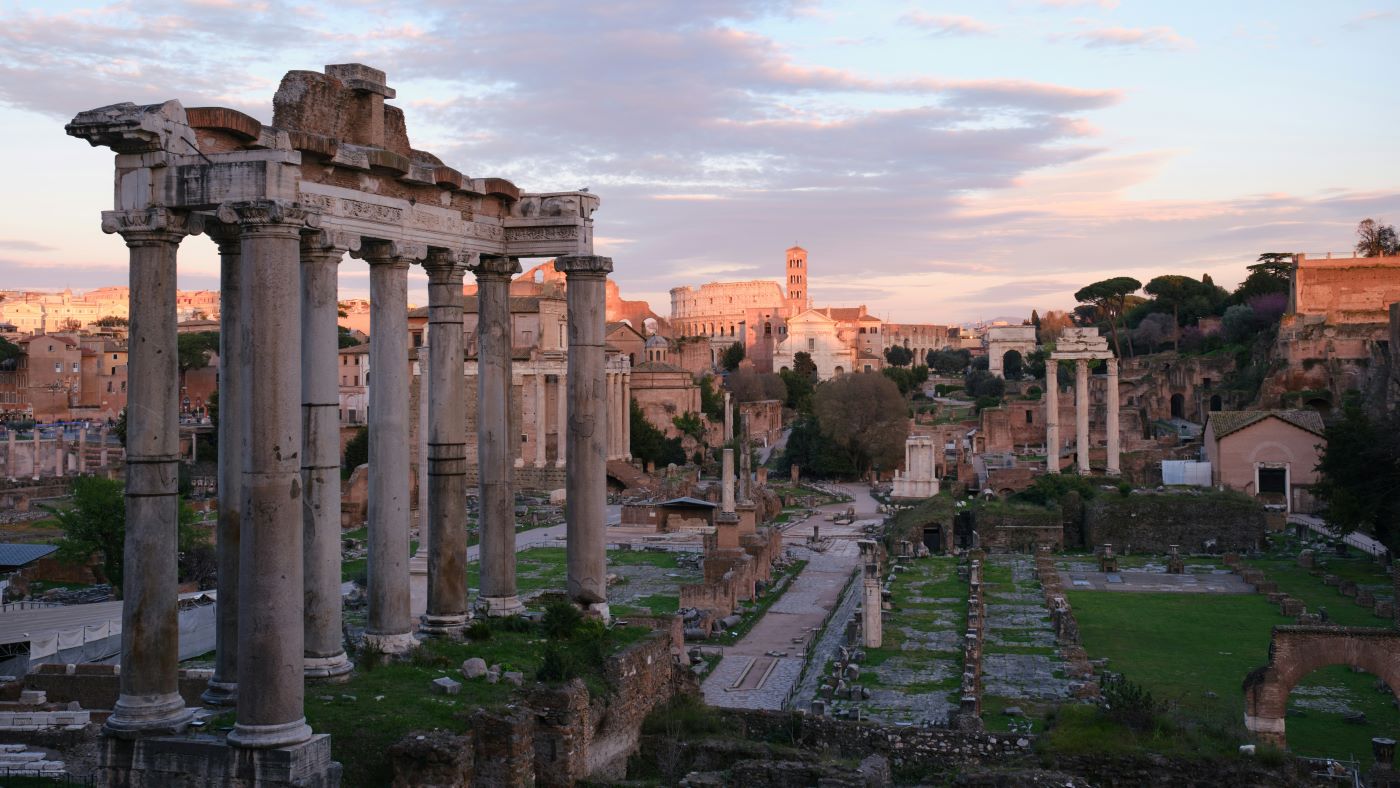
The Roman Forum is a four-acre graveyard of ideologies, a dense architectural thicket where the ruins of a participatory Republic are literally crushed beneath the marble weight of the Emperors who replaced them. To the modern eye, it is a romantic collection of sun-bleached pillars and weathered brick. To the Roman, it was a high-definition theater of state-sanctioned terror. It was a place where you didn’t just lose a debate; you lost your head, your name, and your right to a grave. This is the anatomy of a marsh that became a machine for the public display of death.
The Sacred Swamp: The Engineering of the First Sacrifice
Before the marble and gold, the Forum was a death trap. Situated in a malarial basin between the Palatine and Capitoline hills, the valley served as a communal cemetery for Iron Age tribes. It was a No-Man's Land where the only way to inhabit the earth was to drain the water. The construction of the Cloaca Maxima (The Great Sewer) was the first systemic act of the Roman state, but it did not just drain the swamp; it consecrated the mud with the logic of sacrifice.
The early Romans believed the Forum was a literal gateway to the underworld—the Mundus. This was not a metaphor. Deep in the center of the square sat the Lacus Curtius, a hole in the earth that legends say demanded a human life to close. According to the chronicler Livy, a chasm opened in the center of the Forum in 362 BC that no amount of earth could fill. The oracles declared that the chasm would only close if Rome sacrificed its greatest strength. Marcus Curtius, realizing that Rome’s strength was its youth and arms, donned his full armor, mounted his horse, and leaped into the abyss.
This established the primary systemic cycle of the Forum: the belief that the stability of the state was paid for in blood. The geography dictated the politics. Because the space belonged to no single hill, it became the communal stage where tribal tensions were resolved—often with a blade.
The Vestal Virgins: The Blood Beneath the Purity
Overlooking the main square sat the Atrium Vestae, the House of the Vestal Virgins. These women were the biological batteries of the Roman State; their job was to keep the Sacred Fire burning. But their purity was maintained through the threat of a specific, claustrophobic execution.
When a Vestal was accused of incestum (unchastity), she was not just killed—she was erased. The Romans, fearful of spilling the blood of a sacred person, developed a legal loophole. The condemned woman was stripped of her honors, placed in a shrouded litter, and carried through the Forum in a funeral procession as if she were already a ghost.
At the Campus Sceleratus (the Field of Wickedness), she was forced down a ladder into a small underground vault containing a bed, a lamp, and a tiny portion of bread and water. The ladder was withdrawn, and the earth was leveled over the entrance. This living burial was the ultimate Roman psychological horror: a human being turned into a permanent secret beneath the feet of the people. The Forum was literally built on top of these silent, buried women.
The Republic’s Rostra: A Gallery of Severed Trophies
As the Roman Republic grew, the Forum became a physical map of its constitution, centered on the Rostra. This was the speaker’s platform, the heart of Roman Voice. But the name itself reveals the Roman obsession with the trophy. Rostra means beaks—the bronze rams torn from the front of captured enemy warships and nailed to the platform as proof of conquest.
For centuries, the Rostra was where the citizen was born through speech. But as the Republic fractured in the 1st Century BC, the platform transformed into a literal trophy cabinet for human remains. During the Proscriptions of Sulla, the names of enemies of the state were posted in the Forum. Anyone on that list could be killed for a bounty, provided their severed head was brought back to the Forum for verification.
The Desecration of the Voice: Marcus Tullius Cicero
The most iconic moment of this transition was the death of Cicero. The man who embodied the Voice of the Forum was hunted down on the orders of Mark Antony in 43 BC. His severed head and the hands that had written the speeches against Antony were brought back to the Forum. Fulvia, the wife of Antony, reportedly pulled out Cicero’s tongue and pierced it repeatedly with her golden hairpins before the head and hands were nailed to the Rostra. The message was unmistakable: the era of the word was over. The Era of the Flesh had begun.
The Human Zoo: The Logistics of the Triumph
The most spectacular form of systemic cruelty in the Forum was the Triumph. To the Romans, this was a religious procession; to the rest of the world, it was a high-production human zoo. The Sacred Way (Via Sacra) served as the runway for the industrial-scale display of stolen wealth and broken lives.
The logic of the Triumph was to compress the entire world into the four acres of the Forum. Following the wagons of gold and silver came the floats—massive wooden stages depicting the battles, the burning cities, and the massacres. Behind them walked the captured kings, the queens in golden chains, and the exotic animals of the conquered territories.
In 46 BC, Julius Caesar’s quadruple triumph turned the Forum into a sensory nightmare. He displayed Vercingetorix, the Gallic king who had been rotting in the Mamertine for six years, just so the crowd could see how much a man withers in the dark. He displayed Arsinoe IV, the sister of Cleopatra, in chains so heavy she could barely walk. The Forum functioned as a machine that transformed a living human being into an object of state.
The Mamertine Prison: The Waiting Room for the Grave
Tucked into the slope of the Capitoline Hill sat the Tullianum (Mamertine Prison). This was the dark counter-weight to the bright, marble sun of the Forum—a logistical holding cell for the grave.
The logistics of the Tullianum were designed to break the human spirit. It consisted of two damp, lightless chambers stacked on top of each other. Enemies of the state were lowered through a hole into the lower, windowless pit. There is a ritualized cruelty in how the Romans used this space. While a victorious General celebrated his Triumph in the Sacred Way, the defeated king was taken to the Mamertine. As the General ascended to the Temple of Jupiter to offer thanks, the executioner would enter the pit and strangle the prisoner. The Greatness of Rome was a two-sided coin: a parade in the light and a strangulation in the dark.
The Scalae Gemoniae: The Architecture of Disgrace
If the Mamertine was where you died, the Scalae Gemoniae (Stairs of Mourning) were where you were erased. These stairs led from the Capitoline down into the heart of the Forum. This was the designated site for the public display of enemies of the state.
After the strangulation in the Tullianum, the bodies were dragged out with meat hooks and dumped on these stairs. They were left to rot for days in the Roman heat. In 31 AD, the fall of Sejanus turned the stairs into a charnel house. Not only was Sejanus’s body torn apart by the mob, but his young children were also executed and their bodies placed beside him—a brutal systemic erasure of an entire bloodline.
Once the crowd had sufficiently jeered, the bodies were dragged through the Forum and tossed into the Tiber River. This was the ultimate systemic punishment: Damnatio Memoriae. To the Romans, having your body denied a grave was a fate worse than death. The Forum was the mechanism that performed this erasure.
The Tarpeian Rock: The Spectacle of Gravity
While foreign kings were dealt with in the dark, the Tarpeian Rock (Saxum Tarpeium) was for the Roman traitor. Located on the southern peak of the Capitoline Hill, this jagged cliff looked directly down into the Forum. It was the site of the most public execution in the city.
The logic of the Rock was a physical metaphor for social collapse. Those who rose too high in their ambition were cast down to the rocks below. The condemned was led to the edge in full view of the crowded square, then hurled into the void. The impact on the stones below was the final Voice of the traitor. This served as a constant psychological anchor: the height of your status was exactly equal to the length of your fall.
The Clodius Riots: The Senate as a Funeral Pyre
In 52 BC, the Forum witnessed the total breakdown of urban order. Publius Clodius Pulcher, a populist leader who controlled the city's street gangs, was murdered. His supporters turned the Forum into a riot zone, carrying his naked, bloodied corpse into the Curia Hostilia (the Senate House).
In a frenzy of rage, they tore up the wooden benches of the Senators, piled them into a massive pyre, and set the building on fire. The Senate House—the architectural brain of the Republic—burned to the ground as a makeshift crematorium for a gang leader. This was the literal incineration of the Republic’s old order. When Julius Caesar later rebuilt the Curia, he moved it, physically signaling that the old Senate was dead and a new, more compliant version had taken its place.
The Mundus Patet: The Opening of the Hell-Pit
Deep within the Comitium lay the Mundus, a ritual pit connecting the world of the living to the dead. Three times a year, the state performed the ceremony of Mundus Patet (The World is Open). When the stone was removed, the laws of the Forum were suspended. It was believed that the ghosts of the ancestors and the demons of the underworld rose up to walk among the living.
This ceremony reveals the Smolder beneath the marble: the Roman fear that their civilization was built on a thin crust of stone over an ocean of blood. The Forum was not just a marketplace; it was a lid on a boiling pot of spirits that demanded acknowledgment to keep them from swallowing the city.
The Imperial Fossilization: From Speech to Stone
When the Republic collapsed and the Emperors seized control, they realized the Forum was a liability. The transition from the Voice to the Monarch was achieved through architectural suffocation.
The Emperors began building massive temples to their own divinity directly on top of the old Republican meeting spaces. They moved the Rostra so that speakers were no longer looking at the people, but at the Imperial palace on the Palatine. In 69 AD, the Emperor Galba was hacked to death in the middle of the square. Because Galba was bald and the soldiers couldn't find hair to grip, they stuck their thumbs into his mouth to parade the severed head. The Forum had become a trading floor where the currency was the heads of the elite.
The Final Desecration: The End of the Gods
The final death of the Forum came in 394 AD, when the Emperor Theodosius I banned paganism. The most intimate act of violence was the extinguishing of the Sacred Fire of Vesta. For over a thousand years, that flame had represented the life of Rome. When the last Vestal Virgins were evicted and the fire was doused, the spiritual logic of the Forum died.
Monks and officials began a systemic recycling of the space. They didn't just leave the temples; they baptized them. The Senate House was turned into a church; the Temple of Antoninus and Faustina was hollowed out. The Forum was not destroyed; it was inhabited by a new god who used the marble of the old gods to build a different kind of sovereignty.
The Campo Vaccino: The Cow Pasture of History
The most staggering irony of the Forum is its return to the mud. After the fall of the Western Empire, the aqueducts were cut, and the Cloaca Maxima clogged. The silt began to rise. For nearly a thousand years, the heart of the Roman world was known as the Campo Vaccino—the Cow Pasture.
The great temples were half-buried in dirt. Local builders treated the Colosseum and the Forum as a quarry, melting down statues for cannonballs and burning marble into lime. The sediment grew so high that by the Renaissance, people were walking thirty feet above the original Republican pavement, completely unaware of the heads once nailed to the Rostra or the kings strangled in the pits beneath their boots.
The Modern Void: Navigating the Ruin
Today, the Forum Romanum is a landscape of Negative Space. You are not looking at what is there; you are looking at the holes left by what was taken. Walking the Via Sacra is an exercise in cognitive dissonance.
The Altar of the Dictator
The most visited fragment of the modern Forum is the Temple of Divus Iulius (The Temple of the Deified Julius Caesar). Standing at the eastern end of the main square, it is little more than a weathered concrete core under a modern corrugated roof. This is the exact location where Julius Caesar’s body was cremated following his assassination in 44 BC.
The causal thread of this site is unique. Despite the systemic beheadings and the centuries of looting, the altar remains an active site of pilgrimage. To this day, you will find fresh flowers—bouquets of roses and laurels—left on the dirt by strangers from across the globe. It is a psychological fossil: even 2,000 years after his blood was spilled in the Curia, the cult of the Patron survives. This fragment represents the exact moment the Republic’s DNA was rewritten into Empire.
The Anatomy of the Fragment
To stand at the base of the Capitoline is to stand at the Zero Point of Roman cruelty. You can visit the Mamertine Prison (the Tullianum) via a modern staircase, where the air is still heavy and cold, smelling of the ancient damp. You see the shadow of the Tarpeian Rock looming above, a silent cliff now surrounded by residential gardens.
The Forum remains a sedimentary memory. You can trace the brick of the Republic, the marble of the Empire, and the churches of the Middle Ages, all clinging to the same few acres of blood-soaked dirt. It is a reminder that Roman civilization was not built just on laws and marble, but on the public display of what happens to those who lose the game of power. It is a place that proves nothing is ever truly deleted; it is simply built over until the foundation can no longer support the weight of the ego.
FAQ
What happened to the Forum after the fall of the Western Empire?
The Forum didn't vanish; it was "digested." As the central government collapsed, the systemic maintenance of the site (like the Cloaca Maxima sewer) failed. The valley flooded and filled with silt, burying the Republican floor. For centuries, it was known as the "Campo Vaccino" (Cow Pasture). The marble was stripped and burned in lime kilns to create cement for medieval buildings, effectively using the ruins of the Empire to build the infrastructure of the Middle Ages.
Why was the Forum the primary site for public executions?
In Rome, justice was a spectator sport. The Forum was the heart of the city’s legal and social life, so performing executions there—specifically on the Gemonian Stairs or the Rostra—served as a massive public deterrent. By displaying the bodies of "enemies of the state" in the most crowded area of the city, the ruling power physically demonstrated the consequences of treason. It turned a legal sentence into a psychological weapon.
How did the Roman legal system justify the "living burial" of the Vestal Virgins?
The Romans faced a theological paradox: a Vestal’s blood was sacred and could not be spilled, yet her perceived impurity (incestum) threatened the safety of the State. The living burial was a bureaucratic loophole. By providing a bed and a small amount of food, the State technically did not "kill" her; they merely placed her in a room and allowed the gods to decide her fate. It was a form of legalised human sacrifice disguised as a religious isolation.
What was the specific role of the "Carnifex" in the Forum?
The Carnifex was the state executioner, a figure of absolute social loathing. While the Forum was the center of Roman life, the Carnifex was legally forbidden from living within the city walls. He would enter the Forum only to perform his duties—typically the strangulations in the Mamertine or the hooking of bodies for the Gemonian Stairs. His existence was a necessary systemic evil; he performed the violence that the marble and laws of Rome were designed to mask.
Why was the display of severed heads on the Rostra considered a "legal" act?
During the Proscriptions (state-sanctioned purges), the Law of the Republic was suspended through the "Senatus Consultum Ultimum." This decree gave the Triumvirs the power to declare citizens "enemies of the state" (hostis). Once declared a hostis, a man lost all legal protections. The display of his head was the official "receipt" required for the executioner to claim the bounty from the state treasury, turning the Rostra into a literal accounting office for political murder.
What happened to the thousands of statues that once filled the Forum?
The "Systemic Recycling" of the Forum was brutal. As the Roman economy collapsed, the marble statues were smashed and fed into lime kilns to create mortar for new, cruder buildings. The bronze statues—including those of the Great Orators and early Kings—were melted down for weaponry or currency. Most of the "art" of the Forum didn't vanish through time; it was physically digested by the city to fuel its own survival during the Dark Ages.
Sources
- The Roman Triumph: A History of Spectacle and Slaughter — Mary Beard (2007)
- The Mamertine Prison: Archaeological Records of the Tullianum — Vatican Archaeology (2012)
- Public Execution and the Roman Mob — Journal of Roman Studies (2008)
- The Fall of Rome: A Systemic Collapse — Bryan Ward-Perkins (2005)
- The Cloaca Maxima and the Draining of the Roman Forum — Scientific American Archive (2018)