Historical Context: The Wealth and Hubris of Roman Campania
The Bay of Naples curves along the southwestern coast of Italy, a sun-drenched amphitheater of blue water and green earth, dominated entirely by the brooding, twin-peaked silhouette of the Somma-Vesuvius complex. Here lies Pompeii, an ancient Roman port city that was not merely destroyed, but arrested in time. Unlike other ruins that have been eroded by wind and centuries of looting, Pompeii is a sealed chamber. It is defined by the cataclysmic Plinian eruption of 79 AD, an event that buried the city under twenty feet of volcanic ash and pumice in less than two days. This is not simply an archaeological site; it is a crime scene of geological proportions, representing the single most comprehensive record of daily Roman life and the most visceral testament to the fragility of civilization in the face of nature’s violence.
To understand why thousands of people died here, one must first understand why they stayed. In the first century AD, the region of Campania was the playground of the Roman elite and the breadbasket of the empire. Pompeii was not a sleepy village; it was a thriving commercial hub with a population of roughly 12,000 to 15,000 people. It was a city of stark contrasts, where Greek culture mixed with Oscan roots and Roman administration. The city boasted a complex water system, an amphitheater capable of holding every resident, and a bustling port that traded in wine, olive oil, and garum—the fermented fish sauce that made the merchant Aulus Umbricius Scaurus a wealthy man.
The residents lived in a state of luxurious ignorance. To them, the mountain that loomed to the north was known as Vesuvius, but it was not feared. It was merely a mountain, its slopes blanketed in vineyards that produced the famous Falernian wine, and its forests teeming with wild boar. The Romans did not even have a specific word for "volcano" in the way we understand it today; they classified Vesuvius similarly to Mount Etna, but viewed it as extinct. They did not know that they were living on top of a ticking tectonic clock. The very fertility that drew them there—the rich, volcanic soil that allowed for three grain harvests a year—was the bait for the trap. Geography here was destiny in its cruelest form: the geological processes that made the region wealthy were priming a thermal bomb.
The Sleeping Giant: Anatomy of a Disaster
The antagonist of this story is the landscape itself. Mount Vesuvius is not a simple mountain; it is a "stratovolcano," a type known for violent, explosive behavior rather than slow lava flows. Unlike the volcanoes of Hawaii that gently ooze, Vesuvius acts like a champagne bottle under immense pressure.
For centuries before 79 AD, the mountain was silent. The volcanic vent was plugged solid by hardened rock, trapping immense heat and gas deep underground. The longer it stayed quiet, the more dangerous it became. When that plug finally failed, the result wasn't a leak—it was a detonation.
This wasn't the first time the mountain had exploded. We now know Vesuvius operates on a violent cycle, with a massive eruption occurring roughly every 2,000 years. But for the Romans, that history was lost to time. They had no records of the mountain's true nature, only myths. They believed they were living on solid ground, unaware that the pressure beneath their feet had reached a breaking point.
The final piece of the trap was the wind. On the day of the eruption, the winds were blowing unusually toward the southeast. Typically, the wind would have carried the ash harmlessly out to sea. Instead, the weather acted as a funnel, directing the massive cloud of rock and ash directly over Pompeii. This crucial twist of fate meant that while other nearby towns were destroyed quickly by heat, Pompeii was slowly buried alive, locked in place by the fallout before the final blow arrived.
Timeline of the 79 AD Eruption: From Tremors to Total Darkness
The catastrophe did not arrive without warning, though the signs were misread by a population unversed in modern volcanology. For years, the earth had trembled. A massive earthquake in 62 AD had significantly damaged the city, toppling statues and cracking temples. In the weeks leading up to the eruption, the tremors increased in frequency. Wells dried up as the magma chamber swelled and deformed the water table. The mountain was groaning, but the city remained bustling, frantically repairing the damage from the earlier quakes, tied to the rhythms of commerce and the illusion of permanence.
1:00 PM - The Pine Tree Cloud
Around noon or early afternoon on August 24 (or possibly October 24, according to newer archaeological evidence), the summit of Vesuvius ruptured. Pliny the Younger, a 17-year-old Roman watching from across the bay at Misenum, provided the only eyewitness account that survives. He described the eruption column as resembling a "Mediterranean pine"—a vertical trunk of smoke and debris that rose nearly 20 miles into the stratosphere before spreading out at the top. This was the launch of the Plinian phase, ejecting molten rock at a speed of 1.5 million tons per second. The energy released was roughly 100,000 times the thermal energy of the Hiroshima bomb.
3:00 PM - The Pumice Rain
For the people of Pompeii, the sky simply vanished. The sun was blotted out by a curtain of falling lapilli—small, porous stones made of frothed-up magma—that rained down with the intensity of a hailstorm. This was the "Pumice Rain." It did not kill instantly; it accumulated. For hours, the stones piled up in the streets at a rate of six inches per hour. They clogged the drainage systems, blocked doorways, and began to weigh down the wooden roofs of the villas.
This was the critical window for escape. The psychological reaction of the Pompeians was split. Those who fled immediately, abandoning their wealth and homes as soon as the ash began to fall, likely survived. But human nature is prone to the "normalcy bias." Many waited, hoping the storm would pass. They stayed to guard their property, to pray to their household gods (Lares), or simply because they were too old, sick, or pregnant to run. As the afternoon wore on, the streets became impassable, filled with waist-deep drifts of sharp stone. Darkness descended—not the darkness of night, but the pitch black of a sealed room, broken only by the flashes of volcanic lightning.
6:00 AM (Next Day) - The Pyroclastic Surge
The end came the following morning. After nearly 18 hours of ash fall, the eruption column, too heavy to sustain its own weight, collapsed. This triggered the pyroclastic surge: a superheated avalanche of gas, ash, and rock racing down the mountain at sixty miles per hour. The first few surges stopped short of Pompeii, but the fourth surge breached the city walls.
It hit Pompeii with the force of a hurricane and the heat of a furnace. The temperature spiked to 300 degrees Celsius instantly. It was not the lava that killed the stragglers; there was no lava. It was the nuée ardente, the glowing cloud. It vaporized soft tissue, boiled brain fluid, and suffocated those seeking shelter in cellars. Victims died of "thermal shock"—their muscles contracting instantly in the extreme heat, locking them into the "pugilist pose" often seen in the casts. The city was silenced in seconds, buried under a final layer of fine, cement-like ash that sealed it from the world for seventeen centuries.
The Archaeology of Pompeii: Plaster Casts and The Garden of Fugitives
For nearly 1,700 years, Pompeii remained a legend, a "Civitas" marked on old maps but buried beneath vineyards and mulberry trees. When serious excavation began in the 18th century under the Bourbon kings of Naples, it was initially a treasure hunt. Looters and early archaeologists tunneled through the walls, stripping frescoes and statues for private collections. It wasn't until the 19th century that the site began to be treated with scientific rigor.
The Fiorelli Method
As excavators dug through the compacted layers of hardened ash, they frequently encountered hollow cavities. These voids contained human skeletons. The organic bodies of the victims had decomposed over centuries, but the volcanic ash had hardened around them immediately after death, forming a perfect negative mold of their final moments.
In 1863, the archaeologist Giuseppe Fiorelli devised a method to recover these lost forms. He stopped the diggers whenever they hit a void and injected liquid plaster of Paris into the cavity. When the ash was chipped away, the plaster revealed the "casts"—detailed, three-dimensional statues of the victims. These were not sculptures; they were the physical space once occupied by a dying human being. The level of detail was agonizing: the folds of a toga pulled over a face for protection, the texture of clothing, the facial expressions of agony.
The Garden of the Fugitives
The most harrowing collection of these casts is found in the "Garden of the Fugitives." Here, thirteen victims were found huddled together near the Nuceria Gate, trying to flee the city. The casts show adults and children, some lying face down, others propped up on their elbows as if trying to rise one last time. They are not anonymous skeletons; they are recognizable humans. We see the heavy belts, the footwear, and the posture of defeat. In one of the grandest villas, the House of the Golden Bracelet, a family of four was found embraced in a final, futile attempt at comfort, the mother still clutching a small bag of gold and jewelry—a heartbreaking reminder of how little material wealth mattered in the end.
Visiting Pompeii Excavations: Highlights and Conservation Challenges
To visit Pompeii today is to walk through a city that feels interrupted. Entering through the Porta Marina, the noise of the modern world fades, replaced by the crunch of gravel and the overwhelming stillness of the ruins. The scale is disorienting; this is not a small village but a sprawling urban center covering 160 acres.
The Forum: The Center of the World
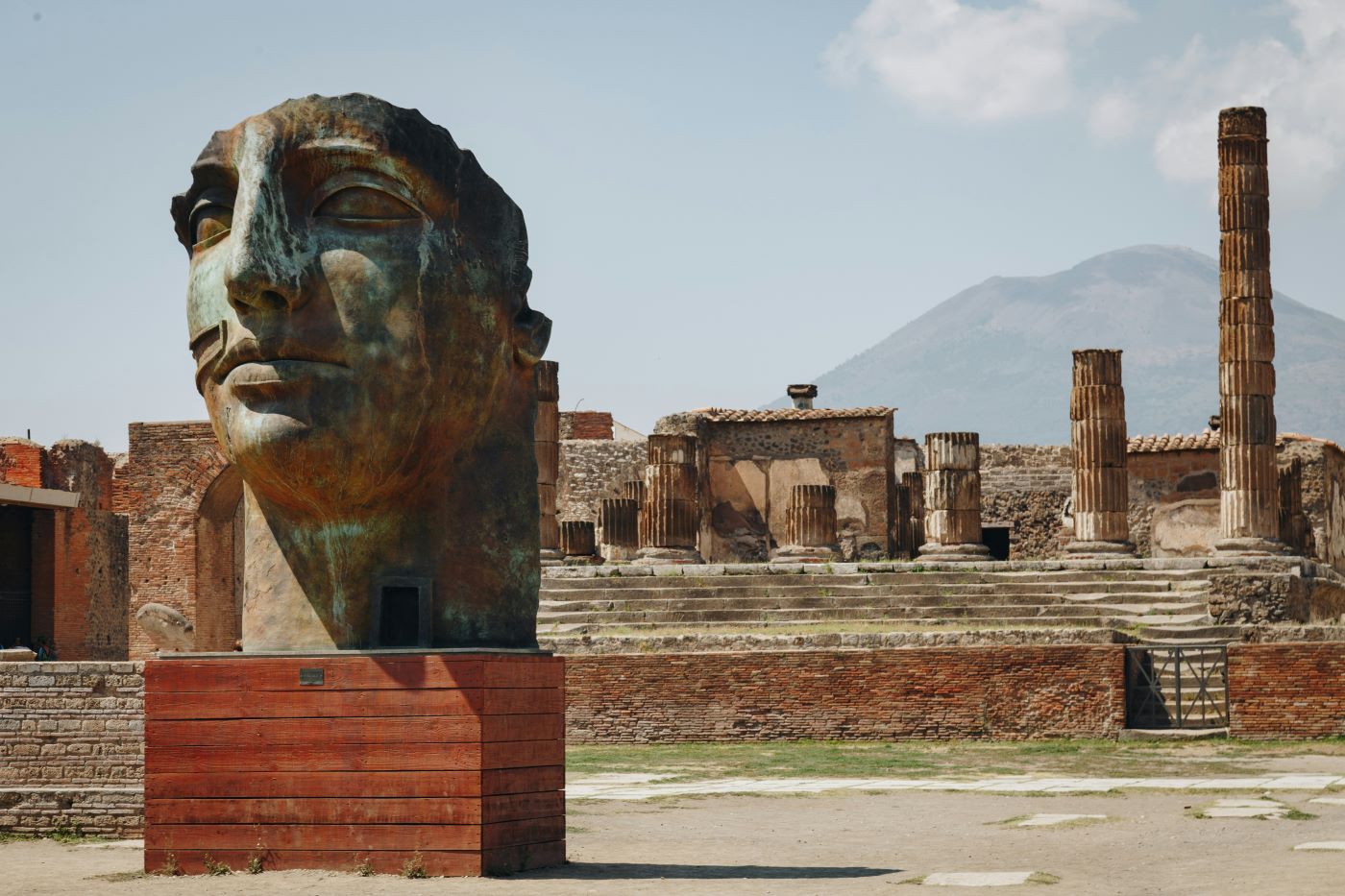
The most striking location in the city is the Forum, the civic and religious heart of Pompeii. Entering the vast, rectangular piazza, one is immediately struck by the deliberate framing of the landscape. The colonnades guide the eye northward, directly toward the smoking cone of Mount Vesuvius. It is a chilling realization that the citizens conducted their daily business—politics, justice, and worship—literally in the shadow of their executioner. The Forum was the only pedestrian-only zone in the city, a place where the noise of carts ceased, now filled only with the silence of the curious.
The Lupanar: The Hidden City
A short walk from the grandeur of the Forum lies a smaller, darker reality: the Lupanar, or the official brothel. It is one of the most visited sites, not for its beauty, but for its stark humanity. The building is claustrophobic, featuring small cells with uncomfortable stone beds. Above the doors, erotic frescoes depict the services offered, functioning as a pictorial menu. But it is the graffiti scratched into the walls that speaks the loudest. Insults, boasts, and crude jokes cover the plaster. One inscription captures the raw, unfiltered voice of the city: "Weep, you girls. My penis has given you up. Now it penetrates men’s behinds. Goodbye, wondrous femininity!" It is vulgar, hilarious, and devastatingly human—a voice from 2,000 years ago that refuses to be silenced.
Daily Life on the Decumanus Maximus
Connecting these sites is the Decumanus Maximus, the main thoroughfare. Walking here offers a sensory connection to the ancients. The original basalt paving stones are still there, deeply rutted by the iron wheels of Roman chariots. Raised stepping stones allow pedestrians to cross the street without stepping in the muck of the ancient drainage system. On the corners, the thermopolia (fast food stalls) still display their frescoed counters, with terracotta jars embedded in the masonry that once held dried nuts, wine, and garum.
The Villa of Mysteries
Located just outside the city walls, the Villa of Mysteries contains some of the most preserved ancient painting in the world. The frescoes depict the initiation rites of the Cult of Dionysus. The colors are vibrant, the figures life-sized and startlingly realistic. Standing in that room, surrounded by the gaze of 2,000-year-old painted figures, the gap between the past and present dissolves.
Conclusion: The Enduring Legacy of the Buried City
Pompeii is often framed as a story of total annihilation, but the ruins also tell a story of survival. We know that many escaped before the final surge. One such survivor was Aulus Umbricius Scaurus, the wealthy garum merchant whose jars were found throughout the city. Historical records suggest he resettled in nearby Puteoli (modern Pozzuoli), where he named his first son born in exile Puteolanus—"the Puteolanean"—as a tribute to his new home. His story is a rare glimpse of resilience, a reminder that while the city died, the people endured.
Yet, for the thousands who remained, Pompeii is the ultimate reminder of the impermanence of our structures. The loaf of bread found carbonized in an oven was meant for a lunch that never came. The dog, chained to a post and immortalized in a twisted cast of agony, was waiting for a master who had already fled.
We build our homes on the slopes of our own sleeping giants—economic, environmental, or political—and assume the ground will hold. Pompeii whispers that the earth is indifferent to our plans. The silence of the ruins is not empty; it is heavy with the weight of a suspended breath, a permanent reminder that the line between a bustling civilization and a layer of archaeology is thinner than the crust of a volcano.
FAQ
Is Mount Vesuvius still active?
Yes, Mount Vesuvius is the only active volcano in mainland Europe. It is currently in a state of repose (sedimentary dormancy), but it is monitored 24/7 by the Vesuvius Observatory. It has erupted more than 50 times since 79 AD, with the last major eruption occurring in 1944. A future eruption is considered a question of "when," not "if," posing a significant risk to the 3 million people living in the "Red Zone."
Is Pompeii safe to visit with Vesuvius still active?
Yes, Pompeii is safe to visit. While Mount Vesuvius is an active volcano and is considered one of the most dangerous in the world due to the high population density nearby, it is closely monitored by the Vesuvius Observatory 24 hours a day. Scientists track gas emissions, ground deformation, and seismic activity to detect any signs of an impending eruption. Evacuation plans are in place for the surrounding "Red Zone," but for a day trip to the archaeological site, the risk is statistically negligible.
Can you see actual bodies in Pompeii?
You cannot see actual organic bodies, but you can see the famous plaster casts which contain the skeletal remains of the victims. The soft tissue decomposed centuries ago, leaving hollow voids in the hardened ash. Archaeologists filled these voids with plaster to recreate the exact shape of the victims at the moment of death. These casts are on display at various locations within the site, including the Garden of the Fugitives, and are a solemn reminder of the human cost of the eruption.
How much time is needed to see Pompeii properly?
A thorough visit requires at least 4 to 6 hours. The site is massive, covering roughly 160 acres (about 44 hectares are excavated and open). A quick 2-hour tour will only allow you to see the Forum and a few highlights. To truly appreciate the scale, visit the Villa of Mysteries, the Amphitheater, and the quieter side streets, which requires a full half-day and comfortable walking shoes for the uneven ancient cobblestones.
What is the difference between Pompeii and Herculaneum?
Pompeii was destroyed by a rain of pumice and ash followed by pyroclastic surges, which crushed roofs but preserved the city structure. Herculaneum, located closer to the volcano, was hit almost immediately by pyroclastic surges. This carbonized organic matter instantly, preserving wooden furniture, doors, and even food, which generally did not survive in Pompeii. Herculaneum is smaller, deeper, and better preserved, but Pompeii offers a vast sense of scale.
Sources & References
- Pompeii Archaeological Park: Official Guide - Ministry of Culture (2024)
- The Letters of Pliny the Younger: Book VI - Project Gutenberg (Translation)
- Vesuvius: Eruptive History - National Institute of Geophysics and Volcanology (INGV)
- The Casts of Pompeii: History and Method - Smithsonian Magazine (2019)
- Volcanic Stratigraphy of the A.D. 79 Eruption - Sigurdsson et al. (1985)
- Life and Death in Pompeii and Herculaneum - British Museum (2013)
- Conservation Challenges in the Shadow of Vesuvius - UNESCO World Heritage Centre
- The Economy of Pompeii - Oxford University Press (Flohr & Wilson)