The Siege of Carthage: 17 Days of Fire and the End of a World
The air in Carthage during the spring of 146 BC did not smell of the Mediterranean sea; it smelled of rendered fat and roasting cedar. For six days and six nights, the Roman legions under Scipio Aemilianus fought a vertical war. They did not simply march through the streets; they climbed through the houses. Carthaginian families retreated to the upper stories of their six-story apartment blocks, raining roof tiles and furniture down on the attackers. The Romans responded by tunneling through the walls of the interconnected buildings, slaughtering every living soul from room to room until they reached the rooftops, then using planks to bridge the gaps between the heights of the city.
The Breach of the Inner Walls
The final Roman assault was not a clean military maneuver; it was a 400-meter-wide meat grinder. When the walls finally gave way at the Cothon (the military harbor), the Roman soldiers found a city that had been starving for three years but refused to break. The street fighting was so dense that the Roman command ordered the city to be set on fire to clear a path for the cavalry. As the multi-story insulae collapsed, thousands of non-combatants—the elderly, the wounded, and children—were buried alive in the cellars or crushed by falling masonry. Roman clearing parties followed the fire, using iron hooks to drag the bodies and the still-living into mass pits to make way for the next wave of troops. The physical destruction was so absolute that the very topography of the Byrsa Hill was altered by the weight of the debris.
Scipio’s Choice and the Tears of the Victor
As the citadel finally surrendered and the last 50,000 survivors—a mere fraction of the original half-million—were led away into the slave markets, Scipio Aemilianus stood on the heights and wept. He did not cry for the Carthaginians. He wept because he saw in the flames of Carthage the future of Rome. He quoted the Iliad, acknowledging that a day will come when sacred Troy shall perish. This was the realization that the most sophisticated civilization on Earth can be deleted from the map if the victor possesses enough iron and enough spite. This erasure was the ultimate Roman victory, a precursor to the same brutal discipline they would later display when they lined the Via Appia with the crucifixions of Spartacus’s rebels to ensure no one forgot who held the hammer.
The Punic Superpower: Life Before the Dust
Before it was a graveyard, Carthage was a loud, wealthy, and crowded metropolis that made Rome look like a backwater village. At its peak, nearly 700,000 people were crammed into the city and its immediate suburbs. It wasn't just a city-state; it was the heart of a massive maritime empire that stretched across North Africa, Spain, Sicily, and Sardinia. If you were a citizen of Carthage, you lived in the New York City of the ancient world.
Gold, Ships, and Six-Story Skyscrapers
Life in Carthage was defined by the hustle. While Romans were obsessed with dirt and farming, Carthaginians were obsessed with the sea and the ledger. They lived in the world’s first apartment complexes—towering blocks six stories high, packed along narrow, paved streets that hummed with dozens of languages. You would walk past shipyards where workers used assembly-line techniques to build a warship in weeks, or markets filled with British tin, Spanish silver, and African ivory. The average Carthaginian was more literate, better traveled, and significantly wealthier than their Roman counterpart. They weren't interested in conquering the world for glory; they wanted to dominate the world's trade routes.
The Fragile Alliance of the Merchants
Carthage wasn't a lone wolf; it was the CEO of a massive Mediterranean conglomerate. They had a complex web of allies—the Numidian kings provided the world's best light cavalry, the Libyans provided the bulk of the infantry, and the Phoenician sister-cities like Utica offered strategic ports. But this wasn't a brotherhood. It was a business arrangement. As long as the gold flowed, the alliance held. The moment Rome started cutting off the Carthaginian trade routes, those "allies" began to look for a better deal. Carthage didn't have a "country" in the modern sense; it had a series of contracts, and Rome was about to tear them up.
The Three Great Wars: Why the Mediterranean Wasn't Big Enough
Rome and Carthage didn't go to war because they hated each other’s gods; they went to war because they were two predators fighting over the same piece of meat—Sicily. What followed was a 118-year geopolitical boxing match known as the Punic Wars.
The First Round: A Fight for the Island
The First Punic War started because both powers wanted to control the grain and ports of Sicily. Carthage had the best navy; Rome had the best army. The Romans, in an act of pure desperation and engineering genius, found a wrecked Carthaginian ship, took it apart, and reverse-engineered it to build a fleet of their own. They added a "corvus"—a boarding bridge—to turn sea battles into land battles. Carthage lost Sicily and their pride, but they didn't lose their bank account.
The Second Round: Hannibal and the Elephants
The Second Punic War was a war of revenge. Hannibal Barca, arguably the greatest military mind in history, decided that if Carthage couldn't beat Rome at sea, he would walk to their front door. He led an army of 50,000 men and 37 elephants across the Alps—a feat that was considered physically impossible. He spent 15 years rampaging through Italy, winning every battle but failing to deliver the killing blow to Rome itself. Rome survived by refusing to quit, eventually taking the fight to Africa and forcing Hannibal home to his defeat at Zama.
Delenda Est Carthago: The Cold Logistics of Roman Vengeance
The Third Punic War was a war of choice, not necessity. By 150 BC, Carthage was a neutered state. It had no navy, no elephants, and was paying massive war indemnities to Rome. However, its economic recovery was so rapid that it terrified the Roman conservative faction. The city refused to die quietly in the shadows of history.
Cato’s Obsession and the Politics of Fear
Cato the Elder ended every speech in the Roman Senate with the phrase Ceterum censeo Carthaginem esse delendam (Furthermore, I move that Carthage must be destroyed). This was not the rambling of a madman; it was a calculated campaign of dehumanization. Cato would show the Senate fresh figs from Carthage, pointing out that they were only three days' sail away. He weaponized the fear of the Punic person who dressed differently, spoke a Semitic tongue, and supposedly practiced dark rites. He convinced the Roman public that as long as one stone stood upon another in North Africa, Rome was not safe. The eventual Roman ultimatum was designed to be rejected: Carthage was told to abandon their city and move ten miles inland, effectively killing their maritime identity. They chose to fight and die instead.
The Salt Myth vs. the Physical Reality
There is a popular historical myth that the Romans salted the earth of Carthage to prevent anything from growing. This is a 19th-century poetic invention. The reality was much darker and more labor-intensive. The Romans didn't use salt; they used hammers. They spent months systematically dismantling the stone blocks of the city. Every temple was stripped, every library was burned, and every residential district was leveled. The ground was cursed by priests, and the site was declared sacer—taboo. The goal was not to make the land barren, but to make the memory of the city uninhabitable. This stolen wealth and stone ultimately fueled the glory of the conquerors, funding the massive expansion of the Roman Forum and later grand projects like the Colosseum.
The Tophet of Salammbô: Analyzing the Sociology of Sacrifice
To look at the ruins of Carthage without addressing the Tophet is to ignore the most unsettling aspect of its history. Located near the Cothon, the Tophet of Salammbô is a dense field of thousands of small stelae and urns. For decades, historians argued this was a simple cemetery for stillborn children, a way to protect the Punic reputation from Roman slander. Archeological science has since shattered that comfort.
The Bone Urns of Baal Hammon
Modern osteological analysis of the remains within the urns confirms the presence of healthy infants, mostly aged between a few weeks and four years. These were not deaths by natural causes. The inscriptions on the stelae—He heard my voice, he blessed me—indicate a transactional relationship with the gods Baal Hammon and Tanit. In times of extreme national crisis, the Carthaginian elite sacrificed their own firstborn sons to ensure the survival of the state. This was not a primitive act of bloodlust; it was a highly regulated, legalistic religious ritual. The more prestigious the family, the more valuable the sacrifice. It was the ultimate expression of the Carthaginian belief that everything, even human life, had a price that could be negotiated with the divine.
The Investigative Guide: Navigating the Ghosts of the Gulf of Tunis
Visiting Carthage today is a disjointed, haunting experience. Unlike Pompeii, which is a frozen moment in time, Carthage is a shattered jigsaw puzzle spread across a wealthy modern suburb of Tunis.
The Disconnected Archipelago
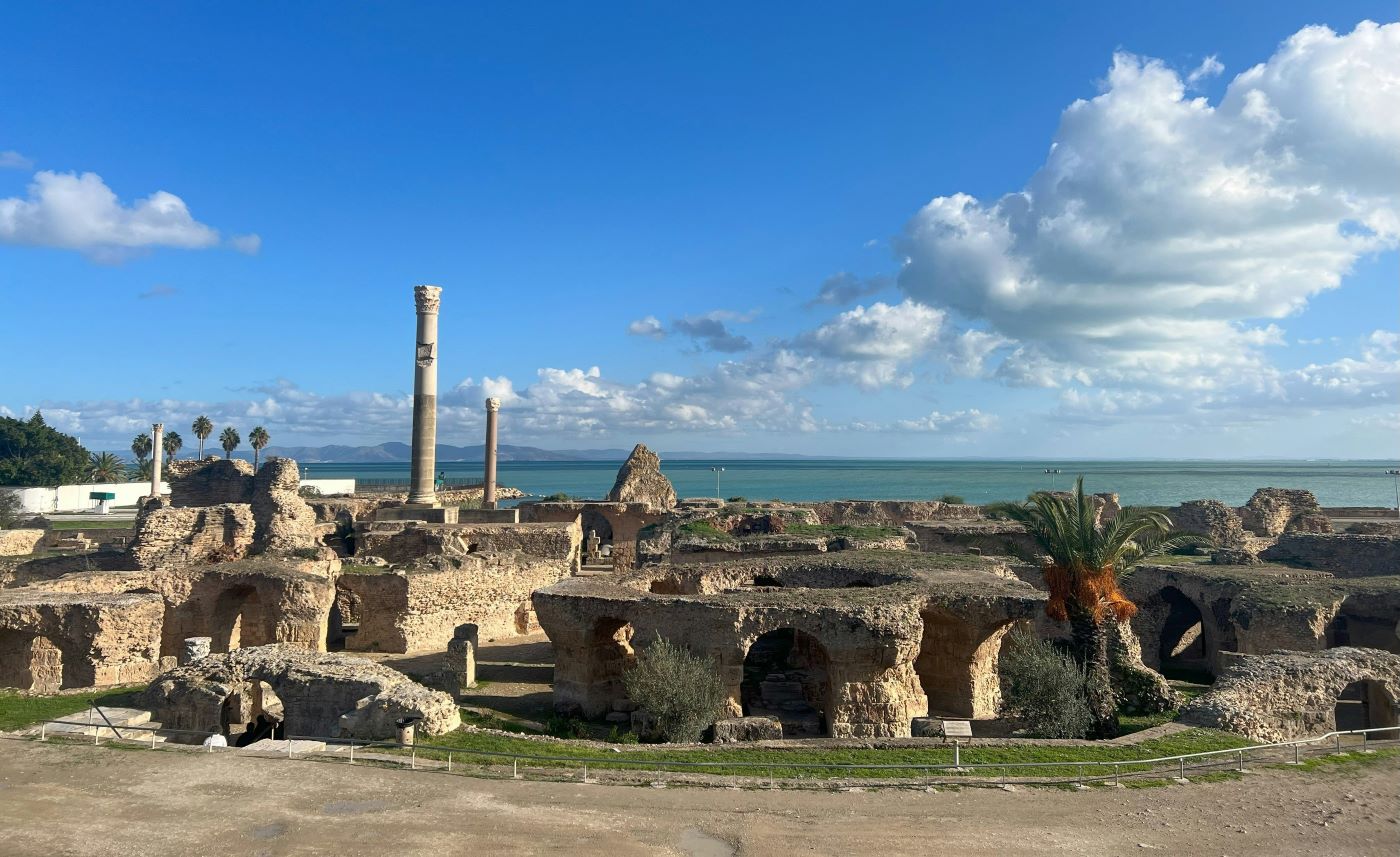
The ruins are not a single park; they are a series of islands of history scattered between modern villas and presidential palaces. This fragmentation is the final stage of the city's erasure. You start at the Cothon, the circular naval harbor. It is eerily quiet now, a shallow ring of water where 220 warships once sat in readiness. Then you move to the Tophet, which feels heavy, the air thick with the weight of the thousands of urns still buried beneath the garden floor. Finally, you ascend Byrsa Hill. The psychological impact is one of profound hollow silence. You are standing at the epicenter of a world that was deleted, looking out over a blue gulf that has forgotten the names of the men who died defending it.
The Ethics of the Tourist Gaze
There is a moral complexity to standing at Carthage. It is one of the world's most beautiful sites, with the bougainvillea draped over Roman marble and the Mediterranean shimmering in the distance. But beneath your feet is the literal dust of a civilization that was murdered with intent. To visit Carthage is to participate in an act of historical witness. It is not about seeing the sights; it is about acknowledging the absolute fragility of culture. The ethics of the site demand that we look past the Roman marble to the Punic rubble beneath. The hollow feeling you get while walking through the Roman baths isn't just travel fatigue—it’s the recognition that history is written by the victors, but the truth is buried in the landfill.
FAQ
How do I get to the Carthage ruins from Tunis?
The most efficient way to reach the site is via the TGM light rail from central Tunis (Marine station). Take the train toward La Marsa and get off at the Carthage Hannibal or Carthage Salammbô stations. Taxis are plentiful and inexpensive, but ensure the meter is running or agree on a fare beforehand.
Is a single ticket valid for all the Carthage sites?
Yes. A single "group ticket" purchased at any of the major sites, such as the Roman Theater or the Baths of Antoninus, grants access to all eight archaeological zones within the Carthage park. Keep this ticket on you at all times as it will be scanned at each individual entrance.
What is the best time of day to visit to avoid crowds?
Arrive exactly when the gates open at 8:30 AM. Start with the Byrsa Hill to understand the layout of the city before the heat and tour buses arrive. The Baths of Antoninus are best visited in the late afternoon for the specific light over the Mediterranean, but the site closes strictly at 5:00 PM (winter) or 7:00 PM (summer).
Is it safe to visit the Tophet of Salammbô?
The site is entirely safe and accessible. While it is the most emotionally heavy part of the ruins, it is physically just a quiet, enclosed garden. It is located about a 15-minute walk south of the Cothon (Punic Ports).
Are there guided tours available on-site?
Official guides often wait near the entrance of the Baths of Antoninus and Byrsa Hill. While they are knowledgeable, ensure they are licensed by the Tunisian National Heritage Institute. Negotiate the price upfront; typically, 30–50 TND is a standard rate for a private walk-through.
Sources & Citations
- Carthage: A History - Serge Lancel (1995)
- The Punic Wars - Adrian Goldsworthy (2000)
- Carthage Must Be Destroyed: The Rise and Fall of an Ancient Civilization - Richard Miles (2010)
- Appian: The Punic Wars (Book VIII) - Appian of Alexandria (C. 160 AD)
- The Fall of Carthage: The Punic Wars 265-146BC - Adrian Goldsworthy (2003)
- UNESCO World Heritage: Archaeological Site of Carthage - UNESCO (1979)
- Hannibal: A Hellenistic Life - Eve MacDonald (2015)