120 Miles of Crucifixion: How Rome Made an Example of the Spartacus Rebels
Six thousand timber crosses line the basalt stones of the Via Appia, stretching in a jagged, unbroken line from the gates of Capua to the walls of Rome. On each one, a human being is dying in the midday heat. This is not a standard execution; it is Marcus Licinius Crassus’s 120-mile-long message to every slave in Italy. To walk this road in the spring of 71 BCE is to walk through a forest of human wreckage, where the air is heavy with the smell of waste and the sound of 6,000 men fighting for one last breath against the weight of their own collapsing lungs.
The Appian Way: Rome’s “Queen of Roads” Turned Site of Mass Terror
The Appian Way was designed to be the "Queen of Roads," a dead-straight corridor of grey volcanic stone that announced the prestige of the Republic. By the end of the revolt, that prestige was replaced by a rhythmic, wet gasping that echoed across the Italian countryside. Crassus ordered the survivors to be spaced at intervals of roughly forty yards. As a traveler, you could not look away. If you rode a horse at a steady pace, you passed a dying man every few seconds. The sun baked the sweat and blood into the timber, and the crows were so satiated by the unprecedented feast that they barely moved when travelers passed by.
Marcus Licinius Crassus and the Political Logic of Public Punishment
Marcus Licinius Crassus, the wealthiest man in Rome, didn't just want the rebels dead; he wanted them to be a legacy. He had funded the war out of his own pocket after the Senate's initial failures, and he needed a visual return on his investment. This 120-mile execution was his political campaign in wood and iron. By lining the most famous road in the world with the broken bodies of those who challenged the state, he was re-establishing the "natural order." He was telling the Roman elite that their property was safe under his watch, and he was telling the slaves that their dreams of freedom ended in a slow disintegration under the Mediterranean sun.
Roman Legal Philosophy and the Display of Power
Roman legal philosophy relied on the concept of exemplum—the idea that the punishment of a crime must be so public and horrific that it serves as a permanent deterrent. The Via Appia was the main artery for the slave trade, connecting the southern ports to the city markets. Crassus ensured that every slave trader bringing fresh "merchandise" into Rome had to drive their human cargo through this gauntlet of corpses. A slave entering Rome for the first time did not just see a city; they saw the price of disobedience before they even reached the suburban villas of the wealthy.
The Slave Revolt Begins: Spartacus, Capua, and the Rise of the Third Servile War
The horror on the road was the final answer to a moment of pure panic that had gripped Rome for two years. Before the crosses, there was a Republic that ran on human fuel and a small group of men who decided they were finished being burned.
The Kitchen Riot of the Seventy-Four
In 73 BCE, the Roman world was arrogant, stable, and entirely dependent on the ludus—the gladiatorial training school. In the city of Capua, Lentulus Batiatus owned a group of high-value gladiators who realized their lives were nothing more than a countdown to a bloody death for public entertainment. Seventy-four of them staged a breakout using whatever they could scavenge. They didn't have swords; they had heavy meat cleavers and iron spits stolen from the kitchen. They butchered the guards and fought their way into the streets. This was not a grand conspiracy at first; it was a spontaneous burst of survival that accidentally ignited a revolution.
The Human Fuel of the Roman Republic
Rome was an empire that classified human beings as instrumentum vocale—speaking tools. The economy was built on the backs of millions of captives brought from the edges of the Mediterranean. These were not unskilled laborers; they were former Greek teachers, Gallic warriors, and Thracian veterans who had been stripped of their names and worked to death on massive agricultural estates called latifundia. The Senate wasn't just afraid of a few gladiators; they were afraid of the math. Slaves outnumbered free citizens in many parts of Italy, and the mere existence of a free slave army threatened to collapse the entire social hierarchy of the ancient world.
Spartacus: Gladiator, Strategist, and Leader of the Revolt
The man who emerged as the leader of this chaos was Spartacus, a Thracian who had once served in the Roman military as an auxiliary soldier. This detail changed the nature of the revolt. Spartacus wasn't just a strong man; he was a trained tactician who understood how the Roman legions thought, moved, and ate. He didn't lead a mob; he organized a mobile state. He divided his followers into centuries, established a chain of command, and set up forges to melt down agricultural chains into spearheads. He was the ultimate nightmare for the Roman elite: a slave who could beat them at their own game of war.
Two Years of Battle: How Spartacus Challenged Rome
For two years, the Roman military was humiliated by its own property. Spartacus and his followers didn't just survive; they conquered, moving across the Italian peninsula like a scythe and defeating every legion sent to stop them.
The Vine-Ladder Descent of Vesuvius
The first major clash proved that Spartacus was a genius of unconventional warfare. The Roman general Gaius Claudius Glaber trapped the rebels on the summit of Mount Vesuvius, blocking the only path down and waiting for hunger to do his work. Spartacus looked at the vertical, vine-covered cliffs behind his men and saw an opportunity. His men wove long, sturdy ladders from wild grapevines and rappelled down the sheer rock face in total silence. They circled the mountain and struck the Roman camp from the rear. The slaughter was absolute, and the rebels walked away with their first cache of high-quality Roman steel.
Rome’s Military Response and the Final Defeat at the Silarus River
By 72 BCE, Spartacus led a force of nearly 100,000 people, including women, children, and the elderly who had escaped the nearby plantations. They marched north, defeating two Roman consuls along the way. The path to the Alps—and freedom—was open. However, the slave army was a fractured mosaic of Celts, Germans, and Thracians. Many, emboldened by victory and rich with plunder, refused to leave Italy. They wanted to stay and bleed Rome dry. Against his better judgment, Spartacus turned his army back south. This decision was the death warrant for the 6,000 men who would eventually end up on the Via Appia.
The Final Stand at the Silarus River
The end came in 71 BCE in the region of Lucania. Crassus had cornered the rebels at the Silarus River using a massive wall and trench system to block their retreat. Spartacus knew the odds were impossible. In a final gesture of defiance, he killed his horse in front of his troops, declaring he would have thousands of Roman horses if they won and no need for one if they lost. He led a suicide charge directly into the center of the Roman line, trying to kill Crassus himself. He was cut down, his body lost in a mountain of corpses so thick that he was never found. The rebel army broke, and 6,000 men were taken alive into Roman custody.
How Crucifixion Worked and the Mechanics of Rome’s Message
The Roman state did not just want these 6,000 men dead; they wanted them to be a process. Crucifixion was specifically engineered to turn the human body into a mechanism of its own destruction, ensuring that death was as slow as the biological limits of the victim would allow.
Turning the Body Against Itself
A clinical look at crucifixion reveals that the victim dies because they are too tired to breathe. The nails were driven through the wrists—specifically the space between the radius and ulna—to ensure the body weight didn't tear the hands through the soft tissue of the palms. To take a breath, the prisoner had to push up on the nail driven through their ankles. This allowed the lungs to exhale. But as the legs cramped and the wounds in the feet became unbearable, the prisoner would slump back down. This collapsed the chest cavity, making it impossible to breathe out. For three days, the survivors were forced to choose, second by second, between searing pain and suffocation.
The Logistics of 120 Miles of Death
Lining the road with 6,000 bodies was an industrial undertaking that required massive coordination. Crassus’s legions had to harvest entire forests of timber to build the crosses and dig 6,000 holes in the hard, packed soil of the roadside. They had to coordinate the transport of these beams along the highway while maintaining order among the thousands of prisoners. Squads of soldiers were stationed at intervals not to provide mercy, but to ensure that no one—no family member or sympathetic passerby—offered the dying men water or a quick death. The soldiers sat in the shade of the crosses, playing dice and eating, while the men above them slowly disintegrated into the landscape.
The Crows and the Denial of Burial
As the days passed, the nature of the road changed from a site of execution to a site of biological decay. The screaming stopped first, replaced by the sound of the birds. Crows start with the eyes and the soft tissue of the face, often while the victim is still conscious but too weak to move. Roman law was clear: the bodies stayed up. They were denied the one thing ancient people feared losing most: a proper burial. They were left to hang until their bones fell into the dust of the roadside, to be stepped on by the next generation of slaves heading to the market. This was the ultimate erasure of human dignity.
Erasing the Memory: How Rome Suppressed the Story of the Fallen
The rebellion ended on the road, but the struggle to control the memory of the event began immediately. Rome wanted the world to forget that a slave had almost brought the Republic to its knees, and they used every tool of the state to scrub Spartacus from the record of "honorable" wars.
The Silence of the Archaeological Record
If you visit the museums of Rome today, you will find countless marble busts of Crassus and Pompey. You will find grand inscriptions detailing every minor Roman victory. You will find almost nothing about the men who died on the Via Appia. The Roman historians wrote about the war as a "disgraceful" event, a stain on the national honor. The 6,000 were eventually swept into mass pits once the crosses rotted away. Their names, their original languages, and their individual stories were intentionally deleted, leaving only the names of the men who killed them as the primary historical record.
The Birth of a Global Legend
Crassus’s attempt to erase Spartacus through extreme violence failed. By creating such a horrific visual legacy, he ensured the story would never die. The image of the 6,000 crosses became a haunting memory that survived the fall of the Republic and the Empire. Spartacus became the patron saint of the oppressed, a symbol for the French Revolution, the labor movements of the 19th century, and the civil rights struggles of the 20th. The violence on the Via Appia didn't prove that slaves couldn't win; it proved that Rome was so terrified of them that they had to resort to 120 miles of murder to feel secure again.
The Ironic Victory of the Damned
There is a deep irony in the fact that we know the name of Spartacus better than we know the names of almost any Roman senator from his era. Crassus spent his fortune to prove that Spartacus was a "nobody," a piece of property to be discarded. Instead, he turned a Thracian gladiator into the world's most enduring symbol of the human will to be free. The 6,000 on the road died in agony, but their collective silence became a roar that has lasted for two thousand years, outliving the basalt stones and the empire that laid them.
Visiting the Via Appia Today: Layers of History and Haunting Silence
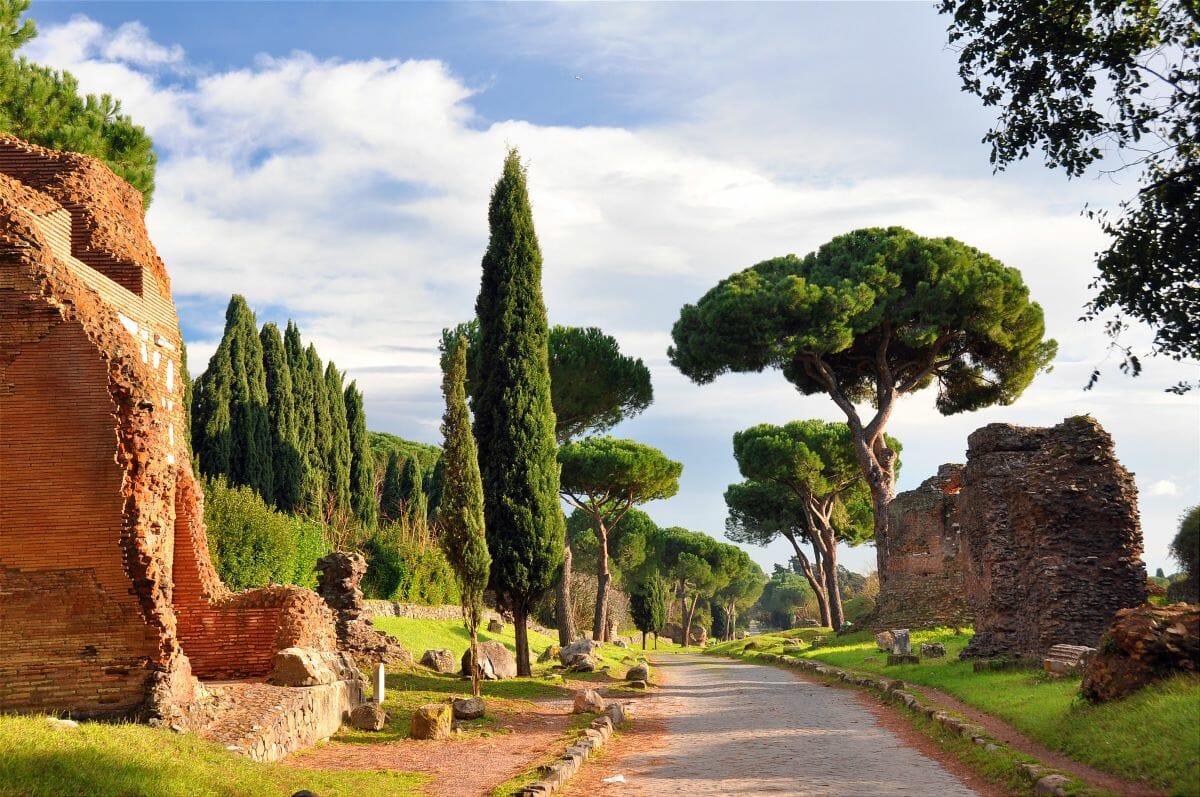
The Via Appia Antica is now a sprawling archaeological park, a quiet escape from the chaos of modern Rome. It is beautiful, shaded by towering cypress trees, and deeply unsettling for those who know what the soil beneath the road contains.
Walking the Parco Regionale dell'Appia Antica
When you walk the stretch of the road near the Tomb of Caecilia Metella, you are walking on the original basalt blocks—the basolato—laid in the 3rd century BCE. These are the same stones that were soaked in the waste and blood of the 6,000. You can still see the ruts carved into the stone by ancient cart wheels—wheels that once rolled past a mile-long line of dying men. To visit today, you take the 118 bus from central Rome to the park entrance. The best experience is to walk south, away from the city, until the sounds of modern traffic fade and you are left with the silence of the ancient ruins.
The Psychological Weight of the Site
Standing on the Via Appia is a complicated experience. On a practical level, it is a marvel of engineering. On a human level, it is a site of mass trauma. You might expect to feel a profound connection to the past, but often, the site offers only a haunting, hollow silence. The wind through the pines and the chirping of cicadas are the only sounds where thousands once screamed. It is a place that demands honesty from the visitor: you are standing on a graveyard that was designed to be a billboard. There is no monument to the slaves here, only the road that was used to display their destruction.
The Ethics of Visiting a Site of Mass Cruelty
There is an ethical tension in treating the Via Appia as a scenic walk. We admire the Roman ruins and the "grandeur" of the Republic, but that grandeur was bought with the industrial-scale cruelty witnessed here in 71 BCE. Visiting the site requires a rejection of the "travel blog" mentality. It is not a place for "aesthetic" photos; it is a place to bear witness to the fact that the stones of our civilizations are often held together by the blood of those who weren't allowed to walk on them as equals. The "Queen of Roads" remains a monument to the cost of stability, and the ghosts of the 6,000 remind us that peace built on a foundation of crosses is no peace at all.
FAQ
How long did it take for a victim to die on the Via Appia?
Death by crucifixion was a slow process of attrition. While some succumbed to shock or blood loss within hours, most victims survived for two to three days. The Roman soldiers occasionally used a practice called crurifragium—breaking the legs with a heavy club—to accelerate death by preventing the victim from pushing up to breathe, but in the case of the 6,000 rebels, Crassus likely ordered the process to be as prolonged as possible for maximum visibility.
Why wasn't Spartacus himself crucified on the road?
Spartacus fell during the peak of the Battle of the Silarus River. According to Roman historians, he fought with desperate bravery, attempting to reach Crassus in single combat. He died in the melee, and because the slaughter was so absolute and the field was covered in thousands of bodies, his remains were never identified. The 6,000 crucified were the survivors of the battle, not its leaders.
Is the Via Appia safe to visit today?
The Via Appia Antica is a protected regional park and is very safe for visitors. Because it is a long, linear site, it is best explored on foot or by bicycle. It is recommended to visit on Sundays when the road is closed to most motorized traffic, allowing for a quieter experience that is more conducive to reflecting on the site's history.
What happened to the 6,000 crosses after the executions?
Roman policy was to leave the crosses standing until they succumbed to the elements. Once the wood rotted and the remains fell, the debris was cleared to maintain the functionality of the road. The timber was likely recycled for other military or construction purposes, and the bones were swept into mass pits (puticuli) or simply integrated into the soil over centuries.
Sources
- The History of Rome: The Servile Wars - Theodor Mommsen (1854)
- The Spartacus War - Barry Strauss (2009)
- Slavery and Rebellion in the Roman World - Keith Bradley (1989)
- Appian: The Civil Wars, Book I - Appian of Alexandria (2nd Century CE)
- Plutarch: The Life of Crassus - Plutarch (1st Century CE)
- The Roman Way of Death: Burial and Memorial - Valerie M. Hope (2009)
- Archaeology of the Via Appia Antica - Parco Regionale dell'Appia Antica Official Site (2025)
- Spartacus and the Slave Wars: A Brief History with Documents - Brent D. Shaw (2001)