The Golden Fortress of the Hills
The approach to Arkadi is a journey through the deceptive gentleness of the Cretan landscape. Driving southeast from Rethymno, the road winds through the foothills of Mount Psiloritis, the mythological birthplace of Zeus. The terrain here is a patchwork of silver-green olive groves, wild thyme, and steep ravines that smell of heated earth and pine resin. As you ascend, the air grows thinner and crisper, and the noise of the modern coastal cities fades into a profound, ringing silence.
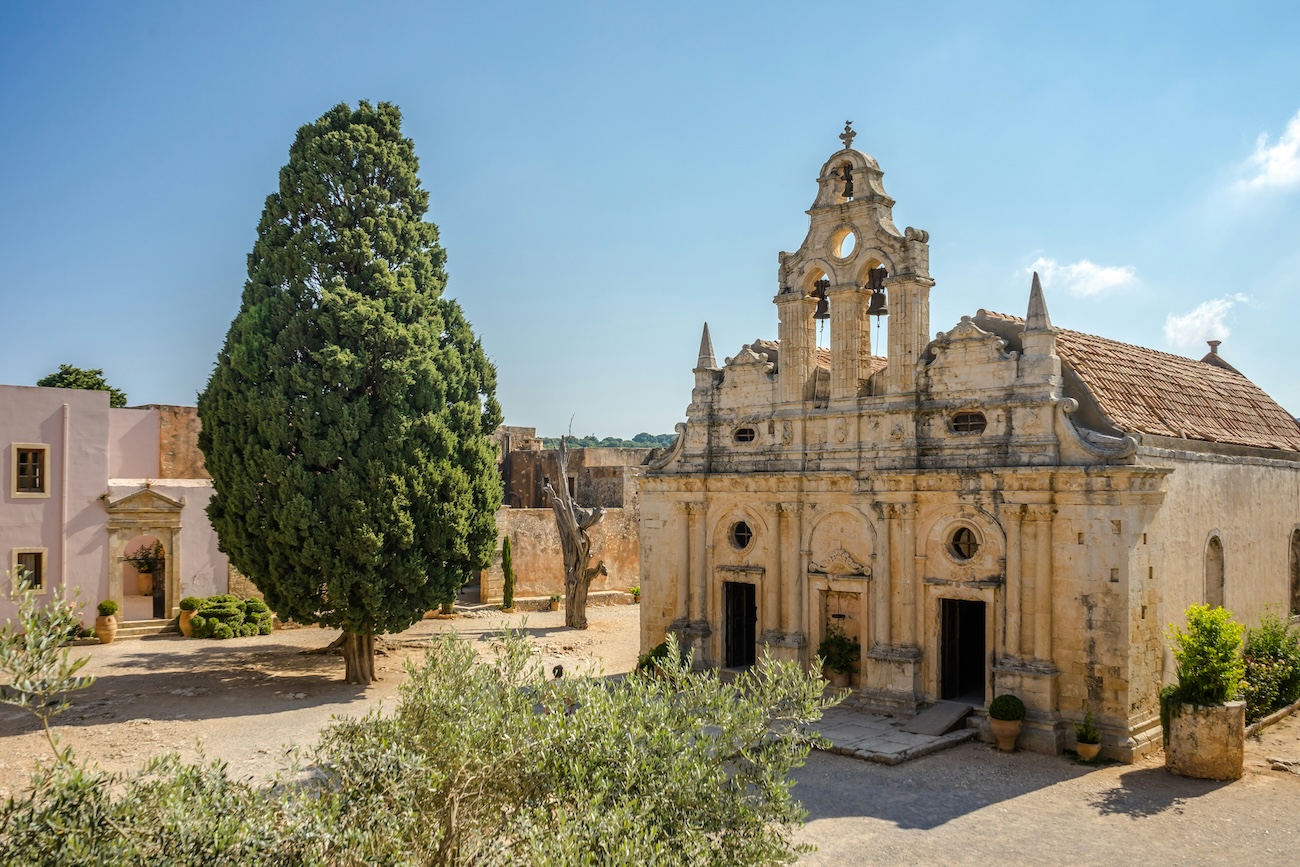
Then, the monastery appears. It sits on a plateau like a golden crown, its walls glowing with the honeyed hue of local limestone. At first glance, it is a vision of Venetian Baroque elegance. The famous western façade, with its intricate bell tower, Corinthian columns, and graceful arches, suggests a place of high culture and serene contemplation. The sunlight hits the warm stone, turning it a shade of amber that feels inviting, almost soft. It is a scene of immense peace, framed by the rugged grey shoulders of the mountain.
But this beauty is a facade in the most literal sense. To walk toward Arkadi is to walk toward a paradox. The architecture sings of the Renaissance, of art and prayer, yet the ground beneath your feet is soaked in the blood of one of the most violent episodes in Greek history. This is not merely a house of God; it is a tomb, a fortress, and a national altar. The golden light that bathes the courtyard today belies the smoke and sulfur that once choked the sky here, blotting out the sun. To understand Arkadi, one must look past the picturesque arches and see the monastery for what it truly is: the epicenter of a holocaust that defined the soul of modern Crete.
A Sanctuary Built on Stone and Faith
Long before the smell of gunpowder settled into its masonry, the Arkadi Monastery (Moni Arkadiou) was a beacon of Orthodox spirituality and learning. Founded according to tradition by the Byzantine Emperor Heraclius, and later expanded during the Venetian occupation of Crete, it grew into a wealthy and formidable institution. By the 16th century, the monastery was a self-sustaining village behind high walls.
The monks here were not simple ascetics; they were scholars and artisans. Arkadi was famous for its scriptorium, where brothers hunched over parchment, copying ancient texts to preserve the Greek language and liturgy during centuries of foreign rule. It was a center of gold embroidery, its vestments sought after across the Orthodox world. The central church, the Katholikon, dedicated to the Transfiguration of the Savior and Saint Constantine, stood as a testament to a faith that refused to erode under the pressure of Catholic Venetians or, later, Muslim Ottomans.
Yet, the architecture of the monastery always hinted at a dual purpose. The walls were too thick, the gates too heavy, and the location too strategic for mere prayer. It was built to withstand the banditry of the highlands, but as the 19th century progressed, the monks found themselves guarding something far more dangerous than gold chalices or ancient manuscripts: they became the guardians of the Cretan desire for freedom.
The Turning of the Ploughshare
By 1866, the simmering resentment of the Cretan people against Ottoman rule had boiled over into open insurrection. The "Great Cretan Revolution" had begun. The island was a powder keg, and Arkadi was the spark. The monastery ceased to be a place of quiet contemplation and transformed into the beating heart of the rebellion.
The Abbot, Gabriel Marinakis, was a man of imposing physical and spiritual stature. He was not a man to turn the other cheek when his people were being subjugated. Under his guidance, the refectory tables where monks once ate in silence became strategy maps for the Cretan Revolutionary Committee. The cellars, once stocked with wine and olive oil, began to fill with crates of muskets and gunpowder.
Monks traded their prayer ropes for rifles. The cloisters echoed with the heavy boots of warlords and rebel chieftains, including the fiery Panos Koronaios and the determined Ioannis Dimakopoulos. Arkadi was no longer just a spiritual center; it was the headquarters of the insurgent government for the Rethymno region. The ploughshare had been beaten into a sword, and the Ottomans knew it. The golden fortress on the hill had become an intolerable thorn in the side of the Sultan.
The Gathering of the Innocents
As the autumn of 1866 deepened, a sense of foreboding swept through the villages surrounding Mount Psiloritis. Word spread that Mustafa Pasha, the formidable Ottoman governor, was marching an army of overwhelming size to crush the rebellion at its source.
Panic triggered a mass migration. It was not just soldiers who flocked to Arkadi, but the innocent. Hundreds of women, children, and elderly villagers from the surrounding region fled their homes, carrying whatever they could hold, seeking the perceived safety of the monastery’s high walls. They believed in the sanctity of the church; they believed that even in war, the House of God might offer asylum.
By early November, the monastery was dangerously overcrowded. Inside the walls were approximately 964 people. Of these, only roughly 250 were armed men capable of fighting. The rest—over 700 souls—were women, children, and the infirm. The cells were packed tight; the courtyard hummed with the nervous energy of refugees. Mothers hushed crying infants, looking anxiously at the heavy wooden gates, while the rebels manned the parapets, scanning the horizon for the glint of steel. The air grew thick with the claustrophobia of the doomed.
The Tide of Iron and Crescent
The realization of their plight came with the sound of marching boots that shook the earth. Mustafa Pasha arrived with a force that made resistance seem like madness. The Ottoman army surrounding Arkadi numbered approximately 15,000 regular soldiers, supplemented by Egyptian troops and local irregulars, and supported by 30 field cannons.
From the bell tower of the monastery, the defenders looked out at a terrifying transformation of the landscape. The green hills were swallowed by a sea of white tents and red fezzes. The valley floor teemed with cavalry, and the sun glinted off thousands of bayonets. The disparity was almost comical in its tragedy: 250 rebels with hunting rifles and old muskets against a professional imperial army of 15,000.
The blockade was total. The water supply was cut off, forcing the defenders to ration meager supplies. The circle of iron tightened around the golden stone walls. Inside, the atmosphere shifted from anxiety to a grim, steely resolve. There was no way out, and for the Cretans, there was no desire to flee. They were digging in for a fight that they knew they could not win, but one they refused to lose.
A Silence Louder Than Cannon Fire
Before the first shot was fired, there was a moment of diplomatic theater. Mustafa Pasha, confident in his crushing superiority, sent a messenger to the gate. His demand was simple: surrender the monastery, hand over the revolutionary leaders, and lay down arms. In exchange, he promised mercy.
The response from Abbot Gabriel and the revolutionary committee was swift and absolute. It was a refusal delivered with a spiritual arrogance that enraged the Pasha. The monks and rebels replied that they would never surrender their souls or their land.
Tradition holds that when the demand for surrender was shouted up to the walls, the only response was the sound of a rifle bolt clicking into place. The silence that followed was heavy, amplified by the presence of hundreds of women and children huddled in the courtyard, waiting for the sky to fall. It was the silence of people who had already accepted death and were now merely negotiating the price of their lives.
The Walls Begin to Bleed
On the morning of November 8, 1866, the silence shattered. The Ottoman artillery opened fire. The initial bombardment was relentless. Cannonballs hammered the western façade, chipping away at the ornate Venetian carvings and sending clouds of limestone dust billowing into the air.
Inside, the chaos was absolute. The noise was deafening—a continuous roar of explosions mixed with the screams of the terrified and the shouting of orders. Yet, the walls held. The monastery’s construction was robust, and the rebels, firing from narrow slit windows and the roof, proved to be deadly marksmen. They poured a withering fire into the Ottoman ranks, forcing the infantry to pull back time and again.
For a full day, the 250 defenders held off 15,000 attackers. The courtyard filled with smoke and debris. The beautiful baroque masonry began to bleed dust and rubble. Women ran through the crossfire, carrying water and ammunition to the men on the walls, some taking up rifles themselves when a defender fell. But as night fell on November 8, the situation was critical. The rebels were exhausted, their ammunition was running low, and the structural integrity of the main gate was failing.
The Abbot’s Last Communion
In the dark hours before the dawn of November 9, a scene of profound pathos played out in the smoke-filled Katholikon. Abbot Gabriel, sensing the end was near, celebrated the Divine Liturgy.
It is said that the Abbot wore his priestly vestments over his weapons. He moved among the terrified refugees and the exhausted fighters, offering communion and words of comfort. He did not promise them survival; he promised them salvation. He urged them to be brave, framing their coming death not as a defeat, but as a martyrdom for the faith and for Greece.
The church was lit only by flickering oil lamps and the flashes of cannon fire from outside. The faces of the children were streaked with soot and tears. In this final mass, the distinction between the spiritual and the martial dissolved completely. They were no longer just refugees; they were a congregation of the condemned, preparing to meet their creator.
The Breaching of the Iron Gate
The morning of November 9 brought the end of hope. Mustafa Pasha, frustrated by the resilience of the "monks," ordered his heaviest artillery brought forward from Rethymno. A massive cannon, known as the Koutsovoula, was dragged into position directly facing the main gate.
The first shot from the great gun was devastating. The second shattered the heavy wooden doors that had barred the world for centuries. With the gate breached, the dam broke. A tidal wave of Ottoman soldiers poured into the courtyard.
The battle transitioned instantly from a siege to a massacre. The fighting devolved into brutal hand-to-hand combat. In the confined space of the courtyard, bayonets clashed with Cretan knives. The cloisters became kill boxes. The rebels fought with the fury of trapped animals, retreating room by room, making the attackers pay in blood for every inch of stone. But the sheer weight of numbers was irresistible. The defenders were pushed back, squeezed toward the rear of the complex, toward the wine cellars and the powder magazine.
The Covenant of Fire
As the defensive lines collapsed, the women and children, along with many of the surviving fighters, retreated into the Kelisak, the monastery’s old wine cellar which was being used to store the gunpowder. It was a dark, vaulted room, heavy with the smell of old wine and raw fear.
Inside, hundreds of people were crushed together. The sounds of the slaughter outside grew louder—the screams of the dying, the triumphant shouts of the Ottoman troops breaching the inner doors. They knew what awaited them if they were taken alive: slavery, torture, and execution.
In this moment of ultimate despair, a decision was made that would echo through history. Konstantinos Giaboudakis, a rebel leader from the village of Adele, stood near the open barrels of gunpowder. He looked at the faces around him—mothers clutching their babies, old men praying, young women paralyzed with terror. The consensus was unspoken but shared: Death is better than this.
Giaboudakis asked the people to move close to the barrels. It was a covenant of fire. They would not give the Ottomans the satisfaction of capture. They would turn their bodies into a weapon.
A Holocaust of Flame and Bone
The term "Holocaust" is used here in its original, ancient Greek etymology: holokaustos, meaning a "wholly burnt offering" to God. What happened next was exactly that.
As the Ottoman soldiers battered down the door to the magazine, swarming the entrance with swords drawn, Giaboudakis waited for the room to fill with the enemy. When the threshold was crossed and the space was thick with attackers, he lowered his pistol—or perhaps a lit torch, accounts vary—into the gunpowder.
The explosion was cataclysmic.
It was not merely a detonation; it was an erasure. The sheer force of the blast lifted the massive stone roof of the cellar and hurled it into the sky. The walls blew outward, disintegrating instantly. A pillar of fire erupted from the monastery, visible from the sea. The mountain itself seemed to shake.
In a fraction of a second, hundreds of Cretan women, children, and rebels were vaporized. But the blast also took with them hundreds of Ottoman soldiers who had crowded near the building. The explosion was so violent that debris and body parts were found scattered hundreds of meters away on the hillsides. It was a suicidal, sacrificial strike of biblical proportions.
The Silence of the Dead
When the smoke finally cleared, a terrible silence descended on Psiloritis. The courtyard of Arkadi was a ruin of smoking rubble, blackened limbs, and shattered stone. The air smelled of sulfur, roasted meat, and blood.
The cost was staggering. Of the 964 Christians in the monastery, over 800 were dead. Those who survived the blast were dragged from the ruins and, for the most part, executed on the spot by the enraged surviving Ottoman troops. Only a handful managed to escape or were taken prisoner.
However, the Ottomans had paid a pyrrhic price. They had lost over 1,500 soldiers in the siege, many killed in the final explosion. The monastery was destroyed, the rebellion’s headquarters decapitated, but the victory felt like ashes in their mouths. They had conquered a graveyard.
Echoes Across a Horrified Continent
The explosion at Arkadi sent shockwaves far beyond the shores of Crete. It was the 19th-century equivalent of a viral global event. As news of the "Holocaust of Arkadi" reached Europe, the narrative of the Cretan revolt shifted overnight.
No longer were these merely troublesome islanders defying the Sultan; they were tragic heroes, martyrs who preferred self-destruction to tyranny. The intellectual elite of Europe was electrified. Victor Hugo, the great French author, wrote deeply moving letters in support of the Cretans, famously proclaiming, "Why has this people revolted? Because it is a people, and you are treating it like a flock of sheep."
The volunteerism of Philhellenes surged. Money and weapons began to flow from Europe and America to the Greek rebels. The sacrifice at Arkadi did not win the war in 1866—the rebellion was eventually suppressed—but it won the moral argument. It set the stage for the eventual liberation of Crete and its union with Greece. The dead of Arkadi had not died in vain; they had ignited the conscience of the world.
The Chapel of Ash: Visiting Ground Zero
Today, when you visit Arkadi, the path eventually leads you to the site of the explosion. It is the most arresting part of the complex. The old wine cellar remains roofless, a deliberate choice to leave the wound open to the sky.
Walking into this space, now known as the Powder Magazine, is a physical experience. The air feels different here—still, heavy, and charged. You are standing at Ground Zero. The stone walls are still scorched and blackened, resisting the bleaching power of the sun even after a century and a half.
There is no ceiling, only the blue Cretan sky, which feels like a window through which the souls of the departed ascended. A commemorative plaque marks the spot where Giaboudakis stood. Visitors tend to fall silent here without being told. It is a "Chapel of Ash," where the violence of the past feels incredibly close, as if the dust of the explosion has just settled.
Silent Witnesses
Stepping back out into the blindingly bright courtyard, the scars of the battle are everywhere, hidden in plain sight.
In the center of the courtyard stands an ancient cypress tree. It is gnarled and twisted, a survivor of the siege. If you look closely at its trunk, you can see the arrow-shaped marker pointing to a rusted Ottoman bullet still embedded deep within the wood. The tree is a living organism that absorbed the violence of 1866 and kept growing around it, a bio-historic record of the fusillade.
Inside the Refectory (the dining hall), the heavy wooden tables bear similar witness. Deep gashes mar the wood—marks left by the yataghans and swords of the Ottoman soldiers who stormed the room, hacking at the furniture in their fury or perhaps during the chaotic hand-to-hand combat. These are not museum reproductions; they are the actual surfaces that were present when the world ended for the people of Arkadi.
Facing the Dead
Perhaps the most confronting experience at Arkadi lies just outside the main gate. Opposite the entrance is the Ossuary, a former windmill converted into a tomb.
Through the glass windows, you are forced to look directly at the cost of freedom. Inside, arranged in neat, chilling stacks, are the skulls and bones of the defenders and refugees. Some of the skulls bear the clear marks of sword cuts or bullet holes.
It is a memento mori of aggressive intimacy. These are not abstract statistics in a history book. These are the physical remains of the mothers, the children, and the monks who crowded into the dark just a few yards away. To stare into the hollow eyes of these skulls is to make eye contact with the history of Crete. It is a somber reminder that the golden architecture and the peaceful olive groves are built on a foundation of human bone.
The Eternal Flame of Crete
Leaving Arkadi, the drive back down to the coast feels different. The beauty of the landscape is no longer just scenic; it feels earned.
Arkadi is more than a tourist destination or a historical site. It is the sacred crucible of Cretan identity. The islanders are known for a specific kind of fierce, unyielding pride, and Arkadi is the genesis of that spirit. It represents the ultimate extreme of the Greek motto Eleftheria i Thanatos (Freedom or Death).
As the monastery recedes in the rearview mirror, glowing orange in the setting sun, it stands as a sentinel. It is a reminder that there are things more valuable than life, and that sometimes, the only way to save a people is to burn the ground on which they stand. The fires of 1866 have long since burned out, but the flame of what happened there—the sheer, terrible courage of the act—remains the eternal light of Crete.
Sources & References
- UNESCO World Heritage Tentative List - Arkadi Monastery: UNESCO Centre - Fortress of Spinalonga and Arkadi
- Official Website of the Holy Monastery of Arkadi: Arkadi Monastery Official Site
- Explore Crete - Historical Account: The Arkadi Holocaust
- Greeka - History of Arkadi: Arkadi Monastery in Rethymno
- Cretanbeaches.com - Comprehensive Guide: Arkadi Monastery Guide
- Syntagma Watch - Historical Context of 1866: The Cretan Revolt of 1866-1869 (General historical reference regarding Greek constitutional history and revolts)
- British School at Athens - Crete Archives: Archaeology and History in Crete
- SearchCulture.gr - National Aggregator: Digital Archives on the Cretan Revolution
- Municipality of Rethymno: History of Rethymno and Arkadi
- Victor Hugo’s Letters on Crete (French National Library): Gallica - Victor Hugo et la Crète
- Orthodox Crete - Ecclesiastical History: Church of Crete Historical Data
- Greece Is - Travel & Culture: The Heroes of Arkadi