The Last Day of Don Julián Santana Barrera
On an April morning in 2001, Don Julián Santana Barrera stood at the edge of his chinampa with his nephew Anastasio, fishing in the dark canal water as they had done hundreds of times before. The old man was 80 years old. He had lived alone on this island for half a century, surrounded by the thousands of plastic bodies he had nailed, tied, and impaled on every available branch. Anastasio knew the routine. When Don Julián sent him away to check on some cattle nearby, there was nothing unusual about it.
When Anastasio returned, his uncle was floating face-down in the water.
The spot where Don Julián's body drifted was the same stretch of canal where, in the early 1950s, he claimed to have found the corpse of a young girl tangled in the water lilies. That discovery had triggered everything — the first doll hung on a tree, the whispers he heard at night, the decades of scavenging and hanging and fortifying. Don Julián had told Anastasio many times that the "mermaid" in the water wanted to take him. He said she was calling. He predicted, with the calm certainty of a man who had stopped questioning his own visions, that the canal would eventually swallow him too.
The dolls watched from above. Their caretaker was gone. The island's population of plastic and wire outnumbered its human residents by thousands to one. Nothing changed on the island that day except the silence got one degree deeper.
The Isla de las Muñecas is not a haunted house. It is a physical record of what happens when grief, isolation, and undiagnosed illness are left alone for fifty years in a landscape where no one is watching. Every doll on the island is a data point in a single man's psychological collapse — each one scavenged from garbage, hung without repair, and left to rot in the subtropical air until the plastic blistered and the eye sockets filled with spiders. The horror is not supernatural. The horror is that one human mind, operating under its own unbroken internal logic, can reshape an entire landscape into a mirror of its fear.
Xochimilco and the Chinampas: Where the Island Sits
The Ancient Canal Network South of Mexico City
The island sits inside the canal network of Xochimilco, the last surviving fragment of the vast lake system that once cradled the Aztec capital of Tenochtitlan. Before the Spanish conquest, Lake Texcoco and its connected waterways stretched across the Valley of Mexico, and the Aztecs built chinampas — artificial islands of staked mud, sediment, and decaying vegetation — to farm the shallow lake bed. These were not floating gardens, despite the common label. They were engineered platforms anchored to the lakebed, producing maize, beans, and squash in quantities sufficient to feed an empire. The same engineering that built Teotihuacan and Chapultepec Castle shaped this waterlogged terrain into arable land.
Today, the Xochimilco canals are a UNESCO World Heritage site and a weekend party destination. Brightly painted trajineras — flat-bottomed boats — carry tourists through the wider waterways while mariachi bands play and vendors sell beer from passing canoes. The noise, colour, and chaos are deliberate theatre. Past the tourist perimeter, the canals narrow, choked by invasive water hyacinth, and the Mexican willows close overhead. GPS signals drop. The city skyline disappears. Don Julián's chinampa lies deep inside this ecological reserve, reachable only by a two-hour boat ride through corridors of green silence. The geography did not cause his madness, but it guaranteed that no one would interrupt it.
Who Was Don Julián Santana Barrera?
The Recluse of the Canals
In the early 1950s, Don Julián Santana Barrera left his wife and child and moved alone to a small chinampa deep in the Xochimilco reserve. The reasons for his self-imposed exile have never been definitively established. Local accounts vary — some point to alcoholism, others to a religious crisis, still others to a man who simply could not tolerate the pressures of mid-century Mexican domestic life. What is clear is that he chose the most isolated patch of land available to him and committed to staying there.
His daily life before the dolls was the life of a subsistence farmer. He grew pumpkins, squash, and vegetables on the chinampa's fertile soil, occasionally trading produce with locals who poled their boats past his plot. He built a small wooden shack. He spoke to almost no one. The canal provided water, the soil provided food, and the willows provided shade. It was a life of radical simplicity — and radical solitude.
The Drowned Girl in the Water Lilies
The story that Don Julián told for the rest of his life — and that his family still recounts — begins with a body in the water. According to Don Julián's account, he found a young girl's corpse tangled in the water lilies at the edge of his island. She had drowned in the canal and drifted until the roots of his chinampa snagged her. By the time he waded in and reached her, she was dead.
The drowning has never been independently verified. No police report matching the description has been located. No family has come forward to claim the girl. This does not necessarily mean it didn't happen — drownings in the Xochimilco canals were not uncommon and were not always documented — but it means the origin of the island's entire mythology rests on one man's testimony, given after decades of solitary living in a swamp.
What happened next is consistent across every version of the story. Shortly after finding the girl, Don Julián saw a doll floating in the water near the same spot. He assumed it was hers. He pulled it out and hung it on a tree — a gesture of grief, a makeshift memorial, a way to mark what had happened. It was a single doll on a single branch. The canal was quiet again.
Then the whispers started. Don Julián reported hearing a girl's voice at night, footsteps in the mud, the anguish of a spirit caught between worlds. He became convinced the dead child's ghost was trapped on the island. The single doll was not enough. She wanted more. She wanted company. The first doll was a memorial. The second was an offering. By the third, it was a compulsion that would not stop for fifty years.
Fifty Years of Dolls: How the Collection Grew
The Logic of a Frightened Man
Don Julián was not decorating his island. He was fortifying it. His internal logic — terrifying in its consistency — assigned the dolls two functions. They were toys for the dead girl's spirit, intended to keep her appeased and distracted so she would not torment him. And they were wards against the darker entities he believed lurked in the ancient canals, a barrier of plastic sentinels meant to frighten away malas vibras — evil spirits — before they could reach him.
Every doll hung was a prayer. Every piece of plastic was a brick in a wall that only he could see. The horror that visitors feel today is the residue of one man's half-century of terror. The island was not built to scare tourists. It was built because Don Julián was scared. He performed the same ritual day after day, year after year, with the desperate regularity of a man who believed that stopping would mean death. The routine was the point. The accumulation was the defence.
Where the Dolls Came From
Don Julián never bought a doll. Every one of the hundreds — possibly thousands — of figures on the island was salvaged from places where it had already been thrown away. He trawled the canals for dolls drifting in the sewage and silt. He dug through the trash heaps on the outskirts of Mexico City. As word of his eccentricity spread through the local farming communities, he began trading the produce he grew — pumpkins, tomatoes, squash — for old, broken toys that neighbours brought to him by boat.
The dolls arrived on the island already damaged, already discarded, already unwanted. Porcelain faces from the 1960s with spiderweb cracks. Mass-produced plastic babies from the 1990s with missing limbs. Cloth dolls with their stuffing exposed. They had one thing in common: a child had stopped loving them, and Don Julián had decided they still had a purpose. He built an orphanage of refuse, and every resident had been abandoned twice — once by the child who owned it, and once by the world that threw it away.
The Rule of No Repair
Don Julián's curatorial method was strict and non-negotiable: he never cleaned, restored, or repaired a single doll. A figure pulled from the canal coated in green slime was hung coated in green slime. A doll missing both legs was hung legless. A doll with a crushed face was hung with a crushed face.
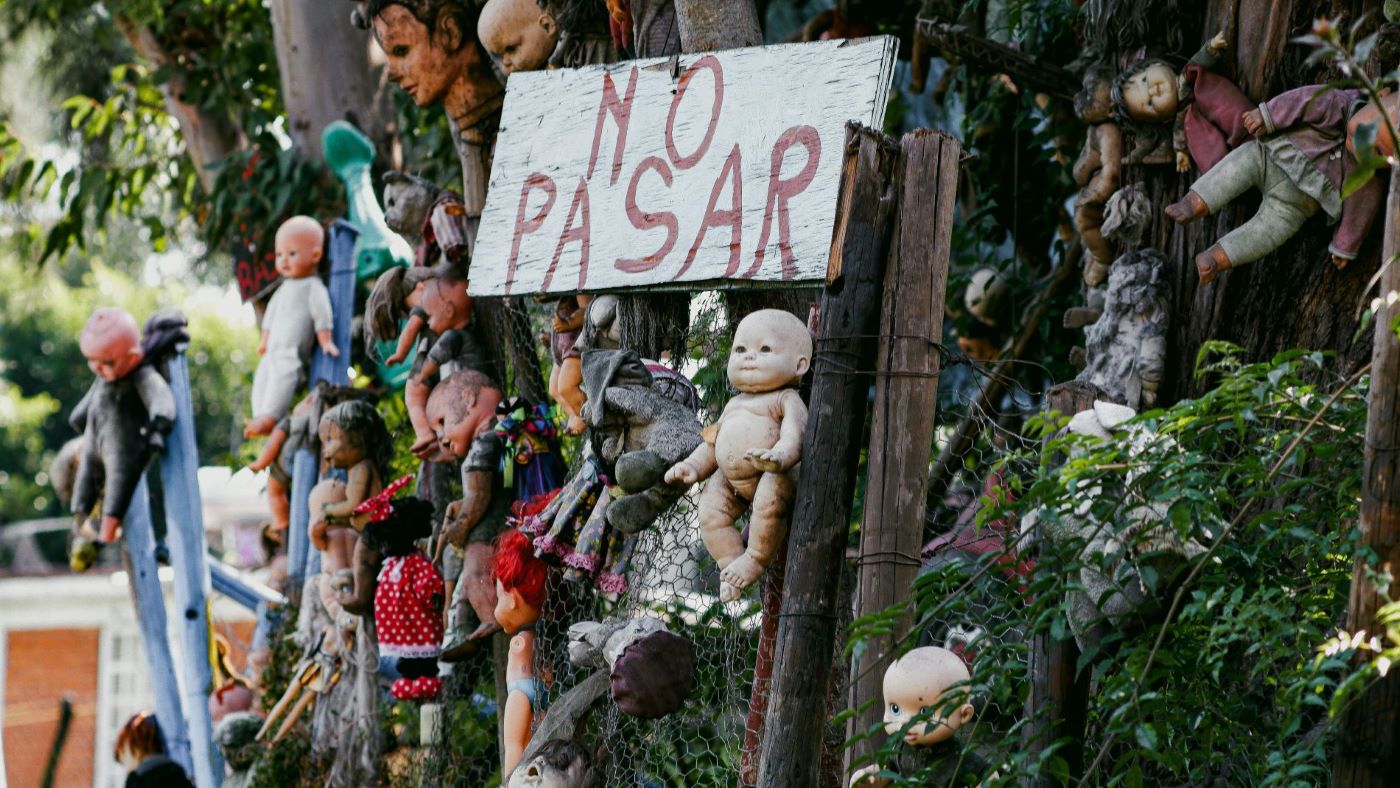
He would take a headless torso and impale it on a branch. He would take a severed head and suspend it by its hair from a wire. He would place a doll with empty eye sockets facing the water, its hollow gaze directed at the spot where he had found the girl. The damage was the point. A pristine doll is a symbol of childhood and innocence. A broken one, smeared in canal mud and hung from a tree by its neck, is a symbol of something that went violently wrong. Don Julián did not see the distinction. He saw protection. But the effect for anyone arriving by boat is visceral and immediate: the trees do not look like a shrine. They look like the aftermath of something unspeakable involving children. The island forces the viewer to confront the fragility of the human form by mirroring it in plastic — damaged, discarded, and silently accusing.
What Happens When Nature Digests Plastic
Sun, Mold, and the Biology of Decay
The dolls have been exposed to the Xochimilco microclimate for decades, and the result is a kind of horror that no human hand could manufacture. The high-altitude Mexican sun bleaches the pigment from plastic skin, turning pink and brown tones into a corpse-like grey or chalky white. The surface blisters and peels in sheets, resembling burn wounds or advanced skin disease. Black mold, fed by the canal's relentless humidity, blooms across the faces in patterns that look like bruising or gangrene.
Nature is not just weathering the dolls — it is colonising them. Vines do not grow around the figures; they grow through them. Roots split open vinyl stomachs. Leafy tendrils wrap around throats and push through cracked mouths. The hollow interiors of the dolls provide shelter for the canal's insect population. Spiders weave webs inside empty skulls. Ants march in disciplined columns through gaping eye sockets. A wasp nest fills a chest cavity where a child's hand once pressed to feel a plastic heartbeat.
The dolls no longer occupy the uncanny valley because they resemble living humans. They occupy it because they resemble decomposing ones. The swamp has done in slow motion what time does to all organic matter, and the plastic — designed to last centuries — splits the difference between decay and permanence in a way the human brain finds deeply wrong.
Augustinita: The Queen of the Island
One doll on the island received treatment that no other did. Augustinita was Don Julián's favourite — the figure he kept in a small covered shrine inside his shack rather than exposing to the elements. She sits at the centre of a cluttered altar surrounded by offerings left by visitors who know the island's lore: sunglasses, coins, bracelets, half-empty bottles of tequila. She is weathered but not destroyed. In the hierarchy of the island's silent population, she is the queen — the primary conduit, in Don Julián's cosmology, between himself and the spirit of the drowned girl. His tenderness toward this one object, amid a landscape of deliberate neglect, is one of the few visible cracks in the armour of his obsession. He treated a plastic doll with the care he could not — or would not — give to a living person.
How Don Julián Santana Barrera Died
The Drowning in the Same Spot
The details of Don Julián's death come from Anastasio, who was the only witness. In 2001, the two men were fishing together at the edge of the chinampa — a routine activity. Don Julián asked his nephew to walk to a nearby plot to check on cattle. Anastasio left. When he came back, his uncle was face-down in the canal.
Don Julián was 80 years old. An elderly man losing his footing on a muddy bank is not, in itself, remarkable. What makes the death impossible to dismiss as simple accident is the location. The stretch of water where Anastasio found his uncle's body was, according to Don Julián's own account, the exact spot where he had discovered the drowned girl fifty years earlier. The place where the first doll had floated. The origin point of everything.
Don Julián had told Anastasio, repeatedly, that the "mermaid" — his word for the spirit in the water — wanted to claim him. He spoke of it not with panic but with the resignation of a man who had accepted a transaction. He had spent fifty years paying her in dolls. The final payment, it seemed, was himself.
The rational explanation is an old man slipping on wet earth. The poetic explanation is a debt collected. Neither version changes what the death accomplished: it sealed the island's mythology permanently. The caretaker died the way the ghost did. The story became a circle. The dolls, which had been placed to protect him, now had no one left to protect. Anastasio buried his uncle and inherited the island.
The Island After Don Julián: Family Legacy and Dark Tourism
The Santana Family as Stewards
The Isla de las Muñecas is no longer a hermitage. It is a family operation. Anastasio and other members of the Santana family maintain the site, managing the flow of tourists who arrive by boat throughout the year. Their approach to preservation is defined by a single rule: do not restore the dolls. To clean or repair them would erase Don Julián's work. The family maintains the paths, manages the dock, and keeps the shack standing, but the dolls themselves are left exactly as nature and their creator arranged them.
When the Santana family speaks of Don Julián, it is without sensationalism. They describe a troubled, isolated man — not a monster, not a sorcerer, not a character from a horror film. They humanise him in a way that the internet's appetite for creepy content does not. They welcome visitors not to frighten them but to share the history of their uncle, with all its sadness and strangeness intact.
Isla de las Muñecas as a Dark Tourism Destination
Visiting the island falls squarely under the umbrella of dark tourism — travel to sites associated with death, suffering, or the macabre. The atmosphere on the island is solemn. The party boats of central Xochimilco are two hours behind you. Voices drop. Photography is permitted, but touching the dolls is forbidden — they are brittle after decades of sun exposure, and a careless hand can destroy a fifty-year-old artefact.
A local custom bridges Catholic tradition and older Mesoamerican practice: visitors are encouraged to bring offerings. Candy or small toys for the spirit of the child. Tequila or whiskey poured into a shot glass at Don Julián's altar. The ritual is optional, but it serves a function beyond superstition — it transforms the visitor from consumer to participant. You are not observing someone else's story. You are briefly entering it. The parallels to other islands shaped by death and belief — places like Poveglia in the Venetian lagoon — are hard to miss. Isolated water, accumulated legend, and the slow weight of decades pressing down on a single patch of land.
The island also has an unlikely thematic cousin in Nagoro, the Japanese village where a single woman has replaced her departed neighbours with life-sized dolls. The impulse is different — Nagoro is about loneliness and demographic collapse, not supernatural fear — but the visual result is eerily similar: a landscape where human-shaped figures outnumber the living, and where one person's private response to loss has become a public spectacle.
How to Visit Isla de las Muñecas from Mexico City
Getting to the Real Island: Embarcaderos, Costs, and Route
The Isla de las Muñecas is not a quick stop. The round trip takes approximately four hours by trajinera, and the journey is the price of admission. The best departure points are Embarcadero Cuemanco or Embarcadero Fernando Celada, both located in the southern part of Xochimilco, closer to the ecological reserve. The central tourist docks at Nativitas are further from the island and the boatmen there are less accustomed to long-haul trips.
Boats are rented by the hour, not per person. As of 2025, the official government rate is approximately 600–700 MXN per hour per boat — negotiate the destination, duration, and total price before boarding. Tell the boatman clearly: "La Isla de las Muñecas original." The emphasis on "original" matters, for reasons explained below.
How to Spot the Fake Doll Islands of Xochimilco
The most important warning for any visitor: because the real island is a four-hour round trip requiring significant effort and fuel, some boatmen have created counterfeit versions. They hang a dozen dolls on a random stretch of shoreline twenty minutes from the main docks, take tourists there, declare it the famous island, and collect payment.
The fakes are easy to identify if you know what to look for. Time is the first indicator — if you arrive in under an hour, you are not at the real island. Density is the second — the genuine site has hundreds of dolls covering almost every surface, not a scattered handful. The shack is the third — Don Julián's wooden dwelling, containing the Augustinita altar and newspaper clippings about his death, exists only on the original chinampa.
What to Expect on the Island
The island itself is small — walkable in minutes. The experience is not about physical scale but about accumulation. Every tree, every post, every wire holds a doll or a fragment of one. The air is thick and humid. The canal water is dark and opaque. The sounds of central Xochimilco — the trumpets, the laughter, the vendors — are completely absent. The only sounds are insects, water, and the occasional creak of a plastic limb swinging in the breeze.
Bring water, insect repellent, and sunscreen. The canal offers no shade during the midday hours and the mosquitoes are aggressive year-round. If you are bringing an offering, place it at the altar inside the shack — the Santana family will direct you.
The return journey feels longer than the arrival. The dolls face the water, and from the back of a departing trajinera, the last thing visible through the willows is the same thing Don Julián saw every day for fifty years: a wall of hollow eyes, watching the canal, waiting for something that may have already come and gone.
Frequently Asked Questions
Is Isla de las Muñecas a real place?
Isla de las Muñecas is a real chinampa — an artificial island — located in the canal network of Xochimilco, a borough in the southern part of Mexico City. It is accessible by boat and receives visitors year-round. The dolls visible in photographs are genuine; they were placed on the island over approximately fifty years by a man named Don Julián Santana Barrera, who lived there alone from the 1950s until his death in 2001. The site is currently maintained by his surviving family members.
Who was Don Julián Santana Barrera?
Don Julián Santana Barrera was a Mexican recluse who abandoned his wife and child in the early 1950s to live alone on a chinampa in the Xochimilco canals. After reportedly discovering the body of a drowned girl in the water near his island, he began collecting discarded dolls from trash heaps and canal waterways and hanging them from the trees. He continued this practice for approximately fifty years. He died by drowning in 2001 at the age of 80, reportedly in the same spot where he found the girl's body decades earlier.
Is the drowned girl story true?
The story of the drowned girl comes entirely from Don Julián's own account, repeated consistently throughout his life and corroborated by his family. No independent documentation — police reports, news coverage, or a family claiming the child — has been found to verify the drowning. Drownings in the Xochimilco canals were not uncommon and were not always recorded, so the absence of documentation does not disprove the account, but it means the origin story remains unverified legend rather than confirmed history.
How do you get to Isla de las Muñecas from Mexico City?
The island is located deep in the ecological reserve of Xochimilco and can only be reached by boat. The round trip takes approximately four hours by trajinera. The best departure points are Embarcadero Cuemanco or Embarcadero Fernando Celada, both in the southern part of the borough. Boats are rented by the hour at a government-set rate of approximately 600–700 MXN per hour. Visitors should be aware that some boatmen operate counterfeit "doll islands" closer to the main docks to avoid the long journey.
How many dolls are on the Island of the Dolls?
No precise count has been conducted, but estimates place the number in the hundreds, with some accounts suggesting over a thousand individual dolls and doll fragments. Don Julián collected them over approximately fifty years from canal waterways, trash heaps, and neighbours who traded them for vegetables. New dolls are occasionally added by visitors, though the Santana family directs where offerings are placed.
Can you touch the dolls on Isla de las Muñecas?
Touching the dolls is forbidden. After decades of exposure to sun, humidity, mold, and insect colonisation, the dolls are extremely brittle and can disintegrate with minimal contact. The site is maintained as an open-air memorial by the Santana family, and visitors are expected to observe without physical interaction. Offerings such as candy, small toys, or alcohol should be placed at the designated altar inside Don Julián's shack.
Sources
- [Island of the Dolls: The Darker Side of Xochimilco] - Gastón Gordillo, Spaces of the Dead: The Political Ecology of Xochimilco (2015)
- [Historic Centre of Mexico City and Xochimilco] - UNESCO World Heritage Centre, Inscription Document No. 412 (1987)
- [La Isla de las Muñecas] - Atlas Obscura, community field reports and logistical updates (ongoing)
- [The Chinampas of Mexico City: An Agricultural Tradition at Risk] - UNESCO Intangible Cultural Heritage Programme (2018)
- [Leyenda de la Isla de las Muñecas] - Interview with Anastasio Santana, Discovery Channel Latin America (2014)
- [Island of the Dolls: Inside Mexico's Creepiest Tourist Attraction] - Simon Carrasco, Vice Mexico (2016)
- [Xochimilco: Portrait of a Polity in a Dying World] - Edward Calnek, Ethnohistory, Vol. 19, No. 3 (1972)
- [Dark Tourism: Understanding Visitor Motivations at Sites of Death and Disaster] - Philip Stone and Richard Sharpley, Annals of Tourism Research, Vol. 36, No. 4 (2009)
- [Water Management in Ancient Mesoamerica: The Chinampa System] - Christopher T. Morehart, Latin American Antiquity, Vol. 23, No. 1 (2012)
- [Life Among the Dolls: Xochimilco's Most Unlikely Shrine] - Karla Zárate, Proceso Magazine (2019)