The Execution Chamber Disguised as a Kitchen
The killing room sits in the basement, and on the original Soviet floor plan it is labeled a kitchen. The label was a lie meant to be read by the wrong people. What happened in the room is documented in the KGB’s own procedure and reconstructed for visitors today: two guards walked a prisoner in, a third officer shot him in the back of the head, the body was dragged out a side door, and a bucket of water was thrown across the concrete to wash away the blood before the next prisoner was brought down. The work was done quietly, efficiently, and on a schedule. Roughly a thousand people died this way between 1944 and the early 1960s, about a third of them for the crime of resisting the Soviet occupation.
The Soviets poured a fresh layer of concrete over the floor when they abandoned the building in 1991, sealing the room as if it had never been used for anything but cooking. Archaeologists broke it open later. The museum now keeps a glass floor over the excavation, and through it visitors look down at what was recovered from the ground and the mass graves connected to it: buttons, the bows of eyeglasses, fragments of bone.
This building never had a single identity. It became whatever the power of the moment required — a courtroom, a torture house, a records office, an execution site — and each occupier left its marks on the walls before the next moved in. The Soviet security services worked here under four sets of initials, the Nazis ran their secret police out of the same corridors, and a Russian imperial court sat here before either. The museum that fills it today carries its own contradiction in its history. For most of its existence it was named for one genocide while standing a few miles from the site of another it chose, for a long time, not to discuss. The building is a monument to real and terrible suffering. It is also a record of how a nation decides whose suffering to name.
From Tsarist Courthouse to Gestapo Headquarters: The Building Before the KGB
The grey building went up between 1899 and 1901 as a courthouse for the Russian Empire, which then ruled Vilnius. Its life as an instrument of foreign power began the way it would continue. German troops used it during the First World War, and the interwar Polish administration ran it as a court after Vilnius fell under Polish control. The Soviet secret police, the NKVD, took the building in 1940 when the Soviet Union annexed Lithuania, and the cells in the basement began filling with people who had drawn official suspicion.
Nazi Germany invaded in 1941 and turned the building into the headquarters of the Gestapo. The German secret police held prisoners in the same basement the Soviets had just vacated, and some of those prisoners scratched their names and dates into the cell walls. Inscriptions from 1942 to 1944 survive in one of the cells, left by people the Gestapo would deport or kill. The Soviets returned in 1944 and held the building until Lithuania broke free in 1991. Three regimes, one basement, and a near-unbroken half-century in which the building’s purpose was to frighten, hold, and dispose of human beings.
Inside the KGB Prison: Cells, Water Torture, and Interrogation
The Basement Cells and the Freezing Water Cell
The basement is where the museum stops being a museum and becomes the thing itself. The cells held people from the autumn of 1940 until 1987 — close to the end of the Soviet era — and several survive in close to their working state. One is a soft cell, its walls padded so a prisoner driven to the edge could not injure himself, or could be restrained without leaving marks. Another is the water cell: a tank with a small raised platform at its center, filled with freezing water so that a prisoner had to balance on a disc the size of a dinner plate to stay out of it. A man could last hours. Exhaustion eventually dropped him into the cold water, and the choice between standing and falling reset, again and again, through the night.
The cruelties were engineered, not improvised. The prison’s first director after independence noted that the building was designed for torture from the blueprints up — cells without beds, isolation by design, the killing room mislabeled to hide it on paper. The architecture did the work. A prisoner brought into this basement was meant to understand, within the first hours, that the building had been built to break him and that no one outside knew he was there.
How the KGB Built a Prison Designed for Terror
Interrogation was the engine of the place. The cells fed a system whose purpose was confession, names, and networks, and the methods ran from sleep deprivation and cold to beatings and worse. The KGB and its predecessor agencies — the NKVD, the NKGB, the MGB — used the building as the nerve center of repression across Soviet Lithuania, planning the mass deportations that sent tens of thousands of Lithuanians to the Gulag and into exile in Siberia. The upstairs offices generated the paperwork; the basement extracted the material that filled it.
The deportations swept up whole families. The Soviet machine run from this building sent on the order of 130,000 Lithuanians east in waves of cattle-car deportations and imprisoned tens of thousands more, emptying villages in a single night. Among the museum’s most quietly devastating exhibits are objects from the “little deportees” — children sent east with their parents or alone, some of whom died on the journey or in the camps. A censored letter on display was written on birch bark and smuggled home from a Siberian camp, the kind of object that makes the scale legible: not a number, but one hand writing on bark because there was no paper, hoping the words would reach a kitchen table a continent away.
The building also held a smaller, stranger room. The KGB kept its own in-house museum on the upper floors, a display of commendations and honors celebrating the achievements of the officers who worked there. The men who ran the basement curated a shrine to their own service one floor above it. The same building now houses both that vanished self-tribute and the memorial to the people it processed, which is as close to a confession as a structure can make.
The Forest Brothers and the Hunt for Lithuania’s Last Partisans
The Armed Resistance That Fought the Soviets Until 1953
The partisans gave the building most of its political prisoners. When the Soviets reoccupied Lithuania in 1944, tens of thousands of men and women took to the forests rather than submit, and the resistance — the Forest Brothers — fought a guerrilla war that lasted until 1953. They built bunkers in the woods, ran an underground press, and signed, in February 1949, a declaration asserting an independent Lithuanian state. Roughly twenty thousand of them died in the fighting and the reprisals that followed. The KGB hunted the survivors from this building, coordinating informers, ambushes, and the slow strangulation of the movement through betrayal and attrition. Captured partisans were often displayed dead in town squares, their bodies left in the open so relatives might be watched as they came to identify them. By the mid-1950s the Forest Brothers were broken, their commanders dead or captured, their networks turned inside out.
Adolfas Ramanauskas-Vanagas: Captured, Tortured, Executed
Adolfas Ramanauskas was a schoolteacher born in New Britain, Connecticut, to Lithuanian immigrants who brought him home as a boy. He took the codename Vanagas — Hawk — and rose to command the partisans of the southern Dzūkija region, becoming one of the most senior resistance leaders in the country and a signer of the 1949 declaration. He stayed at large for eleven years, living under false papers, hunted by the top KGB officers in the republic. A former classmate from the Kaunas War School betrayed him, and on 11 October 1956 he was arrested in Kaunas and taken to the basement of this building.
The torture began the first day. By the next morning he was so badly injured that the KGB moved him to a hospital to keep him alive for interrogation, and the doctors there recorded what had been done to him: a punctured eye, severe wounds to the genitals, his body covered in injuries. The interrogations continued for a year. The court sentenced him to death on 25 September 1957, and on 29 November 1957 he was shot. His wife, Birutė, was sent to the Gulag for eight years. His body disappeared into an unmarked pit, and Lithuania did not learn where for sixty-one years.
Executions and Secret Graves: Tuskulėnai and the Orphans’ Cemetery
The dead had to go somewhere, and the KGB hid them carefully. The earliest waves of executions, from 1944 to 1947, produced more than seven hundred bodies that were buried in secret at Tuskulėnai Manor on the edge of Vilnius, the location concealed for decades and not uncovered until 1994. Later victims were disposed of elsewhere. Research by the Genocide and Resistance Research Centre established that of the people executed in Vilnius between 1956 and 1969, dozens charged with political crimes were shot in the KGB prison itself, while those condemned for ordinary criminal offenses were executed across the square at Lukiškės Prison.
Excavations at the Orphans’ Cemetery between 2017 and 2021 finally located the men shot in the basement. Ramanauskas-Vanagas was found in grave number 27, his body at the bottom of a pit beneath two criminals executed the same day in November 1957, still crouched in the position he had been dumped in. Anthropologists confirmed his identity through his skull, photographs, and DNA, and the marks of the 1956 torture were still legible on the bone. The pattern of secrecy — the execution hidden, the burial hidden, the truth denied for generations — runs through Soviet repression from Vilnius to Katyn, where the same instinct buried thousands and the same lie held for half a century.
The Genocide Museum That Forgot the Holocaust
The museum opened in 1992, a year after independence, founded by the Ministry of Culture together with the union of former political prisoners and deportees, and it was called the Museum of Genocide Victims. The name reflected a real and raw wound. Soviet repression had killed, deported, and imprisoned vast numbers of Lithuanians, and the new republic was determined to confront a history the Soviet Union had spent fifty years denying. The cells, the execution chamber, and the Gulag exhibits told that story with documentary force.
The name also produced a long and bitter controversy. The term “genocide” was applied here to the Soviet persecution of Lithuanians, while the museum, for more than two decades, said almost nothing about the genocide that most of the world means by the word — the murder of Lithuania’s Jews. Nazi Germany and local collaborators killed roughly ninety-five percent of the country’s Jewish population, on the order of two hundred thousand people, in a community that had been one of the great centers of Jewish life in Europe.
Much of that killing happened at Paneriai, in a forest barely ten kilometers from the museum’s front door. Between 1941 and 1944 German units and Lithuanian auxiliaries shot people there at the edge of fuel pits dug before the war — roughly seventy thousand of them Jews, marched out from the Vilnius ghetto in batches and killed where they stood. The slaughter was close, recent, and partly local. A museum named for genocide stood a short drive from one of the most complete annihilations of a community anywhere in Europe and, for years, barely mentioned it. Critics in Israel, the United States, and within Lithuania pressed the point for a long time.
The museum added an exhibit on the Nazi occupation in 2011, installed in one of the former cells, and in 2018 it was renamed the Museum of Occupations and Freedom Fights, with a room addressing the Jewish genocide. The change did not end the argument. Lithuania’s memory of the Soviet period and its memory of the Holocaust remain difficult to hold in the same frame, in part because some of the anti-Soviet partisans the country honors as freedom fighters have themselves been linked, in contested and disputed accounts, to violence against Jews in 1941. The building forces both histories into the same walls and offers no easy reconciliation between them. That tension is the truest thing it now contains.
Visiting the Museum of Occupations and Freedom Fights
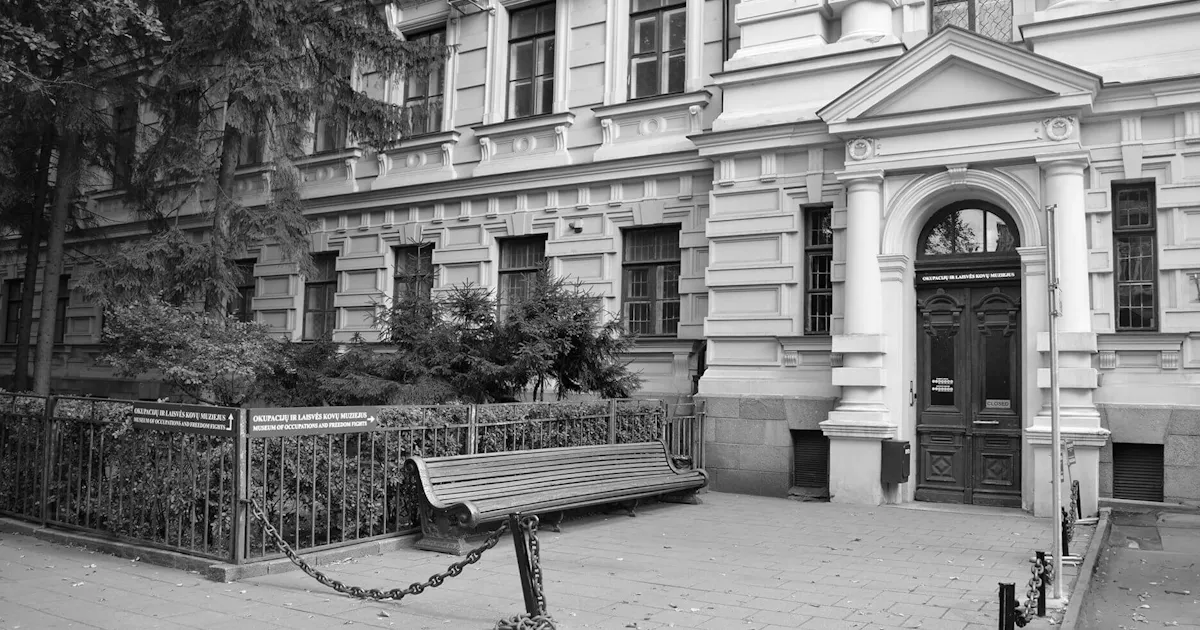
The museum stands at Aukų gatvė 2A, on the corner of Gediminas Avenue across from Lukiškės Square, in central Vilnius. The two upper floors carry the documentary exhibitions — the occupations, the deportations, the resistance, the Gulag — and the basement holds the prison. A visit runs one to two hours, and the descent into the cells is the part that stays with people; the upstairs explains, but the basement shows. Plaques on the exterior wall mark the building’s function, and the execution chamber, with its glass floor over the excavation, is open to view. Photography is restricted inside, and the staff keep the place quiet, which is appropriate to what it is.
The building belongs to a small group of secret-police prisons across the former Eastern Bloc that have been turned into museums of their own crimes, alongside the Stasi prison in Berlin and Patarei in Tallinn. Standing in the basement, the appeal of the place and its discomfort are the same thing: this is not a reconstruction but the actual room, the actual cell, the actual concrete the KGB poured to hide what it had done. The discomfort sharpens when you carry the museum’s own argument with you — that a building can tell the truth about one set of crimes and stay silent about another, and that remembering is always a set of choices about whom to mourn.
Ramanauskas-Vanagas received a state funeral in October 2018, eight months after his remains were identified, and was buried with military honors as a man the Lithuanian parliament had recognized as the country’s de facto head of state during the resistance. He had been shot in this building, tipped into a pit, and erased for sixty-one years. The funeral closed one account and reopened the larger one: a country deciding, decades later, exactly which of its dead to lift out of the ground and name.
Frequently Asked Questions About the Vilnius KGB Prison
What is the KGB Museum in Vilnius?
The Museum of Occupations and Freedom Fights, informally called the KGB Museum, occupies the building on Gediminas Avenue where the Soviet security services ran their Lithuanian operations from 1940 until 1991. The upper floors house exhibitions on the Soviet occupation, the mass deportations, and the armed resistance, while the basement preserves the actual KGB prison: the cells, the interrogation rooms, and the execution chamber. It is one of the only museums of its kind located inside a former secret-police headquarters.
Why was the Museum of Genocide Victims renamed?
The museum opened in 1992 as the Museum of Genocide Victims, applying the term to Soviet repression of Lithuanians. The name drew sustained international criticism because the museum said almost nothing for over two decades about the Holocaust, in which roughly 95 percent of Lithuania’s Jews were murdered. A Nazi-occupation exhibit was added in 2011, and in 2018 the institution was renamed the Museum of Occupations and Freedom Fights, with a room addressing the Jewish genocide.
What happened in the KGB prison’s execution chamber?
The basement execution chamber, labeled a kitchen on the Soviet floor plan, was where roughly 1,000 prisoners were shot between 1944 and the early 1960s, about a third of them for resisting the occupation. The documented procedure was assembly-line: a prisoner was walked in, shot in the back of the head, and removed, and the floor was washed before the next was brought down. The Soviets sealed the room under fresh concrete in 1991, and archaeologists later excavated it; a glass floor now displays recovered artifacts.
Who was Adolfas Ramanauskas-Vanagas?
Adolfas Ramanauskas, codenamed Vanagas, was a schoolteacher who became one of the senior commanders of the Lithuanian partisans, the Forest Brothers, who fought the Soviet reoccupation until 1953. Betrayed by a former classmate, he was arrested in 1956, tortured in this building, and executed in 1957, after which his body was hidden in an unmarked pit. His remains were identified in 2018, and Lithuania, which recognizes him as the country’s de facto head of state during the resistance, gave him a state funeral.
Was the building used by the Nazis as well?
Yes. The building served as the Gestapo headquarters during the German occupation from 1941 to 1944, between two periods of Soviet control. Gestapo prisoners scratched inscriptions into a basement cell wall that survive today. Across its history the building functioned as a Tsarist courthouse, a Gestapo base, and a Soviet prison, making it a rare structure used by three successive occupying regimes.
Where is the museum and can you visit it?
The museum is at Aukų gatvė 2A, on the corner of Gediminas Avenue across from Lukiškės Square in central Vilnius. It is open to the public, with a typical visit lasting one to two hours, and the basement prison and execution chamber are part of the tour. Photography is restricted inside, and certain national commemorative dates offer free entry.
Sources
Museum of Occupations and Freedom Fights: History of the Museum — Genocide and Resistance Research Centre of Lithuania (2024)
The Execution Chamber and the Excavations at the Orphans’ Cemetery — Genocide and Resistance Research Centre of Lithuania (2021)
Forest Brothers: The Account of an Anti-Soviet Lithuanian Freedom Fighter, 1944–1948 — Juozas Lukša (1975)
Conclusions on the Crimes of the Soviet and Nazi Occupation Regimes — International Commission for the Evaluation of the Crimes of the Nazi and Soviet Occupation Regimes in Lithuania
Why Does Lithuanian Post-War Partisan Leader Remain a Global Controversy? — LRT (2019)
Remains of Lithuanian Partisan Commander Ramanauskas-Vanagas Found in Vilnius — BNS / Lithuania Tribune (2018)
Ponary Diary, 1941–1943: A Bystander’s Account of a Mass Murder — Kazimierz Sakowicz, ed. Yitzhak Arad, Yale University Press (2005)
The Holocaust in Lithuania — United States Holocaust Memorial Museum, Holocaust Encyclopedia
Soviet Deportations from Lithuania, 1941–1952 — Genocide and Resistance Research Centre of Lithuania
The Unknown War: Re-Assessing Anti-Soviet Lithuanian Partisans — Bitter Winter (2022)