
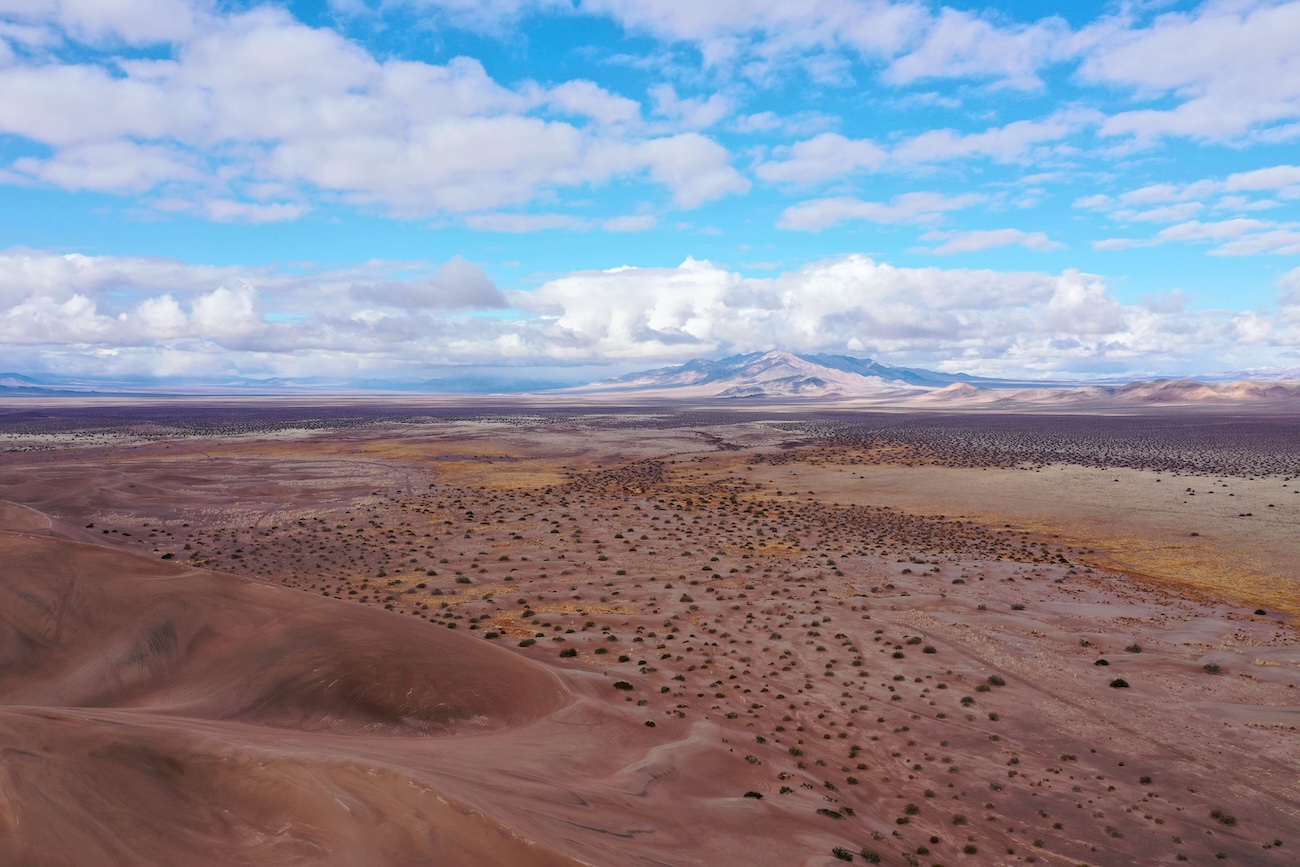
The most famous secret on Earth sits in the silence of Emigrant Valley, a desolated basin of sand and scrub located eighty-three miles north-northwest of Las Vegas. Geographically, it is known as Groom Lake, a dry salt flat within the Southern Nevada Basin and Range province. Operationally, it is Detachment 3 of the Air Force Flight Test Center, a remote spur of Edwards Air Force Base. Culturally, it is the epicenter of modern paranoia, a grid of restricted airspace where the American military-industrial complex intersects with the world’s most persistent folklore.
To the uninitiated, the name "Area 51" conjures images of saucer autopsies and greys in vats of formaldehyde. It is the shorthand for a government that knows too much. But this pop-culture caricature does a disservice to the physical reality of the site, which is far more pragmatic and arguably more dangerous. The base was not established to commune with the stars; it was carved out of the hostility of the Great Basin Desert to hide the dark arts of the Cold War. It is the place where the United States solved the impossible physics of high-altitude reconnaissance, where titanium was bent into shapes that baffled radar, and where captured Soviet MiGs were flown by American pilots to learn the lethal dance of the enemy. It is a facility born of fear—the fear of a nuclear surprise attack—and sustained by the geography of absolute isolation.
The Anatomy of the Void
The Salt Flat
To understand why the Central Intelligence Agency selected this specific patch of hell in April 1955, one must look at the geology. Groom Lake is a relic of the Pleistocene epoch, a time when the region was submerged under Lake Lahontan. As the climate shifted and the water evaporated, it left behind a perfectly flat, hard-packed surface of clay and salt, stretching three miles north-to-south. In the aviation world, this is a naturally occurring runway that cannot be bombed out of existence. It is resilient, expansive, and utterly exposed to the sun, yet hidden from the horizon.
The lakebed itself is a hostile shimmering expanse. In the summer, the heat distortion (known to pilots as "shimmer") rising off the white clay is so intense that it can visually liquefy the mountains in the distance. This surface is the facility’s greatest asset. When Kelly Johnson, the legendary engineer of Lockheed’s Skunk Works, first scouted the location, he wasn't looking for infrastructure; he was looking for a surface that could support the fragile, glider-like landing gear of the U-2 spy plane without the need for a paved tarmac that would show up on Soviet geological surveys.
The Natural Fortress
The terrain surrounding the lakebed acts as a geological amphitheater designed for exclusion. The base sits at an elevation of 4,462 feet, but it is a bowl. To the west rise the Jumbled Hills; to the east, the imposing limestone spine of the Groom Range dominates the skyline. These peaks—specifically White Sides and Freedom Ridge—served for decades as the only unauthorized bleachers for the show below. They do not merely frame the valley; they sequester it.
This "bowl" effect blocks line-of-sight observation from ground level, ensuring that the only way to see what happens on the salt flat is to be directly above it—or to be invited inside. The airspace above, designated R-4808N, is the most restricted box of sky in the Western Hemisphere. It is a "no-fly zone" so absolute that even military pilots from the neighboring Nellis Air Force Base face court-martial and immediate career termination if they drift across the boundary, known as "The Box."
The Tyranny of Distance
The vegetation is sparse, consisting mostly of Joshua trees, greasewood, and sagebrush that cling to the alkaline soil. It is a landscape of violent extremes, where summer temperatures regularly breach 100 degrees Fahrenheit and winter nights drop below freezing. This hostility is the facility’s first layer of defense. Before one even encounters the motion sensors or the private security forces, one must contend with the emptiness of the Great Basin Desert. The geography itself enforces the silence. Water must be pumped from deep wells; food must be trucked in; every scrap of existence here is imported. The isolation is not a bug; it is the primary feature. It allowed the CIA to build a city where no city should exist, a "company town" where the currency was silence.
The Cold War Reality
Project AQUATOX and the "Watertown" Strip
The mythology of Area 51 often obscures its industrial history, which is a tragedy of omission, for the truth is compelling enough without embellishment. In 1955, the CIA needed a place to test the U-2 "Dragon Lady." The aircraft was a secret of the highest order—a glider with a jet engine capable of flying at 70,000 feet, well above the reach of Soviet interceptors or surface-to-air missiles.
When Kelly Johnson and CIA officer Richard Bissell landed on the old World War II gunnery range at Groom Lake, they named the site "Watertown," reportedly after the rumor that Bissell was born in Watertown, New York (though likely a grim joke about the lack of water). The living conditions were spartan. The original crew lived in trailers, battling scorpions, rattlesnakes, and the blinding dust storms that would scour the paint off vehicles. They were not fighting aliens; they were fighting the elements to build a surveillance capability that would prevent World War III. The U-2 flights launched from here brought back the intelligence that revealed the "Missile Gap" was a myth, stabilizing the terrifying paranoia of the 1950s.
The Oxcart Legacy
The ensuing decade turned Groom Lake into the most technologically advanced mechanic’s garage in history. This was the womb of Project OXCART, the program that birthed the A-12, the sinister, serpentine predecessor to the SR-71 Blackbird.
The A-12 was a machine that defied the thermodynamics of its time. It was designed to fly at Mach 3.2—over three times the speed of sound. At that velocity, the friction of the air against the fuselage generated temperatures exceeding 1,000 degrees Fahrenheit. Standard aluminum airframes would melt. The Skunk Works team had to build the plane entirely out of titanium, a metal that was incredibly difficult to machine and, ironically, had to be covertly sourced from the Soviet Union via shell companies.
The testing of the A-12 at Groom Lake in the early 1960s was a masterpiece of operational security. The plane was so secret that when it was moved outside the hangar, satellites schedules were checked to ensure no Soviet eyes were overhead. When the engines—massive Pratt & Whitney J58s—were tested, the afterburner roar shook the valley floor. The fuel, a special blend called JP-7, was so stable you could extinguish a cigarette in a bucket of it; it required a chemical injection of triethylborane just to ignite, resulting in the famous "green flash" at startup that became part of the base’s lore.
The Red Eagles and the MiGs
Perhaps the most fascinating chapter of Groom Lake’s history—and one completely devoid of extraterrestrials—is the "Red Hat" and "Red Eagle" squadrons. During the Cold War, the United States acquired Soviet MiG fighters through various defectors and covert deals with nations like Israel and Indonesia. These enemy aircraft were brought to Area 51.
Here, under the project names HAVE DRILL and HAVE DOUGHNUT, American test pilots flew actual MiG-17s, MiG-21s, and later MiG-23s. They pushed these machines to their limits to understand their turn rates, their radar signatures, and their blind spots. This data was then taught to Top Gun instructors. When American pilots shot down North Vietnamese aircraft years later, they were winning battles that had been mathematically solved years prior in the silence of Groom Lake. The "saucers" people saw were often these strange, delta-winged silhouettes, flown by Americans speaking English, simulating a war that hadn't happened yet.
Manufacturing "Aliens"
It is here that the seeds of the UFO phenomenon were inadvertently sown by the CIA. In the late 1950s and early 1960s, commercial airliners flew at altitudes between 10,000 and 20,000 feet. When a pilot looked up and saw a silver object gleaming in the setting sun at 80,000 feet—streaking across the sky at speeds that rendered conventional propulsion theories obsolete—there was no terrestrial language to describe it.
The Air Force’s "Project Blue Book" investigators were often aware that these sightings were U-2 or A-12 test flights. The sun would hit the unpainted titanium of the A-12 at dusk, creating a burning streak of light while the ground below was already in darkness. Yet, the investigators could not reveal the existence of the aircraft. Consequently, they lied. They attributed the sightings to "natural phenomena," "Venus," or "high-altitude ice crystals." This discrepancy between what people saw (a metallic craft moving at impossible speeds) and what the government claimed (ice) created a vacuum of trust. That vacuum was quickly filled by the extraterrestrial hypothesis. The government effectively gaslit the public to protect the Oxcart, and in doing so, they built the altar of the alien religion.
The Architecture of Conspiracy
The Lazar Event
If the 1950s provided the visual language for the myth, 1989 provided the script. The transition of Area 51 from a niche military site to a global pop-culture brand can be traced to a single man: Bob Lazar. In May 1989, an anonymous silhouette appeared on KLAS-TV in Las Vegas, interviewed by investigative reporter George Knapp. The man, later revealed as Lazar, claimed to be a physicist hired to reverse-engineer alien propulsion systems at a subsidiary facility known as "S-4," allegedly built into the side of a mountain near Papoose Lake, just south of Groom.
Lazar’s story was incredibly detailed. He spoke of "Element 115," a stable super-heavy element that generated gravity waves. He described the "Sport Model" saucer. He described the hand scanners and the debriefing protocols. Whether Lazar was a whistleblower, a brilliant fabulist, or a pawn in a disinformation campaign remains a subject of fierce debate. His educational records have never been found, and his physics claims are widely disputed. However, the sociological impact of his story is undeniable. Before Lazar, the secrecy of Groom Lake was understood as a necessity of anti-Soviet strategy. After Lazar, the secrecy was reinterpreted as a cover-up of existential magnitude. The narrative shifted from "What are they building?" to "Who are they hiding?"
The Camouflage of Boredom
This paranoia is fueled by the visible infrastructure of the secrecy itself, specifically the "Janet" airlines. Every day, a fleet of unmarked Boeing 737-600s departs from a private, fenced-off terminal at Harry Reid International Airport in Las Vegas (callsign "Janet," often joked to stand for "Just Another Non-Existent Terminal").
These planes, distinct only by a single red stripe down the fuselage and no tail numbers, ferry hundreds of workers to the base. It is a mundane, bureaucratic ritual—the morning commute—that has been elevated to high drama. The passengers are not men in black; they are electricians, cafeteria workers, radar technicians, and security personnel. They carry lunch boxes and thermoses. They sign non-disclosure agreements that could send them to prison for life, yet they go home to their families in Henderson and Summerlin every night. The juxtaposition of the ordinary (the daily grind) and the extraordinary (the restricted destination) creates a cognitive dissonance that keeps the legend alive. The base is not a ruin; it is a living, breathing city with a baseball diamond, a bar (Sam's Place), and a massive payroll, all operating in a black hole of information.
The Toxic Legacy
The silence of Area 51 has a darker, more tangible cost than just mystery. In the 1990s, workers at the site began to fall ill. The families of former employees sued the government, claiming that the military had disposed of toxic stealth coatings and hazardous waste by burning them in open trenches on the base. The smoke from these pits, laden with dioxins and exotic chemicals, allegedly caused respiratory diseases and cancers. The lawsuit, Kasza v. Browner, hit a wall when the government invoked the "State Secrets Privilege." President Clinton signed a presidential determination exempting the "Air Force's operating location near Groom Lake" from environmental disclosure laws. The judge was forced to dismiss the case not because the claims were false, but because confirming or denying the chemicals would reveal classified stealth capabilities. Here, the secrecy did not protect the nation; it protected the institution from accountability.
Visiting the Perimeter
The Extraterrestrial Highway
For the civilian observer, the reality of Area 51 is experienced only at the margins. The pilgrimage begins on Nevada State Route 375, officially designated the "Extraterrestrial Highway" in 1996. It is a lonely ribbon of asphalt that cuts through the Tikaboo Valley, flanked by open range where cattle wander across the road with indifferent lethargy.
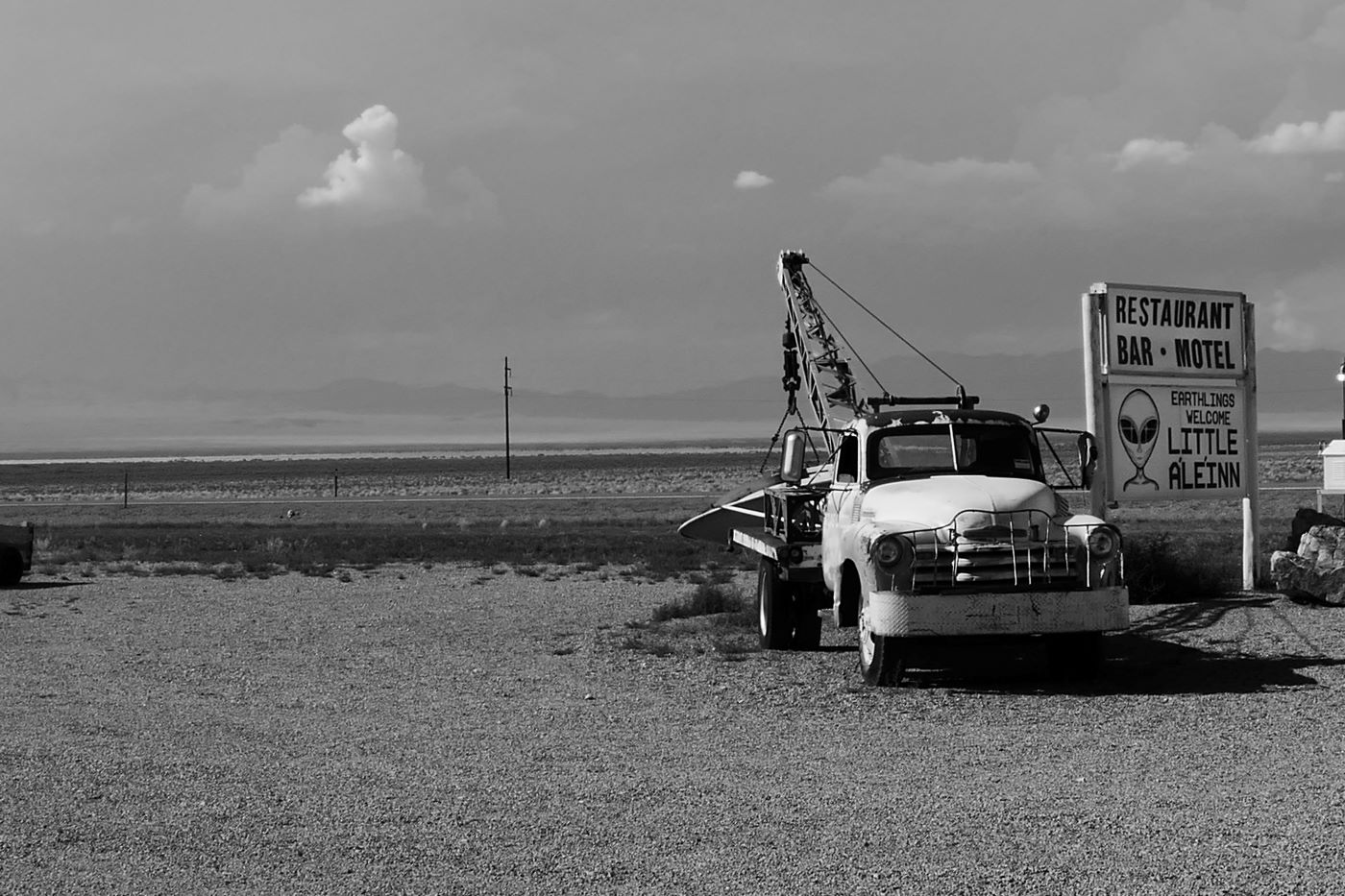
The hub of this tourism is the tiny, dusty hamlet of Rachel, Nevada. With a population that fluctuates in the double digits, Rachel exists in a symbiotic relationship with the base. The Little A'Le'Inn, a motel and bar constructed of prefabs, serves as the frantic heart of the believer community. Its walls are plastered with blurry photographs, dollar bills signed by visitors from around the globe, and maps of the restricted zone. The "Alien Burger" is served with a side of speculation. But the true gravity of the site is found closer to the boundary.
The Warning Signs
Turning off the highway onto the unpaved mail roads leads one into a cloud of white dust and escalating tension. The washboard dirt road rattles the bones of any vehicle not built for the terrain. After miles of nothingness, the road ends abruptly.
There are no fences at the perimeter of Area 51, only orange posts and signs that scream warnings in capital letters: "USE OF DEADLY FORCE AUTHORIZED" and "PHOTOGRAPHY PROHIBITED."
Standing at the "Back Gate" or the "Front Gate," the silence is absolute. There is no hum of machinery, no sound of jets. There is only the wind and the unnerving presence of the "Camo Dudes." These are private military contractors (currently run by AECOM) who sit in white pickup trucks on the ridges, watching through high-powered binoculars. They do not wave. They do not speak. They simply wait. Behind them, cameras mounted on cactus-like structures swivel to track your movement. A sound cannon (LRAD) and scent sensors are rumored to be embedded in the scrub. It is a theater of intimidation, a clear demarcation line between the citizen and the state. The line in the dust is real; cross it, and your life changes instantly.
Conclusion
In 2013, following a Freedom of Information Act request by the National Security Archive, the CIA officially acknowledged the existence of "Area 51" by name, releasing declassified maps and documents related to the U-2 program. It was a moment of transparency that resolved nothing. The confession that the base exists did not destroy the mystery; it merely anchored it.
We remain fixated on Groom Lake not because of what we know is there, but because of what we need it to be. In a world mapped by satellites and street views, where privacy is an antiquated concept, Area 51 remains a final frontier of the unknown. The geography of the salt flat has become a psychological canvas. Whether it houses the wreckage of Roswell, the next generation of hypersonic drones, or simply the toxic refuse of the Cold War is almost irrelevant. The silence of the desert serves a function. It reminds us that there are still doors we cannot open, and horizons we are forbidden to cross. As long as the Camo Dudes sit on that ridge, watching the dust settle, the world will keep looking past them, searching for monsters in the heat haze. The silence is not empty; it is full of our own reflections.
FAQ
Is Area 51 visible on Google Maps?
Yes, the base is clearly visible on Google Maps and Google Earth. For decades, satellite imagery of the facility was censored or low-resolution, but high-definition images are now publicly available. You can clearly see the massive runway (14L/32R), the hangars, and the "Janet" terminal. However, the imagery is often updated with a time lag, meaning current prototypes or sensitive movements are rarely captured in real-time.
What are the legal consequences of crossing the perimeter?
The boundary is marked by orange posts and warning signs, not fences. Crossing this line is a federal offense. Trespassers are immediately detained by private security until the Lincoln County Sheriff arrives. The standard penalty is a $1,000 fine and a misdemeanor conviction, though prison sentences of up to six months are legally possible. If you cross with a drone or camera equipment, that equipment is almost always confiscated.
Who are the "Camo Dudes"?
The "Camo Dudes" are private military contractors employed by AECOM (formerly EG&G) who provide physical security for the perimeter. They patrol in white pickup trucks (often Ford F-150s or Chevy Silverados) and wear camouflage fatigues with no name tags or insignia. They are authorized to use deadly force if necessary, though their primary role is surveillance and deterrence. They will not answer questions or engage with tourists.
Can you visit the "S-4" facility mentioned by Bob Lazar?
No. The alleged "S-4" facility, which Bob Lazar claimed was built into the side of a mountain near Papoose Lake to house alien spacecraft, is located deep within the restricted zone, south of Groom Lake. It is completely inaccessible to the public. To this day, no physical evidence of S-4's existence has been verified on satellite imagery or by independent corroboration, unlike the main base at Groom Lake.
Sources & References
- The CIA and the U-2 Program, 1954-1974 - Central Intelligence Agency (1998/2013)
- Archangel: CIA's Supersonic A-12 Reconnaissance Aircraft - David Robarge/CIA (2012)
- Area 51: An Uncensored History of America's Top Secret Military Base - Annie Jacobsen (2011)
- Dreamland Resort: Area 51 Research & History - Joerg Arnu (Ongoing)
- The Road to Groom Lake - Peter Merlin (Searchable Citation)
- Nevada Test and Training Range (NTTR) Fact Sheet - United States Air Force (Official Site)
- I Was a Judge at Area 51 - Las Vegas Weekly (2010)
- Bob Lazar: The Man Behind the Area 51 Myth - George Knapp/KLAS-TV (Archival Reports)
- Skunk Works: A Personal Memoir of My Years at Lockheed - Ben R. Rich (1994)
- How Area 51 Became the Center of Conspiracy - National Geographic (2019)



%2C%20Konjic%2C%20Bosnia.jpg)


