
What Cheyenne Mountain Actually Is: The Brain Behind NORAD
On the morning of June 3, 1980, Zbigniew Brzezinski — President Carter's National Security Advisor — was woken at three in the morning by a phone call. NORAD was reporting an inbound Soviet missile strike. The count stood at 200 submarine-launched ballistic missiles. Before he could process this, a second call came. The number had revised upward: 2,200 missiles were now tracking toward the United States. Brzezinski sat with the phone in his hand in the dark. He did not wake his wife. He calculated that if the count was correct, she would be dead in minutes anyway, and there was no point in disturbing her final sleep. He was preparing to call the President when a third call arrived. The radars weren't confirming anything. A 46-cent computer chip had failed.
It had produced the most convincing false alarm in the history of nuclear warfare: 2,200 phantom missiles, a Threat Assessment Conference convened at the highest level, bomber crews across the country seated in their aircraft with engines running, the Pacific Command's airborne command post already airborne from Hawaii. All of it — every muscle in the American nuclear machine, flexed and ready — because a component worth less than a cup of coffee had malfunctioned inside a mountain in Colorado.
Cheyenne Mountain is where that chip lived. It is where the United States has kept its eyes open since 1966, watching for the event it has spent billions of dollars and tens of thousands of careers trying to prevent. It is the most sophisticated aerospace surveillance installation ever built, constructed under the explicit assumption that Washington, the Pentagon, and every soft target on the surface would eventually be destroyed. The mountain would remain. From the mountain, someone would issue the order that completed the mutual destruction.
That is what Cheyenne Mountain is. Not a curiosity. Not a Cold War relic. A machine built to outlast civilization and ensure that civilization's ending is symmetrical.
How Cheyenne Mountain Was Built: The Cold War Origins of NORAD's Bunker
Gen. Partridge's Problem: A Command Center That Could Be Erased
The idea that became Cheyenne Mountain began with a general staring at a building he knew would not survive a war. On January 15, 1956, General Earle E. Partridge, commander of the Continental Air Defense Command, directed his staff to begin planning for a hardened underground Combat Operations Center. His existing headquarters at Ent Air Force Base in Colorado Springs was too small and too vulnerable. A single strike would eliminate it. The entire command architecture of North American air defense sat in a collection of above-ground brick buildings that would be vaporized in the opening seconds of a Soviet attack.
Partridge's concern hardened dramatically on October 4, 1957, when the Soviet Union launched Sputnik 1. If Moscow could put a satellite in orbit, they could put a warhead on Colorado Springs. NORAD — the binational North American Aerospace Defense Command, formalized as a U.S.-Canada partnership in 1958 — needed a brain that could survive what was coming. The search led planners to Cheyenne Mountain: a triple-peaked mass of Precambrian granite, dense enough to absorb the thermal radiation and blast overpressure of a hydrogen bomb, close enough to Colorado Springs to be operationally viable.
Excavating the Mountain: Construction Begins in 1961
The Utah Construction and Mining Company won the excavation contract on May 2, 1961. Work began May 18. At the official groundbreaking on June 16, 1961, General Laurence S. Kuter — the second NORAD commander in chief — and General Robert Lee simultaneously set off symbolic dynamite charges. The estimated cost was $66 million. The actual excavation would take three years and remove 693,000 tons of rock.
Clifton W. Livingston of the Colorado School of Mines consulted on controlled blasting techniques — specifically, smooth-wall blasting, which shears rock cleanly rather than fracturing it, preserving the structural integrity of the cavern walls. The main chambers were cut to 100 feet wide and 60 feet high, with tolerances tight enough to allow the installation of freestanding steel buildings.
Six months in, on December 20, 1961, with excavation 53 percent complete, 200 workers walked off the site. Cecil Welton, the Utah Construction project manager, called it a wildcat strike, triggered when a worker was fired for disobeying safety rules. The crew returned three days later, the fired worker reinstated. Then, in August 1962, engineers discovered a geological fault running through the ceiling at one of the tunnel intersections — a massive crack requiring a $2.7 million concrete dome, poured and bolted from above, before work could continue. Excavation was not fully complete until May 1, 1964.
Continental Consolidated Corporation built the interior in 1963: 15 steel structures mounted on 1,311 massive steel springs, each weighing roughly 1,000 pounds. The total cost of the completed facility: $142.4 million. On April 20, 1966, General Dean C. Strother, NORAD commander in chief, formally declared the command center operational. The mountain had taken a decade to build. It has been running continuously ever since.
Inside Cheyenne Mountain: How a Nuclear-Hardened Bunker Actually Works
The 25-Ton Blast Doors and the Sealed Air System
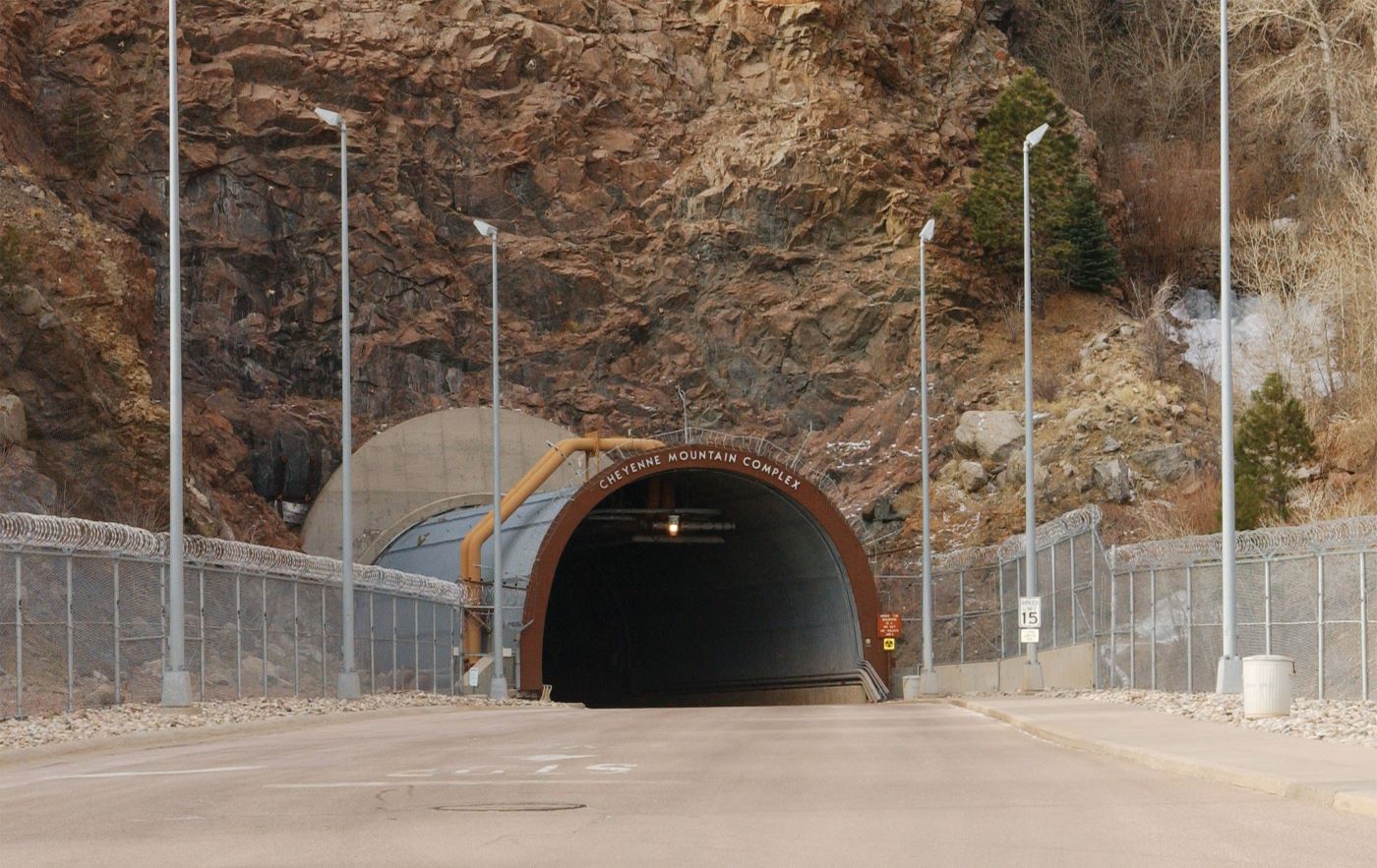
The approach to the facility runs through a J-shaped access tunnel cut into the north face of the mountain. The tunnel's curves are a defensive feature: they allow explosive overpressure from a surface detonation to flow through without reaching the interior. At the inner end sit two sets of blast doors — each weighing 25 tons, three feet thick, operable electronically or by hand crank. Once sealed, they create a vacuum barrier isolating the interior air supply completely.
That air supply runs through redundant filtration systems rated to block radioactive fallout, chemical agents, and biological contaminants. The interior is maintained at slightly higher pressure than the tunnel outside, so any breach drives air outward rather than drawing contamination in. Power comes from six internal diesel generators drawing from a 1.5 million-gallon underground fuel reservoir. Water comes from two underground reservoirs. In a full lockdown, the mountain is entirely self-contained. The surface can cease to exist.
Personnel working extended assignments describe the air consistently as "dead": no rain, no soil, no organic complexity. Floor wax and ozone. The mountain has a chapel, a medical clinic, a dental clinic, a gym, and a bar called the Granite Inn — the psychological maintenance infrastructure for the humans running the machine.
The 1,311 Springs: Surviving a Nuclear Shockwave
The complex's most counterintuitive feature is that its buildings are not attached to the walls or floor. They sit on forests of coiled steel, each spring bearing the weight of a three-story structure, each calibrated to allow the building above it to sway up to 12 inches in any direction. During a nuclear ground burst, granite behaves briefly like a liquid — rippling, shearing, transmitting enormous kinetic energy. The springs decouple the buildings from the mountain's movement. The computers, the displays, the operators — they ride the shock.
The buildings are also Faraday cages: their steel hulls welded into a continuous electrical skin that prevents an electromagnetic pulse from reaching the electronics inside. Every power and data cable entering the mountain passes through EMP surge suppressors. In a total-war scenario, Cheyenne Mountain would be among the only functioning electronic installations in the hemisphere — the one node in a global network that cannot be taken offline by the weapon it was built to survive.
Pine Gap and the Global Sensor Network Feeding Cheyenne Mountain
Cheyenne Mountain does not detect missile launches on its own. The screens inside the Combat Operations Center display data gathered by a planet-wide network of radar stations and infrared surveillance satellites — the mountain is the processing brain, not the eye. Understanding what it processes, and from where, explains why Pine Gap in the Australian Outback sits at the far end of the same architecture.
The primary eyes of the missile warning system are the Defense Support Program (DSP) satellites — geosynchronous platforms in orbit at roughly 22,000 miles, each equipped with infrared sensors capable of detecting the heat signature of a missile plume against the cooler background of the earth within seconds of launch. A Soviet ICBM fired from Siberia, a submarine-launched ballistic missile breaking the surface of the Arctic Ocean, a Chinese missile launched from the interior — all of them generate the same infrared signature, visible from geosynchronous orbit almost immediately. That data is relayed, via communications links, to NORAD's early warning centers within Cheyenne Mountain, giving decision-makers an estimated 25 to 30 minutes of warning before impact.
Pine Gap, operated jointly by the United States and Australia in the desert near Alice Springs, functions as one of the primary ground control and relay stations for this satellite constellation — particularly for coverage of the Eastern Hemisphere, the Indian Ocean region, and the southern approach corridors that polar-route radar arrays are not positioned to monitor. It is the listen post for the part of the world that faces away from Colorado. The data it captures feeds into the same stream that appears on the Cheyenne Mountain displays. When Brzezinski's phone rang in the early hours of June 3, 1980, the phantom missile count climbing from 200 to 2,200 on the screens inside the mountain was — in a functioning system — exactly the kind of data Pine Gap exists to help provide. The mountain processes. The network watches. They are two parts of the same machine.
No Windows, No Sun: Underground Duty at NORAD
There are no windows inside Cheyenne Mountain. Personnel operate under fluorescent light, governed entirely by Zulu Time — UTC — which has no relationship to whether it is day or night outside. The facility has run 24 hours a day, every day, since 1966, on a clock that treats all hours identically. One description from an Air Force colonel familiar with both Cheyenne Mountain and Raven Rock: "It's really an austere environment; it's essentially an office building." What distinguishes it from an office building is that the office building is inside a mountain engineered to outlast the civilization that built it.
NORAD Cold War History: False Alarms and Close Calls
November 9, 1979: The Test Tape That Became World War III
At 8:50 a.m. on November 9, 1979, the warning displays at Cheyenne Mountain lit up with 1,400 Soviet ICBMs inbound across the polar arc. The same signature simultaneously appeared on screens at Strategic Air Command, the Pentagon's National Military Command Center, and the Alternate National Military Command Center at Raven Rock. Fighter interceptors were scrambled. The National Emergency Airborne Command Post was readied for immediate takeoff.
The cause, established after six minutes of escalating alert, was an anomaly in the new 427M missile-warning system installed at Cheyenne Mountain two months earlier. A troubleshooting test program had been routed — through a failure mode NORAD engineers later said they could never replicate — into the live warning network. The Honeywell 6080 computers that processed the warning data could not distinguish between the test and a real strike.
Soviet leader Leonid Brezhnev formally complained to Washington about the "tremendous danger" of such errors. Secretary of Defense Harold Brown assured Carter that false warnings were essentially inevitable but that human safeguards would prevent escalation. Senior State Department advisor Marshal Shulman was less reassuring. "False alerts of this kind are not a rare occurrence," he said publicly, "and there is a complacency about handling them that disturbs me."
June 3, 1980: The 46-Cent Chip and Brzezinski's Phone Call
Seven months later, a single computer chip inside the mountain's warning system failed. The chip was worth 46 cents. Its malfunction cascaded through the missile-warning network, generating a count of 200 inbound submarine-launched missiles that revised, within minutes, to 2,200 ICBMs. Bomber crews across the country were in their aircraft. The Pacific Command's airborne command post left Hawaii. A Threat Assessment Conference was convened at the highest military level.
Brzezinski was woken at three in the morning. He did not wake his wife, calculating she had minutes to live if the count was accurate. He was preparing to call the President when the third call came: no radars were confirming, no satellites were confirming, and the anomalies in the pattern indicated a system error. The alert was resolved before Carter was reached.
A scientist at the Office of Technology Assessment, describing the incident, said the warning system had been "going to war. And it came damn close to taking the country with it." In the aftermath, NORAD built a $16 million off-site testing facility to ensure no simulation program could ever again enter the live detection network. The 427M system's inadequacies — flagged years earlier by the Government Accountability Office — were finally addressed.
September 11, 2001: The Threat Turned Inside Out
On the morning of September 11, 2001, Cheyenne Mountain was locked down and its attention rotated 180 degrees. For 35 years, NORAD had looked outward — northward and eastward, across the poles, anticipating Soviet bombers or ICBMs flying the great-circle routes from Siberia. The threat model was external, distant, arriving from the direction of the horizon. When the hijacked aircraft struck the World Trade Center and the Pentagon, the threat was already inside American airspace, flying domestic routes on domestic schedules.
NORAD's commander implemented Operation Noble Eagle from the Cheyenne Mountain Command Post — the emergency air defense posture for domestic airspace that the military had never needed and was not fully prepared to execute. The mountain's computational power turned toward tracking every commercial aircraft in American skies simultaneously, coordinating with the FAA to identify which planes were still in the hands of their pilots and which were not.
Cheyenne Mountain Today: Warm Standby in the Age of Hypersonic Missiles
The Move to Peterson and Why Granite Still Matters
In July 2006, Admiral Tim Keating announced that NORAD's primary command center would relocate to Peterson Air Force Base in Colorado Springs. The mountain was designated warm standby — fully operational, continuously staffed, but no longer primary. The move made operational sense: Peterson was easier to staff and more connected to modern communications infrastructure.
The post-Cold War logic of that decision has been revised steadily since. The mountain's defining strategic feature is now its defining advantage: it is physically disconnected from civilian networks. A facility that cannot be reached by a network cannot be compromised by one. As Russia and China developed hypersonic missile systems capable of maneuvering unpredictably at speeds that complicate traditional early-warning timelines, the value of a hardened, isolated command node that cannot be cyberattacked became newly relevant. In 2022, the Department of Defense awarded significant contracts for infrastructure upgrades across the COG network, including the mountain.
WarGames, Stargate, and the Door Labeled "Stargate Command"
The public's understanding of Cheyenne Mountain has been shaped almost entirely by fiction. The 1983 film WarGames drew directly from the November 1979 false alarm. The film's screenwriters gained access through General James V. Hartinger, the NORAD Commander in Chief, during a research trip in September 1980. Hartinger reportedly embraced the project when the writers emphasized the need for human control over automated nuclear systems. After the film's release, President Reagan screened it at Camp David in June 1983 and asked his National Security Advisor the next day whether the scenario was actually possible. He was told it was.
The Stargate SG-1 television series subsequently ran its fictional command center inside Cheyenne Mountain for ten seasons. The facility responded by installing a door labeled "Stargate Command" — a piece of institutional self-awareness that has become a standard reference point for authorized visitors. It is not the only joke in the mountain. In the Granite Inn bar, where personnel drink under 2,000 feet of granite installed to ensure the building survives everything else's destruction, the menu is reportedly unremarkable.
How to Visit Cheyenne Mountain Space Force Station
Access to the interior requires security clearance and formal authorization arranged months in advance. Electronics are confiscated at the gate. Transport is by white military bus through the access tunnel. The experience inside is described consistently as institutional rather than dramatic: grey corridors, fluorescent light, the sound of machinery. What is visible from public areas nearby — the Cheyenne Mountain State Park trails, the surrounding roads — is largely unremarkable. The antenna arrays on the ridgeline and the tunnel entrance visible in the cliff face are the only surface indications of what lies beneath. The mountain was designed to look like a mountain. It succeeded.
The ethical weight of the site, which does not require entry to feel, is the same weight that settles over Mount Weather and the Greenbrier Bunker — the realization that this infrastructure was built to survive the destruction of the society it serves, and to ensure that destruction is completed. The 1,311 springs and the 46-cent chip and Brzezinski sitting alone in the dark at three in the morning: all maintenance work on a deterrent that has, so far, held.
Cheyenne Mountain, along with Camp Peary and Raven Rock, is part of a broader network of Cold War facilities that remain operational today.
FAQ: Common Questions About Cheyenne Mountain and NORAD
What is Cheyenne Mountain used for today?
Cheyenne Mountain operates as the alternate command center for NORAD and U.S. Northern Command on warm standby status, following the relocation of primary operations to Peterson Air Force Base in 2006. The facility is fully staffed around the clock and can assume full control of North American aerospace defense within minutes. Its physical isolation from civilian networks has made it increasingly valuable as a cyberattack-resistant fallback as adversary cyber capabilities have grown.
How deep underground is the Cheyenne Mountain bunker?
The command center is approximately 2,000 feet below the summit, inside chambers excavated from Precambrian granite between 1961 and 1964. The main caverns are 100 feet wide and 60 feet high. The depth and density of the granite provide the primary protection against nuclear blast, thermal radiation, and electromagnetic pulse.
Has Cheyenne Mountain ever detected a real nuclear attack?
No. The most serious incidents were the November 1979 test-tape false alarm and the June 1980 computer chip failure, both of which triggered high-level alert actions before being identified as system errors. NORAD's systems have also required assessment of decaying satellites, missile tests, and atmospheric anomalies. No confirmed inbound nuclear strike has ever appeared on the mountain's screens.
Can the public tour Cheyenne Mountain?
No. The facility is an active military installation — the Cheyenne Mountain Space Force Station — closed to general public access. Rare authorized visits require security clearance and advance vetting. The surrounding area, including Cheyenne Mountain State Park, is publicly accessible and offers views of the mountain's external infrastructure.
Is the WarGames scenario based on something that actually happened?
The 1983 film's premise — a computer unable to distinguish simulation from reality — was directly inspired by the November 9, 1979 NORAD false alarm. The screenwriters visited Cheyenne Mountain with the cooperation of General James V. Hartinger, the NORAD Commander in Chief. After Reagan screened the film in 1983, his follow-up question to his National Security Advisor — whether the depicted scenario was actually possible — contributed to a broader review of computer security across the defense network.
Sources
- NORAD History and Cheyenne Mountain Complex — NORAD History Office / NORAD Public Affairs
- Construction of the Cheyenne Mountain Complex — Merwin H. Howes, U.S. Department of the Interior, Bureau of Mines (1966)
- False Warnings of Soviet Missile Attacks During 1979–80 — National Security Archive, George Washington University (2020)
- Colonel Odom's "Chilling" Four A.M. Phone Call — National Security Archive, George Washington University (2022)
- The Storied History of Cheyenne Mountain — Brian D. Laslie, The Watch Journal (2020)
- A Nuclear False Alarm That Looked Exactly Like the Real Thing — Union of Concerned Scientists (2022)
- USAF's Cheyenne Mountain Complex Is, in Some Ways, Busier Than Ever — Air Force Magazine, Jennifer Hlad (2016)
- WarGames: Games on Film — The Dot Eaters
- Raven Rock: The Story of the U.S. Government's Secret Plan to Save Itself — Garrett M. Graff (2017)
- Cheyenne Mountain Space Force Station — United States Space Force (2024)



%2C%20Konjic%2C%20Bosnia.jpg)


