
The Strategic Gravity of the Alice Springs Interior: The Epicenter of Global Erasure
The significance of Pine Gap cannot be measured by the footprint of its buildings, but by the invisible reach of the signals it captures. To understand Pine Gap is to understand the end of geography. Positioned in the deep isolation of the Australian Outback, the facility serves as a literal and metaphorical anchor for American hegemony in the Eastern Hemisphere. It is not merely a tracking station; it is a point of absolute strategic gravity where the physical emptiness of the desert facilitates a totalizing digital presence. This site represents the ultimate realization of modern warfare: the ability to see, hear, and destroy from a position of total geographic immunity. Before a single boots-on-the-ground operation occurs in the Middle East or the South China Sea, the intent is filtered through the red dirt of the Northern Territory.
The Geometry of Hegemony: Why Central Australia?
The selection of the Alice Springs interior was a masterstroke of Cold War physics and clandestine planning. To intercept the telemetry of Soviet missiles or the high-frequency communications of a distant superpower, one requires a "radio quiet" zone of immense proportions. The MacDonnell Ranges provide a natural shield against the electronic noise of civilization, but the true value lies in the site’s longitudinal alignment. Positioned at approximately 24 degrees south, Pine Gap sits in a unique "hemispheric sweet spot." From this coordinate, US geostationary satellites—such as the Orion and Mentor series—parked over the Indian and Pacific Oceans can relay massive streams of data to the ground with minimal latency. It is the only location on Earth that allows the United States to maintain a constant, unblinking eye on the vast swaths of Eurasia and Africa simultaneously. This is the high ground of the 21st century—not a mountain peak, but a secluded valley where the curvature of the Earth and the vacuum of space are harnessed to ensure that no signal goes unrecorded.
The Five Eyes and the Sovereignty of Silence
Pine Gap is the crown jewel of the "Five Eyes" (FVEY) intelligence collective, a supra-national entity that effectively operates above the laws of individual member states. While the facility is technically a "Joint" operation between the Australian Department of Defence and the US Central Intelligence Agency (CIA), the power dynamic is inherently asymmetrical. The legal framework—the 1966 Agreement—explicitly grants the United States "exclusive use" of certain communications channels. Sociologically, Pine Gap represents a voluntary ceding of Australian sovereignty in exchange for a seat at the table of global power. For decades, the specific operations within the facility were kept secret even from the Australian Prime Minister, creating a "state within a state." This sovereignty of silence ensures that the facility operates as a legal and political monolith. It is a place where the concept of the nation-state begins to blur, replaced by a trans-pacific intelligence apparatus that views the world not as a collection of borders, but as a map of electromagnetic emissions to be harvested, decoded, and weaponized.
The ECHELON Mechanism: Harvesting the Ionosphere
To grasp the scale of Pine Gap, one must understand its role as a primary node in the ECHELON program. This is not passive listening; it is active, industrial-scale data mining. The facility utilizes sophisticated signal-processing algorithms to sift through billions of intercepted transmissions per minute, searching for "selectors"—specific keywords, voiceprints, or digital signatures. Unlike traditional SIGINT (Signals Intelligence), which targets specific military adversaries, the ECHELON-era Pine Gap operates on a "collect-all" philosophy. This section of the facility functions as a digital sieve, catching everything from diplomatic cables and corporate encrypted data to the private calls of world leaders. The sociological weight of this is profound: it represents the transformation of the Australian desert into a global panopticon where the right to privacy is non-existent, sacrificed on the altar of "predictive intelligence."
The Chronology of Secrecy: From 1966 to the Modern Era
The history of Pine Gap is a narrative of escalating stakes and hidden consequences. Established under the 1966 Pine Gap Treaty, the facility was born in an era of existential dread, designed to monitor nuclear compliance during the height of the Cold War. However, its timeline is marked by moments of profound political upheaval that suggest the facility is not just a witness to history, but an active participant in it. The transition from a passive monitoring station to an active participant in kinetic warfare represents one of the most significant shifts in the history of international relations.
1975: The Dismissal and the CIA Shadow
The most enduring mystery of Australian politics—the 1975 dismissal of Prime Minister Gough Whitlam—finds its dark heart at Pine Gap. In the early 1970s, Whitlam began to question the lack of transparency surrounding the facility, threatening to let the lease expire unless the CIA disclosed the full extent of its activities. His insistence on sovereignty triggered a cascade of panic within the US intelligence community. Historical records and declassified cables suggest that the CIA viewed Whitlam as a threat to the most critical link in their global surveillance chain. When Governor-General Sir John Kerr dismissed Whitlam in a move that many describe as a "constitutional coup," the shadow of Pine Gap loomed large. The removal of a democratically elected leader who dared to peer behind the curtain of the facility remains the definitive example of the site's untouchable status; it proved that the security of the facility's mission superseded the democratic will of the host nation.
From Cold War Relics to Targeted Lethality
Following the collapse of the Soviet Union, Pine Gap did not fade into obsolescence; it evolved. The facility transitioned from monitoring ICBM launches to the hyper-specific task of geolocation and signals interception in the "War on Terror." During the conflicts in Iraq, Afghanistan, and Yemen, Pine Gap became an essential component of the US drone program. The facility’s ability to intercept cellular signals and radio transmissions—frequently through the "FORNSAT" (Foreign Satellite Collection) program—allowed for the "targeted killing" of individuals thousands of miles away. This evolution shifted the moral and legal landscape of the site. It was no longer a defensive shield against nuclear armageddon, but a proactive sword used in extrajudicial strikes. Whistlebowers and investigative journalists have detailed how the metadata harvested in the quiet of the Australian desert is used to provide the precise coordinates for Hellfire missiles, making the red sand of Alice Springs a silent partner in the bloodletting of distant lands.
The Snowden Revelations and XKeyscore
In 2013, the leaks by Edward Snowden provided the first technical confirmation of what had long been suspected: Pine Gap is a primary ingest node for the XKeyscore system. This program allows analysts to search nearly everything a user does on the internet in real-time. The facility at Alice Springs doesn't just monitor satellites; it serves as a bridge between the physical signals intercepted in space and the digital databases housed in Fort Meade, Maryland. This discovery forced a public reckoning with the facility’s role in mass domestic surveillance. It revealed that the "joint" nature of the facility was effectively a veneer for a system that allows the NSA to bypass US domestic spying laws by using Australian soil and Australian personnel to gather data that would be illegal to collect on American soil.
The Architecture of the Void: The Physicality and Atmosphere
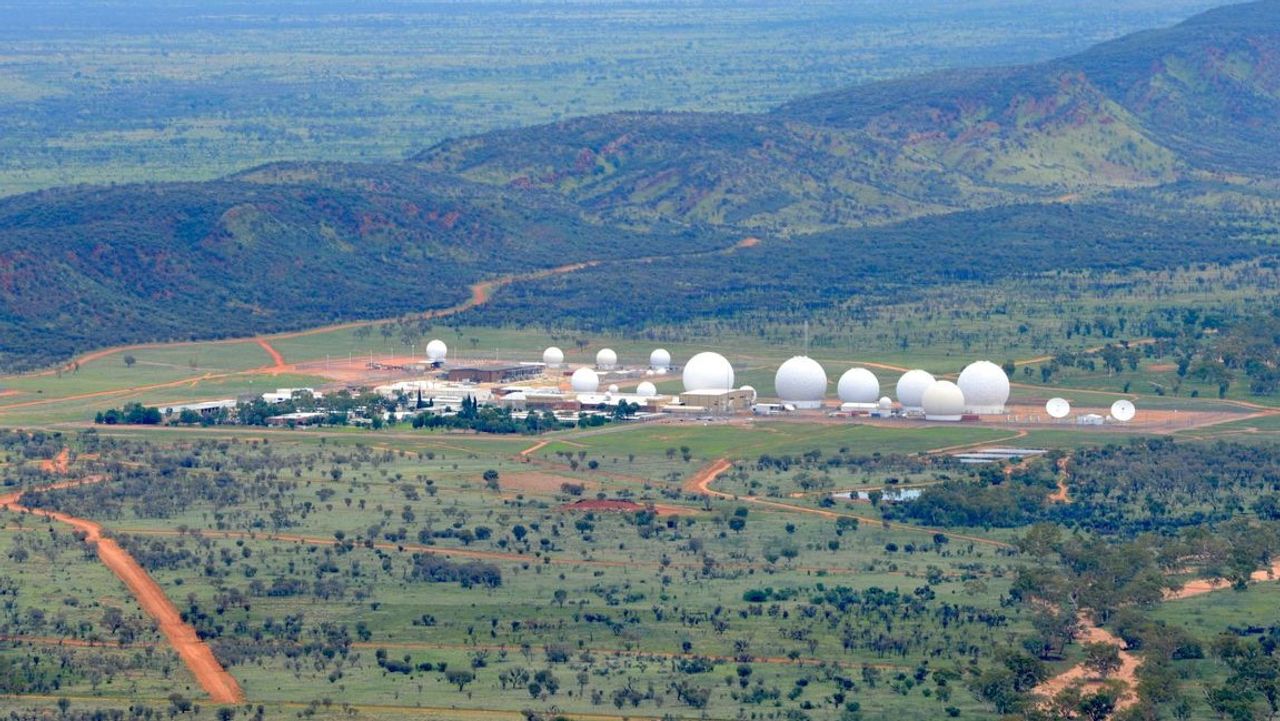
To see Pine Gap from the air is to look upon a cluster of white, spherical "golf balls" resting in a sea of ancient rust-colored earth. This architectural juxtaposition is jarring—a high-tech colony grafted onto one of the oldest landscapes on the planet. The physicality of the site is designed for one purpose: the total obfuscation of intent. Every dome, every fence, and every high-security enclosure is a layer of a physical encryption system that protects the digital secrets within.
The Psychology of the Radome Forest
The 38 radomes that dot the landscape are not merely weather protection for the sensitive antennas they house; they are a psychological barrier. Because the domes are opaque, an observer—whether a citizen on a nearby ridge or a foreign satellite overhead—cannot determine which direction the antennas are pointing. This creates a state of perpetual, omnidirectional surveillance. The "Radome Forest" is a physical manifestation of the panopticon. You know you are being watched, but you cannot see the eyes. This architecture of concealment serves to project an aura of invincibility. Inside these pressurized spheres, massive parabolic dishes tilt and rotate in total silence, tracking satellites that are themselves invisible to the naked eye. It is an architecture that emphasizes the insignificance of the individual in the face of the machine.
Alice Springs: The Dependent Frontier
The relationship between Pine Gap and the nearby town of Alice Springs is one of symbiotic tension. Sociologically, the town has been transformed into a "dependent frontier." A significant portion of the local economy is tied to the thousands of American and Australian employees who live in the community, bringing a slice of suburban Virginia to the rugged interior of the Northern Territory. This creates a strange cultural friction. The Arrernte people, the traditional custodians of the land, find their ancestral territory occupied by a facility that is legally a foreign enclave. The "Pine Gappers" live in gated communities like "The Gap," existing as a privileged caste within a town that struggles with systemic poverty and the legacies of colonialism. The facility does not just occupy the land; it occupies the social fabric of the region, creating a town that is both defined by and excluded from the secrets of its most famous neighbor.
The Underground: Hardened Data Vaults and the Virginia Pipeline
While the radomes are the most visible aspect of Pine Gap, the true heart of the facility lies beneath the surface in hardened bunkers designed to survive a nuclear first strike. These subterranean levels house the high-performance computing clusters that process raw data into actionable intelligence. This is the workplace of the "Special Programs" personnel—a highly vetted cadre of analysts and operatives. It is here that the human element of the facility is most apparent. The personnel who staff these windowless vaults are not typical defense contractors; they are the finished products of an elite intelligence pipeline. Many of the lead operatives who manage the facility’s clandestine tradecraft have been forged and conditioned at Camp Peary, the CIA’s primary training academy in Virginia. At "The Farm," they are taught the psychological resilience and operational secrecy required to manage the absolute power of global surveillance. When they arrive in Alice Springs, they are effectively ghosts in the machine—operators trained to handle the most sensitive data on the planet with a cold, clinical detachment that was perfected in the woods of the American East Coast.
The Legacy and Modern Status: Logistics of a Secret State
In the contemporary era, the secrecy of Pine Gap is enforced not just by fences, but by a formidable legal and logistical architecture. As technology makes it easier for activists and journalists to document the site through high-resolution satellite imagery and drones, the state has responded by hardening the legislative perimeter. Accessing Pine Gap is not merely a matter of physical trespassing; it is a challenge to the foundational security laws of the Australian Commonwealth.
The Defense (Special Undertakings) Act: Legalized Exclusion
The legal perimeter of Pine Gap is defined by the Defense (Special Undertakings) Act 1952, a piece of legislation that grants the government extraordinary powers to protect "proscribed areas." This act effectively suspends the normal rules of civil liberty within the vicinity of the site. Trespassing on Pine Gap is not a misdemeanor; it is a federal crime that carries a potential sentence of seven years in prison. The law is designed to be a deterrent of absolute proportions, ensuring that the physical void surrounding the facility remains empty. This legislative fortress creates a "black hole" in the Australian legal system where the burden of proof and the rights of the accused are often secondary to the ambiguous requirements of "national security." It is a site where the law is used to ensure that the state remains unanswerable to its citizens.
The Pine Gap Pilgrims and the Cost of Dissent
Despite the legal risks, Pine Gap has long been a site of intense protest and civil disobedience. From the "Women’s Peace Camp" of 1983, where hundreds were arrested for protesting nuclear proliferation, to the more recent "Pine Gap Pilgrims"—a group of Christian activists who broke into the facility to perform a "lament" for those killed by drone strikes—the site has become a cathedral of dissent. These activists highlight the paradox of the facility: while it is protected by the most advanced security in the world, its moral foundations are viewed by many as fragile. The prosecution of these individuals serves as a public ritual, reinforcing the state's control over the site. To protest Pine Gap is to confront the reality that for all our talk of democracy, there are places where the "state" becomes an absolute, impenetrable entity that does not require the consent of the governed.
Modernization and the Space Force Era
As of 2026, Pine Gap is undergoing a massive multi-billion dollar expansion to accommodate the new US Space Force infrastructure. This involves the construction of newer, more efficient radomes designed to communicate with Low Earth Orbit (LEO) satellite constellations, such as Starlink-derived military networks. This modernization ensures that Pine Gap remains relevant in the era of hypersonic missiles and space-based warfare. The facility is no longer just listening; it is actively guiding the next generation of orbital weaponry. This logistical pivot reinforces its status as a permanent fixture of the Australian landscape—a site that is inextricably linked to the future of human conflict, ensuring that the quiet of the desert will continue to be filled with the hum of the world’s most dangerous data.
Conclusion: The Reflection of the Red Center
Pine Gap remains the ultimate paradox of the modern age. It is the most connected location in the Southern Hemisphere, a nexus of light-speed data and global decision-making, yet it is shrouded in a silence that is almost geological in its depth. It sits in the center of a continent, on land that has been inhabited for 60,000 years, serving a power that is barely two centuries old.
As we move further into an era of total digital transparency, Pine Gap stands as a reminder that the most powerful entities in the world still require shadows. It is the invisible architect of our global reality, a place where the air itself is mined for information and the desert sand hides the machinery of modern empire. We are all, in some way, residents of the world that Pine Gap built—a world where privacy is a relic and the red center of Australia is the ear that hears the heartbeat of the planet.
Frequently Asked Questions (FAQ)
Can the public visit Pine Gap?
No. Pine Gap is a designated "Prohibited Area" under the Defence (Special Undertakings) Act 1952. Public access is strictly forbidden. The closest a visitor can legally get is the turnoff at Hatt Road, which is guarded by the Australian Federal Police (AFP). Trespassing carries severe penalties, including imprisonment, as demonstrated by the prosecution of the "Pine Gap 4" protesters.
What did the Edward Snowden leaks reveal about Pine Gap’s mass surveillance?
The 2013 Snowden revelations provided the first technical confirmation that Pine Gap is a primary ingest node for the XKeyscore program. The leaked documents revealed that the facility's mission had expanded far beyond military telemetry into "collect-all" surveillance. It showed that the facility intercepts the private communications—emails, phone calls, and internet metadata—of millions of civilians across the Eastern Hemisphere, effectively bypassing domestic privacy laws by utilizing the legal "gray zone" of the Australian desert.
Why is Pine Gap located in Australia?
The location is a matter of geophysics and security. Alice Springs is seismically stable and located in a "quiet zone" with minimal electromagnetic interference, perfect for detecting faint satellite signals. Crucially, its position allows it to control geostationary satellites parked over the Indian and Pacific Oceans, covering strategic rivals like China, Russia, and North Korea—coverage that US-based ground stations cannot achieve due to the curvature of the Earth.
Does the Australian government know everything that happens at the base?
Officially, yes. The Australian government operates under a policy of "Full Knowledge and Concurrence," stating they have oversight of all activities. However, critics and intelligence historians argue that while Australia has legal oversight, the operational reality is "compartmentalized." Certain raw data streams and high-level NSA taskings are likely restricted to "US Eyes Only," meaning Australian officials may know that data is being collected, but not necessarily the specific content of every intercept.
What role does Pine Gap play in drone strikes?
Leaked NSA documents indicate that Pine Gap is instrumental in the "geolocation" of targets. The facility receives signals from satellites that track handheld devices (like cell phones and satellite phones). By triangulating these signals, analysts can pinpoint a target's location to within meters. This data is allegedly fed into the US military's kill chain to guide drone strikes in conflict zones like the Middle East and Afghanistan.
How does Pine Gap differ from other intelligence sites like Menwith Hill?
While sites like Menwith Hill in the UK perform similar SIGINT roles, Pine Gap’s specific longitudinal position allows it to cover the vast "blind spots" of the Eastern Hemisphere. Its unique ability to control geostationary satellites over the Indian Ocean and the South China Sea makes it the most strategically significant surveillance site in the Southern Hemisphere.
Sources
- The Unfolding of Pine Gap: A Brief History - Desmond Ball (2012)
- The World's Most Important Intelligence Facility - ABC News Investigative Unit (2017)
- Pine Gap's New Era: The Shift to Space Force - Richard Tanter, Lowy Institute (2020)
- The Role of Pine Gap in US Drone Operations - The Intercept (2017)
- Defense (Special Undertakings) Act 1952 - Australian Government Federal Register of Legislation (2016)
- Snowden Archives: XKeyscore and the Australian Connection - Nautilus Institute (2015)
- The 1975 Dismissal: The CIA and the Governor-General - The Guardian (2020)
- SIGINT Architecture of the Pacific Rim - Australian Strategic Policy Institute (2024)



%2C%20Konjic%2C%20Bosnia.jpg)


