A Basement on the Worst Night of the Blitz
The night of 10 May 1941. Above ground, the worst Luftwaffe raid of the entire war is burning London. Five hundred and seven bombers cross the coast after dark. Within hours, 1,436 people are dead. The House of Commons chamber is on fire and will be a roofless ruin by dawn. The Tower of London takes a direct hit. The British Museum is alight. Westminster Abbey loses its roof in three places. The Thames is at low tide and the fire brigades cannot pump water.
Ten feet beneath Whitehall, the lights stay on.
Winston Churchill sits in a small wooden chair in a converted Office of Works basement, smoking a cigar. A map officer pins coloured tape across a chart of the Atlantic. A clerk types minutes on a Remington. In the next room a typist is fielding a call from the Admiralty. The bunker has no windows. The air is bad. The single inadequate toilet for the entire complex carries a sign reading “engaged” that the staff have rigged to lock the door from the outside, since the door itself does not lock. Above their heads is a slab of unreinforced concrete that the building’s own engineers have privately admitted will not survive a direct hit.
The Prime Minister stays. He stays the whole night.
The Churchill War Rooms were the most consequential improvised workspace of the 20th century. A leaking, under-protected government basement that the British state occupied because it had nothing better, and from which it ran a global war for six years. The official story has always been a story of concrete and reinforcement. The reality was sandbags, wishful thinking, and the refusal to leave London. Churchill’s most quoted lines were rehearsed in rooms with bad ventilation and worse plumbing. The myth of the bunker is granite. The truth is plaster.
Why Britain Built a Bunker Under Whitehall
The 1930s Bombing Doctrine That Convinced London the Capital Would Be Destroyed
The dominant military theory of the 1930s held that the bomber would always get through. Stanley Baldwin said it in the House of Commons on 10 November 1932, and the phrase entered the British political bloodstream. Air power, the theorists believed, was now the decisive weapon, and no defence could stop a determined bombing campaign. A future war would open with the destruction of the enemy capital, civilian populations gassed in their streets, government rendered impossible by the collapse of the urban fabric.
British war planning treated this as an operational certainty. Estimates produced for the Committee of Imperial Defence in 1937 forecast 600,000 dead in the first sixty days of any future war with Germany, with 1.2 million wounded. Hospital wards were planned. Mass graves were sketched out. The London Underground was assessed for body storage capacity. The numbers were almost entirely wrong — actual British civilian deaths from German bombing across the entire war came to 60,595 — but the figures shaped every assumption made in Whitehall during the late 1930s.
The implication for government was clear. London would have to be evacuated, or buried.
Ismay, Hollis, and the Search for a Government Refuge in 1938
Hastings “Pug” Ismay was Deputy Secretary of the Committee of Imperial Defence in 1938. He was a small, square-jawed Indian Army officer with a face the Italians said reminded them of a determined dog, hence the nickname he kept his whole life. His job was to think about what would happen on the first night of the war.
Two options sat on the table. Plan One was to evacuate the central government from London entirely — to Worcestershire, to Hampshire, to a network of country houses requisitioned for the purpose, with Churchill (in due course) and the Cabinet operating from rural seclusion. Plan Two was to find somewhere in central London hardened enough to ride out the bombing, keep the apparatus of government within physical reach of Parliament and the BBC, and accept the risk.
Ismay’s assistant Leslie Hollis surveyed dozens of basements across Whitehall during the spring and summer of 1938. He looked at the Foreign Office, at the Admiralty, at the cellars beneath Downing Street itself. The Downing Street basement was particularly dispiriting — damp, low-ceilinged, and so obviously compromised that any reasonable assessment ruled it out. Hollis settled on the basement of the New Public Offices building on Great George Street, completed in 1908, which housed the Office of Works and the Board of Trade. The building’s steel frame and unusually thick ground-floor slab gave it the best protection of anything available, which was another way of saying it was the least bad option in Whitehall.
The choice was made in May 1938, during the Sudeten crisis, with Europe expecting war within weeks. Munich bought another year. The conversion work began that autumn.
The Conversion of the New Public Offices Basement, 1938-1939
The work was carried out by the Office of Works under the direction of Eric de Normann, a senior civil servant whose name appears on every blueprint and never on any plaque. The basement was a maze of storerooms, ventilation shafts, and unused corridors when he arrived. Within a year it had been converted into a working seat of government.
The Cabinet Room was a converted typists’ chamber with a horseshoe of tables, twenty-five chairs, and a single ceiling fan. The Map Room was a long, low space stuffed with charts, telephones, and pinboards. A narrow corridor ran the length of the complex, lined with private rooms for the Prime Minister, the Chiefs of Staff, the duty officers, and the Map Room watch. A small mess kitchen was installed. A telephone exchange room — soon to be known as the Switch Room — was equipped with the most advanced exchange the Post Office could provide. Steel doors were fitted at the entrances. Gas-tight curtains were hung in the corridors.
The structural problem was acknowledged from the start. The ground floor of the New Public Offices was a thick slab, but it was not designed as a bomb shelter, and engineers in 1938 already understood that German aircraft would soon carry bombs capable of penetrating it. The basement was hardened with steel girders, sandbags, and a layer of concrete in the worst-exposed corners. The work was substantial. It was also, everyone involved knew, not enough.
The complex was declared operational on 27 August 1939. Britain declared war on Germany seven days later.
Inside the Cabinet War Rooms: The Architecture of Improvised Government
The Cabinet Room and the Map Room That Ran the War
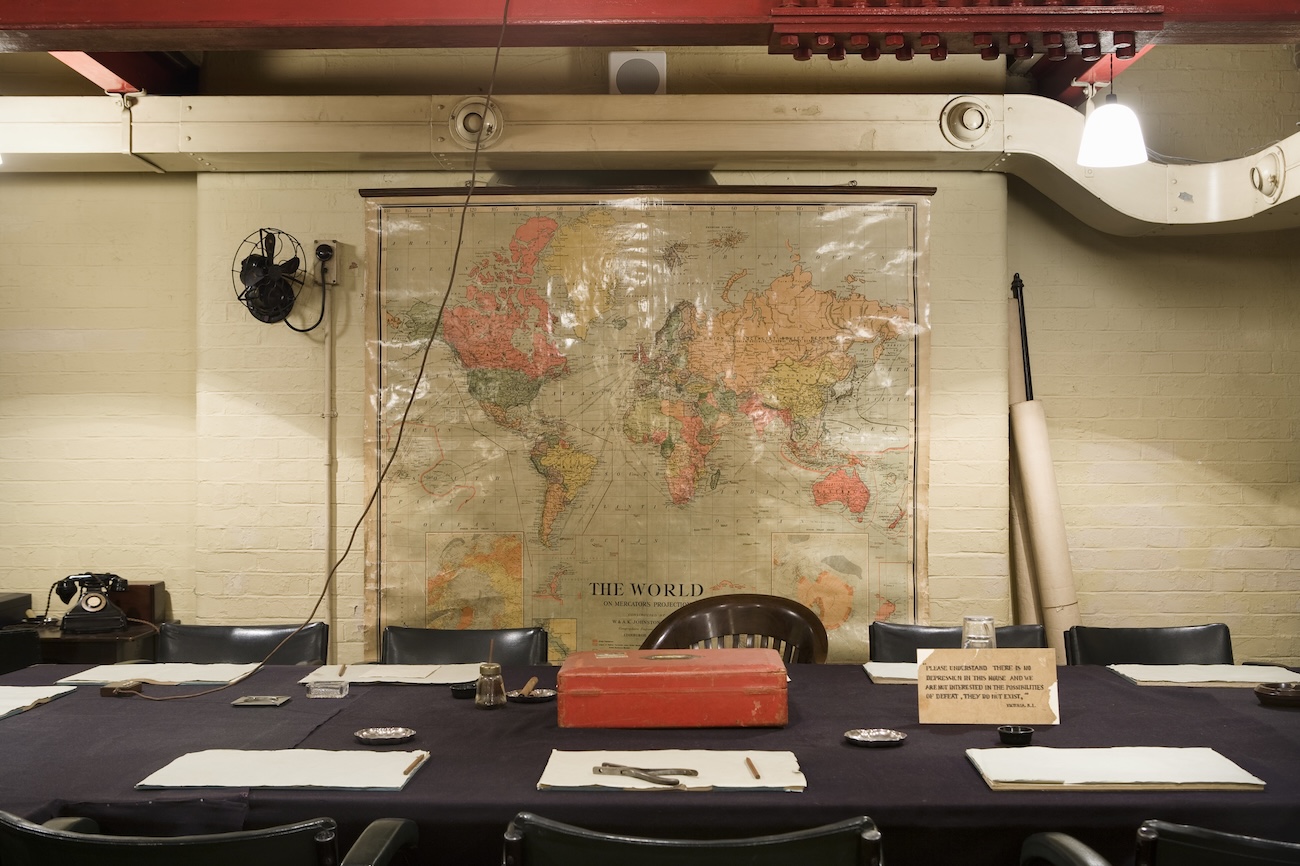
The Cabinet War Room was the smallest serious cabinet chamber in modern British history. Twenty-five chairs around a horseshoe of tables, a wooden lectern at the open end for the speaker addressing the room, a single map of the world on one wall, a clock above the door. The ceiling was low. The air, in the absence of mechanical ventilation, became thick within thirty minutes of a meeting beginning. Churchill smoked cigars through every session. The other members smoked cigarettes. The room operated, by the end of a long evening, in a fog the colour of weak tea.
Churchill chaired the War Cabinet from this room 115 times. The decisions taken in it included the rejection of the Halifax peace overtures in May 1940, the order to sink the French fleet at Mers-el-Kébir in July, the commitment of British forces to Greece in 1941, the launching of the Dieppe raid, the strategic agreement with the Americans at Tehran, and the final approval of the date and beach assignments for D-Day. The room was used because it was where the Prime Minister already was. The decisions were the size they were because the room was the size it was.
The Map Room, three doors down the corridor, was the building’s nerve. It operated twenty-four hours a day for the entire war. Five officers worked each watch, drawn from the three services and from intelligence, plotting the positions of every Allied and enemy unit of significance on a wall of charts that covered every theatre. Coloured pins marked submarines, convoys, divisions, aircraft squadrons. Red string marked the line of the German advance, blue the British. The room produced a daily situation report that was hand-delivered to the King at Buckingham Palace, to the Prime Minister, to the Chiefs of Staff. The report was never missed. Not on the day Coventry burned. Not on the day Singapore fell. Not on the morning of D-Day, when the watch officer wrote at the top of the page, “Operation Overlord commenced 06:30.”
Churchill’s Bedroom, the Transatlantic Telephone Room, and the BBC Microphone
Churchill’s underground bedroom was the smallest of the working chambers — a single bed, a desk, a chair, a portrait of his wife on the wall, a chamber pot beneath. He slept there only three times during the entire war. He preferred the converted flat one floor above, at street level in the same building, where he had a proper bedroom and could see daylight. The underground room was for emergency use, for the night of an exceptional raid, for the hours after a Cabinet meeting that ran past midnight. The bed remained made and waiting for six years.
The desk in the bedroom was where Churchill made four of his most famous wartime broadcasts. A BBC microphone was wired through from the corridor and stood permanently on the writing surface. He spoke into it sitting down, in a thick velvet siren suit, often with a cigar in his free hand. The broadcasts of 11 September 1940, of 9 February 1941, and of 27 April 1941 were all made from this desk. The first of these — “These cruel, wanton, indiscriminate bombings of London are, of course, a part of Hitler’s invasion plans” — was delivered while the building above was being shaken by ordnance falling on Birdcage Walk.
The Transatlantic Telephone Room was the bunker’s strangest space. It was a converted broom cupboard, three feet by five feet, fitted with a single armchair, a desk, a green scrambler telephone, and a sign on the door that read “TELEPHONE ROOM.” The scrambler was the British end of the SIGSALY system installed by the Americans in 1943, a refrigerator-sized voice encryption machine sitting in the basement of Selfridges department store half a mile away. The two prime ministerial calls in greatest secrecy went through this cupboard. Churchill and Roosevelt spoke through it. The staff outside heard nothing but the muffled rumble of one of the most famous voices of the 20th century, talking, alone, in a room the size of a cleaner’s closet.
The Staff Who Lived Underground for Five Years
The bunker employed, at its peak, 528 people. They worked in eight-hour shifts. Many of them slept on site, in subdivided dormitory rooms in the sub-basement two levels below the Cabinet Room — a space the staff called the Dock, after the lowest deck of a warship. The Dock had no daylight, no fresh air, and a permanent smell of unwashed bodies, kerosene from the heaters, and the cigarette smoke that came down through the floor grates from the working levels above.
Joan Bright Astley was one of the senior secretaries. She kept a private war diary which survived and was published much later. She recorded the texture of the place — the perpetual fluorescent light, the way watches lost time without the sun, the difficulty of sleeping under bombing one could feel through the ceiling but not see. She wrote about the rats. The bunker had rats. The kitchen attracted them, the dormitories attracted them, the staff caught them in traps and bet on the body counts. She wrote about the women who worked the typewriters and the switchboards in shifts that ran for five years without proper leave, who emerged into Whitehall at the end of a watch with skin the colour of paper and eyes that could not focus on anything more than ten feet away.
The staff received an extra ration of sugar — three lumps a day, in tea — as compensation for the conditions. It was the only acknowledgement they ever got that the work was, in physical terms, hard.
The Bunker’s Greatest Secret: It Was Never Actually Bombproof
The Concrete Slab That Couldn’t Stop a 500-Pound Bomb
The myth of the Cabinet War Rooms is that they were a bombproof citadel beneath Whitehall, the British equivalent of Hitler’s Wolf’s Lair in East Prussia — a fortified redoubt where the head of state could ride out the worst the enemy could throw at the capital. The reality is that the ground-floor slab above the bunker was three feet of unreinforced concrete, designed in 1906 for the structural load of an Edwardian government office. It was, by 1940, demonstrably incapable of stopping the kind of armour-piercing ordnance the Luftwaffe was now dropping on London.
The Air Ministry knew this. The Office of Works knew this. The Cabinet Office certainly knew it. The Royal Engineers ran tests in 1940 on similar slabs at the Bridges Research Station and found that a 500-pound bomb with a delayed-action fuse would penetrate the concrete and detonate inside the rooms below. A 1,000-pound bomb would destroy the basement entirely. The Luftwaffe was, by the autumn of 1940, dropping both regularly on central London.
The bunker’s vulnerability was a state secret of the highest order. Discussion of it was confined to a handful of senior officials. The fiction of bombproof shelter was maintained because the alternative — admitting that the seat of government was, in physical terms, a sandbagged basement under a 1906 slab — would have been catastrophic for morale and for confidence in Churchill personally.
The “Slab” Reinforcement of 1940 and the Admission of Vulnerability
In October 1940, with the Blitz at its peak, the Cabinet authorised the construction of an additional layer of protection. The Slab, as it was officially designated, was a five-foot thickness of reinforced concrete poured directly on top of the existing ground floor of the New Public Offices, running across the entire footprint of the bunker. It was the largest concrete pour in central London during the war. It was carried out by Office of Works engineers under cover of normal repair work, with the actual purpose never publicly disclosed.
The Slab was completed in December 1940. It improved the bunker’s survival probability against a direct hit from approximately five percent to approximately twenty percent. The engineers who built it left memoranda in the Office of Works files which became available to historians only in the 1990s. They were not optimistic. One internal note observed that the Slab would stop “a 250-pound bomb, possibly a 500-pound, certainly not a 1,000-pound, and not at all the new German ordnance now being reported in operational use.” The new German ordnance was the SC 1800 “Satan,” a 1,800-kilogram armour-piercing bomb that the Luftwaffe began deploying against London targets in early 1941. The Slab would have been irrelevant if a Satan had landed on it.
The bunker was, throughout the war, less protected than the deep tube stations the East End used as shelters. Tens of thousands of Londoners spent their nights in better-defended spaces than the Prime Minister.
The Decision Churchill Made to Stay in London Anyway
The contingency plans for the evacuation of the government remained on file throughout the war. A network of country houses had been requisitioned. Spetchley Park in Worcestershire was prepared for the Prime Minister’s personal use. Codenames were assigned to each location. The trains were timetabled. The vehicles were fuelled and parked in concealment. The order to evacuate could have been given on any night during the Blitz and the move would have been complete within six hours.
The order was never given. Churchill refused.
His reasoning was political and moral. The British population was being asked to endure bombing in its homes, its workplaces, its shops, and its schools. The image of the Prime Minister retreating to a Worcestershire country house while London burned would have been, he believed, fatal to the public will to continue the war. He chose to remain visible — to be photographed in bombed streets, to broadcast from the same city that was being attacked, to take the same risk that everyone in Greater London was taking. The choice was rational in its political logic and slightly unhinged in its physical exposure. Had a Satan bomb landed on the New Public Offices on the night of 10 May 1941, the Allied conduct of the war would have continued under different leadership.
This was the bunker’s deepest function. It was not a fortress. It was a stage set for refusal.
Churchill in the War Rooms: The Six Speeches, the Maps, and the Late Nights
The Transatlantic Hotline to Roosevelt
The relationship between Churchill and Franklin Roosevelt was conducted, from December 1941 onwards, partly through the green scrambler telephone in the broom cupboard. The SIGSALY system was, at the time, the most sophisticated voice encryption ever built — a 50-ton machine that occupied a basement room at Selfridges and transmitted speech via a one-time pad of recorded thermal noise stored on aluminium discs. Each five-minute conversation consumed two discs and required forty-five minutes of preparation by the operators.
Churchill used the room sparingly. The system distorted his voice and Roosevelt’s, gave both men a slight metallic quality that made the conversations strangely intimate, as if they were speaking from inside the same closed space. A staff officer was always present in the room beyond the cupboard. The officer could not hear the words. He recorded only the duration of each call, the date, and the names of those on the line. The transcripts of the conversations exist in fragments. Most of what was said in that cupboard has not survived.
The cupboard is still there. The chair is still there. The telephone is still there.
The Map Room and the Day-by-Day Tracking of the Battle of the Atlantic
The Map Room’s most important wall was the chart of the North Atlantic. The chart was updated four times a day, with the positions of every Allied convoy, every known U-boat, every patrol aircraft, every escort group. Coloured pins recorded sinkings. A separate ledger tabulated tonnage lost and tonnage delivered. The figures decided whether Britain ate.
Churchill called the Battle of the Atlantic “the only thing that ever really frightened me.” He visited the Map Room two or three times a day during the worst months of 1942 and 1943. He would stand at the chart, cigar in hand, asking the duty officer the same questions. How many sinkings overnight? How many merchantmen on the Halifax route? How many escorts at sea? The duty officer would point. Churchill would grunt. He would leave. He would come back four hours later.
The Battle of the Atlantic turned in May 1943, when Allied air cover closed the mid-ocean gap and the U-boats began to die faster than they could be built. The Map Room watch on the night of 24 May 1943 — the night Dönitz withdrew his wolfpacks from the North Atlantic — recorded the event in a single line. U-boats withdrawn from convoy operations west of 20 degrees West. Effect awaited. The watch officer who wrote that sentence later said he understood, at the moment of writing it, that he had just recorded the turning point of the war in the West.
The Personality That Made the Underground Government Work
Churchill’s working style in the bunker was a problem and a solution at the same time. He worked from a quarter past nine in the morning until past two the following morning, with a long nap between five and seven in the evening, after which he would emerge re-energised and begin the second half of his working day at the moment most of his staff were preparing to sleep. The staff coped. Many of them did not sleep. The General Ismay, the Chief of the Imperial General Staff Sir Alan Brooke, and the various private secretaries kept hours that would have destroyed civilian careers in peacetime.
The Prime Minister had specific demands. He required hot baths. He required champagne with dinner, whisky after, brandy with cigars after that. He dictated to a relay of typists who took shifts at the writing desk in his room above the bunker, reading back his sentences as he paced. He had a temper. He was charming. He was cruel to junior staff for short bursts and then would remember to be kind, and would. The combination produced an atmosphere of permanent emotional weather inside the complex.
Brooke’s diary, kept secretly throughout the war and published posthumously, recorded both sides. The brilliance of the man. The exhaustion of working for him. The way Churchill would sit in the Cabinet Room at two in the morning, fingers spread on the table, and dictate the next day’s strategic course of the British Empire while his Chief of the Imperial General Staff fought to stay awake. The bunker was not designed for the man who occupied it. The man was the work. The rooms were just where the work happened.
From VE Day to Museum: The Bunker That Was Locked and Forgotten
The Light Switched Off on 16 August 1945
The Map Room watch on the night of 14 August 1945 received word that Japan had accepted the Potsdam terms. The officer on duty annotated the morning report with the words Japanese surrender announced 23:00 GMT. The watch continued for another thirty-six hours. The final entry in the Map Room log was made on 16 August 1945. The watch officer wrote, simply, Map Room closed. He turned off the strip lights. He walked out. The door was locked behind him.
Nothing in the room was packed. Nothing was filed. The pins were left in the maps. The chairs were left at the tables. The clocks continued to tick until their springs ran down. A duty roster from the final week was still pinned to the corkboard. A half-finished cup of tea sat on a desk. The bunker was sealed exactly as it had been on the last working day, on the assumption that it would be reopened the following month, or the following year, for cleaning and decommissioning.
It was not reopened for forty years.
The Forty Years of Closure and the Decision to Open to the Public
The Cabinet War Rooms passed into the custody of the Ministry of Works in 1948. The rooms were inspected periodically by junior civil servants who maintained the dehumidifiers, checked the doors, and signed a maintenance log that nobody read. Occasional VIP visitors were taken through — Eisenhower in 1952, the young Queen in 1953, a handful of historians during the 1960s. The general public was not admitted. The rooms were classified as a sensitive Crown property and treated as a curiosity of state, partly because nobody in successive governments could decide what to do with them.
The decision to open the bunker to the public was finally made in the late 1970s, driven partly by the influence of Margaret Thatcher’s first government, which saw a heritage opportunity in Churchill’s wartime legacy, and partly by the Imperial War Museum, which had been quietly lobbying for custody since the 1960s. The Cabinet War Rooms opened to the public on 4 April 1984. The opening ceremony was conducted by Mrs Thatcher in the Cabinet Room itself, standing at the place where Churchill had sat. Approximately one third of the original bunker was made accessible. The remainder was sealed off, partly for structural reasons and partly because portions of the complex remained classified.
The Imperial War Museum and the Restoration of the Original Rooms
The bunker passed fully to the Imperial War Museum in the 1990s. A major restoration was carried out between 2003 and 2005, with the addition of the Churchill Museum — a biographical wing housed in the previously sealed eastern third of the complex. The reopened site, renamed the Churchill War Rooms, has since become one of London’s most visited paid historical attractions, receiving approximately half a million visitors annually before the pandemic and now operating at roughly that level again.
The restoration was archaeological rather than reconstructive. The Map Room remains as it was on 16 August 1945, including the original pins, the original maps, the original ledgers. The Cabinet Room has Churchill’s chair at the head of the horseshoe, the only chair with arms. The Transatlantic Telephone Room is preserved exactly. The bedroom is preserved exactly. A small section of the original Slab has been left exposed, with a glass observation panel, so visitors can look up at the layer of concrete on which the survival of the British government partly depended.
The bunker’s secret, the inadequacy of the protection, is now part of the public tour. The museum’s curators decided in the 2000s that the partial vulnerability was, on reflection, the most interesting fact about the place — more interesting than the maps, more interesting than the cabinet chairs, more interesting even than Churchill’s bedroom. The story the rooms tell is no longer the story of a fortress. It is the story of a state that chose, knowingly, to gamble its leadership on a slab of unreinforced concrete and a refusal to leave the city.
The Atlas Entry: Visiting the Churchill War Rooms Today
The Churchill War Rooms are entered from the Clive Steps on King Charles Street, immediately off Horse Guards Parade and a three-minute walk from Westminster Underground station. The entrance is unmarked except for a small Imperial War Museum sign at the top of the steps, which is faithful to the wartime arrangement — the bunker was, throughout its operational life, deliberately easy to miss. Tickets are timed and pre-booking is essential, particularly in summer and around the major anniversaries.
The tour follows the original corridor from the Map Room through the Cabinet Room to Churchill’s bedroom and the Transatlantic Telephone Room, with detours into the dormitories and the kitchen. An audio guide is included with admission and is genuinely worth using — the rooms are small and uninterpreted on their own would not communicate the density of what happened in them. The Map Room, in particular, looks at first glance like an untidy office. The audio guide explains the chart wall, the watch system, the daily report, the moment of Dönitz’s withdrawal. The Cabinet Room is unstaged and surprisingly cramped; visitors who have only seen it in photographs are usually struck by the smallness.
The Churchill Museum, attached to the bunker since 2005, occupies most of the eastern third of the original complex and tells Churchill’s biography from Harrow to Chartwell. It is excellent but secondary. The bunker is the point. Visitors short on time should prioritise the original wartime rooms — the Map Room, the Cabinet Room, the corridor, the bedroom, the telephone cupboard — and treat the museum as additional context if time permits.
A short walk away on the same street, the Cenotaph and the bombed-out interior of the House of Commons (rebuilt after 10 May 1941) are part of the same physical landscape that the bunker existed to defend. So is the Tower of London, which took a direct hit on the same night of May 1941 and is partly rebuilt above the original Norman stone. The cluster of central London war sites is dense enough that a full day spent on the Whitehall–Westminster axis is rewarded.
The Churchill War Rooms are not a memorial. The bunker is not commemorative architecture. It is the actual workspace, preserved in its working state, of the six most consequential years of modern British history. The chairs are the chairs. The maps are the maps. The pins are still in the Atlantic. The cigar smoke is gone and the strip lights have been replaced, but the room is still cold and the corridor is still narrow, and the slab overhead is still the slab it was. A visitor who knows what the slab is, and what the engineers knew about it in 1940, walks out of the bunker understanding something about the war that the cabinet meetings and the maps alone do not communicate. The British government, for six years, ran a global war from a basement it could not actually defend. The decision to do so was the decision that made everything else possible.
Frequently Asked Questions
What were the Churchill War Rooms used for?
The Churchill War Rooms were the underground headquarters of the British War Cabinet during the Second World War, located in a converted basement of the New Public Offices building on King Charles Street, Whitehall. The complex held the Cabinet Room where Churchill chaired 115 wartime meetings, the Map Room that tracked every Allied and enemy unit twenty-four hours a day, the Prime Minister’s underground bedroom, the Transatlantic Telephone Room, and dormitories for the 528 staff who lived and worked on site. The bunker operated continuously from 27 August 1939 to 16 August 1945.
Were the Cabinet War Rooms actually bombproof?
The bunker was never genuinely bombproof, despite its public reputation. The original protection was three feet of unreinforced 1906 concrete, which engineers admitted could not stop a 500-pound bomb with a delayed-action fuse. A five-foot reinforced concrete layer known as the Slab was poured on top of the existing structure in late 1940, improving survival odds against a direct hit from roughly five to twenty percent. The vulnerability was a closely held state secret throughout the war.
Did Winston Churchill actually sleep in the underground bedroom?
Churchill slept in the underground bedroom only three times during the entire war, preferring the converted flat one floor above where he had a proper bedroom and access to daylight. The underground room was kept permanently ready for emergency use during particularly severe raids. He did, however, work in the bedroom often and made four of his most famous wartime broadcasts from the desk inside it, including the speech of 11 September 1940 delivered while bombs fell on Birdcage Walk.
How did Churchill speak to Roosevelt from the bunker?
Churchill spoke to Roosevelt through a green scrambler telephone installed in a converted broom cupboard within the bunker, three feet by five feet in size, fitted with a single armchair and a desk. The phone connected to the SIGSALY voice encryption system, a fifty-ton machine occupying a basement room at Selfridges department store half a mile away. Each call required forty-five minutes of preparation by operators and used two aluminium discs of recorded thermal noise as a one-time pad. The cupboard, chair, and telephone are preserved exactly as they were.
When did the Churchill War Rooms open to the public?
The Cabinet War Rooms were sealed and locked on 16 August 1945 and remained closed to the general public for nearly forty years, with only occasional VIP visits during that period. They opened to the public on 4 April 1984, with the opening ceremony conducted by Prime Minister Margaret Thatcher in the original Cabinet Room. The site passed fully to the Imperial War Museum in the 1990s and underwent a major restoration between 2003 and 2005, when the attached Churchill Museum was added and the site was renamed the Churchill War Rooms.
Where are the Churchill War Rooms located?
The entrance to the Churchill War Rooms is on the Clive Steps at the western end of King Charles Street in Whitehall, central London, immediately off Horse Guards Parade and a three-minute walk from Westminster Underground station. The complex sits beneath the Treasury building (originally the New Public Offices), ten feet below ground level. The entrance is small and easy to miss, faithful to its wartime arrangement which was deliberately inconspicuous. Tickets are timed and pre-booking is essential, particularly in summer.
Sources
The Cabinet War Rooms — Jonathan Asbury, Imperial War Museum (2014)
Secrets of Churchill’s War Rooms — Jonathan Asbury (2020)
The Churchill War Rooms: Official Guide — Imperial War Museum (2012)
Five Days in London, May 1940 — John Lukacs (1999)
The Last Lion: Winston Spencer Churchill, Defender of the Realm 1940-1965 — William Manchester and Paul Reid (2012)
War Diaries 1939-1945: Field Marshal Lord Alanbrooke — Alan Brooke, ed. Alex Danchev and Daniel Todman (2001)
The Inner Circle: A View of War at the Top — Joan Bright Astley (1971)
The Memoirs of General the Lord Ismay — Hastings Ismay (1960)
Action This Day: Working with Churchill — John Wheeler-Bennett, ed. (1968)
Churchill: Walking with Destiny — Andrew Roberts (2018)
The Blitz: The British Under Attack — Juliet Gardiner (2010)
SIGSALY: The Start of the Digital Revolution — National Security Agency Center for Cryptologic History (2002)