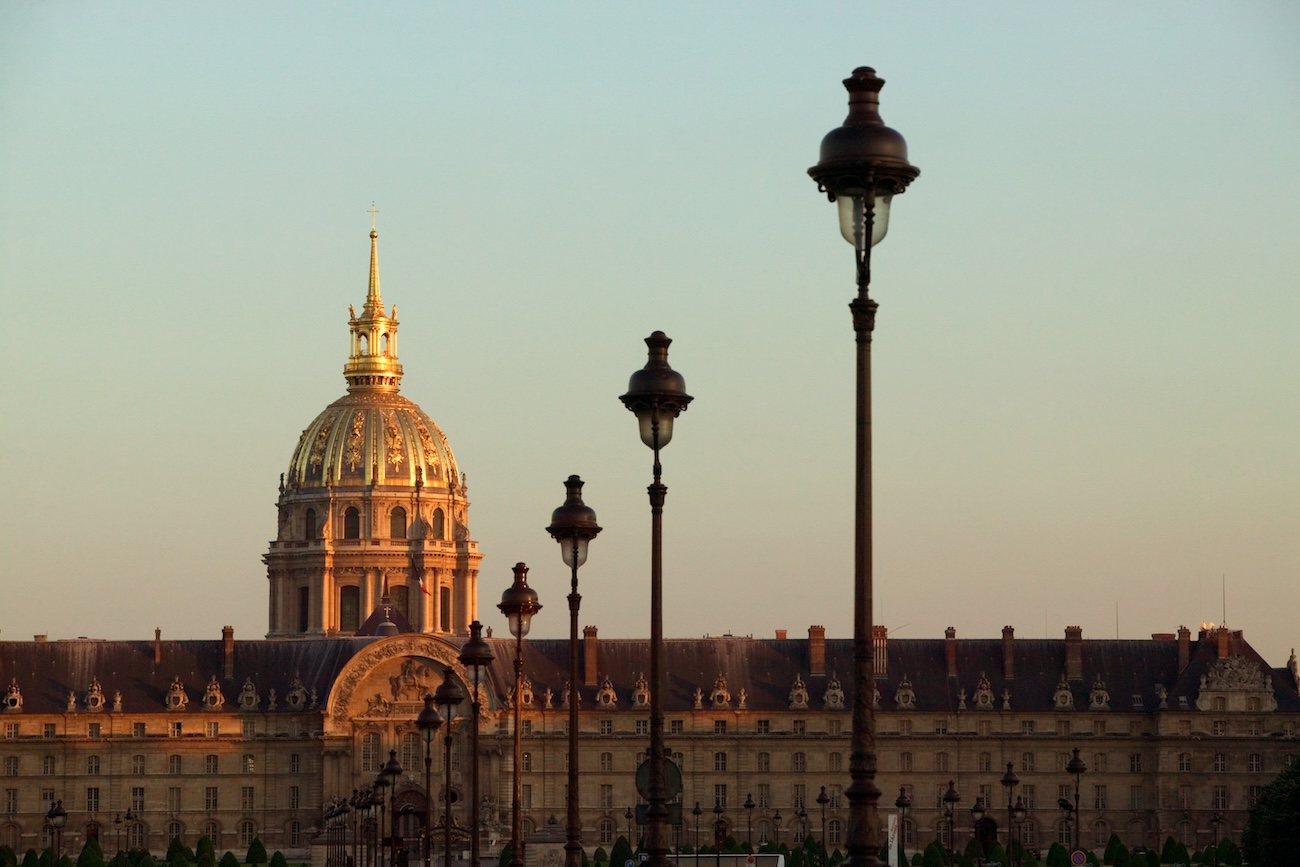
A Glacial Morning in December 1840
Paris is locked in unusual cold on the morning of December 15, 1840; the Seine is carrying floes of ice. From the Pont de Neuilly to the gates of Les Invalides, papier-mâché columns slapped together the previous night line a six-kilometer route. Behind the columns, roughly a million Parisians are pressed against barricades in the freezing air. Bells across the city begin to ring at first light. Cannon fire from the forts on the city’s edge punctuates the morning at measured intervals.
A funeral carriage more than ten meters tall, drawn by sixteen horses caparisoned in gold and white plumes, descends the Champs-Élysées at a slow walk. Behind it march four hundred sailors from the frigate Belle Poule, fifteen abreast, who have spent the previous five months escorting a coffin 7,200 kilometers across the Atlantic. At their head rides François d’Orléans, Prince de Joinville — the king’s third son, a career naval officer, twenty-two years old, and the man personally chosen to retrieve the body. The body in the carriage is Napoleon Bonaparte, dead nineteen years on a rock in the South Atlantic, finally arriving at his own funeral.
Inside the cour d’honneur of Les Invalides, King Louis-Philippe I waits in the freezing wind. He is sixty-seven years old. He has been on the throne for ten years. The bourgeois July Monarchy he heads is unloved by the Bonapartists who never accepted it, by the legitimists who want a Bourbon back, and increasingly by the republicans who will overthrow him in eight years. He has staged this entire ceremony — the diplomatic negotiation with the British, the naval expedition, the procession — to bind his fragile regime to the mythology of the emperor in the carriage. The body is meant to confer legitimacy on the king. The crowd along the Champs-Élysées shouts “Vive l’Empereur!” The crowd does not shout “Vive le Roi.”
Les Invalides is the architecture of French military memory, and every French regime since 1670 has tried to weaponize it. Louis XIV built it to absorb the political danger of broken veterans. The Revolution stripped it of weapons and used them against his great-great-grandson. Louis-Philippe imported the body of an emperor to legitimize his throne and instead launched the dynasty that replaced him. The Third Republic used its courtyard to publicly destroy Alfred Dreyfus and was nearly torn apart by the case. The building is a stage. Whoever miscalculates inside it loses.
Louis XIV’s Solution to the Problem of Broken Veterans
Why No European Monarch Had Systematically Housed Wounded Soldiers Before 1670
Wounded veterans were a chronic political problem of seventeenth-century European kingship. Wars consumed bodies on a scale earlier centuries had not contemplated, and the bodies that came back broken — missing limbs, blinded, paralyzed, mentally destroyed — had nowhere to go. France in 1670 had between fifty and eighty thousand disabled veterans wandering its provinces, begging in cities, joining bandit gangs, occasionally rioting outside royal palaces. Henri IV had attempted a hospital in 1604; it had closed at his assassination in 1610. Cardinal Richelieu had founded another in 1634; it had failed. Louis XIV issued the order founding what would become Les Invalides on November 24, 1670. He was thirty-two years old and had been making war for a decade. He understood that a king who failed his veterans would not be a king for long.
The site chosen was the suburban plaine de Grenelle on the Seine’s left bank, a flat marshy district outside the city wall. The architect was Libéral Bruant, son of a Parisian architectural family with connections to the royal court. Construction began on September 30, 1671. By October 1674 the first wounded soldiers were moving in; by 1676 the main complex was substantially complete, with a Seine façade of 196 meters, fifteen interior courtyards, and a central cour d’honneur measuring 102 by 63 meters that could accommodate the parading of an entire battalion. The complex was not a hospital in the modern sense. It was a small fortified city for war casualties — barracks, infirmary, refectory, kitchens, workshops, all run on military discipline.
Bruant, Hardouin-Mansart, and the Architecture of Royal Mercy
The architectural language of Les Invalides was the same language Louis XIV used at Versailles. The façade is severe Doric; the central pavilion is a triumphal arch crowned with the king depicted as a Roman emperor on horseback. The message is unsubtle: the wounded inside are wounded for the glory of the king, and the building is the king’s gift to them. Architectural propaganda was the operating principle of every Bourbon project of the period, and Les Invalides was no exception. Even the war minister, the Marquis de Louvois, was not permitted to put his coat of arms on the building. He smuggled a single skylight in the cour d’honneur — the lucarne de Louvois — bearing his personal emblem, and got away with it because nobody noticed in time.
The most ambitious component of the complex was the chapel — actually two chapels in one building, designed by Bruant’s collaborator Jules Hardouin-Mansart, the Sun King’s chief architect and the genius behind the Hall of Mirrors at Versailles. Hardouin-Mansart began the dome in 1677; it would not be completed until 1708 by his pupil Robert de Cotte. The dome rises 107 meters, modeled on St. Peter’s Basilica in Rome, gilded with 12.65 kilograms of gold (in its 1989 regilding, using 550,000 leaves at 0.2 microns thick). Hardouin-Mansart designed it as a private royal chapel attached to a public veterans’ chapel — two churches sharing an altar, partitioned so the king and the common soldier could attend the same Mass through different doors and never see each other. The architecture encoded the social contract Louis XIV was offering: the king will house you and feed you for life, and in exchange you will pray on the other side of a wall.
Inside the Hôpital Royal: Four Thousand Veterans Under One Dome
The Daily Liturgy and the Rules of the House
Life inside Les Invalides was governed by a regulation as exact as anything in a working barracks. The veterans rose at dawn, attended Mass in Saint-Louis-des-Invalides at six, and were assigned tasks for the morning depending on capability. Men who had lost legs worked as cobblers and tailors. Men who had lost arms tended gardens and worked as sentinels. Men too damaged to work attended chapel and were fed. Daily attendance at Mass was compulsory. Drunkenness was punished. Fights were punished. Refusal to attend Mass was punished by transfer to a punishment ward called the salle des infâmes — the hall of the disgraced.
Capacity expanded across the eighteenth century. The complex was designed for roughly four thousand residents; at peaks during the Wars of Spanish Succession, more than seven thousand veterans were crammed into wards designed for half that number. Mortality was high — the population was elderly, traumatized, and frequently tubercular — but turnover was constant. By the time of Louis XIV’s death in 1715, more than one hundred thousand French soldiers had passed through the institution. By 1789, the cumulative figure was approaching half a million. Les Invalides was the largest single repository of military experience in Europe, and the men inside it had collectively fought every war the Bourbon monarchy had run for a century.
Two Churches in One Building: The King and the Common Soldier Kept Apart at Mass
The central architectural curiosity of the complex was its dual chapel. Saint-Louis-des-Invalides — the veterans’ chapel, lined with captured enemy flags hung from the vaulting — opens onto the cour d’honneur. The veterans entered through a door reserved for them, sat on hard benches, and prayed under banners they or their predecessors had taken in battle. The Église du Dôme — the royal chapel beneath the gilded cupola — opens to the south and was reserved for the king and his court. The two chapels share an altar and were originally separated only by a curtain; the king and the wounded soldier could attend the same liturgy without ever sharing a pew.
The arrangement carried Bourbon political theology in its bones. The king was sacred; the soldier was the king’s instrument; both were owed to the same God. The architectural separation made the relationship visible. The two chapels were physically reinforced through the eighteenth and nineteenth centuries — first with two altars placed back-to-back, then with a glass wall — until eventually the soldiers’ chapel and the royal chapel functioned as separate buildings. The history of the partition is the history of the French regime’s evolving relationship with its own veterans, visible in stone, mortar, and glass.
July 14, 1789: How the Veterans’ Cellars Armed the Revolution
The Twenty-Eight Thousand Muskets the Sun King’s Great-Great-Grandson Lost in an Afternoon
By the summer of 1789, the cellars of Les Invalides held one of the largest small-arms arsenals in France: roughly twenty-eight thousand muskets and a dozen field cannon, stored against the possibility of a major continental war. The arsenal had not been intended for an urban insurrection. Paris in early July was running out of bread and patience. The royal army was visibly massing on the city’s outskirts. On July 13, the bourgeois militia of Paris began breaking into armories across the city in search of weapons. The largest arsenal they knew of was inside the most prestigious military institution in the country.
A crowd estimated at between eight and ten thousand massed outside the gates of Les Invalides on the morning of July 14, 1789. The governor — an aging royalist named Charles François, Marquis de Sombreuil — was unable to mount an effective defense. The veterans inside the hospital, asked to fire on the crowd, refused. Many of them were old enough to have spent decades fighting for the same king whose grandson they were now being asked to defend; the prospect of shooting Parisians on behalf of a regime that had recently stopped paying them on time was not appealing. The crowd entered the courtyards within an hour. They moved straight to the cellars and began carrying out muskets. By midday, the arsenal of Louis XIV had been distributed onto the streets of Paris.
From Invalides to Bastille: The Revolution’s First Ammunition Run
The muskets needed gunpowder. The largest gunpowder magazine in central Paris was at the Bastille — the medieval fortress-prison on the eastern edge of the city. The mob that had armed itself at Invalides regrouped and marched east. The afternoon storming of the Bastille that French history would commemorate as the symbolic beginning of the Revolution was, in operational terms, the second event of the day. The first event was the looting of Les Invalides. The Bastille came second because the Bastille was where the powder was. Without the morning at Invalides, the afternoon at the Bastille would have been a riot with bare hands.
The veterans inside Les Invalides watched the cellars empty and did not intervene. Several joined the crowd. Within weeks, the institution had been formally placed under National Assembly authority; within years, it had been renamed the Hôpital National des Militaires Invalides, stripped of its overtly Bourbon iconography, and refitted as an institution of the new Republic. The building survived the Revolution intact because the Revolution needed the building. Wounded soldiers do not stop being a political problem because the king has been guillotined. The architecture Louis XIV had built to manage that problem was simply repainted and repurposed.
The Retour des Cendres: A King’s Plan to Co-Opt a Dead Emperor
The Belle Poule, the Prince de Joinville, and the 7,200-Kilometer Voyage
Napoleon Bonaparte had died on Saint Helena on May 5, 1821. He had been buried on the island under a plain stone marked simply Ici git. By the late 1830s, Bonapartism in France had quietly become the most dangerous political current the July Monarchy faced. Prime Minister Adolphe Thiers, an ambitious historian-politician, calculated that the most effective way to neutralize Bonapartist nostalgia was to absorb it. If the regime brought Napoleon’s body home and gave it a state burial inside the institution Louis XIV had built, the July Monarchy would inherit the Napoleonic legacy by association. King Louis-Philippe agreed. Negotiations with Britain were opened in May 1840. The British, anxious to repair relations with France over the deteriorating Egyptian crisis, agreed.
The expedition departed Toulon on July 7, 1840. The frigate Belle Poule, painted black for mourning, was commanded by the king’s third son, the Prince de Joinville. The escort vessel Favorite sailed alongside. Aboard were several of the men who had been with Napoleon on Saint Helena — Marshal Henri-Gatien Bertrand, his son Arthur, and the valet Louis Marchand — returning to recover a body they had buried nineteen years earlier. The voyage took ninety-three days. The ships called at Cádiz, Madeira, Tenerife, and spent fifteen days in Bahia, Brazil, where the prince attended a series of balls. On October 15, 1840, on Saint Helena, the coffin was raised from the grave. The body inside, when the inner coffin was opened for verification, was reportedly remarkably preserved — Napoleon’s face still recognizable, his uniform intact. The witnesses on the island wept. The coffin was sealed, transferred aboard the Belle Poule, and the squadron sailed for France.
December 15, 1840: The Procession Louis-Philippe Could Not Control
Cherbourg received the coffin on November 30, 1840. From Cherbourg the body traveled by river and steamer to the outskirts of Paris, arriving at Courbevoie on December 14. Final preparations along the cortège route had run desperately late — Interior Minister Tanneguy Duchâtel had announced flatly that the funeral would take place on the fifteenth, “whatever weather should happen or arise,” and the papier-mâché architecture lining the Champs-Élysées was hammered into place overnight, on the morning of the ceremony itself.
The cold on the day was the most severe Paris had seen in years. The cortège began at the Étoile and moved down the Champs-Élysées at a slow walk. Eighty thousand troops of the Army and the National Guard lined the route. The funeral chariot, designed to evoke a Roman triumph, was draped in violet velvet and topped with an enormous gilded crown. The crowd — estimated at one million Parisians, drawn from across the suburbs and the surrounding countryside — broke into spontaneous shouts of “Vive l’Empereur!” as the carriage passed. The shouts were not for Louis-Philippe. The procession reached Les Invalides shortly after one o’clock. The coffin was carried into the Église du Dôme. The king received it formally. The state ceremony was respected. The political ceremony, the one Louis-Philippe had actually been hosting, was a quiet disaster. The crowd had come to mourn the dead emperor, not to legitimize the living king. Within eight years, Louis-Philippe would be in exile in England, and the dead emperor’s nephew, Louis-Napoleon Bonaparte, would be the elected president of the Second Republic. Within twelve years, that nephew would crown himself Napoleon III.
Visconti’s Crypt and the Twenty-One-Year Construction of the Tomb
The Architectural Competition, the Porphyry Sarcophagus, the Six Coffins
The 1840 ceremony placed Napoleon’s coffin in a temporary location — the Chapelle Saint-Jérôme, a side chapel of the Église du Dôme. The permanent tomb did not yet exist. An architectural competition was announced in April 1840; eighty-one architects submitted designs; the winner, named in 1842, was the Italian-born Louis Visconti, the same architect who would later design the new wings of the Louvre under Napoleon III.
Visconti’s design called for the floor of the Église du Dôme to be opened, an enormous circular crypt to be excavated beneath it, and a single monumental sarcophagus to be placed at the crypt’s center. The sarcophagus was carved from a single block of red Finnish porphyry — a stone the Russian Empire allowed France to extract from its territory specifically for this purpose. The block weighed approximately thirty-five tonnes after carving. Inside it, Napoleon’s body was sealed within six coffins, one inside the next, in the manner of a Russian doll: an outer coffin of ebony, then oak, then lead, then mahogany, then lead again, then tinplate. The inner coffin held the body. The outer porphyry sarcophagus stood approximately four meters high and weighed enough to require structural reinforcement of the crypt floor.
1861: Napoleon III Completes the Tomb on the Throne the 1840 Ceremony Helped Him Win
The crypt took twenty-one years to complete. Visconti worked on the design until his death in 1853. The work continued under his successors. By 1861, the Second Empire had been in power for nine years, and the man on the throne — Napoleon III — was the direct political beneficiary of the 1840 ceremony his predecessor had staged. On April 2, 1861, Napoleon I’s coffin was finally moved from the Chapelle Saint-Jérôme into Visconti’s crypt. The transfer was a quiet, intimate ceremony, attended by Napoleon III, Empress Eugénie, the Prince Imperial, and a small group of ministers. There was no public spectacle. There did not need to be. The dynasty had returned, the body was where it belonged, and the cycle that had begun with the funeral of 1840 had completed itself.
Visconti’s crypt is the most photographed military tomb in the world. The sarcophagus sits at the center of a circular gallery rimmed by twelve marble Victories representing Napoleon’s major campaigns, and a mosaic floor inscribed with the names of his battles — including Austerlitz, where the man inside the porphyry had crushed two emperors in a single afternoon thirty-five years before he died on Saint Helena. Visitors to the crypt are obliged to bow their heads to read the names — a piece of architectural choreography that Visconti, on Napoleon III’s instructions, designed deliberately. The dead emperor would receive every visitor with an inclination of the head. The architecture was still doing political work twenty years after the funeral.
January 5, 1895: The Public Degradation of Captain Dreyfus
The Ceremony in the Cour Morland and the Crowd Outside the Gates
Captain Alfred Dreyfus, a Jewish artillery officer from Alsace, was convicted of treason by a French military court on December 22, 1894, on falsified evidence engineered by senior army officers. The verdict was life imprisonment on Devil’s Island. Before the prison sentence began, the Republic required a formal degradation ceremony — the public stripping of an officer’s rank and the breaking of his sword, conducted before assembled troops. The ceremony was held at Les Invalides.
The morning of January 5, 1895, was cold. Five thousand troops were drawn up in formation in the Cour Morland, a small interior courtyard opening off the cour d’honneur. Dreyfus was marched in under escort, in full uniform. A senior officer read the sentence aloud. A sergeant-major of the Republican Guard then approached him and tore the gold braid, the buttons, and the regimental insignia from his uniform, one by one. He drew Dreyfus’s sword from its sheath and broke it across his knee. Dreyfus, who had insisted on his innocence at every stage, shouted across the courtyard: “Vive la France! Vive l’Armée! Je suis innocent!” He then walked the perimeter of the courtyard in his stripped uniform, displayed to the assembled troops.
A crowd of several thousand had gathered outside the gates on the Place Vauban. As Dreyfus walked, the crowd outside chanted “À mort le Juif!” — Death to the Jew. Among the journalists present was a thirty-four-year-old correspondent from Vienna’s Neue Freie Presse, an assimilated Hungarian Jew named Theodor Herzl. Herzl heard the chants. Herzl had not previously thought of himself as primarily Jewish; he was a Viennese man of letters who happened to be Jewish. The chants rearranged that. Within eighteen months he had written Der Judenstaat. Within five years he had founded the political Zionist movement. The courtyard at Les Invalides, on a January morning in 1895, produced the modern state of Israel as a side effect of a French miscarriage of justice.
The Affair tore France apart for twelve years and ended with Dreyfus formally exonerated in July 1906. The reinstatement ceremony took place in the cour d’honneur of Les Invalides — the same complex, a different courtyard, twelve years after the degradation. The ceremony was small and deliberately understated. Most of the senior officers who had engineered the original conviction did not attend. The destruction in 1895 and the rehabilitation in 1906 are both stones in the same building. The architecture absorbed the contradiction without comment, the way it had absorbed the contradictions of the Bourbons, the Revolution, and the two empires before it.
Bonaparte Family Tombs and Hitler’s Strange Gift to Paris
Joseph, Jérôme, and the Marshals of France
The Église du Dôme is the dynastic chapel of the entire Bonaparte family, and Napoleon’s tomb is its centerpiece, but the building also houses the bodies of figures the French Republic and the empires before it chose to honor. Joseph Bonaparte — Napoleon’s elder brother and the briefly installed king of Spain — was returned from his American exile and interred in a side chapel in 1862. Jérôme Bonaparte — the youngest brother, briefly king of Westphalia — was placed in another side chapel after his death in 1860. Marshal Foch, the supreme Allied commander of the First World War, was given a tomb in the Église Saint-Louis after his death in 1929. Marshal Lyautey, the architect of French Morocco, joined him in 1934. Marshal Vauban — the seventeenth-century military engineer whose fortifications defined the borders of Bourbon France — had been moved to the Dôme in 1808 on Napoleon’s personal order. Henri de la Tour d’Auvergne, Vicomte de Turenne — Louis XIV’s most celebrated marshal — had been transferred even earlier, in September 1800, when the dome was first designated a military necropolis.
The accumulation tells its own story. The chapel has been used by every regime — empire, monarchy, republic — to house the bodies of figures the regime wanted associated with its legitimacy. The bodies do not all belong to the same political tradition. Foch, who fought to defend the Third Republic, lies in the same building as Napoleon, who would have abolished it. Vauban, who served the Sun King, lies near Lyautey, who served a colonial Republic. The architecture treats them as a single tradition. They were all, in the end, French soldiers, and Les Invalides is where French soldiers go.
December 1940: Hitler Returns the Aiglon’s Body to Paris
Adolf Hitler made a calculated political gesture in December 1940, with Paris under German occupation. The body of Napoleon François Charles Joseph Bonaparte — Napoleon’s only legitimate son, known as l’Aiglon, the Eaglet, who had died of tuberculosis in Vienna in 1832 at the age of twenty-one — had been buried in the Habsburg imperial crypt at the Capuchin Church in Vienna for over a century. Hitler ordered the body exhumed and transferred to Paris as a gift to occupied France, on the centenary of Napoleon’s own funeral.
The transfer took place on the night of December 14-15, 1940 — exactly one hundred years to the day after the original Retour des cendres. The Aiglon’s coffin was placed in the Église Saint-Jérôme, a few meters from his father. The gesture was political theater on the same model Louis-Philippe had used a century earlier: a Nazi regime trying to legitimize its occupation of France by associating itself with the dynasty buried in Les Invalides. The gesture did not work. The Vichy regime received the coffin. The French public, on the whole, ignored it. The Aiglon’s body remains in the chapel today. The German army used parts of the Invalides complex as a workshop and weapons depot for the duration of the occupation, a grim echo of the cellars Louis XIV had stocked with muskets in 1670 and the mob had emptied in 1789.
The building was used. It is always used. That is what the building is for.
The Atlas Entry: Visiting Les Invalides
Les Invalides is open to the public daily, with reduced hours on certain Mondays and closures on January 1, May 1, and December 25. The complex sits in the 7th arrondissement of Paris, accessible via Métro lines 8 and 13 at Invalides station, or via the RER C line at the same stop. A single ticket covers the Musée de l’Armée (the principal military history museum, with extensive collections from medieval armor through the Second World War), the Musée des Plans-Reliefs (a remarkable collection of three-dimensional fortification models built between 1668 and 1870 for the use of French military planners), the Musée de l’Ordre de la Libération (devoted to the Free French Resistance during the Second World War), and access to the Église du Dôme and Napoleon’s crypt. The Paris Catacombs — the city’s other monumental nineteenth-century engagement with the dead — sit roughly forty minutes south by Métro and pair naturally with a visit to the crypt.
The complex is also still a working military hospital. The Institution Nationale des Invalides continues to house and care for severely disabled French veterans — an unbroken institutional line from Louis XIV’s foundation in 1670 to the present. Visitors who pass through the cour d’honneur in the early afternoon will sometimes see elderly residents in dress uniforms taking the air. They are the direct descendants, in function, of the four thousand original invalides of 1674. The cathedral of the French Armed Forces, Saint-Louis-des-Invalides, remains in active use; commemorative masses are still held annually for the founding of the Hôpital Royal and for the death of Napoleon Bonaparte.
Standing in the cour d’honneur is a quiet but layered experience. The same stones absorbed the boots of veterans of the wars of Louis XIV, the muskets of the Revolutionary mob, the procession of December 1840, the destruction of Captain Dreyfus, the tanks of the Wehrmacht, and the rehabilitation ceremony of 1906. The architecture is unchanged. The political content of the architecture has been rewritten by every regime that has held France. A useful exercise for the visitor, before descending into the crypt to see the porphyry, is to stand in the middle of the cour d’honneur and consider that the central question Les Invalides has been asking, in different idioms, for three and a half centuries, is the same question every regime has had to answer in its own way. What does a state owe to the men it has used up?
Frequently Asked Questions
What is Les Invalides and why was it built?
Les Invalides — formally the Hôtel National des Invalides — is a seventeenth-century complex in central Paris built by Louis XIV beginning in 1670 to house and care for wounded and aged veterans of his armies. France in 1670 had between fifty and eighty thousand disabled veterans with nowhere to go, and the institution was the first systematic attempt by any European monarch to provide them with permanent housing, medical care, and a daily routine. The architect Libéral Bruant designed the main complex; Jules Hardouin-Mansart designed the gilded dome that still defines the building’s silhouette. The institution opened its doors in October 1674 and is still a working military hospital today.
Where is Napoleon buried?
Napoleon Bonaparte’s body lies in the crypt beneath the Église du Dôme at Les Invalides. The body was returned from Saint Helena in December 1840 in a state ceremony known as the Retour des cendres, organized by King Louis-Philippe and Prime Minister Adolphe Thiers. The remains lay in a temporary side chapel for twenty-one years while the architect Louis Visconti designed and built a permanent crypt. The body was transferred to its current sarcophagus on April 2, 1861, during the reign of Napoleon III. The sarcophagus itself is carved from a single thirty-five-tonne block of red Finnish porphyry. Inside it, Napoleon’s body is sealed within six coffins, one inside the next.
What happened at Les Invalides on July 14, 1789?
On the morning of July 14, 1789, a Paris mob of eight to ten thousand people stormed the cellars of Les Invalides and carried off roughly twenty-eight thousand muskets and a dozen field cannon — the largest small-arms arsenal in central Paris. The veterans inside the building, asked to fire on the crowd, refused. The mob then marched east to the Bastille later the same afternoon, where they obtained the gunpowder needed for the muskets they had already taken. The afternoon storming of the Bastille that French history commemorates as the symbolic beginning of the Revolution was, in operational terms, the second event of the day. The first event was the looting of Les Invalides.
Who is Captain Alfred Dreyfus and what does he have to do with Les Invalides?
Alfred Dreyfus was a Jewish artillery officer convicted of treason in December 1894 on falsified evidence engineered by senior officers of the French Army. The public degradation ceremony that preceded his transportation to Devil’s Island took place on January 5, 1895, in the Cour Morland of Les Invalides, before five thousand assembled troops. Dreyfus’s gold braid and insignia were torn from his uniform and his sword broken across an officer’s knee while a crowd outside the gates chanted “Death to the Jew.” Among the witnesses was the journalist Theodor Herzl, whose response to the ceremony directly motivated his founding of the political Zionist movement. Dreyfus was eventually exonerated and reinstated in the Army at a small ceremony in the same complex in July 1906.
Who else is buried at Les Invalides besides Napoleon?
The Église du Dôme functions as a dynastic chapel for the entire Bonaparte family and as a national mausoleum for selected French military figures. Napoleon’s brothers Joseph and Jérôme are interred there, as is his only legitimate son, Napoleon François Charles Joseph (the “Aiglon”), whose body Hitler transferred from Vienna in December 1940 in a calculated political gesture. The seventeenth-century military engineer Vauban and Louis XIV’s marshal Turenne were placed in the Dôme by Napoleon’s order in 1800 and 1808. Marshal Foch, the supreme Allied commander of the First World War, was buried in the adjacent Église Saint-Louis after his death in 1929, and Marshal Lyautey joined him in 1934.
Can I visit Les Invalides today?
Les Invalides is open to the public daily and accessible via Métro lines 8 and 13 at Invalides station or RER C at the same stop. A single ticket covers the Musée de l’Armée, the Musée des Plans-Reliefs, the Musée de l’Ordre de la Libération, and access to the Église du Dôme and Napoleon’s crypt. The complex closes on January 1, May 1, and December 25. The cathedral of the French Armed Forces, Saint-Louis-des-Invalides, remains in active religious use, and the Institution Nationale des Invalides continues to function as a working military hospital for severely disabled French veterans — an unbroken institutional line from Louis XIV’s foundation in 1670 to the present.
Sources
Les Invalides: Three Centuries of History — Musée de l'Armée Official Catalogue, Paris (2008)
Louis XIV: A Royal Life — Olivier Bernier, Doubleday (1987)
Hardouin-Mansart and the Architecture of the Sun King — Robert W. Berger, Pennsylvania State University Press (1994)
The Coming of the French Revolution — Georges Lefebvre, Princeton University Press (1947, English edition 1989)
The Retour des Cendres: Napoleon's Body Returns to Paris — Fondation Napoléon (napoleon.org)
Napoleon: A Life — Andrew Roberts, Viking (2014)
The Second Funeral of Napoleon — William Makepeace Thackeray writing as Michael Angelo Titmarsh (1841)
Funerals, Politics, and Memory in Modern France, 1789–1996 — Avner Ben-Amos, Oxford University Press (2000)
The Affair: The Case of Alfred Dreyfus — Jean-Denis Bredin, Braziller (1986)
The Jewish State (Der Judenstaat) — Theodor Herzl (1896)
Paris Under the Occupation — Allan Mitchell, Berghahn Books (2008)
Le Tombeau de Napoléon: Visconti et l'Art Funéraire du Second Empire — Thierry Lentz, Fondation Napoléon (2010)