
The Black Pope and the Society of Jesus: A Global Intelligence Network
Ignatius of Loyola: From Basque Soldier to Spiritual General
The Society of Jesus was founded not by a mystic, but by a professional soldier. Ignatius of Loyola was a Basque nobleman whose legs were shattered by a cannonball at the Battle of Pamplona in 1521. His recovery was marked by a brutal realization: he could no longer serve an earthly king, so he would apply the principles of Spanish military discipline to the service of God.
Ignatius did not write prayers in the traditional sense; he wrote the Spiritual Exercises, a rigorous 30-day manual of psychological conditioning. It was designed to strip away the initiate's ego and replace it with a singular, iron-clad loyalty to the Pope. The Jesuits were not monks; they were soldiers of Christ. They did not retreat into monasteries; they were deployed into the world as a mobile, intellectual strike force.
The Military Hierarchy of the Jesuit Command Structure
The Order is governed by a Superior General, often nicknamed the Black Pope due to his immense, shadow-dwelling power and the black cassock he wears. Unlike the traditional Pope, who is a public figure of ritual and diplomacy, the Superior General is a military commander. He holds office for life and demands absolute, unquestioning obedience from his subordinates.
The hierarchy is clinical. Beneath the General are Provincials, who manage entire geographic regions, and beneath them are the Rectors of houses. Every Jesuit is required to submit regular, detailed reports to Rome. This created the world’s first truly global intelligence-gathering network. Long before the CIA or MI6, the Black Pope in the rooms adjacent to Il Gesù knew the secrets of the Chinese Emperor and the weaknesses of the French King.
Total Obedience: The Doctrine of Perinde ac Cadaver
The core of Jesuit discipline is the vow of obedience. In his Constitutions, Ignatius famously commanded that a member of the Society should be perinde ac cadaver—as a corpse. This means the individual must have no will of his own. If the Superior commands that black is white, the Jesuit is expected to believe it with his entire being.
This doctrine turned the Order into a terrifyingly efficient machine. A Jesuit could be ordered to infiltrate a hostile court, knowing he would likely be caught and executed, and he would go without hesitation. This corpse-like obedience made them the most dangerous men in Europe. They were untethered from personal safety or national loyalty. Their only reality was the mission dictated from the headquarters at Il Gesù.
The Counter-Reformation: Reclaiming Rome Through Blood and Beauty
The Council of Trent and the Birth of the Jesuit Mission
In the mid-16th century, the Catholic Church was dying. Martin Luther’s Reformation had torn Germany away, and the corruption of the Vatican was a global joke. The Council of Trent (1545-1563) was the Church’s desperate attempt to save the brand. The Jesuits were the consultants hired to execute the turnaround.
Their mission was the Counter-Reformation: the total reclamation of lost territory. This was a war fought on two fronts. In Europe, it was an intellectual and political battle to suppress Protestantism. Overseas, in the Americas and Asia, it was a race to conquer souls. Il Gesù was built as the flagship of this movement—a visible sign that Rome was back, and it was more powerful and more organized than ever before.
Infiltrating Monarchies: The Jesuit Confessors as Political Puppeteers
The Jesuits’ most effective weapon was the confessional. They understood that to control a nation, you do not need to convert the peasants; you only need to control the conscience of the King. Jesuits became the private confessors to almost every major Catholic monarch in Europe.
This gave them unprecedented access to the deep state of the 16th and 17th centuries. In the quiet of the confessional, they could influence succession, dictate war policy, and ensure that the laws of the land favored the Church. They were the ultimate grey eminences, moving the pieces on the European chessboard from their offices in Rome. This political infiltration made them deeply feared, leading to the myth of the Jesuit Plot—the idea that every palace intrigue was secretly orchestrated from the Piazza del Gesù.
The Brutal Reality of the Inquisition and Overseas Conversions
While the Jesuits were masters of education, they were never shy about the use of force. They were the intellectual backbone of the Inquisition, providing the theological justification for the suppression of forbidden books. They viewed the world in binary terms: those within the Church and those who must be broken.
Overseas, the conquest was even more literal. In the Reductions of Paraguay and the missions of the Philippines, the Jesuits created semi-autonomous states where indigenous populations were rounded up into planned communities. While they protected these populations from traditional slave traders, they also subjected them to a totalizing regime of labor and religious indoctrination. The Jesuits were the pioneers of soft power colonialism, and the wealth generated from these global outposts flowed back to Rome to fund the very gold and marble found in Il Gesù.
The Final Interrogators: Jesuits on the Killing Floor
The Jesuit mission of total obedience reached its most lethal application in the shadow of the gallows. Members of the Order were the designated handlers for those condemned by the Inquisition, serving as the final spiritual interrogators on the "Walk of the Condemned." As the prisoners were led from their cells to Campo de’ Fiori, it was the Jesuits who walked beside them, utilizing the psychological pressure of the Spiritual Exercises to demand a final, public recantation.
In the case of Giordano Bruno in 1600, Jesuit confessors hovered over him at the stake until the moment the wood was lit, attempting to force a "corpse-like" submission before the flames consumed him. This was the dark reality of the Jesuit command structure: while the "Black Pope" managed global intelligence from the offices of Il Gesù, his soldiers were on the ground in the Campo, ensuring that even the state's most high-profile murders were processed with the Order's clinical, theological precision.
The Psychological Warfare of the Baroque Interior
The Sensory Overload of Gold, Marble, and Incense
To walk through the doors of Il Gesù is to be subjected to a deliberate assault on the human nervous system. This is not a place of quiet contemplation; it is a theatre of power. The air is thick with the residue of centuries of frankincense and the cold, mineral scent of ancient marble. In the 16th century, when the majority of the Roman population lived in squalor and dim light, the interior of this church was a supernova of gold leaf and polished polychrome stone.
The Jesuits understood that to conquer the mind, one must first overwhelm the senses. Every surface is hyper-active. There is no empty space for the eye to rest, a technique known as horror vacui. This sensory saturation was designed to render the individual small and porous, ready to be filled with the ideology of the Order. It is the architectural equivalent of shock and awe, a structural intimidation tactic that preceded modern psychological operations by four hundred years.
The Triumph of the Name of Jesus: A Ceiling That Swallows the Soul
The ceiling fresco, The Triumph of the Holy Name of Jesus by Baciccio, is the ultimate weapon in this interior. It is a masterpiece of trompe l'oeil engineering, where the paint spills over the stucco frames and into the physical space of the nave. To look up is to experience a violent vertigo; the ceiling appears to dissolve, sucking the viewer into a swirling vortex of light and falling bodies.
The falling figures represent the heretics—those who resisted the Catholic Church—being cast down into darkness. It is a graphic, vertical representation of the Jesuit mission: the elevation of the faithful and the literal crushing of the opposition. The use of perspective and light is clinical and manipulative, designed to create a physical sensation of the supernatural that the uneducated or the emotionally vulnerable could not resist. It is propaganda executed with the precision of a master surgeon.
Geometry as a Tool of Religious Intimidation
The ground plan of Il Gesù was a radical departure from the traditional Latin cross. It is a single, massive barrel-vaulted nave without side aisles, ensuring that every person in the building has a direct, unobstructed line of sight to the high altar. This is the auditorium model of church design. It was built for the sermon—the primary tool of Jesuit indoctrination.
The geometry is focused. It channels the energy of the crowd toward a single point of authority. By removing the architectural distractions of medieval cathedrals, the Jesuits created a space where the General of the order could project his voice and his will with maximum efficiency. The church is a megaphone of stone, a centralized node of communication designed to synchronize the belief systems of thousands of people simultaneously.
Architecture as Propaganda: Decoding the Facade of Il Gesù
Giacomo della Porta and the Standard for Global Church Design
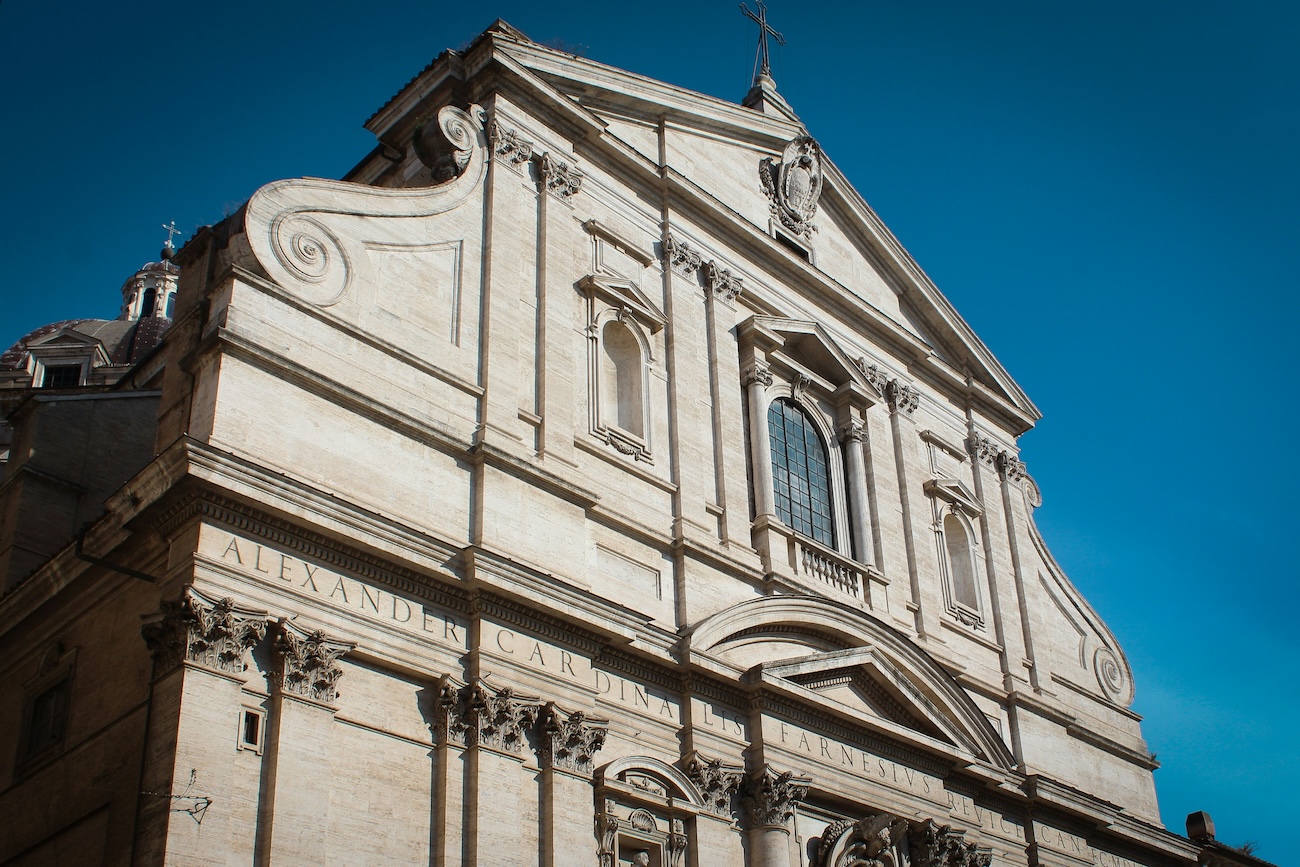
The facade of Il Gesù, designed by Giacomo della Porta, is the most influential piece of religious architecture in history. It was the blueprint. Every Jesuit church from Mexico City to Macau followed this model. It features a two-story structure with massive volutes that hide the roofline and create a sense of imposing height and stability.
This was branding before the concept existed. The goal was for a person anywhere in the world to see this facade and immediately know they were standing before the power of the Jesuit Order. It is a design of heavy, muscular authority. It doesn't invite you in; it commands you to enter. It is the architectural equivalent of a military uniform—standardized, recognizable, and designed to project disciplined strength.
The IHS Monogram: Branding the Catholic Reconquista
Above the main door sits the IHS monogram. While it is technically a contraction of the name Jesus in Greek, the Jesuits turned it into a global corporate logo. It is often accompanied by a sunburst and three nails—symbols of the Passion.
In the context of the Counter-Reformation, this was the flag of the Reconquista. It signaled that the Secret Army of the Vatican had arrived. In Rome, the monogram is placed at the highest point of the facade, a reminder to the city that the Name of Jesus—and the Order that bears it—is the supreme authority.
The Hidden Vaults and the Bureaucracy of the Order
Below the splendor of the nave lies the engine room. The basement and the adjacent corridors are a labyrinth of archives and administrative offices. For centuries, this was the most data-rich environment on Earth. The Jesuits were obsessive record-keepers. Every letter sent by a missionary in the Amazon was transcribed and filed in Rome.
This bureaucracy allowed for a level of centralized control that was unprecedented in the 16th century. If a Jesuit in Goa made a tactical error, the General in Rome would know within months. The reality of Il Gesù is that it is a giant filing cabinet made of marble. The beauty of the frescoes above was only possible because of the cold, administrative efficiency of the men working in the shadows below.
Suppressions and Shadows: When the Vatican Turned on Its Own Army
The 1773 Suppression: Why the Pope Feared the Jesuit Shadow State
By the mid-18th century, the Jesuits had become too powerful for their own good. They owned land, controlled trade, influenced kings, and possessed a private army of information. The Catholic monarchs of Europe began to see the Order as a state within a state. They pressured Pope Clement XIV to destroy them.
In 1773, the Pope officially suppressed the Society of Jesus. The Black Pope was imprisoned, and the doors of Il Gesù were symbolically closed to the Order's leadership. This was a moment of profound irony: the Vatican’s most loyal army was dismantled by the very man they were sworn to obey. It remains one of the greatest betrayals in religious history, a testament to the fact that in the game of power, even God’s Marines are expendable.
The Restoration and the Modern Survival of the Order
The suppression lasted for 41 years. During this time, the Jesuits survived in the shadows, particularly in Russia and Prussia. In 1814, with the world in chaos after the Napoleonic Wars, the Church realized it needed its old intelligence agency back. The Order was restored.
The Jesuits returned to Il Gesù, but they were different. They were quieter, more focused on education and social justice, yet the core military structure remained intact. Today, the Order is influential once again, with a Jesuit—Pope Francis—sitting on the throne of Peter for the first time in history. The command center, however, has never moved.
The Ethics of Standing at the Epicenter of Holy Ambition
Standing in the center of the nave today, one must grapple with the ethics of this space. It is a monument to a group that did brutal things in the name of a higher good. They were the architects of the modern world’s first global surveillance and propaganda machine. They used art to manipulate, politics to infiltrate, and religion to conquer.
To visit Il Gesù is to witness the reality of sacred imperialism. You are looking at the beautiful result of an ugly process. The gold on the altar was often bought with the suffering of the colonized; the marble was laid to cement the power of a shadow state. To appreciate the church purely as art is to ignore the blood in the mortar. It is a site that demands we ask: how much darkness is acceptable to bring about a religious mission?
Navigating the Heart of Jesuit Rome
Logistics of Visiting the Piazza del Gesù
The Chiesa del Gesù is located at the Piazza del Gesù, a high-traffic intersection in central Rome near the Largo di Torre Argentina. It is a site of constant activity, fitting for an Order that never stops moving.
- Timing: The church is free to enter, but to see the miracle of the Altar of Saint Ignatius, you must arrive at 5:30 PM.
- The Rooms of St. Ignatius: Adjacent to the church are the original living quarters of Ignatius of Loyola. They are a stark contrast to the church—tiny and Spartan. This is the true General’s Bunker.
Observing the Rooms of Saint Ignatius: The General’s Bunker
Visiting the rooms where Ignatius lived and died is essential to understanding the Jesuit psyche. You walk through a corridor painted with trompe l'oeil scenes of his life, only to enter a space that feels like a prison cell. This is where the Spiritual Exercises were codified.
There is a psychological weight here. You are standing in the room where a single man decided to change the course of global history through sheer force of will. There is no gold here, only the cold reality of a soldier's discipline. It is the place where the Army was born.
The Psychological Weight of Sacred Imperialism
When you leave Il Gesù and step back into the chaotic streets of modern Rome, the transition is jarring. You have just left a 16th-century cockpit of global control. The psychological weight comes from the realization that the world we live in—defined by global networks and centralized intelligence—was pioneered in this very building.
The Jesuit legacy is everywhere. Every time you see a corporate logo or witness a hearts and minds military campaign, you are seeing the ghost of the Society of Jesus. They were the first to understand that the ultimate territory to be conquered is the human mind. Il Gesù is the monument to that victory—a victory of gold, stone, and absolute obedience.
FAQ: Common Inquiries Regarding the Jesuit Headquarters
Who is the "Black Pope" and does he still exist?
The "Black Pope" is the informal name given to the Superior General of the Society of Jesus. The title refers to the immense power the leader wields behind the scenes and the simple black cassock he wears, which contrasts with the white cassock of the Pope. The position still exists today; the Superior General is elected for life by the General Congregation of the Jesuits and continues to oversee the global operations of the Order from the Jesuit Curia adjacent to Il Gesù.
Is the Chiesa del Gesù the same as the Vatican?
No. While both are in Rome and part of the Catholic Church, they represent different entities. The Vatican is the sovereign city-state and the seat of the papacy. Il Gesù is the mother church of a specific religious order—the Jesuits. Historically, the two have often been in tension, as the Jesuits were seen as a powerful, semi-independent military and intellectual force that at times rivaled the influence of the traditional Vatican bureaucracy.
What is the daily "miracle" at the Altar of Saint Ignatius?
Every afternoon at 5:30 PM, a hidden mechanical system is activated at the Altar of Saint Ignatius within the church. A large painting of the saint is lowered into the altar structure to reveal a hidden, silver-plated statue of Ignatius of Loyola behind it. This spectacle is accompanied by music and lighting, serving as a surviving example of Baroque theater intended to create a sense of divine awe and mechanical mystery for the observer.
Why were the Jesuits suppressed by the Pope in 1773?
The suppression was the result of intense political pressure from the Catholic monarchies of Europe, specifically France, Spain, and Portugal. These nations viewed the Jesuits as an autonomous "shadow state" that held too much influence over colonial trade and domestic politics. To avoid a total schism with these powerful kings, Pope Clement XIV issued a decree to dissolve the Order, though they were eventually restored in 1814 after the Napoleonic Wars proved the Church needed its intellectual "army" once again.
What is the significance of the "IHS" symbol found throughout the church?
IHS is a Christogram—a monogram representing the name of Jesus. For the Jesuits, it became a standardized brand used to mark their presence globally. The Jesuit version typically includes a cross atop the 'H' and three nails below, representing the Crucifixion, all enclosed in a sunburst. It was a tool of visual dominance used to mark the territory of the Counter-Reformation.
Sources
- The First Jesuits - John W. O'Malley (1993)
- The Jesuits: A History from Ignatius to the Present - John W. O'Malley (2014)
- The Jesuit Order as a Global Intelligence Network - Journal of Jesuit Studies (2018)
- Baroque Art and the Counter-Reformation - The Metropolitan Museum of Art (2021)
- Official Site of the Chiesa del Gesù - General Curia of the Society of Jesus (2025)
- The Suppression and Restoration of the Society of Jesus - Vatican News Archive (2014)
- Ignatius of Loyola: The Spiritual Exercises - Jesuit Sources Publishing (2020)
- The Architecture of Giacomo della Porta - Encyclopedia Treccani (2022)
- Jesuit Missions and Global Colonialism - Cambridge University Press (2019)
- The Rooms of Saint Ignatius: Historical Guide - Jesuit Heritage Site (2024)




%2C%20Konjic%2C%20Bosnia.jpg)


