
The Grinding Teeth of the Sahara: The Reality of the Ore Train
Sensory Deprivation and Physical Trauma in the Open Hopper Cars
The journey begins with a violent, metallic shriek that echoes for miles across the flat expanse of the Sahara. When you climb into an open hopper car, you aren't just boarding a train; you are entering a mechanical furnace. During the day, the sun beats down with a 45°C intensity, reflected off the dark, heavy hematite rocks until the air itself feels liquid. The dust is the first thing to break you. It is a fine, red-black powder that tastes like blood and grit. It permeates every layer of clothing, finding its way into the corners of your eyes and the deep recesses of your lungs. There is no seat, no shelter, and no respite. You sit directly on the ore, feeling every vibration of the steel wheels as they grind against the sand-clogged tracks.
The Mechanical Symphony of Three Kilometers of Braking Steel
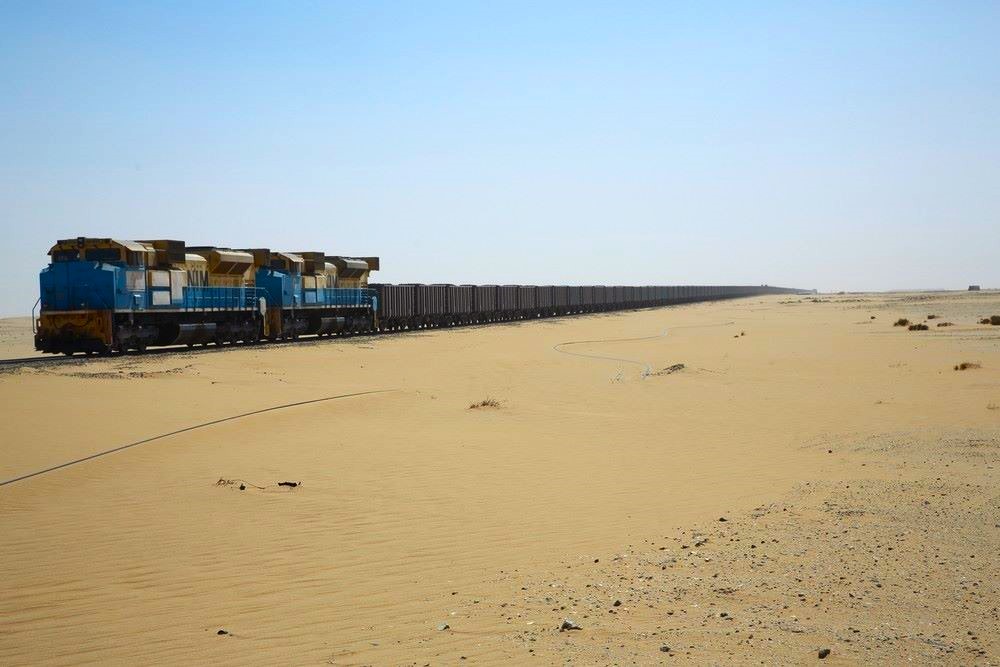
As the sun drops, the desert undergoes a violent transformation. The heat vanishes, replaced by a wind that cuts through wool and skin alike. The train, a 2.5-kilometer leviathan powered by three or four massive diesel locomotives, moves with a terrifying momentum. When the engineers apply the brakes, the sound is a cascading series of thunderclaps—the slack between 200 cars being taken up in a chain reaction of kinetic energy. In the middle of the night, in the absolute blackness of the Empty Quarter, the train may stop for no apparent reason. The silence that follows is deafening, broken only by the ticking of cooling metal and the distant, rhythmic breathing of the locomotives. This is the moment the hitchhikers fear most—the vulnerability of being stationary in a void where help is a thousand kilometers away.
The Colonial Ghost in the Machine: Historical Origins of the Rail
French Interests and the Scramble for Mauritanian Hematite
The tracks were not laid for the benefit of the Mauritanian people; they were forged by the hunger of European industry. In the 1950s, the French colonial administration and a consortium of European steel giants formed MIFERMA (Mines de Fer de Mauritanie). They discovered a mountain of iron—the Kedia d'Idjil—rising out of the desert like a rusted tooth. To extract this wealth, they needed a way to move 20 million tons of earth annually to the coast. The rail line was a feat of colonial hubris, a straight line of steel etched across a landscape that had known only camel tracks for three millennia. The laborers who built it died in the hundreds, victims of heatstroke and the relentless physical toll of shifting millions of cubic meters of sand by hand.
Engineering a Life-Line Against the Encroaching Sahara Dunes
The geography of Mauritania is an active enemy of infrastructure. The shifting dunes of the Adrar region move several meters a year, threatening to bury the tracks under millions of tons of sand. Maintaining this 704-kilometer corridor requires a constant, desperate war of attrition. Teams of "sand-shovellers" live in isolated shacks along the line, their entire existence dedicated to keeping the steel clear. The rails themselves are subjected to extreme thermal expansion, swelling in the day and shrinking in the sub-zero nights. Without the constant vigilance of these workers, the desert would reclaim the line in less than a month. It is a fragile umbilical cord connecting the mineral heart of the country to the global market, held together by sheer human willpower and aging French engineering.
The Mechanics of the Desert Leviathan: A 20-Hour Chronology
The Loaded Journey from the Mines of Zouérat to Nouadhibou
The cycle begins in the industrial dust-bowl of Zouérat. Here, massive excavators chew through the iron mountains, loading each wagon with 84 tons of ore in a matter of seconds. Once the 200 to 210 cars are coupled, the train begins its slow, agonizing crawl westward. For the first six hours, the landscape is a monotonous blur of gravel plains and jagged rock. As the train enters the Tiris Zemmour region, the hitchhikers—mostly traders and nomads—secure their positions. They build small walls out of the ore rocks to block the wind and light small charcoal fires on top of the iron to brew tea. It is a surreal sight: tiny sparks of domestic life moving at 50 kilometers per hour across an uninhabited wasteland.
The Choum Tunnel and the Irony of the Spanish Sahara Detour
One of the strangest landmarks along the route is the Choum Tunnel. Originally, the most efficient path for the rail ran through a corner of what was then the Spanish Sahara. When negotiations between the French and the Spanish broke down, the engineers were forced to tunnel through a massive granite outcrop inside Mauritanian territory. It was a brutal, unnecessary expense that became a monument to colonial bureaucracy. Only a few years after the tunnel was completed, the borders changed, and the rail could have run on the flat sand just a few hundred meters away. Today, the tunnel stands as a dark, echoing throat that the train takes several minutes to pass through, a brief moment of absolute darkness and intensified noise that serves as the midpoint of the journey.
Statistics of the World’s Longest and Heaviest Working Train
The sheer physics of the Mauritania Iron Train are staggering. Each train carries approximately 17,000 tons of iron ore. The combined weight of the wagons and cargo exceeds 22,000 tons. To move this mass, the locomotives consume over 20,000 liters of diesel per trip. The brakes are pneumatic, but the latency between the first car and the last car means that the train is in a constant state of internal tension. If a coupling snaps—a frequent occurrence in the early days—the runaway cars can reach speeds that melt the axles before they inevitably derail in a spectacular explosion of red dust and twisted steel.
The Hematite Lung: The Physical Reality of Iron Dust
The Clinical Impact of Hematite Dust Inhalation
The iron ore carried by the train is not just rock; it is a fine, abrasive dust. Within three hours of boarding, the hitchhikers begin to experience "Hematite Lung." The particles are small enough to bypass the cilia in the throat and lodge deep in the alveoli. The result is a persistent, metallic cough and a chronic inflammation of the respiratory tract. For the nomads who ride this train once a week to move supplies, the long-term effects are comparable to silicosis. Their eyes are permanently bloodshot, the fine dust having scratched the corneas. This is the "Gut Punch" of the journey: the very material that provides Mauritania with its only source of income is slowly destroying the bodies of the people who rely on it for transport.
Survival Tactics of the Saharan Iron Hitchhikers
The people on top of the train have turned survival into a science. They wear "shesh"—long cotton turbans wrapped tightly around the face, leaving only a tiny slit for the eyes. They use cheap plastic goggles to battle the dust. To prevent being thrown off during the violent jolts of the train, they dig shallow pits in the ore, huddling together for warmth as the temperature drops toward zero. They carry "bidons" of water that quickly become grit-filled and tepid. You will see goats with their legs tied, lying terrified on the shifting rocks, and bags of flour and sugar that will be stained red by the time they reach the market. This is the only way for the people of the interior to access the coast without paying for a 4x4 transport that costs more than a month's salary.
The Psychological Toll of the Sub-Zero Saharan Gale
The desert night is a psychological vacuum. Away from the light pollution of any city, the stars are blindingly bright, but they offer no comfort. The wind on top of the train is a constant, screaming presence. It robs the body of heat through convection at an alarming rate. Many travelers fall into a state of semi-catatonic shivering, their minds focused entirely on the arrival of the sun. There is a specific kind of madness that sets in around hour fourteen—a feeling that the train is not moving at all, but that the earth is sliding beneath it, and that the journey will never end. When the sun finally rises over the dunes of the Sahara, it brings warmth, but it also reveals the red-stained, haggard faces of your fellow travelers, looking like survivors of a battlefield.
The Iron Vein of a Failing Economy: Mauritania's Dependency
SNIM and the State’s Single-Point Economic Failure
Mauritania’s economy is a hostage to the rail. The Societe Nationale Industrielle et Miniere (SNIM) is the country's largest employer and the source of nearly 50 percent of its export earnings. If the train stops, the country starves. This dependency has created a state-within-a-state. SNIM provides its own schools, hospitals, and security for the mining towns. The rail line is the only thing that keeps the capital of Nouakchott connected to the vast, mineral-rich interior. However, this focus on extraction has left the rest of the country’s infrastructure to rot. The train is a rolling metaphor for the "Resource Curse"—a massive, powerful machine that generates billions in revenue while the people riding on top of it still live in mud-brick huts without electricity.
The Erosion of Nomadic Sociology and the Camel Caravan
For thousands of years, the Sahara was crossed by caravans of thousands of camels, moving salt and gold. The Iron Train killed that culture in a single generation. The nomads of the Adrar region realized that the train was faster, cheaper, and more reliable than the camel. They settled in permanent shanty-towns along the tracks, waiting for the leviathan to pass. This has led to a "de-skilling" of the desert population; the ancient knowledge of star navigation and desert survival is being lost as the younger generation simply learns the train schedule. The train is an invasive species that has successfully outcompeted the traditional Saharan way of life.
Riding the Backbone of the Sahara: The Logistics of Extremity
Practical Survival: Packing for the World's Toughest Commute
If you intend to ride the iron train, your packing list is a inventory of defense. You need industrial-grade goggles—ski goggles will suffice, but they will be ruined by the end. You need a 10-meter cotton turban to protect your respiratory system. You need a sleeping bag rated for -10°C, and even then, you will be cold. You must bring all your own water and food, knowing that anything you eat will have the texture of sandpaper. Boarding at Zouérat is a chaotic scramble; the train does not stay in the station for long, and the ladder onto the hopper cars is a vertical climb of three meters over moving steel. It is a physical test that excludes the weak and the unprepared.
The Ethics of Poverty Tourism and the "Train of Misery"
In recent years, the iron train has become a "bucket list" item for extreme travelers and "influencers." There is a deep, uncomfortable irony in a tourist with a $3,000 camera riding on top of a load of ore next to a man who is transporting his only three goats to market so he can pay for his daughter’s medicine. To ride the train as a choice is a luxury; to ride it as a necessity is a tragedy. Any traveler must confront the reality that they are "performing" poverty in a space where the stakes are life and death for the locals. However, there is also a profound communal spirit on the train. The shared hardship leads to a breaking of barriers; tea is shared, bread is broken, and the "hollow silence" of the desert is filled with the stories of people who have nothing but the steel beneath them.
The Nouadhibou Graveyard: Where Iron Meets the Sea
The journey ends in the port of Nouadhibou, a city that feels like the end of the world. Here, the iron ore is loaded onto massive bulk carriers destined for China and Europe. The coast of Nouadhibou is famous for being the world’s largest ship graveyard—hundreds of rusted husks of fishing trawlers and cargo ships scuttled in the shallow water. It is a fitting conclusion to the journey: a graveyard of iron at the end of an iron rail. As you step off the train, covered in red dust, you look back at the leviathan as it begins its empty return journey to the mines. You are left with a sense of the immense, cold scale of global industry—a machine that doesn't care if you live or die, as long as the ore continues to flow.
FAQ: The Sociological and Industrial Impact of the Mauritanian Rail
What is the specific role of the iron train in Mauritania’s national security?
The rail line is considered a "strategic corridor of national survival." Because the state's entire solvency rests on the export of ore from the Zouérat mines, the Mauritanian military maintains a constant presence along the tracks. The line serves as a de facto border wall against insurgent movements in the Western Sahara. Any disruption to the rail is treated as an act of war, as the state lacks the fiscal reserves to survive even a week of industrial stoppage.
How does the hematite cargo affect the regional environment?
The "Iron Dust Plume" is a permanent environmental fixture. As the train moves, the wind strips fine particles of hematite from the open cars, depositing a layer of metallic dust for several kilometers on either side of the track. This has fundamentally altered the soil chemistry of the Tiris Zemmour region, making traditional agriculture impossible and forcing the local nomad populations into a total dependency on the train for imported food and water.
What are the mechanical limitations of a three-kilometer train?
The primary limitation is "longitudinal slack." Because there is several centimeters of play in the coupling of each of the 200+ wagons, the train can expand and contract by over ten meters during acceleration and braking. This creates massive "shock waves" that travel the length of the train. If these waves are not managed by the engineer through precise throttle control, the kinetic energy can literally snap a steel coupling or crush the bearings of a wagon, leading to a catastrophic derailment in the deep desert.
Why was the Choum Tunnel abandoned?
The tunnel was a $10 million geopolitical mistake. Constructed by the French to avoid paying transit fees to the Spanish Sahara, it became obsolete almost immediately after Mauritania’s independence and the subsequent withdrawal of Spain from the region. Today, the tracks run around the mountain rather than through it, leaving the tunnel as a "ghost monument" to the era of colonial competition. It serves as a stark physical reminder of how European bureaucracy once dictated the geography of the Sahara.
Sources and Citations
- SNIM: The Backbone of the Mauritanian Economy - Official Corporate Report (2024)
- The World's Longest Train: Engineering the Sahara - Railway Technology (2021)
- Siderosis and Dust Inhalation in Mining Regions - The Lancet Global Health (2019)
- The Choum Tunnel: A Monument to Colonial Stubbornness - BBC Travel Archive (2018)
- Mauritania: A Country Study - Library of Congress Federal Research Division (2022)
- The Impact of the Iron Rail on Nomadic Saharan Sociology - National Geographic Society (2020)
- Ship Graveyards of the Maghreb: Nouadhibou’s Rusted Coast - The Guardian Environment (2017)
- Logistics of the Tiris Zemmour Mining Corridor - International Monetary Fund Mauritania Report (2023)




%2C%20Konjic%2C%20Bosnia.jpg)


