A Bird Lands on the Wrong Branch
A Chilean elaenia drops onto a low branch in the forest canopy of an island 33 kilometers off the coast of São Paulo state. Resting on the same branch, motionless and the color of dry leaves, is a golden lancehead pit viper. The strike takes a fraction of a second. The bird dies in roughly thirty. The snake does not have to follow it — the venom is fast enough that the dead bird falls within reach of the branch. Within the hour, the snake swallows the bird whole and resumes its position, indistinguishable from the wood.
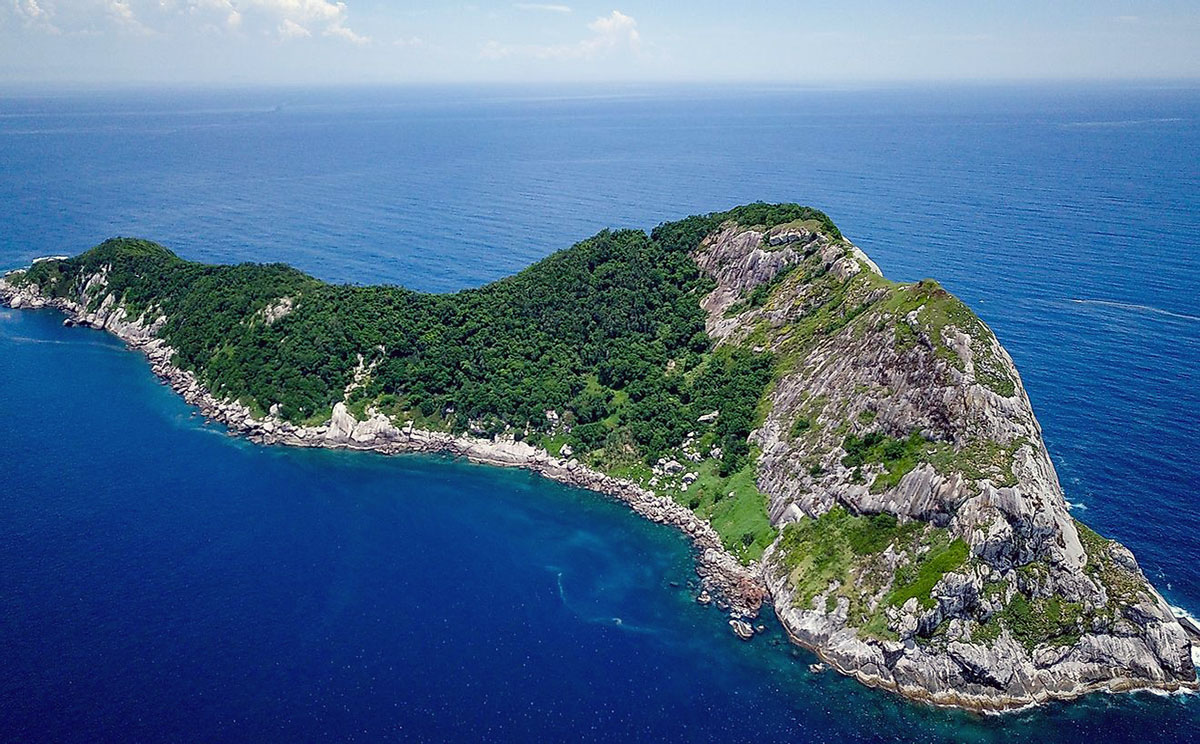
There are several thousand of these snakes on this 43-hectare island. They share it with no humans, no rodents, no large mammals, no other predators. They have had it almost entirely to themselves for 11,000 years. Sailors along the São Paulo coast call it Ilha das Cobras — the Island of Snakes. The map calls it Ilha da Queimada Grande.
The story of the island is what happens when a population of animals runs out of options. It is also the story of a country that decided, against most of human conservation precedent, that the right thing to do with the most lethally evolved predator in the South Atlantic was to leave it alone — and to keep everyone else away from it, including the lighthouse keepers, fishermen, and pharmaceutical companies that have wanted it for the past four hundred years.
The Island the Sea Made
Snake Island was once a piece of mainland Brazil. Sea levels rose at the end of the last ice age, around 11,000 years ago, drowning the land bridge that connected the headland to the São Paulo coast and stranding a population of common Brazilian pit vipers on a 43-hectare rock with no large mammals on it and none coming.
The vipers had two options: starve or learn to climb. Over centuries, they did the second thing. They became arboreal, their bodies grew slender, their coloration shifted from forest-floor brown to a pale yellowish-tan that matches sun-bleached canopy wood, and their venom became dramatically more potent than anything their mainland relatives needed. The reason was logistics, not aggression. A snake on the ground can follow a bitten rodent through the underbrush. A snake on a branch cannot follow a bitten bird that flies away to die on the ocean. The venom had to kill the bird before it left the branch. Evolution selected, ruthlessly, for speed.
The Golden Lancehead
The species Bothrops insularis was formally described in 1921 by the Brazilian zoologist Afrânio do Amaral, working from specimens collected during early naval expeditions to the island. It is, in evolutionary terms, an island offshoot of Bothrops jararaca — the common Brazilian pit viper responsible for most snakebite cases in the country. The split is recent enough to be measured in millennia and dramatic enough to be measured in millimeters: a slender 70- to 90-centimeter snake with a pale yellow body, dark dorsal blotches, the broad triangular skull of the genus, and venom three to five times more potent than its mainland ancestor.
The bite is documented. It produces immediate severe pain, tissue necrosis spreading from the wound — the flesh around the strike point dissolves — blood-clotting failure, internal hemorrhaging, kidney failure, and brain hemorrhage. Untreated mortality runs at roughly seven percent. With antivenom and supportive care, the rate drops to three percent. The antivenom is produced at the Butantan Institute in São Paulo from horses inoculated with diluted venom and is not stocked at most coastal Brazilian hospitals.
The snakes prey on exactly two of the island's forty-one bird species: the southern house wren and the Chilean elaenia. The rest are too large, too small, or too fast. The lancehead's diet is two species of bird and nothing else.
For decades the popular literature claimed Queimada Grande held 430,000 snakes — one for every square meter of the island. The first systematic mark-recapture study, conducted by Brazilian researchers between 2002 and 2010, produced a figure between 2,000 and 4,000, with a 2014 follow-up suggesting the lower end. The snakes are concentrated in the lowland rainforest that covers about 60 percent of the island. The species is critically endangered, genetically inbred from eleven millennia of isolation, and showing the developmental abnormalities that come with that. The snake that gave Snake Island its reputation is on the edge of extinction.
The Lighthouse Keeper's Family
Snake Island enters the European record in 1532, in the logs of Martim Afonso de Souza, the Portuguese fleet commander who charted southern Brazil for the crown. His log noted a small forested island; it did not mention snakes. The reputation came later, accreting around generations of fishermen who learned by word of mouth not to land.
Sometime in the eighteenth or nineteenth century, Portuguese settlers from the mainland tried to clear the island for a banana plantation. They cut the forest. They burned the cleared vegetation to fertilize the soil. The fires gave the island its name — queimada, in Portuguese, means burned. The plantation never produced a harvest. The settlers abandoned it after losing laborers to snakebite. The forest grew back. The snakes did not leave.
1909: The Navy Builds a Lighthouse
The Brazilian Navy completed a stone lighthouse on the highest point of the island in 1909. The shipping lane was busy enough by then that the rocks around Queimada Grande had wrecked enough boats to justify the construction. The lighthouse was a twelve-meter tower with a keeper's residence attached at its base. It was staffed continuously, on a rotating basis, for the next decade and a half.
The keepers lived inside a stone building surrounded on all sides by forest containing several thousand pit vipers. The Navy issued them machetes, antivenom, and instructions. The Navy also ordered the keepers to clear the vegetation around the residence and to burn the underbrush periodically — the same colonial practice that had given the island its name. Snakes were found in the kitchen. Snakes were found in the storage shed. Snakes were found on the stairs and in the bedding. Several keepers resigned. The Navy replaced them.
The Night the Snakes Came In
The last keeper of the lighthouse at Queimada Grande lived in the residence with his wife and three children. On a night in the mid-1920s, snakes came in through the windows.
The family ran for the dock.
The path from the residence to the water passed under low branches. The snakes were in the branches. The family was bitten as they ran. By the time the boat pushed off — if it pushed off — the last keeper of Ilha da Queimada Grande and his wife and his three children were dying.
The Brazilian Navy automated the lighthouse within months. No civilians have lived on the island since.
The official records of the closure are silent on the family. Naval archives describe the automation as a logistical modernization. What survives in the coastal villages between Itanhaém and Peruíbe is the other version — the one the fishermen have been telling each other for a hundred years, the one that explains why a working lighthouse stopped having keepers and why nobody who knows the coast has ever wanted to land there. The folklore has done the job. The island has stayed closed.
The Folklore the Coast Believed
Two other legends circulate along the São Paulo coast and have done so for at least two centuries. Both are almost certainly false. Both have been told as if they were obviously true.
The first is the pirate-treasure story: a crew of seventeenth- or eighteenth-century pirates buried a cache of gold on Queimada Grande and released a population of snakes onto the island to guard it. The vipers were on the island eleven thousand years before any pirate ever sighted the coast of Brazil, but the story has every hallmark of post-hoc folk explanation, and it has persisted because it is more satisfying than the truth.
The second is the fisherman with the bananas: a laborer ignored the warnings of his village, rowed to Queimada Grande to harvest the abandoned plantation's overgrown fruit, and was found days later in his boat, dead from bites, banana stems still in his hand. The story has no original source and many tellings. Its function is simple: it warns coastal residents not to land on the island. The warning is good.
What the folklore captured, accurately, is that Brazilian sailors had closed Queimada Grande informally long before the Navy closed it officially. The island had no natural harbor, the surrounding rocks were sharp enough to gut a wooden boat, and the certainty of what lived inside did the rest. The 1920s closure formalized a custom that was already centuries old.
Thirty Thousand Dollars a Snake
The reason the Brazilian Navy still patrols Queimada Grande is not the snakes themselves. It is the people willing to risk the snakes. On the international black market, a single golden lancehead specimen sells for between $10,000 and $30,000. Specimens turn up in the private collections of exotic-animal dealers in Europe and North America, in unauthorized pharmaceutical research, and in zoos in countries where Brazilian export controls do not reach. The Portuguese word for the people who take them is biopirata.
The pharmaceutical interest is real and substantial. Captopril, the world's first widely used ACE inhibitor for hypertension and heart failure, was developed in the 1970s from a peptide isolated from the venom of Bothrops jararaca — the golden lancehead's mainland ancestor. The drug transformed cardiovascular medicine and generated billions of dollars in revenue, of which Brazil received a small fraction. The Captopril story is the cautionary tale that runs underneath every modern Brazilian conservation argument: a foreign company isolated a compound from a Brazilian snake, patented a derivative, made a fortune, and left.
The same logic applied to Bothrops insularis venom — three to five times more potent, with documented potential for blood pressure regulation, blood-clot management, and tumor research — is what makes every smuggled snake carry the financial weight of a small drug-development pipeline. Marcelo Duarte, the Butantan Institute herpetologist who has spent decades studying B. insularis on the island, has described the venom's pharmaceutical horizon as scratching the surface of a universe of possibilities. Brazilian law treats unauthorized capture as a federal environmental crime punishable by imprisonment. Specimens still turn up periodically in European and American customs seizures. Each one is a small, irreversible reduction in the population of a species that has only a few thousand individuals left.
The Navy, the Doctor, and the Lighthouse Run
In 1985 the federal government formally designated Queimada Grande and the smaller neighboring island as a single protected area. Civilian access requires a permit from ICMBio, the Chico Mendes Institute for Biodiversity Conservation. Permits are granted only for scientific research, conservation work, and lighthouse maintenance — and only with a documented protocol that includes a federally certified physician on the visiting team and pre-deployed antivenom. The model is unusual. Brazilian officials have described it openly as exclusionary conservation: the most effective form of protection is the prevention of contact, full stop.
The Navy returns to the island roughly once a year. A small team of technicians, escorted by armed personnel, lands at a rocky cove on the eastern side, walks a cleared path to the automated lighthouse, performs maintenance over the course of a day, and leaves. A naval physician travels with them. Antivenom is staged in the boat. No injuries during these maintenance trips have been publicly documented in decades, which suggests the protocol works.
The most widely seen civilian footage of the island's interior comes from a 2014 expedition organized by VICE Media, which embedded with researchers from the Butantan Institute on a permitted scientific trip. The film shows what climbers have always reported: a forest where the snakes are visible everywhere if you know what to look for, and invisible until you do. The vipers' camouflage is so effective that, in still photography, a branch holding a six-foot lancehead is indistinguishable from an empty branch a meter away. The researchers moved slowly, in heavy boots and snake gaiters, and stopped often to point out individual snakes that had been within striking distance the entire time. The doctor stood behind them with a kit. Nothing happened. The snakes, in the way of the species, did not pursue.
The Atlas Entry: Looking at the Island from Itanhaém
You cannot land on Snake Island. The federal closure is absolute. Unauthorized landings are prosecuted under Brazilian environmental law. The Navy patrols the surrounding waters. The relevant question for the curious traveler is not how to reach the island but how to look at it without breaking federal law.
The island is visible, in clear weather, from the coastal town of Itanhaém in São Paulo state. It lies approximately 33 kilometers offshore and appears as a low forested silhouette on the southern horizon, most visible at sunset. Chartered fishing boats from the Itanhaém and Peruíbe harbors will, for a fee, run sightseeing trips that approach the legal exclusion zone — typically a radius of a few hundred meters — and circle the island. The boats do not land. Reputable operators will not attempt to.
The closer legal interaction with the snakes themselves is at the Butantan Institute in São Paulo city, founded in 1901 as a research and antivenom-production center. The institute maintains a public museum where preserved specimens of Bothrops insularis are on display alongside the related mainland species, and where the visitor can read the institutional history of the antivenom program that has saved tens of thousands of Brazilian snakebite victims since the early twentieth century. The Butantan is, in effect, the museum of the island — the place where the work that began with naval expeditions in the 1900s is still ongoing, in a controlled environment that does not require landing on the island itself.
Standing on the Itanhaém shore and looking at the silhouette of Queimada Grande on the horizon is a strange experience. The island is small, beautiful, distant, and indistinguishable from any other forested coastal islet. The fact that its forest is full of one of the most lethally evolved ambush predators on Earth is invisible at thirty-three kilometers. What is visible is a green ridge above the water and a working lighthouse blinking after dark. What is true is that the snakes are on that ridge, in the lower canopy, watching for birds. The Brazilian state has decided to leave it that way.
Frequently Asked Questions
Where is Snake Island and why is it famous?
Ilha da Queimada Grande is a 43-hectare island located approximately 33 kilometers off the coast of São Paulo state, Brazil, administered as part of the municipality of Itanhaém. It is famous for being the only natural habitat in the world of the golden lancehead pit viper (Bothrops insularis), a species that exists nowhere else on Earth. The island holds an estimated 2,000 to 4,000 of these critically endangered snakes, concentrated in roughly 26 hectares of lowland rainforest. The Brazilian Navy closed the island to civilians in the 1920s and has maintained the closure ever since — one of the very few places on Earth where humans are forbidden to land specifically to protect a venomous predator from us.
Why are there so many snakes on Ilha da Queimada Grande?
Sea levels rose at the end of the last ice age, around 11,000 years ago, separating what is now Snake Island from mainland Brazil and trapping a population of pit vipers on the newly isolated landmass. The island had no rodents and no other ground prey, so the snakes evolved to hunt migratory birds in the trees. They became arboreal, developed extreme camouflage, and produced venom three to five times more potent than their mainland ancestors so they could kill bitten birds before the birds could fly away to die elsewhere. With no large predators on the island, the population stabilized at a density that approaches one snake per square meter in the densest patches of forest.
What happened to the lighthouse keeper's family?
Coastal folklore from the São Paulo shore tells that the last keeper of the Queimada Grande lighthouse and his family were killed in the mid-1920s when snakes entered their residence through the windows and bit them as they fled toward their boat. The story has been told for a hundred years in the fishing villages between Itanhaém and Peruíbe, and it matches what is known about the timing — the Brazilian Navy automated the lighthouse and withdrew the human keepers in the 1920s, and no civilians have lived on the island since. The naval archives describe the closure as a routine modernization. The coastal villages have always described it differently.
How dangerous is the golden lancehead's venom?
A bite from Bothrops insularis carries an estimated mortality rate of seven percent if untreated and approximately three percent with prompt medical treatment. The venom is a hemotoxic-cytotoxic mixture that causes immediate severe pain, tissue necrosis (the flesh around the bite dissolves), failure of blood clotting, internal hemorrhaging, intestinal bleeding, kidney failure, and brain hemorrhage. It is three to five times more potent than the venom of the mainland Bothrops jararaca, the species' closest relative. Antivenom is produced by the Butantan Institute in São Paulo but is not stocked at most coastal Brazilian hospitals, so anyone bitten on or near the island would face a difficult evacuation before treatment.
Can I visit Snake Island?
No civilian access is permitted. The island is a federally protected conservation area under Brazilian law, and unauthorized landings are prosecuted as environmental crimes. Permits are issued only by the Chico Mendes Institute for Biodiversity Conservation (ICMBio), and only for scientific research, conservation work, or naval lighthouse maintenance — with a documented protocol that includes a federally certified physician and pre-deployed antivenom. The closest a non-researcher can legally get is by chartered boat from the harbors at Itanhaém or Peruíbe, which will circle the legal exclusion zone without landing. The Butantan Institute museum in São Paulo city displays preserved specimens and is the closest legal interaction with the species.
What is biopiracy and why is it a problem on Snake Island?
Biopiracy refers to the illegal capture and export of endangered wildlife — in this case, golden lancehead specimens — for the international black market. A single specimen sells for between $10,000 and $30,000, driven by demand from private exotic-animal collectors and unauthorized pharmaceutical research. The interest in the venom is grounded in real science: Captopril, the world's first widely used ACE inhibitor for hypertension, was developed in the 1970s from a peptide found in the venom of Bothrops jararaca, the golden lancehead's mainland ancestor. The same logic applied to B. insularis venom — significantly more potent than its mainland relative — makes each smuggled snake a potential pharmaceutical asset. Brazilian law treats unauthorized capture as a federal environmental crime, and specimens have been seized periodically in European and North American customs operations.
Sources
Bothrops insularis: Genetic Variability, Management, and Conservation Implications — Igor Salles-Oliveira, Taís Machado, et al., Ecology and Evolution (2020)
Population Dynamics of the Critically Endangered Golden Lancehead Pitviper, Bothrops insularis: Stability or Decline? — Marques, Martins, Sazima, et al., PLOS ONE (2013)
Ecological Aspects of the Pitviper Bothrops insularis on the Island of Queimada Grande — Ivan Sazima, Otavio A. V. Marques, Ricardo J. Sawaya, Memorias do Instituto Butantan (1992)
Golden Lancehead Vipers: The True Story Behind Snake Island — Alex Hannaford, Smithsonian Magazine (June 2014)
The Most Dangerous Island on Earth: VICE Goes to Snake Island — Hamilton Morris, VICE Media documentary expedition with the Butantan Institute (2014)
Captopril: From the Brazilian Pit Viper to the Modern Antihypertensive — John R. Vane, British Journal of Clinical Pharmacology (1999)
Diet, Venom Composition, and Evolution in Bothrops insularis — Stephen P. Mackessy, University of Northern Colorado School of Biological Sciences (multiple publications, 2010s)
História da Marinha do Brasil: Faróis e Sinais Náuticos do Litoral Paulista — Diretoria de Hidrografia e Navegação, Marinha do Brasil (institutional history archives)
Plano de Manejo da Área de Relevante Interesse Ecológico das Ilhas Queimada Pequena e Queimada Grande — Instituto Chico Mendes de Conservação da Biodiversidade (ICMBio), Federal Government of Brazil (2010, updated)
Afrânio do Amaral and the Brazilian Tradition of Ophiology — Memorias do Instituto Butantan, historical retrospective (multiple authors)
Os Bothrops do Brasil — Otavio A. V. Marques and Ivan Sazima, Holos Editora (1999)
Wildlife Trafficking in Brazil: Biopiracy and the Law — Renctas (Rede Nacional Contra o Tráfico de Animais Silvestres), institutional reports (2001 onward)