Amelia Earhart's Bones on Nikumaroro: The 1940 Discovery
On a morning in late September 1940, Gerald Gallagher was walking the southeastern shoreline of Nikumaroro. He was 23 years old, an Irish-born British colonial cadet posted to this remote atoll in the Phoenix Islands to administer a fledgling settlement of Gilbertese families relocated from the overcrowded Gilbert Islands. The colony had been on the island for less than two years. Gallagher was its sole European authority — young, isolated, and responsible for a hundred people carving a life from coconut palms and reef fish on an island that had been uninhabited for most of recorded history.
Near the southeast tip of the atoll, in an area the colonists called the "seven site," Gallagher found bones beneath a Tournefortia argentea tree — a species known locally as ren. A human skull. Scattered skeletal remains. Nearby, a woman's shoe — American-made, with a sole style consistent with the late 1930s. A sextant box. A bottle of Benedictine liqueur, the herbal French spirit. Evidence of a small campfire. The remains of what appeared to be a castaway camp.
Gallagher wrote to his superiors in the Western Pacific High Commission. He noted that the bones appeared to belong to a woman. He was careful, factual, and aware of what the discovery might mean — Earhart's disappearance was only three years old, and the 157-337 line of position she reported in her final transmission passed directly through this part of the Pacific. The colonial administration instructed him to ship the bones to Fiji for analysis. Gallagher packed them up and sent them by inter-island vessel. He would die of a tropical illness on Nikumaroro the following year, at the age of 24, without learning the result.
Nikumaroro is a place that generates evidence but withholds conclusions. Bones that might be Earhart's — measured, recorded, then lost. Artefacts that are consistent with a 1930s castaway — but also consistent with other explanations. Radio signals received after Earhart's disappearance that match the island's tidal patterns — but were too garbled to confirm. For more than eighty years, investigators have returned to this atoll looking for the answer to aviation's greatest mystery, and the island has given them just enough to keep coming back and never enough to settle the question. Nikumaroro does not confirm or deny. It suggests, and then it falls silent.
The History of Nikumaroro Before the Earhart Mystery
The Norwich City Shipwreck of 1929
Nikumaroro entered the historical record violently. On November 29, 1929, the SS Norwich City — a 1,800-ton British tramp steamer carrying a load of coal from Melbourne to a Pacific island phosphate mine — ran aground on the atoll's western reef during a storm. The ship struck hard and fast, its hull tearing open on the coral. Eleven of the thirty-five crew members died in the grounding or in the surf during the chaotic attempts to reach shore. The survivors — cold, battered, and stranded on an uninhabited island with no radio and no prospect of rescue — camped on the beach for several days before a passing ship spotted their distress signals and evacuated them.
The Norwich City was never salvaged. Its rusting hull remains on Nikumaroro's reef to this day, still visible above the waterline at low tide — one of the most intact pre-war shipwrecks in the Pacific. The wreck would become a critical element in the Earhart investigation decades later. If Earhart and Noonan had landed on the island, the Norwich City would have been the most prominent man-made feature they could see — and its salvageable materials, including metal sheeting, glass, and fresh water catchment surfaces, could have sustained castaways for days or weeks.
The British Phoenix Islands Settlement Scheme
Nikumaroro was uninhabited at the time of Earhart's disappearance in July 1937. It had been uninhabited, with brief exceptions, for as long as colonial records existed. The British government claimed the Phoenix Islands group in the late nineteenth century, but the islands were too remote and too barren to attract permanent settlement.
That changed in 1938, when the British Western Pacific High Commission launched the Phoenix Islands Settlement Scheme — an effort to relocate families from the severely overcrowded Gilbert Islands (now Kiribati) to uninhabited atolls in the Phoenix group. Nikumaroro, then known as Gardner Island, was one of the target atolls. The first Gilbertese colonists arrived in late 1938. Gerald Gallagher was posted to the island shortly afterward as its colonial administrator.
The settlement grew to roughly 100 people at its peak. The colonists planted coconut palms for copra production, fished the reef, and built simple structures from coral slab and pandanus thatch. Life was hard. Fresh water depended entirely on rainfall and shallow wells that often turned brackish. The coconut palms took years to mature. Supply ships were infrequent. Gallagher, who earned a reputation as a dedicated and humane administrator, struggled to keep the settlement viable. He contracted a tropical illness — likely a combination of infection and exhaustion — and died on Nikumaroro on September 27, 1941, aged 24. He was buried on the island he had tried to make habitable.
The colony endured for two more decades, shrinking gradually as drought, economic failure, and the sheer difficulty of atoll life drove families to leave. The last residents departed in the early 1960s. Nikumaroro was abandoned for the final time.
The 157-337 Line of Position and the Castaway Hypothesis
How the 157-337 Line Connects Howland Island to Nikumaroro
Amelia Earhart's final confirmed radio transmission, received by the USCGC Itasca at 8:43 a.m. on July 2, 1937, included the phrase: "We are on the line 157 337." This referred to a celestial line of position — a navigational reference derived from a sun observation that Fred Noonan would have calculated using his sextant and chronometer. The line runs northwest-to-southeast: 337 degrees toward the northwest, 157 degrees toward the southeast. Plotted on a chart, the line passes through Howland Island — the intended destination — and extends southeast across 560 kilometres of open Pacific directly to Nikumaroro.
The logic of the castaway hypothesis begins here. Earhart reported flying "north and south" along this line, searching for Howland. The island's highest point is barely six metres above sea level, and the overcast conditions she described would have made visual detection nearly impossible. If she failed to find Howland and chose to fly southeast along the 157 line — reasoning that the line must intersect something — Nikumaroro would have been the first island she encountered. The distance, approximately 560 kilometres, was within the Electra's remaining fuel range if Earhart's estimates of her fuel state during the final transmissions were accurate. The question is whether she made that decision, and whether the fuel held.
TIGHAR's Castaway Theory — How Earhart and Noonan May Have Survived
The hypothesis advanced by The International Group for Historic Aircraft Recovery (TIGHAR), led by Ric Gillespie, reconstructs the scenario as follows. After failing to locate Howland Island, Earhart flew southeast along the 157 line and reached Nikumaroro. She landed the Electra on the atoll's wide reef flat, which at low tide exposes a relatively smooth coral surface long enough to accommodate a landing — barely. Noonan may have been injured during the landing or incapacitated by this point. Earhart and Noonan survived initially, using the aircraft's radio to transmit distress calls while the Electra's landing gear rested on the exposed reef. At high tide, the reef flat submerges under several feet of water. Over subsequent tidal cycles, the surf gradually pushed the aircraft across the reef flat and over the reef edge into deep water, where it sank. Without the aircraft, the castaways were stranded.
TIGHAR's reconstruction places Earhart and Noonan on the island's southeastern shore, near the Norwich City wreck, where they could have accessed rainwater, shellfish, and salvageable materials from the rusting freighter. The bones Gallagher found in 1940 were in this area. The theory holds that one or both castaways survived for days or possibly weeks before dying of dehydration, exposure, injury, or a combination. Coconut crabs — large, powerful scavengers endemic to Pacific atolls — would have dispersed the skeletal remains across a wide area, consistent with the scattered bones Gallagher described.
Evidence That Amelia Earhart Landed on Nikumaroro
Gerald Gallagher's 1940 Bone Discovery
The full story of the bones is a case study in colonial-era record-keeping and its catastrophic gaps. Gallagher found the remains in September 1940 and reported the discovery to the Western Pacific High Commission in a series of official telegrams and letters. He described a skull, partial skeleton, a woman's shoe, the sextant box, the Benedictine bottle, and signs of a campfire. He noted that the remains appeared to be those of a woman, and that the shoe was consistent with American manufacture. The colonial administration took the report seriously enough to order the bones shipped to Fiji for medical examination.
In Fiji, Dr. David Hoodless — a physician, not a forensic anthropologist — examined the bones in early 1941. He took measurements of the skull and long bones and concluded that the skeleton belonged to a short, stocky European male. Based on this assessment, the colonial administration dismissed any connection to Earhart. The bones were filed away. At some point in the following years, they were lost — discarded, misplaced, or destroyed. No one has seen them since.
The Hoodless measurements survived on paper, and in 1998 forensic anthropologists re-analysed them using modern forensic methods. Their conclusion contradicted Hoodless directly. The measurements, they argued, were more consistent with a tall woman of northern European descent — a description that matched Earhart's known height and build. Hoodless, working in 1941 with outdated reference standards and no training in forensic anthropology, had likely misidentified the sex and stature of the remains. A further computerised forensic analysis in 2018, led by Richard Jantz of the University of Tennessee, applied modern quantitative techniques to the same Hoodless measurements and concluded that the bones were more similar to Earhart than to 99 percent of the reference population — the strongest statistical case yet made for identification. The re-analyses did not prove the bones were Earhart's. They proved that Hoodless's dismissal was unreliable, and that the most important physical evidence in the case had been lost before modern science could examine it.
The TIGHAR Expeditions and Artefact Finds
Ric Gillespie first visited Nikumaroro in 1989 and has led or coordinated roughly a dozen expeditions to the island since. TIGHAR's fieldwork has produced a collection of artefacts that, taken together, paint a picture of a possible American castaway presence on the island before the British settlement arrived — but each individual item remains contested.
The most significant find is Artefact 2-2-V-1: a sheet of aircraft-grade aluminium recovered from the island in 1991. TIGHAR's analysis concluded that the rivet pattern, alloy composition, and dimensions of the fragment were consistent with a patch known to have been installed on Earhart's Electra during a repair stop in Miami. The match was challenged by other aviation researchers, who argued the fragment could have come from other sources, including wartime aircraft or the Norwich City itself. The debate has never been resolved.
Other finds include the sole of a woman's shoe — a blucher-style oxford, size nine, consistent with American manufacture in the 1930s and with Earhart's known shoe size. Glass jars, including one that matched a brand of anti-freckle cream marketed to American women in the 1930s — a product Earhart, who was known to be self-conscious about her freckles, might plausibly have carried. Remnants of campfires containing fish and bird bones. A zipper pull. Each artefact is suggestive. None is conclusive. The island offers the shape of an answer but refuses to fill it in.
Amelia Earhart's Post-Disappearance Radio Signals and Nikumaroro
The "ghost" transmissions received after Earhart's last confirmed call at 8:43 a.m. add a dimension to the Nikumaroro theory that purely archaeological evidence cannot. In the hours and days following the disappearance, at least 57 radio signals were logged by stations across the Pacific on frequencies associated with Earhart's Electra. Most were too weak and garbled to verify. Several were dismissed as hoaxes or misattributions.
TIGHAR commissioned a detailed analysis of the credible signals — those received by trained operators on government or military stations. The analysis found a pattern. The signals tended to occur during periods when Nikumaroro's reef flat was exposed at low tide — the only condition under which the Electra's landing gear could have rested on a solid surface with the engines and radio equipment above water. At high tide, the reef flat submerges, and the aircraft's electrical system would have shorted out. The correlation between the timing of the transmissions and Nikumaroro's tidal cycle was, according to TIGHAR, statistically significant.
The analysis is not universally accepted. Sceptics point out that the signals were unverified, that similar patterns could emerge by coincidence across a large enough dataset, and that no recording of the transmissions exists — only handwritten logs. The signals, like the bones and the artefacts, are evidence that points toward Nikumaroro without arriving there.
Was Amelia Earhart Really a Castaway on Nikumaroro?
Why the Bones on Nikumaroro Remain Inconclusive
The case against the Nikumaroro theory is not that the evidence is fabricated — it is that the evidence is insufficient. The bones found by Gallagher could belong to any number of people. The Pacific is littered with castaways, shipwreck survivors, and itinerant labourers whose deaths were never recorded. The Norwich City wreck alone deposited 24 survivors on the island in 1929 — any one of whom could have died on a later visit, or a fellow crew member's body could have washed ashore. Pre-colonial Polynesian or Micronesian castaways are another possibility. The 1940 measurements, re-analysed in 1998, are consistent with Earhart's build — but "consistent with" is not "identified as." Without the bones themselves, no DNA analysis can be performed, and the forensic debate remains permanently frozen at the level of probability rather than certainty.
The artefacts face the same problem. An aluminium fragment might match the Electra — or it might not. A woman's shoe could be from the 1930s — or from the 1940s. Anti-freckle cream was sold to millions of women. Campfire remains prove someone was on the island, but not who. The cumulative weight of the evidence is suggestive, but no single piece crosses the threshold from suggestion to proof.
Did Amelia Earhart Crash Into the Ocean Near Howland Island?
Most mainstream aviation historians and the US government's official position hold that Earhart's Electra ran out of fuel in the vicinity of Howland Island, ditched in the open Pacific, and sank in waters between 3,000 and 5,000 metres deep. The simplicity of this explanation is its strength. Earhart reported being low on fuel. She could not find Howland. The ocean in that region is deep enough to swallow an aircraft without a trace. The sixteen-day search found nothing — consistent with a plane sinking rapidly in deep water far from any island.
The counter-argument to Nikumaroro is not that the castaway theory is impossible but that it requires a chain of assumptions — Earhart chose to fly southeast, the fuel lasted, the landing on the reef succeeded, the radio signals were genuine — each of which is plausible but none of which is established. The crash-and-sink theory requires only one assumption: the fuel ran out. Occam's razor favours the simpler explanation.
In 2024, deep-sea explorer Tony Romeo and his Deep Sea Vision team identified a sonar anomaly on the ocean floor approximately 160 kilometres west of Howland Island, at a depth of roughly 5,000 metres. The anomaly's shape and dimensions are consistent with a Lockheed Electra 10E. The finding has not been independently verified, and physical recovery from that depth would be extraordinarily difficult and expensive. If confirmed, it would effectively close the Nikumaroro hypothesis. If it proves to be a geological formation or a different aircraft, the question remains open — and Nikumaroro remains the only place where someone has found bones under a tree that might belong to the most famous missing woman in history.
Nikumaroro Today — The Abandoned Atoll and the Ongoing Search
What Nikumaroro Looks Like Today
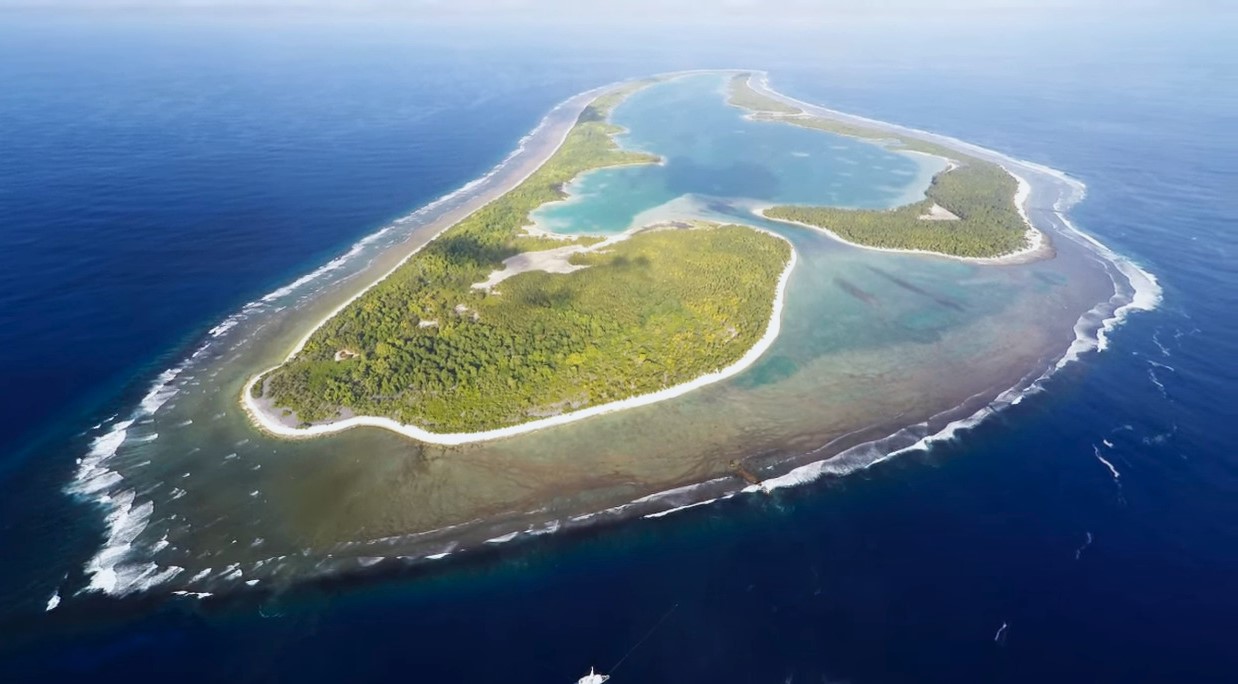
Nikumaroro has been uninhabited since the early 1960s, when the last Gilbertese families left the failed settlement. The coconut palms they planted still stand, mixed with native scrub, Tournefortia trees, and pandanus. The ruins of coral-slab houses dot the interior. Concrete cisterns built during the colonial era are cracked and dry. The Norwich City wreck sits on the western reef, its hull slowly collapsing into rust and coral. Green sea turtles nest on the beaches. Coconut crabs — some with leg spans exceeding half a metre — are among the island's dominant fauna.
The atoll is part of the Phoenix Islands Protected Area, a UNESCO World Heritage Site encompassing over 400,000 square kilometres of ocean and reef — one of the largest marine protected areas on Earth. The Republic of Kiribati, which holds sovereignty over the Phoenix Islands, administers the protected area with minimal on-the-ground presence. There are no permanent structures in use, no communications infrastructure, and no regular human activity on Nikumaroro.
Gerald Gallagher's grave is still on the island, marked by a simple coral slab. The young colonial officer who found the bones, reported them faithfully, and died before the significance of his discovery could be understood lies buried on the same atoll where the mystery he stumbled into remains unresolved.
Can You Visit Nikumaroro?
Nikumaroro is one of the most remote inhabited — or rather, formerly inhabited — islands in the Pacific. It lies roughly 2,800 kilometres south of Honolulu and 1,700 kilometres east of Tarawa, the capital of Kiribati. There is no airstrip, no harbour, no dock, and no anchorage. Landing requires a small boat through a reef pass in calm conditions — and calm conditions at Nikumaroro are not guaranteed.
Access requires permission from the Republic of Kiribati, which manages the island as part of the Phoenix Islands Protected Area. Research permits are granted occasionally; tourism permits are effectively nonexistent. The TIGHAR expeditions have been among the very few organised visits to the island in the twenty-first century, each requiring months of logistical planning and chartered vessel support from Fiji or Samoa.
The island that may hold the answer to Amelia Earhart's fate is, in practical terms, one of the hardest places on Earth to reach. It sits in the middle of the Pacific, surrounded by deep water and reef, marked by a rusting shipwreck and the grave of the man who found the bones. Nikumaroro does not invite resolution. It holds its evidence loosely — scattered across a reef flat, buried in colonial filing cabinets, encoded in garbled radio signals — and lets the Pacific decide what survives and what disappears. Eighty-eight years after Earhart's Electra went silent, the atoll still has not answered the only question anyone has ever asked of it: was she here?
FAQ
Were Amelia Earhart's bones found on Nikumaroro?
In September 1940, British colonial officer Gerald Gallagher discovered a human skull and partial skeleton on the southeastern shore of Nikumaroro, along with a woman's shoe, a sextant box, and a bottle of Benedictine liqueur. The bones were shipped to Fiji, where physician Dr. David Hoodless examined them and concluded they belonged to a short, stocky European male. The bones were subsequently lost and have never been recovered. Modern forensic re-analyses of Hoodless's original measurements — in 1998 and again in 2018 by Richard Jantz of the University of Tennessee — concluded that the bones were more consistent with a tall woman of northern European descent matching Earhart's build. Without the bones themselves, no DNA analysis can be performed, and the identification remains a matter of statistical probability rather than certainty.
What is the TIGHAR theory about Amelia Earhart and Nikumaroro?
The International Group for Historic Aircraft Recovery (TIGHAR), led by Ric Gillespie, has advanced the hypothesis that Amelia Earhart and Fred Noonan, after failing to locate Howland Island, flew southeast along a celestial line of position and landed on Nikumaroro's reef flat at low tide. The theory holds that they survived as castaways for days or weeks, transmitting radio distress calls while the aircraft rested on the exposed reef. Over successive tidal cycles, the surf pushed the Electra off the reef edge into deep water, where it sank. TIGHAR has conducted roughly a dozen expeditions to Nikumaroro since 1989, recovering artefacts including aircraft aluminium, a woman's shoe, and an anti-freckle cream jar that are consistent with a 1930s American castaway presence, though none definitively proves Earhart was on the island.
What is the Norwich City shipwreck on Nikumaroro?
The SS Norwich City was a British tramp steamer that ran aground on Nikumaroro's western reef during a storm on November 29, 1929. Eleven of the thirty-five crew members died in the grounding or in subsequent attempts to reach shore. The survivors were rescued several days later by a passing vessel, but the ship was never salvaged. Its rusting hull remains visible on the reef to this day and is one of the most intact pre-war shipwrecks in the Pacific. The wreck is significant to the Earhart investigation because castaways on Nikumaroro would have had access to its salvageable materials — metal sheeting, glass, and rainwater catchment surfaces — which could have aided short-term survival.
What evidence links Amelia Earhart to Nikumaroro?
The evidence is circumstantial but cumulative. It includes: the 1940 bones found by Gerald Gallagher, whose measurements are consistent with Earhart's build; aircraft-grade aluminium (Artefact 2-2-V-1) whose rivet pattern matches a known repair patch on Earhart's Electra; a woman's shoe sole matching 1930s American manufacture and Earhart's size; a jar of anti-freckle cream of a brand marketed to American women; campfire remains with fish and bird bones; a zipper pull matching 1930s flight jacket hardware; and post-disappearance radio signals whose timing correlates with Nikumaroro's tidal cycles. No single piece of evidence is definitive, and the strongest physical evidence — the bones — was lost before modern forensic methods could examine it.
Can you visit Nikumaroro?
Nikumaroro is extremely difficult to visit. The atoll is uninhabited, has no airstrip, no harbour, and no infrastructure of any kind. It is part of the Phoenix Islands Protected Area, a UNESCO World Heritage Site administered by the Republic of Kiribati. Access requires a research permit from the Kiribati government, which is rarely granted. There is no scheduled transportation to the island, and reaching it requires a multi-day voyage by chartered vessel, typically from Fiji or Samoa. Landing requires a small boat through a reef pass in calm sea conditions. The TIGHAR expeditions have been among the very few organised visits to Nikumaroro in the twenty-first century.
Where is Nikumaroro in relation to Howland Island?
Nikumaroro lies approximately 560 kilometres (350 miles) southeast of Howland Island, the intended destination of Earhart's final flight. The two islands are connected by a celestial line of position — the 157-337 line that Earhart referenced in her last confirmed radio transmission. Extended southeast from Howland, this line passes through or very near Nikumaroro. This navigational connection is the foundation of the castaway hypothesis: if Earhart flew southeast along the line after failing to find Howland, Nikumaroro would have been the first island she encountered, and the distance was within the Electra's remaining fuel range.
Sources
- [Finding Amelia: The True Story of the Earhart Disappearance] - Ric Gillespie, Naval Institute Press (2006)
- [Amelia Earhart's Shoes: Is the Mystery Solved?] - Thomas F. King, Randall S. Jacobson, Karen R. Burns, Kenton Spading, AltaMira Press (2001)
- [Amelia Earhart: The Mystery Solved] - Elgen M. Long and Marie K. Long, Simon & Schuster (1999)
- [The Sound of Wings: The Life of Amelia Earhart] - Mary S. Lovell, St. Martin's Press (1989)
- [Amelia Earhart's Bones and the Challenges of Historical Forensic Identification] - Richard Jantz, Journal of Forensic Sciences, Vol. 63, No. 4 (2018)
- [TIGHAR Nikumaroro Expedition Reports, 1989–2023] - The International Group for Historic Aircraft Recovery (1989–2023)
- [Gerald Gallagher's Correspondence with the Western Pacific High Commission, 1940–1941] - British Colonial Office Records, The National Archives, Kew (1940–1941)
- [The Phoenix Islands Settlement Scheme: Administrative Records and Reports] - Western Pacific High Commission Archives (1938–1963)
- [Post-Loss Radio Signals from Amelia Earhart: A Re-Analysis] - TIGHAR research paper, Ric Gillespie and Robert Brandenburg (2000)
- [Deep Sea Vision: Sonar Imaging and the Search for Earhart's Electra] - Tony Romeo / Deep Sea Vision expedition reports (2024)
- [East to the Dawn: The Life of Amelia Earhart] - Susan Butler, Da Capo Press (1997)
- [Phoenix Islands Protected Area: UNESCO World Heritage Site Nomination Document] - Republic of Kiribati / UNESCO (2010)