The Tape on the Trees
A Yamanashi Prefecture ranger begins a morning patrol at one of Aokigahara's unmarked trailheads. The car park holds a vehicle that has been there since yesterday. No one has returned to it. The ranger follows the main path for two hundred meters, scanning the tree line on both sides, and finds what he is looking for: a length of plastic tape tied to a low branch, trailing off into the interior. The tape is a navigation marker — someone entered the deep forest and wanted to find their way back, or wanted to leave a trail for whoever came looking.
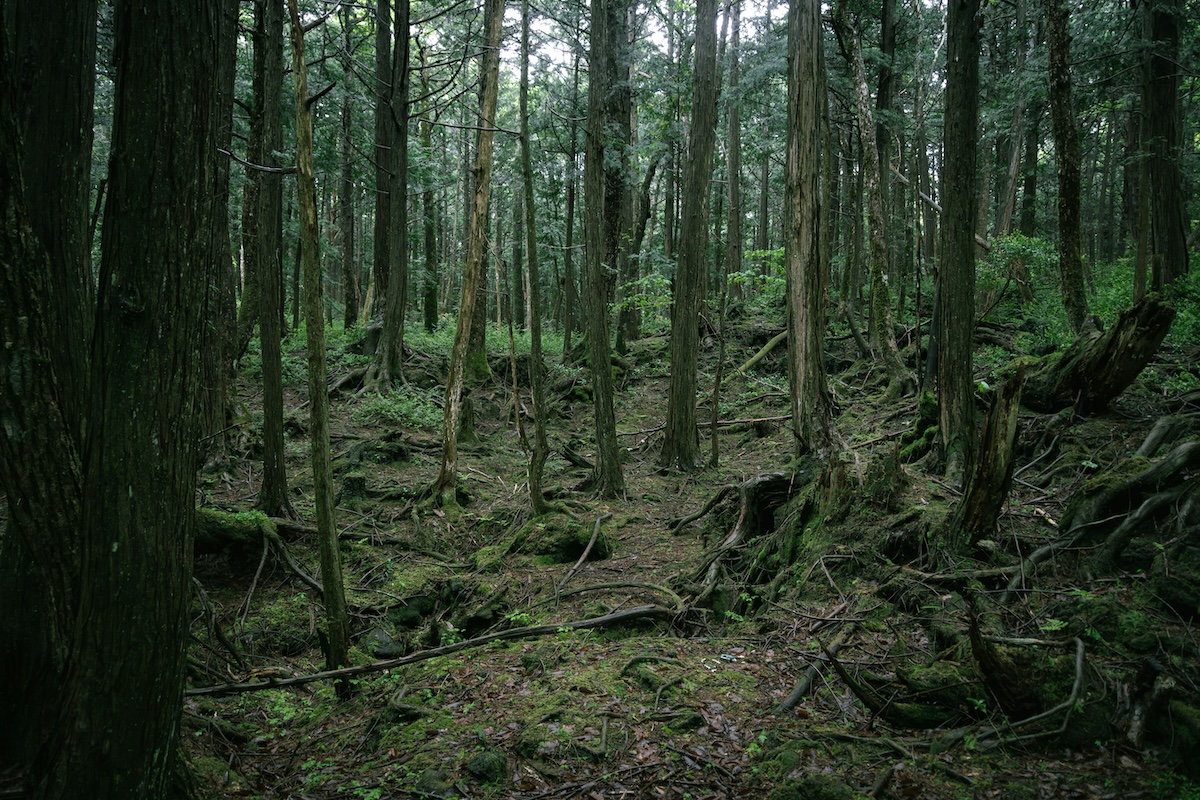
The ranger follows it. The canopy closes overhead. The light drops. The silence — Aokigahara's famous, suffocating silence, produced by a dense ceiling of cypress and hemlock growing on volcanic rock that absorbs sound like acoustic foam — presses in. The tape leads deeper, branching around root systems, looping over fallen trunks. Sometimes the tape runs out and the person is sitting at the end of it, alive, staring at nothing. Sometimes the tape has been cut. Sometimes there is no person at the end, only belongings: a bag, a jacket, shoes placed neatly side by side.
This is the reality of Aokigahara that no tourism campaign can erase and no sensational documentary can improve upon. The forest has been a place of death for centuries — first in mythology, then in literature, and finally in measurable, annual statistics that the Japanese government tracks, fights, and has slowly begun to reduce. Understanding why requires going back far further than the modern crisis. It requires understanding what the Japanese have always believed about this forest, and why the land itself seems purpose-built to hold onto the dead.
Ubasute and the Ghosts of the Abandoned
The Legend of Carrying the Old Into the Forest to Die
The oldest layer of Aokigahara's darkness is ubasute — the practice, real or legendary, of carrying elderly or infirm family members into remote wilderness and abandoning them during periods of famine. The historical reality is fiercely debated among Japanese scholars. Some argue it occurred in impoverished rural communities during the medieval period. Others insist it was always a literary device — a moral parable about the horror of poverty and the weight of filial obligation, never an actual social custom.
The debate is unresolved, but its effect on the forest is not. Oral traditions across the Fuji region placed ubasute in Aokigahara specifically. The logic was grim and practical: the forest was dense enough to swallow a person, silent enough that cries would not carry, and disorienting enough that anyone left inside would never find their way out. Whether or not elderly men and women were ever actually abandoned beneath the canopy, the story fused permanently with the landscape. Aokigahara became, in the folk imagination, a forest where the dying had been left — and where their spirits, unable to find peace, still wandered among the roots.
This was not casual superstition. The contamination was spiritual, categorical. Japanese pilgrims and woodcutters working the forests around Fuji gave the Jukai a wide berth for centuries. The trees were not haunted in the campfire-story sense. They were polluted by acts of cruelty so deep that the boundary between the living and the dead had been torn open.
Yūrei, Yōkai, and Why This Forest Became Their Home
The ghosts of ubasute slotted into a broader Japanese cosmology that already assigned spiritual agency to forests, mountains, and water. In Shinto and Buddhist tradition, death that is sudden, violent, or accompanied by powerful negative emotion — rage, grief, betrayal — produces yūrei: spirits trapped between worlds, unable to complete the journey to the afterlife. Yūrei are not passive hauntings. Classical texts and Edo-period art depict them as purposeful, sometimes malevolent, bound to the location or person that caused their suffering.
Aokigahara's physical properties made it a natural home for these stories. The silence could be the absence of life — or the presence of something that silenced it. The disorientation that trapped hikers could be the deliberate work of spirits pulling the living deeper. The twisted, humanoid root systems visible in the perpetual twilight — arching over volcanic rock, reaching across the forest floor — became the visual vocabulary of centuries of ghost stories.
Dense forests occupy a specific place in Japanese spiritual geography that has no Western equivalent. They are liminal zones, thresholds between the human world and the spirit world, between the ordered space of villages and the wild, ungoverned space of the mountains. Aokigahara, growing on the slopes of Japan's most sacred peak, swallowing sound and direction — it was not merely a creepy forest. It was a cosmological landmark. A place where, by every spiritual metric available to pre-modern Japanese culture, the membrane between the living and the dead was dangerously thin.
From Folk Legend to Modern Crisis
Seichō Matsumoto's Novel and the Literary Turning Point
The transition from ancient folklore to modern notoriety has a specific origin. In 1960, Seichō Matsumoto — already one of Japan's most celebrated mystery writers — published Nami no Tō (Tower of Waves), in which two lovers end their lives in Aokigahara. Matsumoto did not invent the association. He formalized it. His novel treated the Jukai not as a backdrop but as an active participant — a place chosen because it would swallow the evidence, because the bodies might never be found, because the forest itself cooperated with disappearance.
The effect on the public imagination was something like what Bram Stoker's Dracula did for Bran Castle — except that Aokigahara's mythology was not fictional horror but a living tradition with real consequences. Matsumoto gave the forest a narrative framework that resonated with contemporary anxieties about loneliness, shame, and the crushing pressures of postwar Japanese society. The Jukai became, in the cultural shorthand, the place you went when you had exhausted every other option.
Three decades later, the writer Wataru Tsurumi published Kanzen Jisatsu Manyuaru (The Complete Manual of Suicide) in 1993, a controversial bestseller that sold over a million copies and explicitly described Aokigahara as an ideal location. The book's effect was measurable and devastating. Yamanashi Prefecture authorities reported finding copies in the forest in the years that followed.
The Media Feedback Loop and the Damage It Did
International media discovered Aokigahara in the early 2000s. Documentaries, magazine features, and eventually viral online content reduced the forest to a single, flattened label: the "Suicide Forest." The coverage was overwhelmingly exploitative, focused on the macabre at the expense of context. Camera crews filmed personal belongings. Reporters described the place as if death were its only identity.
The nadir came in January 2018, when an American YouTuber entered Aokigahara with a camera crew and filmed the remains of a person who had died in the forest, posting the footage with joking commentary. The video was viewed millions of times before its removal. The backlash was global — from Japanese citizens, mental health organizations, the wider public — but the damage was already compounding. Every irresponsible piece of coverage reinforced the association, which drew more coverage, which deepened the association further.
Japan pushed back. The Yamanashi Prefectural Government issued formal requests to international media to stop using the phrase "suicide forest." Tourism authorities emphasized the forest's ecological significance. Mental health organizations pointed out what the sensational coverage consistently omitted: Aokigahara was a symptom, not a cause. The forest did not create the crisis. The crisis arrived at the forest, carried by people who had been failed by every system that should have caught them long before they reached the tree line.
The Human Cost — What Actually Happens in the Forest
The Volunteers Who Walk the Trails
Every year, volunteers and Yamanashi Prefecture rangers walk the paths of Aokigahara looking for people in distress. The patrols are quiet, deliberate work. Rangers check for cars parked overnight at trailheads with no returning hikers. They follow unofficial paths — the branching tracks that lead away from marked routes into the interior. They look for tape, string, and ribbon tied to branches. Navigation markers left by people who entered the deep forest and may or may not intend to come back.
Hayano Imoto, a geologist who worked near the forest for decades, became one of the most recognized figures associated with Aokigahara's prevention efforts. He spent years walking the Jukai, approaching people he found sitting alone off-trail, and persuading them to leave. His method was not clinical. He sat down. He offered conversation. He asked about their lives. In interviews, he described the work as ordinary human contact delivered at the moment it was most needed — and most absent. Many of the people he encountered had not spoken to another person in days.
The rangers carry the psychological weight of this work across years and decades. Yamanashi Prefecture provides counseling for patrol teams, but the toll is cumulative. Some rangers have walked the same trails for years, knowing that every shift may bring a discovery they cannot undo. The work is rarely discussed publicly. Japan's cultural discomfort with open discussion of suicide — rooted in deeply held values around privacy, shame, and the reluctance to burden others — means that the people who do this work often do it in near-total silence.
The Systemic Failure Behind the Forest
Aokigahara cannot be understood in isolation from the country that surrounds it. Japan has among the highest suicide rates in the developed world — a crisis driven by the culture of karōshi (death by overwork), the stigma attached to psychiatric treatment, the social expectation of self-sufficiency, and an aging, increasingly isolated population.
The Japanese concept of meiwaku — the deep aversion to causing trouble or inconvenience to others — plays a specific, documented role. Seeking help for mental illness can be experienced not as self-care but as an imposition on family, colleagues, and community. The result is a culture in which suffering is endured in silence until it becomes unbearable. People do not arrive at Aokigahara because a forest called to them. They arrive because every other system — family, workplace, healthcare, social connection — failed to catch them first.
The Japanese government has invested significantly in prevention since the mid-2000s. The Basic Act for Suicide Prevention, passed in 2006, established a national framework for intervention, awareness, and research. Rates have declined from their peak, though they remain a major public health concern. At Aokigahara specifically, the measures are visible: signs at every trailhead and along the paths display messages encouraging visitors to seek help, alongside the number for the national crisis hotline. Cameras monitor key entry points. Patrols increase during high-risk periods — March, the end of the fiscal year, and the weeks surrounding the Obon festival.
The message Japan wants the world to hear is straightforward: the forest is not the story. The story is the silence that precedes it.
Born from Fire — Why This Forest Is Like Nowhere Else on Earth
The 864 Eruption That Built the Lava Floor
The physical properties that made Aokigahara a home for mythology and a destination for the desperate are not metaphorical. They are geological. In the summer of 864 AD, Mount Fuji erupted from a parasitic vent called Nagaoyama on its northwest flank. The eruption lasted approximately ten days. Lava flowed northwest in two streams, burying the village of Honse, pouring into a large lake called Senoumi, and splitting it into what survives today as Lake Shōji and Lake Sai. The imperial court record, the Nihon Sandai Jitsuroku, documented the devastation: villages erased, refugees displaced, offerings sent to appease the mountain.
What remained was a lava field roughly 40 square kilometers in area — fractured, porous basalt riddled with gas pockets, lava tubes, and iron-rich mineral deposits. For centuries, nothing grew on it. The rock was too dense for root systems, too nutrient-poor for topsoil. Rain passed through the porous basalt like water through a sieve. Colonization happened over hundreds of years: mosses, lichens, and ferns established themselves in cracks, decomposed into pockets of soil centimeters deep, and eventually supported the roots of trees. The forest that emerged — primarily Japanese cypress, southern Japanese hemlock, and boxwood — roots not into soil but into stone. The root systems spread laterally across the basalt surface, braiding over each other in dense, tangled mats that look like the exposed nervous system of something enormous.
The Silence, the Compasses, and the Landscape That Traps
The shallow rooting creates Aokigahara's most unsettling feature: trees that appear to stand on legs. Roots arch over rock, creating hollows. When a tree falls — which happens often without deep anchorage — it tears up a disc of roots and moss, leaving a pit. New trees grow on the carcasses of old ones. The result is a landscape of constant visible decomposition: living trees consuming dead ones, root systems exposed to air, and a ground surface that is not ground at all but a thin, unstable skin stretched over volcanic stone.
The canopy this produces is nearly airtight. Wind cannot penetrate. Sound, with no surfaces to bounce off and no breeze to carry it, drops to near zero. The lava substrate is laced with magnetite — iron deposits from the 864 eruption that cause compass needles to stutter and spin. GPS weakens. Cell reception vanishes. The trees grow in twisted, repeating patterns with a visual uniformity that erases all sense of bearing. Every direction looks identical. No landmarks. No clearings. No gradient of light. Hikers who step off the trail have been found days later less than 200 meters from the path, unable to locate it.
The geological explanation accounts for everything the mythology describes. The silence that the Japanese attributed to yūrei is produced by canopy density and basaltic sound absorption. The disorientation blamed on spirits pulling the living deeper is caused by magnetite and visual repetition. The forest's reputation as a place that holds onto whatever enters it is not superstition. It is topology.
Walking the Jukai Today — Ecology, Trails, and Reclamation
The Ice Cave, Wind Cave, and the Geology Beneath Your Feet
Aokigahara's lava field also created a network of subterranean caves that are among the most visited natural attractions in the Fuji region. The Narusawa Ice Cave descends into a lava tube where temperatures remain near freezing year-round, producing ice formations that persist through summer. The cave drops 21 meters below the surface and extends approximately 153 meters, narrowing into passages where visitors walk single file past walls of blue ice. Nearby, the Fugaku Wind Cave — a broader, 201-meter lava tube historically used for cold storage of silkworm eggs — hovers around 3°C regardless of season. Both are designated Natural Monuments of Japan and draw hundreds of thousands of visitors annually who come for the geology, not the ghosts.
Conservation, Tourism, and the Battle Over Identity
Yamanashi Prefecture has waged a sustained campaign to redefine Aokigahara. Official tourism messaging emphasizes hiking, cave exploration, birdwatching, and nature photography. Guided ecology tours led by trained naturalists focus on root systems, cave formations, and the interplay between volcanic geology and forest growth. Improved signage, expanded marked trails, and increased ranger presence have reshaped the visitor experience on the official paths.
The tension persists. International tourists still arrive with cameras and expectations shaped by YouTube and horror films. The 2016 American film The Forest and its imitators cemented Aokigahara in Western pop culture as a destination for the macabre. Japanese authorities have responded with a dual strategy: welcoming visitors who come for the ecology while confronting those who treat the forest as a spectacle.
The marked trails — connecting the Saiko Bat Cave, the wind and ice caves, and the shores of Lake Sai — are well-maintained and clearly signed. The primary trailheads are accessible from Kawaguchiko Station by bus, and walks range from easy, flat paths suitable for families to longer routes penetrating deeper into the interior. On the marked trails, the forest is beautiful. Sunlight filters through canopy gaps. Moss glows green on every surface. The root systems, seen in context, are not sinister but astonishing — a visible record of a forest's thousand-year negotiation with bare rock.
Off the trails, the forest remains exactly what it has always been.
The Atlas Entry — Visiting Aokigahara
How to Get There and What to Expect
Aokigahara sits within the Fuji-Hakone-Izu National Park in Yamanashi Prefecture. The most common access point is Kawaguchiko Station, reachable from Tokyo by direct express bus (approximately 1 hour 45 minutes from Shinjuku) or by JR train with a transfer at Ōtsuki. Local buses run from Kawaguchiko to the forest's major trailheads, including the ice cave, wind cave, and Saiko Iyashi no Sato, a reconstructed traditional village on Lake Sai's shore.
The main trails are flat, well-signed, and require no special equipment. The full loop through the major geological sites takes three to four hours at a moderate pace. Guided ecology tours are available through local operators and the Kawaguchiko Tourist Information Center. The caves require a small admission fee and involve steep stairs into cold, damp passages — sturdy shoes and a light jacket are essential even in summer.
Visitors should understand that Aokigahara is a place of ongoing sensitivity. The signs along the trails — displaying messages of encouragement and helpline numbers — are not decorative. They were placed by people who walk these paths looking for someone to save. Treat them with the respect they deserve. Photography is welcome on marked trails. Filming or photographing personal items found off-trail is not.
For those exploring Japan's relationship with abandoned and psychologically charged landscapes, Hashima Island offers a parallel story of decay and contested memory off the coast of Nagasaki. The doll village of Nagoro provides a quieter lens on depopulation and absence in rural Japan. Closer to the forest, the Fuji Five Lakes — particularly Kawaguchiko and Motosu — offer views of Fuji reflected in water, a scene printed on the Japanese 1,000-yen note since 2004.
A Forest, Not a Label
Aokigahara will carry its mythology for as long as the trees stand. The yūrei are not leaving. The lava will keep spinning compasses. The silence will keep pressing on the ears of anyone who steps off the paved paths into the twilight beneath the canopy.
But the forest is older than its darkest chapter, and it will outlast it. The lava tubes were forming when the Roman Empire still held Britain. The first moss colonized the basalt before the Normans crossed the English Channel. The hemlock trees that dominate the canopy today have been growing, falling, and regenerating in a cycle that predates every novel, every documentary, every careless headline that tried to reduce 35 square kilometers of geological wonder to a single word.
Aokigahara is not a story about death. It is a forest that grew on fire, built its own soil from nothing, and created an ecosystem so alien and so silent that human beings, confronted with it, reached for the only explanation that made sense: the dead must live here.
The dead do not live here. The living do — in the root systems that swallow rock, in the ice that persists through summer, in the rangers who walk the trails every morning hoping today is a quiet day. The Jukai asks nothing of its visitors except what every forest asks. Walk carefully. Pay attention. And when you reach the edge of the trail, turn back.
If you or someone you know is in crisis, please reach out to a local helpline. In Japan, contact TELL Lifeline at 03-5774-0992 or the Yorisoi Hotline at 0120-279-338. International resources are available through the International Association for Suicide Prevention at https://www.iasp.info/resources/Crisis_Centres/.
FAQ Section
What is Aokigahara and why is it famous?
Aokigahara is a 35-square-kilometer forest at the northwest base of Mount Fuji in Yamanashi Prefecture, Japan. Known in Japanese as Jukai — the Sea of Trees — it has been associated with death and restless spirits for over a thousand years, rooted in folk traditions of ubasute (the legendary abandonment of the elderly in remote wilderness). In the modern era, Aokigahara became the most common location for suicide in Japan, a reputation accelerated by literature, media coverage, and a 1993 bestseller that named it explicitly. The Japanese government now actively works to redefine the forest through prevention efforts and ecological tourism.
Why do people go to Aokigahara to die?
Aokigahara's association with suicide is the product of centuries of cultural layering, not a single cause. Ancient folklore linked the forest to death and spirit possession. Seichō Matsumoto's 1960 novel and Wataru Tsurumi's 1993 manual both reinforced the connection in popular culture. The forest's physical properties — its extreme isolation, silence, and disorienting terrain — make it a place where disappearance feels possible. Japan's broader mental health crisis, driven by workplace pressure, social stigma around psychiatric care, and cultural reluctance to seek help, provides the systemic context. The forest is a destination, not a driver.
Is Aokigahara really haunted?
Aokigahara has been considered spiritually dangerous in Japanese tradition for centuries. Its association with ubasute — the abandonment of the elderly — produced stories of yūrei (restless spirits) trapped among the trees. The forest's physical characteristics reinforced the mythology: its near-total silence, perpetual twilight, disorienting uniformity, and twisted root systems that resemble human figures all contributed to a spiritual reputation that long predates the modern crisis. Whether one interprets this as supernatural or geological, the effect the forest has on visitors is well documented.
Why do compasses stop working in Aokigahara?
The lava field beneath Aokigahara contains high concentrations of magnetite and other iron-rich minerals deposited during the 864 eruption of Mount Fuji. These deposits create localized magnetic anomalies that interfere with compass needles, causing them to spin erratically. Combined with weak GPS reception under the dense canopy and absent cell phone signal in large areas, this makes off-trail navigation extremely dangerous. Hikers who leave the marked paths have been found days later less than 200 meters from the trail, unable to locate it.
Can you visit Aokigahara safely?
Yes. The marked trails are well-maintained, clearly signed, and suitable for all experience levels. Main routes connect the Narusawa Ice Cave, Fugaku Wind Cave, and Lake Sai shoreline. Guided ecology tours are available through local operators and the Kawaguchiko Tourist Information Center. Visitors should stay on marked paths and respect the sensitivity of the site — signs displaying crisis helpline numbers are placed throughout the forest and are not decorative. Photography is welcome on the trails but filming personal items found off-trail is not.
What is Japan doing about suicide at Aokigahara?
Yamanashi Prefecture and the national government have implemented multiple prevention measures. Rangers and volunteers patrol the forest year-round, with increased presence during high-risk periods. Crisis hotline signage is displayed at every trailhead and along interior paths. Surveillance cameras monitor key entry points. Japan's Basic Act for Suicide Prevention, passed in 2006, established a national framework that has contributed to declining rates since their peak in the early 2000s. The prefectural government has also formally requested international media stop using the term "suicide forest."
Sources
- [The Jōgan Eruption of Mount Fuji (864 AD): Geological Reconstruction and Hazard Implications] - Tsuya, H., Bulletin of the Earthquake Research Institute, University of Tokyo (1955, revised 1988)
- [Nihon Sandai Jitsuroku (The True History of Three Reigns of Japan)] - Imperial Court Record, Heian Period (901 AD)
- [Suicide in Japan: A Sociocultural Perspective] - Ozawa-de Silva, Chikako, Anthropology News (2008)
- [Japan's Suicide Prevention Policy: The National Framework and Local Implementation] - Ministry of Health, Labour and Welfare, Government of Japan (2017)
- [The Complete Suicide Manual: Cultural Impact and Public Health Response] - Ueda, Michiko & Matsubayashi, Tetsuya, Journal of Affective Disorders (2014)
- [Mapping Magnetic Anomalies in Basaltic Lava Fields: Aokigahara Case Study] - Okubo, A. et al., Earth, Planets and Space (2005)
- [Seichō Matsumoto and the Social School of Japanese Mystery Fiction] - Kawana, Sari, Murder Most Modern: Detective Fiction and Japanese Culture (2008)
- [Dark Tourism and the Spectacle of Suffering: Ethical Frameworks for Sensitive Site Visitation] - Stone, Philip, Annals of Tourism Research (2012)
- [Ubasute: Fact, Fiction, and the Ethics of Folklore in Japanese Studies] - Nakanishi, Akira, Journal of Japanese Studies (1991)
- [Forest Vegetation and Primary Succession on Volcanic Substrates in Central Honshu] - Forestry and Forest Products Research Institute, Japan (2010)
- [Lava Tube Caves of the Fuji Volcanic Zone: Survey and Conservation] - Geological Survey of Japan, AIST (2006)