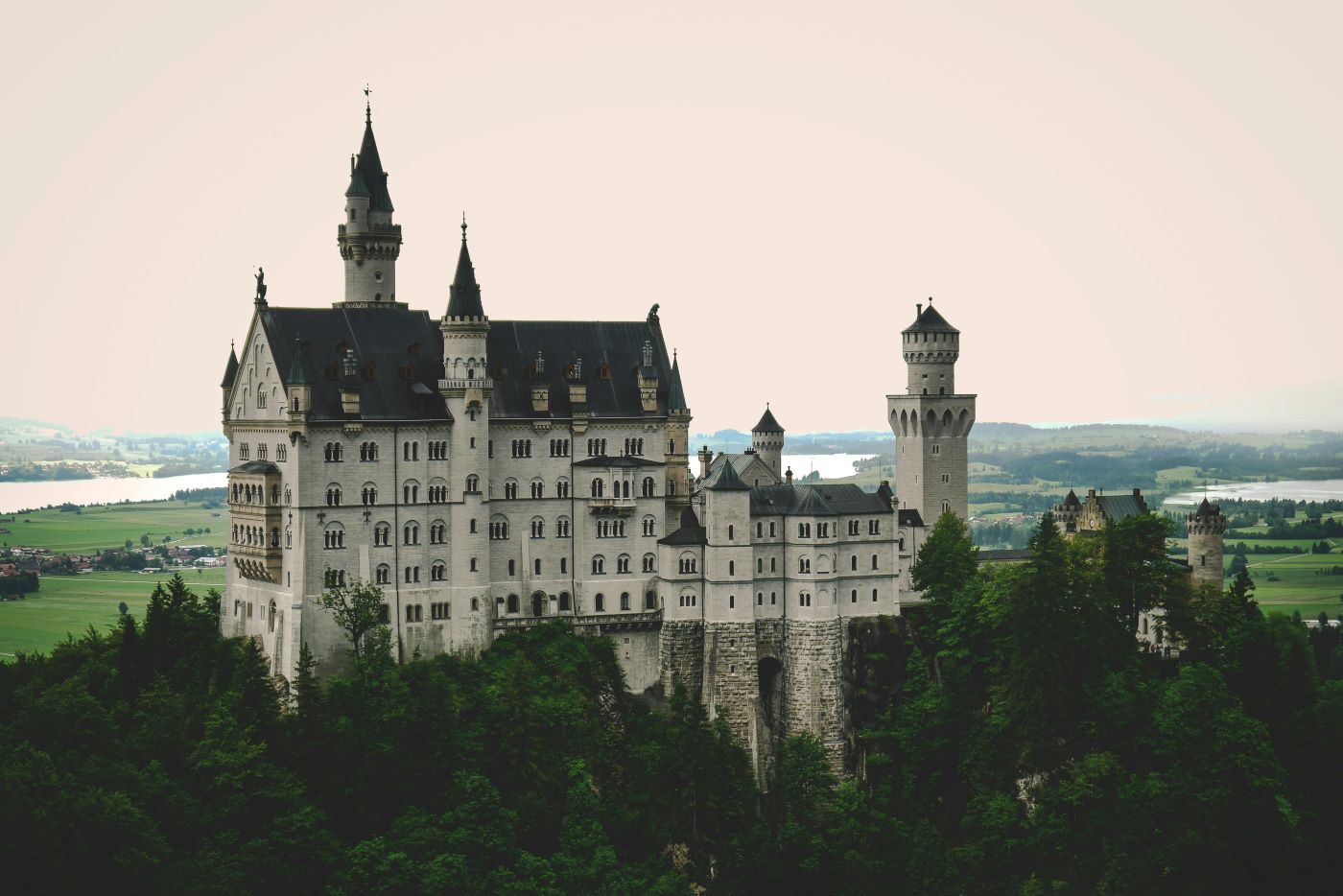
It begins with the mist. Before you see the stone, you feel the altitude. High above the village of Hohenschwangau, where the Bavarian Alps jut into the sky like jagged teeth, a silhouette emerges from the fog. It is an image burned into the collective consciousness of the Western world—the white limestone towers, the dark blue turrets, the impossible verticality of a structure that seems to defy gravity.
For millions, this silhouette represents the ultimate fantasy. It is the real-life inspiration for the Disney logo, a symbol of "happily ever after," and the crowning jewel of European tourism. But to view Neuschwanstein Castle through the lens of a fairy tale is to fundamentally misunderstand its purpose, its creator, and its dark, blood-stained history.
This was not a palace built for a princess to wave from a balcony. It was a fortress of solitude constructed by a misanthropic King who slept by day and lived by night, a man who despised the public eye so intensely that he once threatened to dynamite the castle rather than let the uninitiated set foot inside. The irony, of course, is palpable. The retreat built for one man’s isolation is now trampled by 1.4 million visitors a year.
Beneath the Romanesque facade lies a story of financial ruin, a suspicious death that remains Germany’s greatest cold case, and a second life during World War II as a warehouse for the greatest art theft in human history.
Who Was the Swan King? The Melancholy of Ludwig II
King Ludwig II of Bavaria, often called "The Swan King" or the "Fairy Tale King," was a man born into the wrong century. Ascending the throne in 1864 at the tender age of 18, Ludwig was ill-equipped for the Realpolitik of 19th-century Germany. He was a creature of the night, a romantic idealist who found the mundane duties of court life in Munich—the parades, the parliaments, the wars—unbearably suffocating.
Ludwig possessed a profound sense of Sehnsucht—a uniquely German word describing an intense, painful longing for something indefinable. He did not want to be a constitutional monarch; he wanted to be a medieval grail king. As Prussia rose to dominate Germany, stripping Bavaria of its sovereignty, Ludwig retreated further into his own mind.
He was not merely shy; he was pathologically averse to being looked at. He began to sleep during the day and take sleigh rides through the mountains at night, illuminated by servants carrying torches. He was a man out of time, desperate to construct a world where he could reign supreme, not as a political figurehead, but as the master of his own dreams. Neuschwanstein was to be that world.
Richard Wagner and the Opera Built of Stone
If Ludwig was the architect of the dream, the composer Richard Wagner was the god he worshipped. Ludwig’s patronage of Wagner was obsessive. He paid off the composer's massive debts and gave him a stage to revolutionize music. In return, Ludwig built Neuschwanstein not just as a home, but as a habitable theater set dedicated to Wagner’s operas.
Every inch of the castle is a tribute to the Germanic sagas Wagner brought to life. The walls are not adorned with portraits of the royal family, but with frescoes depicting scenes from Lohengrin, Tannhäuser, and Parsifal. The swan, the heraldic animal of the Knights of the Grail (and the symbol of the Lords of Schwangau), appears everywhere—in the tapestries, the door handles, the washbasins.
The tragic irony of this Richard Wagner patronage is that the composer never set foot in Neuschwanstein. He died in 1883, three years before the castle was habitable. Ludwig built a temple for a deity who never came to bless it, deepening the King’s isolation.
The Medieval Masquerade: High-Tech Illusion
From the Marienbrücke bridge, Neuschwanstein looks like a relic from the Middle Ages, a 13th-century fortress untouched by time. This is the castle’s greatest deception. Construction began in 1869, during the industrial revolution. The Neuschwanstein architecture is not a medieval feat of stone masonry; it is a high-tech Victorian illusion.
Beneath the limestone cladding lies a modern steel skeleton and brick walls. While Ludwig dreamed of the days of knights and chivalry, he demanded the comforts of the 19th century. The castle was equipped with a battery-powered bell system for summoning servants, a telephone line, and a hot air central heating system that was revolutionary for its time.
The kitchen had running hot and cold water, and the toilets were equipped with an automatic flushing mechanism. It was a stage set—a medieval skin stretched over a modern industrial body. It was a place where Ludwig could pretend to be a medieval autocrat while enjoying the benefits of modern engineering.
Inside the Singers’ Hall: The Heart of the Obsession
If the castle is a temple, the Singers’ Hall (Sängersaal) is its sanctuary. Occupying the entire fourth floor of the eastern section, this room was the reason the castle was built. It is a reconstruction of the minstrel’s hall at the Wartburg, the setting for Wagner’s Tannhäuser.
The room is an assault on the senses. Hundreds of candles in massive chandeliers were designed to illuminate the gold leaf and the intricate murals depicting the legend of Parzival. The acoustics were perfected for opera. Yet, in Ludwig’s lifetime, no concert was ever performed here. The silence of the Singers’ Hall is heavy; it is a space built for thunderous music that was occupied only by the footsteps of a lonely man pacing the floor, surrounded by painted legends of heroes he could never emulate.
The Venus Grotto: An Artificial Cave for a Lonely King
Perhaps nothing illustrates the King's flight from reality better than the Venus Grotto. Located on the third floor, between the salon and the study, this is not a room but a full-scale artificial cave.
Modeled after the Venusberg in Wagner’s Tannhäuser, the grotto features artificial stalactites made of canvas and plaster, a waterfall, and a lake deep enough to row a boat in. Ludwig commissioned a golden swan boat in which he would sit, rowing in circles within his own bedroom suite.
The grotto was an engineering marvel. It utilized the first electric power plant in Bavaria to fuel arc lights that could change the color of the "sky" from blue to red to pink. Here, the King could vanish completely. He could turn day into night, silence the world outside, and float in a golden boat through an electric blue haze, the ultimate protagonist in a play with an audience of one.
The Diagnosis of Insanity: A Political Coup?
By 1886, Ludwig’s obsession had bankrupted his personal coffers (though, crucially, not the state treasury). He was millions of marks in debt to foreign banks. The Bavarian ministers, tired of an eccentric King who refused to govern and spent fortunes on castles, decided to act.
They commissioned a panel of psychiatrists, led by Dr. Bernhard von Gudden, to declare the King insane. The resulting report is a document of questionable medical ethics. The doctors declared Ludwig to be suffering from "paranoia" and mentally unfit to rule. The scandal lies in the fact that Dr. Gudden had not examined the King for years, and the other signatories had never met him at all. They based their diagnosis on hearsay and the testimony of disgruntled servants who claimed the King talked to imaginary people and bowed to statues.
Was it a medical reality or a political coup? Historians still debate the King Ludwig II insanity verdict. While his behavior was certainly eccentric and reclusive, he remained lucid in his correspondence and astute in architectural matters until the end. The diagnosis was the weapon used to dethrone him.
The Standoff at the Gates: The King’s Last Stand
The events of June 10, 1886, read like a thriller. A government commission arrived at Neuschwanstein to arrest the King. But Ludwig was not without allies. A local coachman tipped him off, and the King ordered the castle gates locked.
The local peasantry in Hohenschwangau, who loved their eccentric King (who paid them well for construction work), rushed to the castle. The local fire brigade stood guard with axes. The King ordered the police to arrest the government commission, threatening to skin them alive (a threat he likely had no intention of carrying out, but which fueled the insanity narrative).
For a brief moment, Neuschwanstein was a fortress under siege. But the resistance was futile. The government regrouped, replaced the King’s guards, and on June 12, Ludwig was taken into custody. As he was led away from his unfinished masterpiece, he reportedly asked Dr. Gudden, "How can you declare me insane when you have not examined me?"
The Mystery of Lake Starnberg: A Tragic End
Ludwig was transported to Berg Castle on the shores of Lake Starnberg, a place that would become his prison. The following day, June 13, 1886, was Whitsunday. The King appeared calm, perhaps too calm.
In the evening, around 6:00 PM, Ludwig asked to take a walk in the park. Dr. Gudden accompanied him. Confident in his control over the patient, Gudden sent the orderlies back, leaving the two men alone. They were expected back by 8:00 PM for supper.
They never returned.
A frantic search began in the driving rain. At 11:00 PM, the search party found their bodies floating in waist-deep water near the shore. The King’s pocket watch had stopped at 6:54 PM. This moment marks the birth of the Lake Starnberg mystery.
Suicide, Accident, or Murder? Investigating the Theories
The official version of events stated that Ludwig committed suicide by drowning and that Dr. Gudden died trying to save him. However, the autopsy results tell a darker story.
- No Water in the Lungs: The autopsy performed on the King revealed no water in his lungs. It is medically difficult to drown without inhaling water. This suggests he may have died from "dry drowning" (laryngospasm) or cardiac arrest—or that he was dead before he hit the water.
- Signs of Struggle: Dr. Gudden’s body showed clear signs of a violent struggle. He had blows to the head and neck, and his fingernails were broken.
- The Escape Theory: Many historians believe Ludwig was attempting to escape. A boat was reportedly waiting for him across the lake. Gudden may have tried to stop him, leading to a struggle where the doctor was strangled or drowned, and the King subsequently collapsed or was killed.
- The Murder Theory: The "Dark Atlas" perspective must consider the assassination theory. Ludwig was a liability. He was popular with the people and could have rallied support. Did a sniper on the shore silence the Swan King?
The truth died in the water that night, cementing the legend of the tragic, misunderstood genius.
Nazi Art Theft at Neuschwanstein: The ERR Headquarters
The story of Neuschwanstein usually ends with Ludwig’s death, but its darkest chapter began fifty years later. During World War II, the castle’s isolation—the very quality Ludwig prized—made it the perfect hiding place for the Third Reich.
The castle became a primary depot for the Einsatzstab Reichsleiter Rosenberg (ERR), the Nazi party organization dedicated to appropriating cultural property. Under the guise of "protecting" art from Allied bombing, the Nazis looted the private collections of Jewish families in occupied France.
Neuschwanstein was transformed from a fairy tale palace into a warehouse of stolen heritage. The Nazis chose it because it was deep in Bavaria, far from the front lines, and symbolically linked to the Germanic past they idolized.
Stolen Art in the Throne Room: The Rothschild Collection
The image is chilling: The Throne Room, designed to hold a golden throne that was never built, was instead stacked floor-to-ceiling with wooden crates branded with the codes of looted collections.
The ERR inventory for Neuschwanstein was staggering. It held the plunder of the Rothschilds, the David-Weills, and other prominent French Jewish families. The treasures included:
- Precious French furniture from the 17th and 18th centuries.
- Thousands of rare paintings.
- The Rothschild jewelry collection.
- Perhaps most significantly, the Ghent Altarpiece (The Adoration of the Mystic Lamb), one of the world's most coveted artworks, was stored here before being moved to the salt mines of Altaussee.
The cataloging of these stolen works took place in the royal suites. Nazi officers sat at Ludwig’s desk, smoking cigarettes, itemizing the theft of a continent’s culture in the very rooms built to celebrate the purity of the Holy Grail.
The Monuments Men and the Plot to Destroy the Castle
As the Allies advanced into Germany in 1945, the SS had standing orders regarding the depots: if the Reich fell, the treasures—and the buildings holding them—were to be destroyed. Neuschwanstein was rigged for demolition.
This is where the history of the Monuments Men intersects with the castle. This special unit of the Allied armies, tasked with protecting cultural property, was in a race against time. The hero of Neuschwanstein was Captain James Rorimer (later the director of the Metropolitan Museum of Art). Rorimer arrived at the castle in May 1945.
He found the SS guards had fled, choosing self-preservation over the destruction order. The castle was intact. Inside, Rorimer found the meticulous card catalogs of the ERR, providing the crucial evidence needed to track and repatriate thousands of stolen works. The castle that was built on a foundation of madness ended up preserving the sanity of European culture.
The Marienbrücke View: Beauty and Vertigo
For the modern visitor, the experience of Neuschwanstein is a battle between awe and overcrowding. The most famous vantage point is the Marienbrücke (Mary’s Bridge). This slender suspension bridge spans the Pollät Gorge, hanging 300 feet over a waterfall.
The view from here is the "money shot"—the full profile of the castle against the backdrop of the Forggensee lake. However, it induces a sense of beautiful vertigo. The wooden planks creak under the weight of hundreds of tourists. In peak season, the queue to get onto the bridge can take an hour. It is a terrifying, claustrophobic, and undeniably majestic experience. It captures the essence of the Romantic Sublime: beauty mixed with terror.
The Hike and the Ascent: Practical Realities
Visiting the castle is a physical undertaking. Neuschwanstein sits atop a rugged crag. Visitors must navigate the ascent from the ticket center in Hohenschwangau.
- The Walk: A steep, 30-45 minute uphill hike. It is strenuous, especially in the summer heat.
- The Horse Carriage: A nod to the 19th century, but often plagued by long lines and animal welfare concerns.
- The Bus: Shuttles run to the Marienbrücke, but they do not run in snow or ice.
The physical effort required to reach the gates serves as a reminder of just how isolated Ludwig intended to be.
Hohenschwangau Castle: The Yellow Fortress of Childhood
While Neuschwanstein gets the glory, the yellow castle on the lower hill, Hohenschwangau Castle, is historically just as significant. This was the summer residence of the Bavarian royal family, where Ludwig grew up.
From his bedroom in Hohenschwangau, the teenage Ludwig would look up at the ruins of the old Vorderhohenschwangau fortress through a telescope, dreaming of what he would build there. It is here that the seeds of his lonely imagination were sown.
Managing the Tour Experience: What to Expect Inside
A visit to the interior of Neuschwanstein is strictly controlled.
- The Timeline: You must book tickets weeks or months in advance.
- The Duration: The guided tour lasts only about 30 to 35 minutes.
- The Limitation: Photography is strictly forbidden inside.
- The Reality: Visitors only see a fraction of the castle. Out of 200 planned rooms, only about 15 were fully completed.
You are walked through the finished third and fourth floors—the Throne Room, the Bedroom, the Grotto, the Singers’ Hall—and then exit through the unfinished sections, which now house a café and gift shop. It is a brief, dazzling glimpse into a dream that was never finished.
Conclusion: The Irony of Crowds
There is a profound melancholy that hangs over Neuschwanstein, visible only if you look past the souvenir stands and the selfie sticks. King Ludwig II lived in his dream castle for only 172 days. He died before the throne was installed, before the chapel was finished, before the music could play.
This enduring silhouette, born from a king’s reclusive fever dream, eventually provided the spark for a different kind of empire. In the 1950s, Walt Disney visited the castle during a tour of Europe and was captivated by its soaring verticality. He would later use Neuschwanstein as the primary visual blueprint for Sleeping Beauty Castle at Disneyland, effectively rebranding Ludwig’s private sanctuary as a universal symbol of 'happily ever after.' It is the ultimate historical irony: a fortress built to ensure a king’s absolute isolation became the architectural DNA for the most famous, most visited fantasy world in human history.
He built this fortress to exclude the world. "I wish to remain an eternal enigma to myself and to others," he once wrote. Today, he is the most famous tourist attraction in Germany. We walk through his bedroom, stare at his washstand, and analyze his psyche.
Neuschwanstein is a monument to the failure of solitude. It stands as a testament to a man who tried to build a wall against reality, only to have reality invade, loot, and eventually commercialize his sanctuary. It is beautiful, yes. But it is a beauty born of madness, preserved by theft, and sustained by the very gaze Ludwig spent his life trying to escape.
Sources & References
- Bavarian Palace Administration (Bayerische Schlösserverwaltung) - Official history and architectural details of Neuschwanstein.
- The Monuments Men Foundation - Records of James Rorimer and the recovery of art at Neuschwanstein.
- National Archives (USA) - Records regarding the Einsatzstab Reichsleiter Rosenberg (ERR) and art looting.
- Ghent Altarpiece Recovery History - Detailed account of the stash found in the castle.
- Deutsche Welle (DW) - Historical analysis of Ludwig II’s mysterious death.
- Bavaria Tourism - Official guide to Hohenschwangau and the region.
- History.com - "Who were the Monuments Men?"
- UNESCO World Heritage - Context on the tentative listing of Ludwig's castles.
- The Louvre Museum History - Documentation on the looting of French collections (Rothschild/David-Weill).
- Schwangau Municipality - Local history of the region and the Marienbrücke.