The Hidden Pit Beneath the Bloody Chapel
On a summer day in 1909, a workman cleaning a wall in the upper chapel of Leap Castle pried loose a stone and looked into a chamber whose bottom he could not see. He fetched a rope and a lantern. The light caught a forest of human bones rising from a floor of sharpened wooden spikes, still wearing the rotted scraps of medieval clothing. He climbed back out and went to find his employer.
The bones were carted out for weeks. Three full loads, by some accounts. Nobody counted how many people the O’Carrolls had dropped alive into the pit beneath the room where they heard Mass.
The chamber the workman had broken into is an oubliette — from the French oublier, “to forget.” It is a windowless drop-hole built into the thickness of a medieval wall, accessed by a trapdoor in the floor of a room directly above. A prisoner pushed through the trapdoor falls between fifteen and twenty feet onto whatever the lord of the house has put at the bottom. At Leap, that was a bed of upward-pointing wooden spikes. The fall did not always kill. Survivors lay in the pit beside the rotting bodies of earlier prisoners until thirst finished the work.
The trapdoor sits in the floor of a room called the Bloody Chapel. That name predates the discovery of the bones by nearly four hundred years.
Leap Castle is a tower-house in the green pastureland of County Offaly, in the central midlands of Ireland. It is generally called the most haunted castle in the country. The reputation is partly Victorian theater and partly the work of one woman with a typewriter, but it is also rooted in the unusual archaeological fact that a medieval Irish chapel has a slaughter-pit hidden behind its altar wall. Many Irish castles were brutal places. Leap is the one where the brutality left an architectural signature dense enough to grow ghosts.
The O’Carroll Clan and the Building of Leap Castle
Leap Castle sits at the southern edge of the Slieve Bloom Mountains, on a low rise that controls one of the few easy passes between the ancient Irish provinces of Munster and Leinster. Anyone moving an army, a herd, or a wedding party between the south and the east had to come within bowshot of the hill. The Gaelic name preserved by tradition is Léim Uí Bhanáin — the Leap of the O’Bannons — referring to a clan succession ritual in which two rival O’Bannons jumped from a high rock and whichever survived ruled. The story may be myth. The hill is real, and the pass is real, and the kingdoms that fought over it are real.
The O’Bannons, the O’Carrolls, and the Conquest of Ely
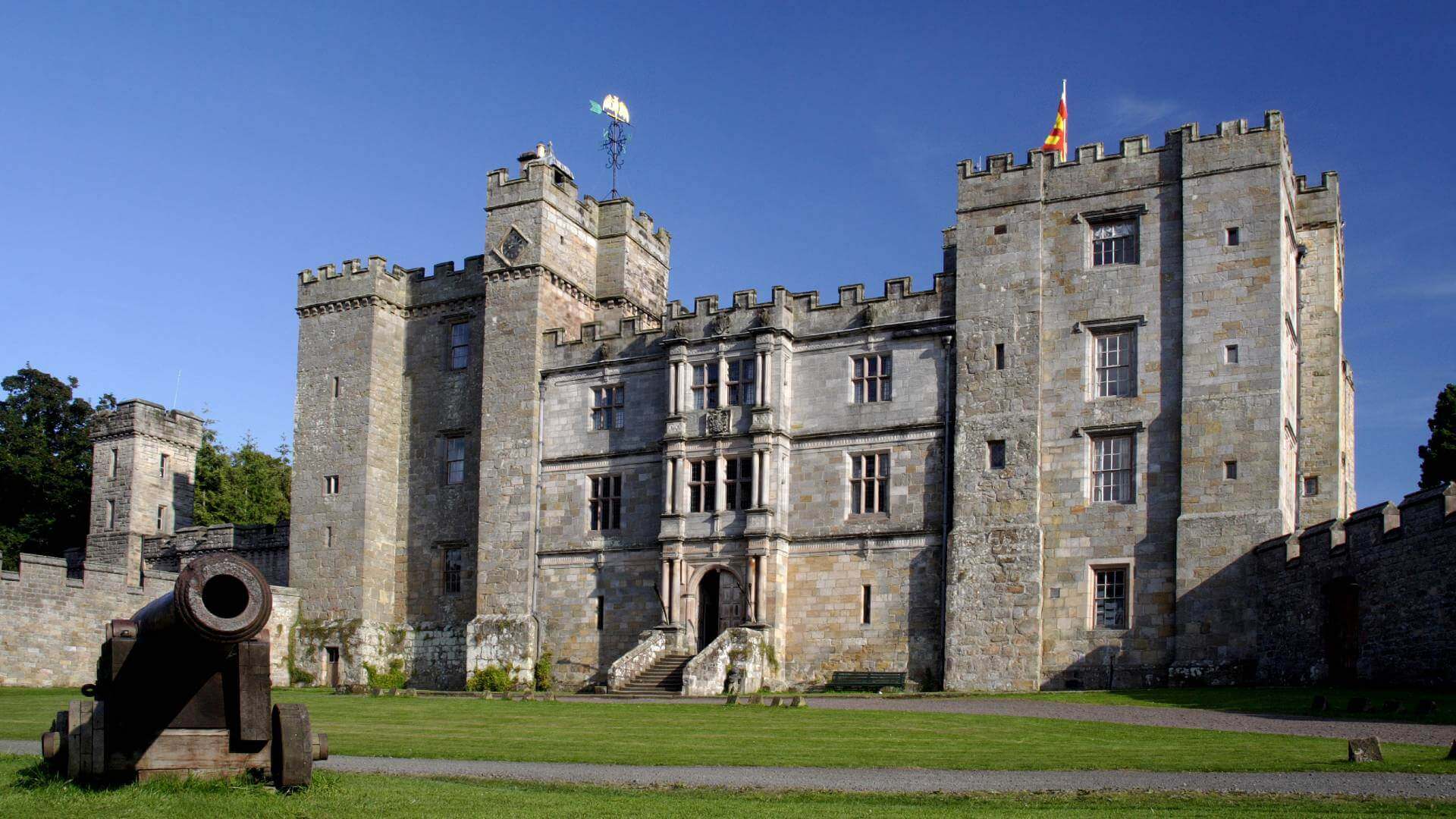
The first tower at Leap was probably built by the O’Bannons in the late thirteenth century. By the early fifteenth century, the O’Bannons had been displaced by their more powerful neighbours, the O’Carrolls of Ely, who had carved out a small Gaelic kingdom called Ely O’Carroll covering most of what is now southern Offaly and northern Tipperary. The O’Carrolls rebuilt the tower in stone, raised it to four storeys, and made Leap one of the principal fortresses of their territory.
A late-medieval Irish tower-house was both a residence and a weapon. The walls are eight feet thick at the base. The single entrance is at ground level, narrow, and overlooked by a hole in the ceiling of the entrance passage called a “murder hole” through which defenders could drop stones, hot water, or boiling pitch onto unwelcome visitors. The interior is a vertical stack of single-room storeys connected by a spiral staircase that turns clockwise so that a defender retreating upward has his sword-arm free against attackers below. Leap was built to kill at every floor.
Most of the killing it did was internal.
The Most Brutal Clan in Late Medieval Ireland
The O’Carrolls were not unusually rich, unusually large, or unusually cultured. Their distinction was the speed and casualness with which they killed each other. Internal succession in the clan was decided by the Gaelic system of tanistry, in which the next lord was chosen from a wide pool of male relatives rather than by primogeniture. Tanistry produced energetic candidates and frequent murders. At Leap, the pattern reached an extreme not even other Irish chroniclers wanted to record in full.
Mulrony O’Carroll and the Banquet of Death
The most famous O’Carroll atrocity is the one tradition calls the Banquet of Death. Mulrony O’Carroll, often called One-Eyed Mulrony, had a long-running feud with the Mac Mahons of the neighbouring territory. Sometime in the early sixteenth century, Mulrony invited forty Mac Mahon men to Leap for a feast of reconciliation. They came under the protection of guest-right, the Gaelic custom that made a guest sacred under the host’s roof.
The Mac Mahons sat at the long table in the great hall of Leap. The O’Carroll servants poured wine. Halfway through the meal, on a signal from Mulrony, the doors were locked and armed O’Carrolls came down the spiral stair from the floor above. The Mac Mahons were unarmed by custom. The killing took an hour.
The story passed into local tradition rather than into formal record, which is what one would expect of an atrocity inflicted on a defeated rival in a Gaelic-Irish world that left most of its history in the oral tradition of bards. The Bardic remembrance is unambiguous: it is the same kind of betrayal that runs through the most haunted episodes of Gaelic memory, the violation of coibhche, the sacred bond of host and guest.
Two Brothers, One Chapel, One Sword in 1532
The killing that gave the Bloody Chapel its name took place in 1532. The lord of Leap at the time was Teige O’Carroll, called Teige an Caoich, “Teige the One-Eyed,” a separate man from Mulrony despite the shared epithet. Teige had a brother named Thaddeus, who had taken holy orders and served as the family priest. Thaddeus was conducting Mass in the upper chapel of the tower — a small vaulted room on the fourth floor, lit by a single arrow-slit window — when Teige climbed the spiral stair, walked the length of the chapel, and ran his brother through with a sword at the altar.
The reasons are lost. The act was either succession politics or personal grievance, or both. The chapel’s reputation was instant. The room was called the Bloody Chapel from that year forward, and the family never reconsecrated the altar.
The corpse of the priest was thrown, by every surviving account, into the same shaft that workmen would open four centuries later.
The Oubliette: The Sharpened-Spike Pit Beneath the Castle
The oubliette of Leap Castle is the dark architectural fact at the centre of every story the building tells. It is set into the south wall of the Bloody Chapel, behind the altar, in a thickness of stone about eight feet deep. The trapdoor that gave access to it from above is small — barely wider than a man’s shoulders — and was concealed by floor rushes for most of the castle’s working life.
The Architecture of the Drop and the Hidden Trapdoor
The drop into the oubliette is roughly fifteen feet. The chamber at the bottom is narrow, perhaps eight feet on a side, and stone-walled on three sides. The fourth side, when the workman of 1909 broke into it, was sealed by the masonry of a much older wall, which is what had hidden the pit from anyone who did not already know it was there.
The floor of the chamber was covered with sharpened wooden stakes set point-up. A body falling fifteen feet onto such a floor would not always die from the fall. The stakes were spaced to maim rather than kill cleanly. A prisoner who survived the drop bled to death over hours or days while the lord of Leap held Mass in the room overhead.
The arrangement is functional, not ornamental. Other Irish tower-houses have oubliettes; what is unusual at Leap is the spike floor and the placement of the trapdoor directly inside the chapel itself.
The 1909 Discovery and the Three Cartloads of Bones
The Darby family, who owned Leap by 1909, were renovating the building. Workmen clearing rubble from the chapel found a stone in the south wall that moved when pushed. Behind it lay the sealed chamber. The skeletal remains were carted out for weeks. The clothing on the upper bodies was European and apparently late-medieval, consistent with the O’Carroll period. The clothing on bodies closer to the spikes had decayed almost entirely.
One of the bodies, near the top of the heap, carried a pocket watch. The watch dated to the early nineteenth century — a fact that suggests the pit was still being used at least sporadically two hundred years after the O’Carrolls had vanished from Leap. The Darbys filled in the spikes, sealed the chamber, and never spoke of the watch on the record.
The trapdoor was preserved. Visitors today walk over it on the way to the chapel altar.
Mildred Darby and the Birth of Ireland’s Most Famous Haunting
The Darby family came to Leap by way of confiscation. After Oliver Cromwell’s reconquest of Ireland in 1649–53, the O’Carrolls — like most of the surviving Gaelic Catholic gentry — were stripped of their lands and transplanted west of the Shannon under the policy known as “To Hell or to Connacht.” The crown granted Leap to an English Protestant officer named Captain Jonathan Darby, who installed his family in the tower-house and held it for nearly three hundred years.
The Darby Family at Leap After the Cromwellian Confiscation
The Darbys lived at Leap as a kind of Anglo-Irish house. They added Georgian wings to the medieval tower in the eighteenth century, transforming the stark fortress into a country residence with drawing rooms, a library, and a stable yard. The Bloody Chapel was kept locked. The oubliette was unknown to anyone but, perhaps, the older servants who had inherited the building’s quieter rumors.
The family produced soldiers, gentry magistrates, and the occasional eccentric. The eccentric who matters most was a woman who married into the Darbys in the 1880s.
The “Elemental” That Walked the Bloody Chapel
Mildred Darby was the wife of Jonathan Charles Darby, the head of the family at the turn of the twentieth century. She was English by birth, intellectually serious, and an active participant in the Victorian fashion for spiritualism. She held séances in the castle. She kept careful notes. In 1908 and 1909 — within months of the discovery of the oubliette — she published a series of essays in The Occult Review under the pseudonym Andrew Merry. The essays described what she had encountered in the upper rooms of Leap.
The most famous of the entities she described, she called the Elemental. She wrote that she had seen it in the corridor outside the Bloody Chapel, that it was the size of a sheep but stood upright, that it had the face of a decomposing human being, and that the smell that accompanied it was the smell of a recently opened grave. She wrote that she had felt its hand on her shoulder. She wrote that the room temperature dropped sharply around it and that she had felt, more than once, that it knew her by name.
The Elemental essays were widely read in spiritualist circles. They are the foundational text of the Leap Castle haunting, and they are why the castle, more than any other in Ireland, became a fixed point in the international literature of psychic phenomena. Mildred Darby believed every word. Whether her readers should is a question for the reader of the Occult Review. What is certain is that no other Irish castle has an inhabitant of its own house publishing first-person essays on its ghosts in a respected occult journal.
The Red Lady, the Two Children, and the Hooded Priest
The Elemental is one of a small catalogue of figures associated with the castle. The most often recorded are the Red Lady, a tall female apparition seen in the upper corridor carrying a dagger, who is said in tradition to be the mother of an O’Carroll child murdered at birth; the Two Children, often described as a brother and sister seen running together on the lower stair, said to be the children of an O’Carroll lord killed in a household accident; and the Hooded Priest, glimpsed near the chapel altar, identified by some with the priest-brother Thaddeus murdered there in 1532.
Visitors continue to describe these figures by the same names today. The names have outlived the family that recorded them.
The Burning, the Ruin, and the Ryan Restoration
The Anglo-Irish age at Leap ended in July 1922. The Irish Civil War had broken out the previous month between supporters and opponents of the Anglo-Irish Treaty of 1921. Anti-Treaty IRA units targeted the “Big Houses” of the Anglo-Irish gentry, partly as a strike against the old landlord class and partly because the houses themselves were used by Free State forces. Leap was burned in July 1922. The Darby family escaped, but the Georgian wings of the building were gutted, and the medieval tower was left a roofless shell.
The 1922 Burning During the Irish Civil War
The fire took everything that could burn. Library, paintings, the personal papers and notebooks of Mildred Darby. The Georgian wings collapsed within years. The tower-house, built of eight-foot stone, survived as a ruin. For nearly seventy years it stood open to the sky in the Offaly pastureland, slowly being colonised by ivy and rooks. Local people stayed away. The Bloody Chapel still had its trapdoor. The oubliette, sealed but not filled, was directly beneath it.
Sean Ryan’s 1991 Purchase and the Slow Rebuilding
In 1991, the Irish traditional musician Sean Ryan bought Leap Castle and began a restoration by hand, working with his wife Anne and a small number of helpers. They reroofed the tower. They restored the spiral stair. They cleared out the rubble of the Georgian wings and consolidated the surviving medieval fabric. Ryan opened the castle for tours by appointment and built a relationship with the local community that the Darby family, as English Protestants, had never managed in three centuries.
He kept the Bloody Chapel intact. He kept the trapdoor visible. He has never sealed the oubliette.
The Atlas Entry: Visiting Leap Castle Today
Leap Castle lies four miles north of the town of Roscrea, in the parish of Coolderry, County Offaly. It is not a state-owned heritage site and does not appear on the standard tourist itineraries. Visits are arranged directly with Sean Ryan and his family, by phone or email, and are usually conducted as small private tours of an hour or two. The castle is not lit electrically in many of its upper rooms; visitors carry torches.
Walking Into the Bloody Chapel
The route through the castle climbs the original spiral stair. The lower rooms — the great hall, the guard chamber, the kitchen — are partially restored and feel like a small Irish house museum. The Bloody Chapel is at the top.
The room is small. The walls are bare stone. The single arrow-slit window admits a vertical bar of grey light. The altar end is empty. In the floor, near the south wall, a wooden trapdoor is set flush into the stone. It is unlocked. The drop below it is the oubliette.
Standing on it is the part of the visit nobody forgets.
Standing on the Trapdoor of the Oubliette
Leap is not the most spectacular castle in Ireland. It is not the most architecturally complete, and the medieval fabric that survives is modest by the standards of the Tower of London or any of the great Norman keeps. What Leap has, and what other haunted sites like Bhangarh Fort or Bran Castle do not, is the documented physical evidence that the ghost stories sit on top of: a real spike-floored pit set into the wall of a real chapel, with the bones still in living memory.
The Leap reputation is in many ways a confection. Mildred Darby was a gifted writer with a sincere belief in what she was describing, but her essays sit in the long Victorian tradition of country-house ghost narrative that produced Poveglia and Hoia Baciu and a hundred other reputations. The Red Lady and the Elemental are largely her bequest to Irish folklore.
The trapdoor, the spike pit, and the cartloads of bones are not. They are the harder fact at the bottom of the haunting. A tower-house has stood on this hill for seven hundred years, and for at least three of those centuries it housed a clan that murdered guests at the table, murdered priests at the altar, and dropped its enemies through a hole in the chapel floor onto sharpened stakes. The ghosts of Leap are the residue of how thoroughly the building was used.
Frequently Asked Questions
Is Leap Castle really the most haunted castle in Ireland?
Leap Castle is widely described as Ireland’s most haunted castle, a reputation that draws on three sources: the documented O’Carroll-era atrocities of the early sixteenth century, the 1909 discovery of an oubliette pit containing the remains of an unknown number of prisoners, and the published occult writings of Mildred Darby in 1908–09. The combination is unusual because few haunted sites have both first-person testimonial literature from a long-term resident and physical archaeological evidence of historical violence. Other contenders for the title include Charleville Castle in Tullamore, but Leap is the most consistently cited.
What is an oubliette and how did Leap’s work?
An oubliette is a small windowless dungeon accessed only through a trapdoor in the ceiling, designed to hold prisoners until they died of thirst, starvation, or injuries from the fall. The word comes from the French oublier, meaning “to forget.” Leap’s oubliette is set into the wall behind the altar of the Bloody Chapel on the fourth floor of the tower-house. The drop is approximately fifteen feet, and the floor was originally covered with sharpened wooden stakes positioned point-upward. Prisoners pushed through the trapdoor would be impaled on the stakes, either dying immediately or surviving to bleed to death over hours or days.
Who lived at Leap Castle?
Leap was built in the late thirteenth century by the O’Bannon clan and taken over in the fifteenth century by the more powerful O’Carrolls of Ely, a Gaelic Irish dynasty who controlled a small kingdom in what is now County Offaly and northern Tipperary. The O’Carrolls held Leap until the Cromwellian confiscations of the mid-seventeenth century, when the castle was granted to an English Protestant officer named Captain Jonathan Darby. The Darby family lived at Leap for nearly three hundred years until the building was burned in 1922 during the Irish Civil War. The castle was bought in 1991 by the Irish traditional musician Sean Ryan, who continues to restore it and conducts private tours.
What is the Bloody Chapel?
The Bloody Chapel is the small fourth-floor chapel at Leap Castle, named for a murder that took place there in 1532. According to tradition, the lord of Leap, Teige O’Carroll, climbed the spiral stair to the chapel and stabbed his brother Thaddeus to death at the altar while Thaddeus was conducting Mass. Thaddeus was a priest in the family. The altar was never reconsecrated, and the chapel has been called the Bloody Chapel for nearly five hundred years. The trapdoor to the castle’s oubliette is set into the floor of this chapel.
Can you visit Leap Castle?
Leap Castle is privately owned by Sean Ryan and his family and is not part of Ireland’s standard heritage circuit. Visits are arranged by direct contact with the family and usually take the form of a private tour lasting one to two hours. The castle is located near the village of Coolderry, about four miles north of Roscrea in County Offaly, in the Irish midlands. There is no public car park, no visitor centre, and no scheduled tour times. The upper rooms, including the Bloody Chapel, are reached by the original medieval spiral stair.
What is the Elemental?
The Elemental is a malevolent entity that Mildred Darby, a resident of Leap Castle in the early twentieth century, described in detail in essays published in The Occult Review in 1908 and 1909. Darby wrote that the Elemental was the size of a sheep but stood upright, had the face of a decomposing human being, and gave off the smell of an open grave. She claimed to have encountered it multiple times in the corridor outside the Bloody Chapel and to have felt its hand on her shoulder. The Elemental remains the most famous of Leap’s supposed inhabitants and is the figure most commonly reported by modern visitors, though most contemporary accounts draw heavily on Darby’s original descriptions.
Sources
Annals of the Four Masters — Compiled by the Ó Cléirigh brothers et al. (1632–36)
A History of Medieval Ireland — A. J. Otway-Ruthven (1968)
Irish Castles and Castellated Houses — Harold G. Leask (1941)
The Tower Houses of Ireland — Tadhg O’Keeffe (2015)
Ely O’Carroll: A History of the O’Carroll Clan and Their Territory — James MacCaffrey, Irish Theological Quarterly (1908)
The Elemental at Leap Castle — Mildred Darby (writing as Andrew Merry), The Occult Review (1909)
Anglo-Irish Houses of the Twentieth Century: Burning and Aftermath — Terence Dooley (2001)
The Decline of the Big House in Ireland — Terence Dooley (2001)
The Irish Civil War 1922–23 — Michael Hopkinson (1988)
Leap Castle: Restoration and Custodianship — Sean Ryan interviews, RTÉ Radio archives (1995–2018)