The SS Solstice of 1935: Inventing an Ancient Religion at the Externsteine
On the summer solstice of 1935, men of Heinrich Himmler’s SS gathered at the foot of the Externsteine to celebrate the ancient faith of the Germanic people — a faith their own organization was in the process of inventing. They lit fires among the sandstone towers, performed ceremonies dressed up as immemorial Teutonic ritual, and declared the rocks the sacred heart of a pure, pre-Christian German past stretching back into the mists of the Aryan dawn.
There was no real evidence that anyone had ever worshipped here before the Christians. The archaeological record at the Externsteine contained nothing to support an ancient pagan sanctuary, and the professional consensus, then and now, was that the site’s documented history began in the medieval period. None of that mattered. The Nazi state did not need the evidence to exist; it needed the conclusion to exist, and so it manufactured one — a holy mountain for a master race, complete with a ritual calendar and a spiritual pedigree, assembled out of sandstone and ideology.
This is the dark truth at the center of the Externsteine, and it inverts everything a visitor expects. The rocks are genuinely ancient. The stories about them are not. Where a place like Rosslyn Chapel had its myths projected onto it slowly, by novelists and enthusiasts over centuries, the Externsteine had a fully formed ancient religion assigned to it almost overnight by a genocidal state that needed Germany to have always been pagan, pure, and superior. The deepest layer of meaning at the Externsteine is not prehistoric. It was written in the 1930s, by men who understood that controlling a nation’s past is the first step to justifying what you intend to do with its future.
What Are the Externsteine? The Sandstone Pillars of the Teutoburg Forest
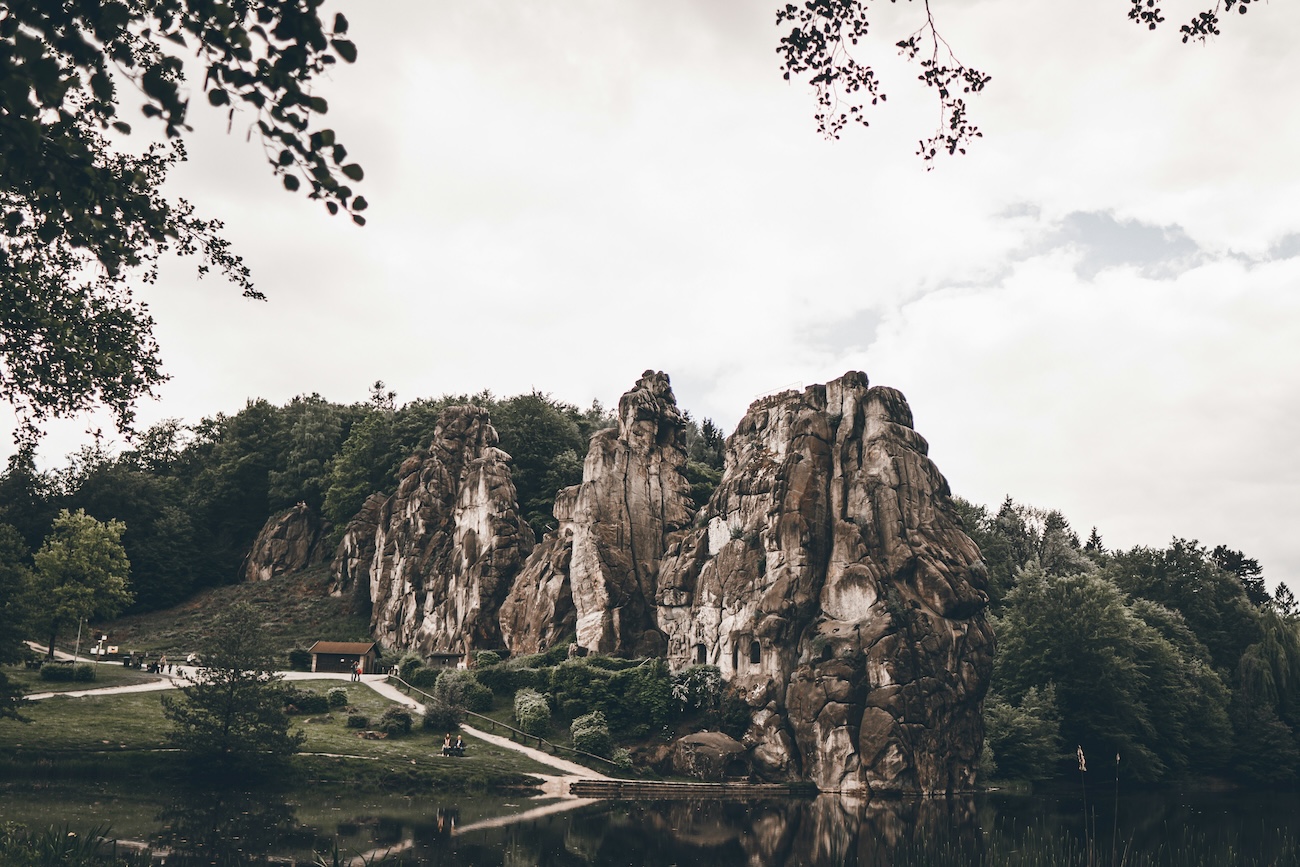
The Externsteine are a row of five tall, narrow sandstone columns standing in the Teutoburg Forest of North Rhine-Westphalia, near the town of Horn-Bad Meinberg. They were formed when ancient rock layers were tilted to near-vertical by geological pressure and then eroded into freestanding towers, the tallest rising over a hundred feet. The result is one of the most striking natural landmarks in Germany, a cluster of stone fins jutting out of gentle wooded hills like something from a different landscape entirely.
Five Stone Towers in the Forest Where Rome Lost an Army
The forest around the rocks carries one of the heaviest symbolic loads in German history. The Teutoburg Forest is where, in 9 AD, the Germanic war leader Arminius ambushed and annihilated three Roman legions under the general Varus, halting the Roman advance into Germania and entering legend as the founding act of German resistance to foreign domination. For nineteenth-century German nationalists, the Teutoburg was the birthplace of national identity itself, the ground where Germans first proved they were a people apart. Any unusual feature in that forest was always going to attract men looking for a sacred origin, and the Externsteine, rising dramatically out of exactly that landscape, were the obvious candidate. The rocks did not need to have been a shrine. They only needed to look like one, in the right forest.
The Medieval Monks and the Real History Carved in the Rock
The firmly documented history of the Externsteine is Christian, not pagan, and it is carved directly into the stone. In the twelfth century, the site belonged to a monastery, and monks shaped the rocks into a place of Christian devotion — cutting chambers and chapels into the sandstone, including a small upper chapel reached by stairs hewn into the rock. The most remarkable survival is a large relief carved into one of the pillars depicting the Descent from the Cross, the body of Christ being lowered from the crucifix, one of the oldest and largest such reliefs north of the Alps. Hermits are believed to have lived in the carved chambers. This is the only chapter of the Externsteine’s human history supported by solid evidence: a medieval Christian sanctuary, carved by named religious orders, in a Germany that was already centuries into its Christian era. Everything older is inference, and most of it is invention.
The Irminsul and the Myth of a Pagan Shrine
The idea that the Externsteine were a pagan holy place did not begin with the Nazis. It had been drifting through German imagination for centuries, built on a few suggestive details and a great deal of wishful reading, and the Nazis inherited it, weaponized it, and gave it the force of state doctrine. Understanding what they fabricated requires understanding the older, softer myth they built upon.
Charlemagne, the Saxons, and the Bent Tree in the Carving
The pagan-shrine theory has a specific seed: the Irminsul, a sacred wooden pillar or tree-trunk venerated by the pagan Saxons, which the Christian emperor Charlemagne is recorded to have destroyed during his brutal conquest and forced conversion of the Saxons in the eighth century. At the base of the great Descent from the Cross relief at the Externsteine, the carving includes a curious detail: a bent, palm-like form being trodden underfoot, which many interpreters have read as an Irminsul broken and humbled beneath the triumph of Christianity. From there it was a short imaginative leap to the conclusion that the rocks themselves had been the site of the Irminsul, a great pagan sanctuary Christianized by force. The scholar Hermann Hamelmann put a version of this in writing as early as 1564, claiming Charlemagne had turned a pagan idol at the Externsteine into a Christian altar. The reading is possible. It is also entirely circumstantial, resting on the interpretation of a single carved detail in an unmistakably Christian monument.
The Astronomical Alignment Claim
The upper chapel carved into the tallest pillar contains a circular window, and through it, on the morning of the summer solstice, the sun rises in alignment. To believers in the ancient-sanctuary theory, this is the clinching proof: an astronomical observatory, deliberately oriented to the solstice by an ancient sky-worshipping people, evidence that the Externsteine were a prehistoric Stonehenge of the north. The deflating reality is that the chamber containing the window is medieval, cut by the same Christian monks responsible for the rest of the site, and a solstice alignment in a structure built by people who tracked the liturgical calendar is neither mysterious nor evidence of paganism. The alignment is real. The conclusion drawn from it is the same leap that recurs everywhere at the Externsteine: a genuine feature, stretched to support an ancient meaning the evidence will not bear.
Himmler’s Holy Mountain: How the SS Fabricated Germany’s Pagan Past
The Nazi seizure of the Externsteine was systematic, well-funded, and entirely deliberate. Heinrich Himmler, head of the SS and a devotee of occult and racial mysticism, recognized in the rocks exactly what his regime needed: a tangible, photogenic, ancient-looking sanctuary that could anchor the fantasy of a glorious pre-Christian Germanic civilization. The myth that had drifted for centuries became, under the SS, an instrument of state.
The Ahnenerbe and the Externsteine Foundation
Himmler created the institutional machinery to manufacture the past he wanted. In 1933 he established an Externsteine Foundation to take control of the site, and the work was folded into the broader mission of the Ahnenerbe, the SS “ancestral heritage” research organization founded in 1935 to find — or fabricate — archaeological proof of Germanic racial superiority. The Ahnenerbe was run not by serious archaeologists but largely by ideologically driven amateurs and humanities scholars, and its method was to begin with the conclusion and work backward. At the Externsteine, figures including the mystic Herman Wirth and the administrator Wolfram Sievers oversaw excavations intended to prove ancient Germanic cultic use of the site. The digs found nothing that supported the theory. The foundation proceeded as though they had, recasting the rocks as a confirmed prehistoric sanctuary in publications, exhibitions, and the carefully staged solstice ceremonies that drew SS men and Hitler Youth to sing pagan-styled hymns among the stones.
Otto Rahn, the Holy Grail, and the Nazi Search for Sacred Origins
The Externsteine project belonged to a wider Nazi obsession with sacred origins that produced some genuinely bizarre figures, none stranger than Otto Rahn. Rahn was an SS officer and self-taught medievalist consumed by the legend of the Holy Grail, which he believed was a real object connected to the Cathar heretics of southern France and, ultimately, to the spiritual heritage of the Aryan race. He traveled France hunting for it, wrote books that captivated Himmler, and was brought into the SS to pursue his Grail research under official sponsorship — a real man whose career reads like the template for the Nazi villains of the Indiana Jones films. Rahn’s story ended darkly: out of favor, reportedly compromised as a homosexual and disillusioned, he died in 1939 in the snow of the Austrian mountains in what is generally regarded as a suicide. He embodied the same impulse that drove the Externsteine project — the conviction that Germany’s claim to greatness could be proven by digging up, or inventing, a sufficiently ancient and mystical past. The rocks in the Teutoburg Forest were that impulse rendered in stone and ceremony, a national religion conjured to order.
The Myth That Outlived the Reich: Neo-Pagans, Neo-Nazis, and the Fight Over the Rocks
The Third Reich collapsed in 1945, but the myth it had welded to the Externsteine proved far more durable than the regime that built it. For two decades after the war, German scholars were reluctant to revisit a site so soaked in Nazi ideology, and the fabricated history filled the silence. It was not until 1965 that the archivist Erich Kittel published a clear scholarly rebuttal, documenting how thoroughly the Nazis had manufactured the racialized prehistory of the stones and how that fabrication had gone unchallenged for a generation. The real history — Christian, medieval, evidenced — had to be excavated from beneath the invented one.
The myth never fully died, and today the Externsteine host one of the strangest collisions in modern Europe. Every summer solstice, the rocks draw thousands of visitors, among them neo-pagans who come to celebrate a nature religion they trace to an ancient Germanic past, and neo-Nazis who come to venerate the same fabricated heritage the SS assembled, sometimes at the same time, in the same place. The site’s managers and the surrounding community navigate a permanent tension between the rocks as a public natural monument, a genuine medieval treasure, and a magnet for ideologies that feed on the invented version. The romantic-nationalist myth-making that the Nazis exploited here ran through other German monuments they prized, including the fairy-tale fantasies of Neuschwanstein, but nowhere did the regime so completely fabricate an ancient sacred meaning from so little. The Externsteine are the clearest case in Europe of a real place whose deepest layer of “ancient” significance was authored within living memory.
Visiting the Externsteine Today: Climbing Germany’s Most Contested Rocks
The Externsteine are a freely accessible natural monument near Horn-Bad Meinberg in North Rhine-Westphalia, set in a wooded park beside a small lake that mirrors the pillars, and they remain one of the most visited natural landmarks in the region. A visitor center interprets the site, and for much of the year the experience is straightforwardly beautiful: a walk through forest to a cluster of dramatic stone towers, with a narrow stairway cut into the rock leading up to the medieval chapel and a small bridge connecting the pillars at height, offering a view across the Teutoburg Forest. The Descent from the Cross relief is still visible on the rock face, weathered but legible, the genuine medieval heart of the place.
The site’s character changes completely around the summer solstice, when the crowds arrive and the contested meanings of the rocks come to the surface. Visitors who come for the natural beauty share the ground with those who come for the manufactured mysticism, and the management works to keep the celebration of a Christian-medieval monument from tipping into the celebration of a Nazi-era fiction. It is a delicate and uncomfortable balance, and it is the most honest thing about the modern site.
Standing beneath the pillars, the visitor faces a question sharper than the usual one about any sacred place. The rocks are real and old and beautiful, and the Christian carvings in them are a genuine medieval achievement worth the climb. But the “ancient religion” that gives the Externsteine their modern aura of mystery was not handed down from the deep past. It was built, deliberately and recently, by a regime that needed it to be true, and it has outlived that regime by the better part of a century. To stand at the Externsteine is to stand at the precise point where a real place was made to tell a lie, and to see how very hard it is, once told, to take a lie like that back.
Frequently Asked Questions About the Externsteine
Were the Externsteine really an ancient pagan site?
There is no solid archaeological evidence that the Externsteine were a pagan worship site. The only firmly documented history of the rocks is Christian and medieval, including chambers and a famous Descent from the Cross relief carved by monks in the twelfth century. The belief in an ancient Germanic sanctuary rests on circumstantial readings of carvings and a solstice alignment, and it was massively amplified by Nazi pseudo-archaeology in the 1930s. Professional scholars regard the ancient-pagan theory as unproven and largely fabricated.
Why were the Externsteine important to the Nazis?
The Nazis, led by SS chief Heinrich Himmler, wanted to prove that Germany had a glorious pre-Christian, pagan, Aryan past, and the dramatic Externsteine rocks in the symbolically important Teutoburg Forest were ideal for the purpose. Himmler established an Externsteine Foundation in 1933 and folded the site into the work of the SS Ahnenerbe, an organization devoted to manufacturing archaeological proof of Germanic superiority. The SS held solstice ceremonies there and promoted the rocks as an ancient sanctuary, despite excavations finding no supporting evidence.
What is the Irminsul and what does it have to do with the Externsteine?
The Irminsul was a sacred pillar or tree venerated by the pagan Saxons, which the Christian emperor Charlemagne destroyed during his conquest of the Saxons in the eighth century. At the base of the Externsteine’s Descent from the Cross relief, a bent form being trodden underfoot has been interpreted by some as a defeated Irminsul, fueling the theory that the rocks were a pagan shrine Christianized by force. This reading dates back to at least 1564. It remains an interpretation of a single carved detail, not proven fact.
Is there an astronomical alignment at the Externsteine?
A circular window in the upper chapel of the tallest pillar aligns with the sunrise on the summer solstice. Supporters of the ancient-sanctuary theory cite this as proof of a prehistoric astronomical observatory. However, the chamber containing the window was cut by medieval Christian monks, not an ancient pagan people, so the alignment reflects medieval rather than prehistoric design. The alignment is real, but it does not support claims of an ancient pagan observatory.
Who was Otto Rahn?
Otto Rahn was an SS officer and amateur medievalist obsessed with finding the Holy Grail, which he linked to the Cathars of southern France and to Aryan spiritual heritage. His writings impressed Heinrich Himmler, who brought him into the SS to pursue Grail research, making him part of the same Nazi obsession with sacred origins that drove the Externsteine project. Rahn is often cited as a real-life model for the Nazi villains of the Indiana Jones films. He died in the Austrian mountains in 1939 in what is generally regarded as a suicide.
Can you visit the Externsteine?
The Externsteine are a freely accessible natural monument near Horn-Bad Meinberg in North Rhine-Westphalia, Germany, set in a wooded park beside a lake. Visitors can walk to the rocks, climb a stairway cut into the stone to reach the medieval chapel, and view the Descent from the Cross relief. A visitor center interprets the site’s history. The rocks draw large crowds around the summer solstice, when neo-pagan and other groups gather, reflecting the site’s contested modern meanings.
Sources
Die Externsteine — Erich Kittel (1965)
The Master Plan: Himmler’s Scholars and the Holocaust — Heather Pringle (2006)
Crusade Against the Grail — Otto Rahn (1933)
Nazi Archaeology and the Quest for an Aryan Past — Bettina Arnold, in Antiquity (1990)
Hermits, Holy Sepulchers, and the Limits of Wilderness at the Externsteine — Different Visions: A Journal of New Perspectives on Medieval Art (2025)
The Ahnenerbe: SS Pseudo-Archaeology and the Politics of the Past — academic survey literature (various)
The Teutoburg Forest and German National Identity — German historical scholarship (various)
Geological Survey of the Externsteine Sandstone Formation — North Rhine-Westphalia geological records