The Discovery of Knossos and the Palace of Minos
Arthur Evans stood in a trench on the hill of Kephala in the second week of the dig and watched his workers uncover a chair carved from a single block of gypsum. It had a high scalloped back, worn smooth, flanked on the wall behind it by painted griffins lying with their forelegs stretched out. The seat was small. A grown man could sit in it, but only just. It had not moved in more than three thousand years. It was the oldest throne in Europe, and no one alive had known it was there.
The date was April 1900. Evans was a short, half-blind, immensely rich Englishman — Keeper of the Ashmolean Museum at Oxford — who had bought the entire hill outright rather than negotiate with the Ottoman authorities who then controlled Crete. He had come chasing engraved seal-stones and a hunch. Within days of striking the throne room, the hunch hardened into conviction. This was the palace of Minos, the legendary king of Crete, the ruler who in Greek myth had demanded a tribute of Athenian children to feed the Minotaur. Evans decided that the people who built this place had no surviving name of their own, so he gave them one. He called them the Minoans.
The naming was an act of extraordinary confidence. Evans had, in effect, reached into a monster story and pulled out a civilization. The problem — the thing that makes Knossos one of the most fascinating and most contested sites on earth — is that the story and the civilization would spend the next century tangled together, and it is often impossible to say where the ruins end and the legend begins. Knossos is a place that was erased so thoroughly it survived only as a fairy tale about a man-eating beast, and then reinvented so aggressively by the man who found it that we are still arguing about which parts he discovered and which parts he built.
The Minoan Civilization: Europe's First Great Culture
The Minoans were sailing, trading, and building multi-story palaces while most of Europe was still living in villages of wood and mud. Their civilization rose on Crete around 3000 BCE and reached its height between roughly 1900 and 1450 BCE — a full millennium before the Athens of Socrates, before the Parthenon, before anything the classical Greeks would have recognized as their own history. They ran a maritime network that reached Egypt, the Levant, and the Aegean islands. They had no need for city walls, which tells archaeologists something important: for a long time, their navy made them untouchable.
They wrote in a script called Linear A, which has never been deciphered. We can read their account ledgers as shapes without sound. We do not know what they called themselves, what language they spoke, or what they named their gods. Everything else about them — the word "Minoan" included — comes from the outside, from Greek legends written down a thousand years after the palace burned, and from the interpretations of the men who dug it up. The Minoans are a civilization we can see in astonishing detail and cannot hear at all.
Inside the Palace of Knossos: The Architecture of a Labyrinth
The Layout of Knossos: 1,300 Rooms and the Origin of the Maze
The palace at Knossos covered around 20,000 square meters and packed more than 1,300 interlocking rooms across as many as five stories in places. It had no single grand entrance and no obvious central axis. Corridors doubled back on themselves. Staircases descended into light-wells — open shafts cut through multiple floors to pull sunlight and air deep into the interior. Rooms opened onto rooms onto more rooms. A visitor stepping inside for the first time, without a guide, could genuinely lose their way.
This is almost certainly the source of the labyrinth. The Greek word for the palace may derive from labrys, the double-headed axe that appears carved into the walls of Knossos over and over, in stone and in plaster. A labyrinthos would then mean, quite literally, "the house of the double axe" — the vast, room-heavy palace itself. When the memory of Knossos survived into Greek storytelling, the building's baffling, endless plan became a maze designed to trap, and the axe-marked halls became the prison of a monster. The most enduring myth in Western culture may be nothing more than the folk memory of getting lost inside a very large building.
Minoan Engineering: Plumbing and Storage Ahead of Its Time
The Minoans built drainage and water systems that would not be matched in Europe for thousands of years. Terracotta pipes, tapering at each joint so that water flowed fast enough to flush out sediment, ran beneath the palace floors. There were channels for rainwater, separate systems for waste, and what many archaeologists identify as a flushing toilet in the queen's quarters — a seat over a drain that could be sluiced with a jug of water, roughly 3,700 years before the device would be reinvented in early modern England.
The western wing held the palace's true engine: long magazines lined with pithoi, storage jars taller than a man, some capable of holding hundreds of liters of olive oil, grain, and wine. Floor cavities beneath the storerooms held still more. This was not decoration. It was the concentrated agricultural wealth of the surrounding countryside, gathered, counted in Linear A on clay tablets, and controlled from the center. The maze that Greek legend remembered as a monster's cage was, in its own time, a warehouse and a bank.
The Bull Cult of Knossos: Frescoes, Horns, and Bull-Leaping
The Bull-Leaping Fresco and the Deadly Sport of Taurokathapsia
The most famous image ever recovered from Knossos shows three figures and a bull. The bull is mid-charge, painted at full stretch. One figure grips its horns. Another is upside down over its back, hands planted, in the act of a somersault. A third stands behind with arms open, waiting to catch. This is taurokathapsia — bull-leaping — and the Minoans painted it, sculpted it in ivory and bronze, and carved it into their seal-stones with an obsessive frequency that leaves no doubt it mattered deeply to them.
Whether a human being can actually vault a charging bull by its horns is fiercely debated. Some scholars think the fresco is stylized or ritual rather than literal. What is not in doubt is that the Minoans placed a young person, a bull, and the moment of maximum danger at the visual center of their culture. The image bleeds straight into the myth. Strip away the fresco's grace and you are left with exactly the raw material of the Minotaur story: youths, a bull, and the strong possibility of a violent death.
The Horns of Consecration and the Sacred Bull of Knossos
Stone horns crowned the palace. Massive carved "Horns of Consecration" — stylized bull's horns rendered in limestone — stood on rooftops and shrines throughout Knossos, and reconstructed examples still sit on the site today. The bull ran through Minoan religion as a central sacred animal: horned altars, rhyta (ritual pouring vessels) shaped as bulls' heads with gilded horns and rock-crystal eyes, and libation scenes involving bulls appear across the material record.
The Greeks inherited this. In their version, King Minos was sent a magnificent white bull by Poseidon and failed to sacrifice it as promised. The god's revenge was to make Minos's wife, Pasiphaë, fall in love with the animal — and from that union came the Minotaur, half man and half bull. The story is grotesque and specific, and it sits on top of a real civilization that genuinely worshipped bulls and staged deadly rituals around them. The myth did not appear from nowhere. It grew, over centuries, out of the actual religious life of the people who built this palace.
The Minotaur and the Labyrinth: The Legend of King Minos
Minos, Daedalus, and the Labyrinth Built to Cage a Monster
King Minos, in the myth, was the son of Zeus and Europa and the most powerful ruler in the Aegean. When the Minotaur was born — a monster with a man's body and a bull's head, given the name Asterion — Minos could neither kill it nor let it roam. He summoned Daedalus, the greatest craftsman of the age, and ordered him to build a prison from which nothing could escape. Daedalus built the Labyrinth: a maze so cunning that its own architect could barely find his way out of it.
The detail that Daedalus himself nearly got lost in his own creation is the tell. This is a story about a building so complex it defeats human navigation — and it attaches itself precisely to a site whose real floor plan defeated navigation. The mythmakers were not inventing an impossible structure. They were remembering a real one.
Theseus, Ariadne's Thread, and the Athenian Tribute
Every nine years, according to the legend, Athens was forced to send seven young men and seven young women to Crete to be fed to the Minotaur in the Labyrinth. It was tribute — a conquered city paying for its defeat in the flesh of its children. On the third cycle, the Athenian prince Theseus volunteered to go, intending to kill the monster and end the tax of blood.
He was saved by love. Ariadne, daughter of Minos, fell for Theseus and gave him a ball of thread. He tied one end at the entrance and unspooled it as he went, walked the maze to its center, killed the Minotaur, and followed the thread back out — the only human ever to enter the Labyrinth and leave alive. Then he abandoned Ariadne on the island of Naxos on the voyage home, which is the kind of detail that makes Greek myth feel less like a fairy tale and more like something that actually happened to actual people.
How the Palace of Knossos May Have Birthed the Minotaur Myth
The pieces line up with unsettling precision. A vast, maze-like palace becomes a labyrinth. A culture obsessed with bulls and with placing young people in mortal danger before them becomes a bull-monster fed on young flesh. A dominant maritime power that could plausibly have demanded tribute from weaker Aegean cities becomes a king exacting a toll of children. The double axe that gave the building its name becomes a footnote the Greeks forgot.
The Minotaur myth is best understood not as fantasy but as history run through a thousand years of oral memory, compressed and dramatized until a warehouse-palace ruled by an accountant-king became a monster's maze. The Greeks were not lying. They were remembering, badly, across an enormous gulf of time. Knossos is what the memory was made of.
The Fall of Knossos: Eruption, Fire, and Collapse
The Minoan world was struck by one of the largest volcanic eruptions in human history. Around the middle of the second millennium BCE, the volcano on the island of Thera — modern Santorini, roughly 100 kilometers north of Crete — detonated with a force that blew the center out of the island and sent tsunamis and ash across the Aegean. It did not destroy Knossos directly; the palace is inland and survived. But it gutted the Minoan coastal settlements and fleets that were the source of their power, and the civilization never fully recovered. The scale of the disaster has fed a second great legend attached to this culture — the story of Atlantis, the advanced island civilization swallowed by the sea, which some scholars believe is a distorted memory of Thera and the Minoans themselves.
Into the vacuum came the Mycenaeans, the warlike Greek-speaking people of the mainland. Around 1450 BCE they took control of Knossos. The clay tablets change with them: Linear A vanishes, and Linear B appears — a script deciphered in 1952 by the young English architect Michael Ventris, who proved it was an early form of Greek. The accounts it records are the accounts of new masters. Knossos itself limped on as an administrative center before a final series of fires gutted it, and the palace was abandoned to the earth. Over the following centuries it was buried, forgotten as a place, and preserved only as a story. By the time Homer sang of "Knossos, a great city" ruled by "Minos," no one knew where it was or that it had ever been real.
Arthur Evans and the Reconstruction of Knossos
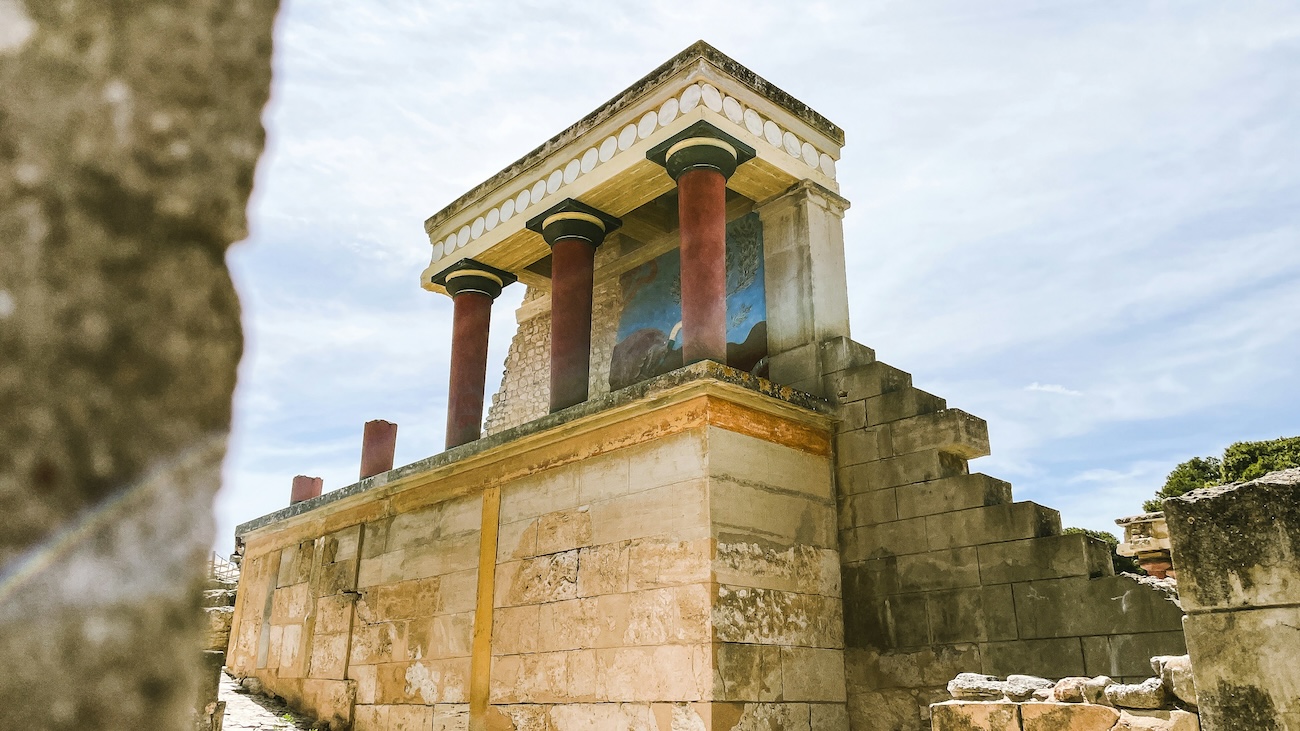
Arthur Evans did not just excavate Knossos. He rebuilt it — in reinforced concrete — and this is where the site's darkness truly lives. Faced with crumbling gypsum, collapsed timber frameworks, and fresco fragments the size of a hand, Evans made a decision that would define and haunt the site forever. He would not merely dig and preserve. He would restore. He called it "reconstitution," and he poured concrete columns, rebuilt entire floors and staircases, and roofed over rooms to create the multi-story palace visitors walk through today. The famous downward-tapering red columns of Knossos are twentieth-century cement.
The frescoes are the sharpest edge of the controversy. Evans employed two Swiss artists, Émile Gilliéron and his son, to restore the wall paintings. What survived was often minuscule — a fraction of a figure, a patch of color, a single hand. From these scraps the Gilliérons produced complete, vivid, confident scenes: the graceful bull-leaper, the beautiful "Ladies in Blue," the elegant "Prince of the Lilies." Later analysis showed how much was guesswork or outright invention. The "Prince of the Lilies" was assembled from pieces that may not even belong to the same figure. What tourists photograph as authentic Minoan art is, in many cases, an Edwardian imagining of what Minoan art should have looked like.
Evans built the palace he wanted to find. He was searching for the seat of a peaceful, sophisticated, art-loving priest-king — his idealized "Minos" — and the reconstruction he left behind reflects that vision as much as it reflects the ancient evidence. Standing at Knossos, you are standing inside a collaboration between a Bronze Age civilization and an early-twentieth-century Englishman who could not tell, or would not admit, where one of them stopped and the other began. It is the same instinct that named the whole culture after a monster's owner — the compulsion to make the ruins fit the story. At few other ancient sites is the act of interpretation so physically, so permanently, poured into the ground.
Knossos Today: The Ruins, the Controversy, and the Crowds
Knossos is the most visited archaeological site on Crete and one of the busiest in Greece, drawing close to a million visitors a year. They come for the Minotaur, and they leave having walked through Arthur Evans's concrete. The tension has never resolved. To one camp of archaeologists, Evans's reconstructions are a scandal — irreversible, misleading, a fantasy set in cement that has contaminated the site permanently. To another, the reconstructions are the only reason a non-specialist can understand the place at all; without the rebuilt walls and roofs, most visitors would see nothing but foundations and be unable to grasp what once stood there.
Both are right, which is the enduring problem of Knossos. The genuinely ancient and the confidently invented stand side by side, often unlabeled, and the average visitor cannot tell them apart. The finest surviving originals — the real fresco fragments, the bull's-head rhyton, the faience figurines — are not even at the site. They sit a few kilometers away in the Heraklion Archaeological Museum, one of the great collections of the ancient world. What remains at Knossos is the shell, the reconstruction, and the myth, layered on top of one another so thickly that separating them has become its own field of study.
The Atlas Entry: Visiting Knossos
Knossos sits about five kilometers south of Heraklion, Crete's largest city, and is reached in fifteen minutes by local bus, taxi, or car. It is open year-round, with long summer hours and shorter winter ones, and it charges admission; a combined ticket with the Heraklion Archaeological Museum is the single best decision a visitor can make, because the site and the museum only make sense together. Arrive early. By mid-morning in summer the crowds are heavy, the shade is scarce, and the exposed gypsum and concrete throw back a brutal heat. Bring water and a hat.
Walking Knossos rewards a particular kind of attention. Look for the honest ruins — the worn gypsum throne, the great storage pithoi, the drainage channels, the raw foundations — and then look at the confident red columns and the glowing frescoes and ask which century you are actually seeing. The most rewarding way to experience the site is to hold both truths at once: that a real and astonishing civilization stood here three and a half thousand years ago, and that much of what you are looking at is a modern man's dream of it. Crete carries this doubled weight elsewhere, too; the island's history of siege and sacrifice runs from the Bronze Age all the way to the fiery last stand at Arkadi Monastery in the nineteenth century, a reminder that Knossos is only the oldest chapter of a very long and often violent story.
Knossos does not ask to be mourned. Nothing terrible happened here that we can name — no massacre, no eruption that buried the living, no prison. Its darkness is quieter and stranger than that. It is the darkness of a whole people erased so completely that they came back only as a monster in a maze, and of the modern hand that dug them up and could not stop reshaping them. You stand at the birthplace of Europe's oldest legend, in a building that is half ancient and half invented, unable to be sure of the ground under your feet. That uncertainty is the truest thing about the place.
Frequently Asked Questions About Knossos
Is the Labyrinth at Knossos real?
There is no literal maze structure at Knossos of the kind described in the Theseus myth. What exists is the palace itself — a sprawling complex of more than 1,300 interconnecting rooms across multiple floors, with corridors that double back and staircases that plunge into light-wells. Most scholars believe this bewildering floor plan, combined with the double-axe (labrys) symbol carved throughout the walls, is the real origin of the labyrinth legend. The word "labyrinth" may itself mean "house of the double axe," a name for the palace rather than a maze within it.
Who was King Minos and did he exist?
Minos is a figure from Greek mythology, described as the powerful king of Crete, son of Zeus, and owner of the Minotaur's labyrinth. Whether a single historical king by that name ever ruled is unknown and probably unanswerable, since the Minoans left no readable records naming their rulers. Arthur Evans borrowed the name to label the entire civilization he uncovered, calling them "Minoans." It is likely that "Minos" was a title or a folk memory of Cretan royal power rather than one specific man.
Why is Knossos so controversial among archaeologists?
The controversy centers on Arthur Evans's reconstructions. Between 1900 and the 1930s, Evans rebuilt large portions of the palace in reinforced concrete, added roofs and staircases, and had artists complete fragmentary frescoes into full, vivid scenes. Critics argue these "reconstitutions" are irreversible, speculative, and blur the line between genuine ancient remains and modern invention. Defenders counter that without them, visitors would see only foundations and could never grasp what the palace once was.
How old is Knossos and what happened to the Minoans?
The palace at Knossos dates to the Bronze Age, with major construction phases between roughly 1900 and 1450 BCE, making it far older than classical Greece. The Minoan civilization was severely weakened by the massive volcanic eruption of Thera (Santorini) around the mid-second millennium BCE, which crippled its coastal power. The mainland Mycenaeans took control of Knossos around 1450 BCE, and after a final series of fires the palace was abandoned and eventually buried for over three thousand years.
Can you visit Knossos, and where is it?
Knossos is open to the public year-round and sits about five kilometers south of Heraklion, the largest city on the Greek island of Crete. It is reachable in around fifteen minutes by bus, taxi, or car, and charges admission. Visitors are strongly advised to also see the Heraklion Archaeological Museum, which holds the genuine Minoan artifacts and original frescoes, since the site itself displays mostly reconstructions and replicas.
What is Minoan bull-leaping?
Bull-leaping, known by the Greek term taurokathapsia, was a ritual or sport in which a person vaulted over a charging bull, most famously depicted in the "Bull-Leaping Fresco" from Knossos. The image shows one figure gripping the bull's horns, another somersaulting over its back, and a third waiting to catch. Scholars debate whether this was physically possible or a stylized ritual, but its constant appearance in Minoan art shows the bull held deep religious significance. This bull obsession is widely seen as feeding directly into the later Minotaur myth.
Sources
The Palace of Minos at Knossos — Arthur Evans (1921–1935)
The Discovery of the Greek Bronze Age — J. Lesley Fitton (1996)
Knossos and the Prophets of Modernism — Cathy Gere (2009)
The Minoans: The Life of Bronze Age Crete as Recorded in the Cave Sanctuaries — Rodney Castleden (1990)
Minoan Architectural Design: Formation and Signification — Donald Preziosi (1983)
The Bull of Minos: The Great Discoveries of Ancient Greece — Leonard Cottrell (1953)
The Decipherment of Linear B — John Chadwick (1958)
Art and Religion in Thera: Reconstructing a Bronze Age Society — Nanno Marinatos (1984)
Knossos: A Complete Guide to the Palace of Minos — Anna Michailidou (2004)
The Troubled Island: Minoan Crete Before and After the Santorini Eruption — Jan Driessen & Colin Macdonald (1997)
Restoring the Minoans: Elizabeth Price and Sir Arthur Evans — Institute for the Study of the Ancient World / NYU (2015)