The Dungeon and the Torturer Who Built Chillingham's Legend
The tour goes down into the dungeon at dusk. The guide stops at the torture chamber, points to the rack and the iron maiden and a barrel lined with nails, and tells the group about John Sage — the lieutenant in Edward I's army who lost the use of a leg, begged the king for work, and was made castle torturer during the wars against Scotland. For three years, the story goes, Sage tortured fifty prisoners a week. When the war ended he burned the surviving adults alive in the courtyard while their children watched, then took an axe to the children in the room upstairs. The floor of the chamber, the guide notes, slopes so the blood can drain.
It is a tremendous story. Visitors leave shaken. The instruments are real antiques, the dungeon is genuinely cold, and the slope in the floor is exactly where the guide says it is.
None of it is in the historical record. John Sage appears in no chronicle, no court roll, no muster list. The figure who anchors the entire haunted-castle brand cannot be found in any document that survives from the period he supposedly terrorized. What can be documented is this: Chillingham was a working border fortress for three hundred years, and the violence that defined it happened mostly outside the walls, in a frontier so lawless that the English crown effectively gave up governing it. The invented torturer in the basement is the product. The frontier above is the history. This is the story of a real fortress whose authentic past — frontier slaughter, sieges, a king's war machine grinding north — was so thoroughly overwritten by a commercial ghost story that most visitors never learn the truth was darker than the myth.
Chillingham Castle's Origins on the Anglo-Scottish Border
Northumberland in the Middle Ages was the most dangerous county in England. The border with Scotland ran a few miles to the north, and for roughly three centuries after the Wars of Scottish Independence began in the 1290s, the land on both sides of it belonged to no one and everyone. Armies marched through it. Raiding parties crossed it nightly. The crown's writ thinned to nothing the closer you got to the line. To live here was to live with the permanent expectation that men on horseback would arrive in the dark.
From Monastery to Border Stronghold: Building Chillingham Castle
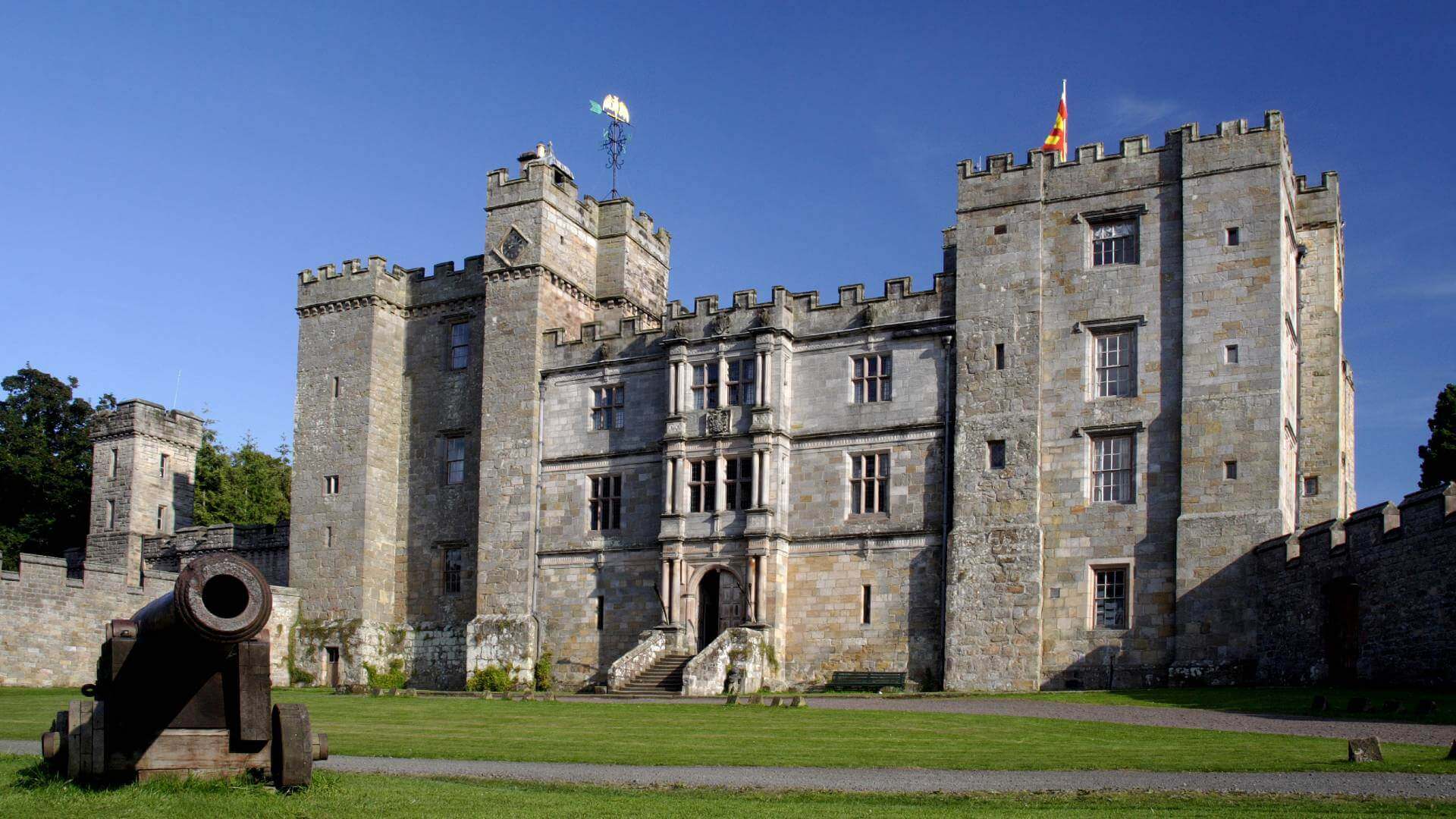
Chillingham began as a monastery in the late twelfth century, and traces of its monastic walls still stand in the gardens. The Grey family — descendants of the Croys, kinsmen of William the Conqueror — took over the manor around 1246 to anchor their holdings in the region, and turned the religious house into something that could be defended. The transformation finished in 1344, when Edward III granted Sir Thomas de Heaton, a Grey relation by marriage, a licence to crenellate. The document still exists, displayed inside the castle, dated and sent from the Tower of London. It is the only such licence in England still kept in the castle it authorized.
The licence mattered more than a piece of paper. Royal permission to build battlements meant the manor became, legally, a castle — four corner towers joined by a curtain wall into a quadrangular fortress, ringed by a moat, with walls thickened to twelve feet in places. A licence to crenellate was not freely given, because a fully fortified castle was also a castle that royal troops would struggle to take back. Chillingham was being armored against the Scots and, implicitly, trusted not to turn against the king who armed it.
Life on the Anglo-Scottish Frontier: Reivers, Raids, and Endless War
The Border Reivers were the reason a stone fortress in these hills was not paranoia but arithmetic. For generations, families on both sides of the line — the Charltons, the Armstrongs, the Grahams — survived by raiding each other: stealing cattle, burning farms, taking hostages for ransom, and answering every theft with another. The word "bereaved" comes from their world. So does "blackmail." The frontier produced its own vocabulary of loss because loss was the local economy.
Picture a farming family in the borderlands on a night when the raiders come. They wake to the sound of horses and the smell of their own thatch burning. The men who arrive are not soldiers and not bandits but something the law has no category for — neighbors, in effect, operating under a code the crown cannot reach. The family's cattle are driven off into the dark. If they resist, they are killed. If they survive, they will do the same to someone across the line within the season, because the only insurance against being raided was the capacity to raid back. This was not a war with a beginning and an end. It was the weather. Chillingham's twelve-foot walls were built to keep this particular weather out.
Edward I at Chillingham: The Castle in the Wars of Scottish Independence
The single best-documented moment in Chillingham's history put a king inside its walls. In 1297, the First War of Scottish Independence broke out. William Wallace, fresh from destroying an English army at Stirling Bridge and newly named Guardian of Scotland, drove south across the border and raided into Northumberland. Chillingham town was badly damaged; the castle held. The following year the man who would answer Wallace arrived at its gate.
Edward Longshanks and the Road to Falkirk
Edward I — Longshanks, the Hammer of the Scots — stopped at Chillingham in 1298 as he rode north to break Wallace's rebellion. The castle was a mustering point, a place to gather an army before pushing it across the line. For the king's comfort, his hosts installed a glazed window in his chamber, a rare luxury in a northern fortress where most openings were arrow slits and shutters. The room is still called the Edward I Room.
The detail is small and the implication is large. While a pane of glass was being fitted for the king's comfort, the machinery of a national war was assembling around him. From Chillingham, Edward marched to Falkirk, where on 22 July 1298 his archers and cavalry destroyed Wallace's schiltrons of spearmen and effectively ended Wallace's command of the Scottish cause. The castle was not the site of the battle. It was the place where the man who won it slept the week before, behind a window installed to keep the northern wind off a king.
The Grey Family and Three Centuries of Border Power
The Greys held Chillingham through it all. They were created Earls of Tankerville in 1417 — the title earned, the family claimed, for capturing the Norman castle of Tancarville in France. Through marriage and inheritance the lands and title passed eventually to the Bennet family, but the Grey line ran continuously through the place for centuries, the local power tasked with holding a corner of an unholdable frontier.
The castle they defended was tested in earnest in 1513. A Scottish army under James IV, perhaps 60,000 strong and supported by heavy artillery, swept south in support of France against Henry VIII. Chillingham was never built to withstand a force that size; after a short bombardment its garrison surrendered. Scottish control lasted only weeks. Thomas Howard, Earl of Surrey, gathered a northern army at Alnwick and met the Scots at Flodden, where James IV was killed alongside much of the Scottish nobility — the last British monarch to die in battle. The Greys fought beside Surrey at Flodden and were soon back in possession of their castle. Chillingham was besieged again in 1536 during the Pilgrimage of Grace. The frontier did not stop generating violence until 1603, when James VI of Scotland inherited the English throne, joined the two crowns, and made the border between them militarily pointless. With nothing left to defend against, the castle began its slow conversion from fortress to house. The moat was filled in. Large windows replaced the arrow slits.
The Ghosts of Chillingham Castle: Separating Legend from History
Chillingham's reputation as the most haunted castle in Britain is largely a modern creation, and the people who built it know it. The castle's history is genuinely well documented — and the parts of it that draw paranormal investigators and overnight ghost-hunters are, for the most part, exactly the parts that are not. The real interest here is not whether the ghosts are real. It is watching how a real place grows a second, more profitable history on top of its first.
The Blue Boy of the Pink Room
The most famous Chillingham ghost is the Blue Boy, or Radiant Boy. The story is consistent across decades of retellings: a child's cries at the stroke of midnight, coming from a stretch of the ten-foot-thick wall in the Pink Room, followed by a flash of blue light and the figure of a boy moving toward the four-poster bed. Then, in the early twentieth century, renovation work is said to have uncovered the bones of a child walled up inside that very stretch of masonry, wrapped in fragments of blue fabric. The bones were buried in the local churchyard, and the apparition is said to have stopped — replaced, in later accounts, by floating blue orbs.
The wall is real. The blue light, by some explanations, is the moon catching the room through a particular angle. The bones are the part that resists easy dismissal: Chillingham has produced human remains more than once. Two skeletons were found beneath the floorboards of the chapel, a third — a young girl's — a short distance away. Whether any of them belonged to a boy in blue is unrecorded. What survives is the pattern: a genuine, unexplained physical find becomes the anchor for a story that grows new detail with every telling.
Lady Mary Berkeley and the Castle's Other Apparitions
Lady Mary Berkeley is Chillingham's Grey Lady, and unlike the torturer, she was a real person. She married Ford Grey, 1st Earl of Tankerville, who then abandoned her — the documented part is that he conducted an affair with her younger sister, Henrietta, for which he was briefly imprisoned. He never came back to Chillingham. Lady Mary, the story goes, wandered the castle searching for the husband who had left, and visitors now report the rustle of her silk dress and a drop in temperature as she passes. The grief is invented in its supernatural form but rooted in a real marriage that really collapsed.
The White Pantry ghost is smaller and stranger. A footman, paid to sleep in the locked inner pantry guarding the family silver, woke to a pale woman in white who asked him for water. He turned to fetch it and she was gone — the door still locked, no way in or out. It is the most modest and the most repeatable of the castle's stories, the kind that survives precisely because it asks for so little belief.
John Sage: The Torturer Who May Never Have Existed
John Sage is where the whole edifice rests, and where it is weakest. The legend is enormous: the crippled lieutenant turned official torturer, the 7,500 dead, the courtyard burnings, the children axed in the King Edward Room, the nailed barrel rolled downhill to skin its victim alive, and Sage's own grotesque end — strangling his lover on the rack during a "sex game," then hanged from a tree in the grounds while the crowd cut off pieces of him for souvenirs.
No record of John Sage exists. He appears in no medieval chronicle, no muster roll, no legal document. The numbers attached to him — 7,500 dead, fifty a week — describe a death toll larger than the populations of most border towns of the period, achieved by one disabled man in a single dungeon. Even sources sympathetic to the castle's haunted reputation concede that while much of Chillingham's history is solidly documented, the character of Sage is not, and that the "most haunted" branding traces to the castle's current ownership rather than to anything in the historical record. The real torture chamber, by some accounts, isn't even the one tourists see — it lies under the tea room.
This is where uncertainty is the actual story. Chillingham did not need to invent a torturer. It was a frontier fortress that held prisoners during real wars, on a border where real families burned. The fiction of John Sage is in some ways an insult to that history: it replaces a documented, structural, grinding horror — the kind that produced the word "blackmail" — with a cartoon villain who never lived. The lie is more comfortable than the truth, because the truth implicates a whole society and the lie blames one monster. Chillingham is far from alone in this. The Bran Castle in Romania built a global tourist economy on a Dracula connection its real history barely supports, overwriting the genuine medieval fortress with a novelist's vampire. The pattern is the same: the manufactured darkness sells better than the real one.
From Ruin to Resurrection: How Chillingham Castle Was Saved
Chillingham nearly did not survive the twentieth century. The same walls that outlasted James IV's artillery were almost finished off by neglect and a leaking roof.
Decay, the Army, and a Castle Left to Rot
The Grey-Tankerville family left the castle to live in the village in 1933. During the Second World War the army moved in and used Chillingham as a barracks, and the soldiers billeted there are said to have stripped out and burned much of the decorative woodwork for fuel. The real damage came after they left. The lead was taken from the roof, and once a great house loses its roof to the weather, the end comes fast. Water poured into the towers and halls. Floors rotted. Ceilings came down. By the time the estate was broken up and sold around 1980, the castle that had survived six centuries of Scots was being killed quietly by rain.
Sir Humphry Wakefield and the Restoration of Chillingham
Sir Humphry Wakefield bought the castle in 1982 and began a restoration that ran for decades. His wife, Catherine, is descended from the Greys of Chillingham, so the rescue carried a genuine thread of continuity — the bloodline that had held the place against the Scots returning to hold it against the weather. Wakefield filled the rebuilt rooms with armor, weapons, tapestries and reproductions of antique furnishings, and reopened the castle to the public. He also, candidly, leaned into the ghosts. The "most haunted castle in Britain" brand, the ghost tours, the overnight vigils, the dungeon with its instruments — that is the modern Chillingham, and it is what funds the survival of the medieval one. In 1997 the restored interiors were filmed for the movie Elizabeth, standing in for Leith Castle and a royal hunting lodge.
The Wild Cattle of Chillingham: A Medieval Herd Frozen in Time
The strangest survivors at Chillingham have nothing to do with ghosts. In the park beside the castle lives a herd of about 130 wild white cattle, and they are the reason the medieval enclosure exists at all. In the thirteenth century the park around the castle was walled — not to keep the cattle in for sentiment, but to keep the Border Reivers from stealing them. In a frontier where the entire economy ran on cattle theft, a fierce, half-wild herd that no rustler could easily drive off was a strategic asset: an unstealable resource behind a stone wall.
What happened next is one of the genuine marvels of British natural history. Sealed off from all other cattle for perhaps 700 years, the Chillingham herd has been inbreeding without interruption ever since. The animals have never been domesticated, never selectively bred, never treated by a vet. By every rule of genetics they should have collapsed; small, closed, inbred populations almost always die out. Instead they thrived. DNA analysis has found the herd to be almost completely homozygous — so genetically uniform that scientists describe them as a natural clone, each animal carrying nearly identical genes. They survived a brutal bottleneck in the winter of 1947 that cut the herd to thirteen, and recovered. The leading theory is that centuries of harsh natural selection slowly purged the lethal genes out of the line, leaving a population uniquely adapted to one valley in Northumberland and existing nowhere else on the planet.
The cattle were enclosed by men afraid of having their livestock stolen on a violent border. Eight centuries later, the wall built out of fear has produced the most genetically isolated large mammals in the world, still thundering across the same grass their ancestors did when Edward I slept up the hill behind his glass window. The herd is the truest ghost at Chillingham: a piece of the thirteenth century that simply never stopped living.
Chillingham Castle Today and the Atlas Entry
Chillingham is a Grade I listed building, a family home, a wedding venue, a film location, and a ghost-tourism business, all at once. The contradictions are the point.
Ghost Tours, Weddings, and the Business of a Haunted Castle
The castle today sells two products that sit uneasily together. One is a genuinely significant piece of border history — a documented royal mustering point in the Wars of Scottish Independence, besieged by the king of Scotland, held by the same family for centuries. The other is the most haunted castle in Britain, with its torturer, its murdered children, its dungeon, and its overnight vigils. The second pays for the first. Visitors who come for John Sage are, without knowing it, funding the preservation of a fortress whose real history they will mostly walk past on the way to the basement. There is an irony worth sitting with: a place that survived everything the Scottish border could throw at it now survives on a story about a man who never existed.
Visiting Chillingham Castle: What to Expect
Chillingham Castle sits near Wooler in north Northumberland, about an hour's drive from Newcastle and well off the main tourist routes. The castle is open to the public seasonally, with the state rooms, the great hall, the dungeon, and the gardens accessible on a standard ticket; ghost tours and overnight stays are bookable separately and in advance, and several of the castle's apartments can be rented for the night for those who want to test the legend themselves. The wild cattle in the park are managed by a separate charity, the Chillingham Wild Cattle Association, and are viewed only on guided tours led by the warden — you do not wander among them, both for your safety and theirs.
Come for the ghosts if you like; the dungeon is genuinely atmospheric and the staff tell the stories well. But stand for a moment in the Edward I Room, by the window installed for a king on his way to Falkirk, and remember that the real history of this place is the one the gift shop barely mentions. The border that made Chillingham necessary killed people for three hundred years, family by family, in the dark, under a code the law could not reach. No invented torturer was ever needed to make this ground bloody. And out in the park, indifferent to all of it, the white cattle graze — the only thing at Chillingham that truly refuses to die.
Frequently Asked Questions About Chillingham Castle
Is Chillingham Castle really the most haunted castle in England?
Chillingham is widely marketed as the most haunted castle in Britain, a reputation that draws ghost-hunters and television crews. The branding largely traces to the castle's current owners rather than to long historical tradition. The castle does have genuinely documented dark history as a border fortress, and human remains have been found in its walls and chapel more than once, but the "most haunted" title is a modern claim rather than a verifiable fact.
Did John Sage the torturer really exist at Chillingham Castle?
There is no historical evidence that John Sage ever existed. He appears in no medieval chronicle, court record, or muster roll, and the death tolls attached to him — often cited as 7,500 victims in three years — are not supported by any document. Even sources friendly to the castle's haunted reputation acknowledge that while much of Chillingham's history is well documented, the figure of John Sage is not. He is best understood as a legend grown up around a real dungeon.
Who is the Blue Boy of Chillingham Castle?
The Blue Boy, or Radiant Boy, is the castle's most famous ghost, said to appear at midnight in the Pink Room accompanied by a child's cries and a flash of blue light. The legend gained force when renovation work in the early twentieth century reportedly uncovered the bones of a child, wrapped in fragments of blue fabric, walled up inside the room. The bones were given a proper burial. Whether they belonged to a "Blue Boy" is undocumented, but Chillingham has produced unexplained human remains on several occasions.
Why did Edward I stay at Chillingham Castle?
Edward I, known as the Hammer of the Scots, stopped at Chillingham in 1298 while marching north to crush William Wallace's rebellion during the First War of Scottish Independence. The castle served as a mustering point for his army. A glazed window was installed in his chamber for his comfort, a rare luxury at the time, and the room is still called the Edward I Room. From Chillingham he advanced to defeat Wallace decisively at the Battle of Falkirk.
What are the Chillingham wild cattle and why are they special?
The Chillingham wild cattle are a herd of roughly 130 white cattle that have lived enclosed in the park beside the castle for perhaps 700 years, originally walled in during the thirteenth century to protect them from Border Reiver rustlers. Completely isolated from all other cattle and never domesticated or selectively bred, they have inbred continuously for centuries. DNA studies show them to be almost genetically identical — effectively a natural clone — yet they remain healthy, making them one of the most genetically isolated large mammal populations on Earth.
Can you stay overnight at Chillingham Castle?
Yes. The castle rents out several apartments, some within the historic building itself, and offers organized ghost tours and overnight vigils that must be booked in advance. The castle is open to the public seasonally for daytime visits to the state rooms, great hall, dungeon, and gardens. The wild cattle in the park are viewed separately on guided tours run by the Chillingham Wild Cattle Association.
Sources
- [Chillingham Castle: Inbreeding and Purging at the Genomic Level] - Williams et al., Animal Genetics (2016)
- [Unique Mitochondrial DNA in Highly Inbred Feral Cattle] - Hudson, Wilson, Payne et al., Mitochondrion (2012)
- [Management of the Chillingham Wild White Cattle] - Hall, S.J.G., Animal Breeding Research (2005)
- [Chillingham Castle] - Castles, Forts and Battles (North East England historical record)
- [The Chilling History of Chillingham Castle] - History Collection (2021)
- [The Wild Cattle of Chillingham] - Chillingham Wild Cattle Association
- [Chillingham Castle State Rooms and Licence to Crenellate] - Chillingham Castle official record
- [National Heritage List for England: Chillingham Castle (1042387)] - Historic England (2020)
- [The Steel Bonnets: The Story of the Anglo-Scottish Border Reivers] - George MacDonald Fraser (1971)
- [Edward I and the Battle of Falkirk, 1298] - Marc Morris, A Great and Terrible King (2008)