Nagoro, Japan: The Census of Silence and the "Uncanny Valley"
350 Dolls vs. 30 Humans: The Arithmetic of a Vanishing Village
Deep in the mountainous folds of the Iya Valley in Tokushima Prefecture, on the remote island of Shikoku, lies a hamlet where the boundary between the living and the remembered has been irrevocably blurred. Nagoro is a settlement defined by a startling, almost impossible ratio: its living population has dwindled to fewer than thirty souls, while its population of life-sized dolls exceeds three hundred and fifty. This is not a film set, nor is it a tourist trap designed for cheap shock value. It is a quiet crisis made visible. It is a place where the demographic collapse of a nation is not presented as a line on a graph, but as a physical presence sitting on a porch, staring eternally at a sunset that marks the end of an era.
Where is Nagoro? Locating the Village of Dolls in Tokushima
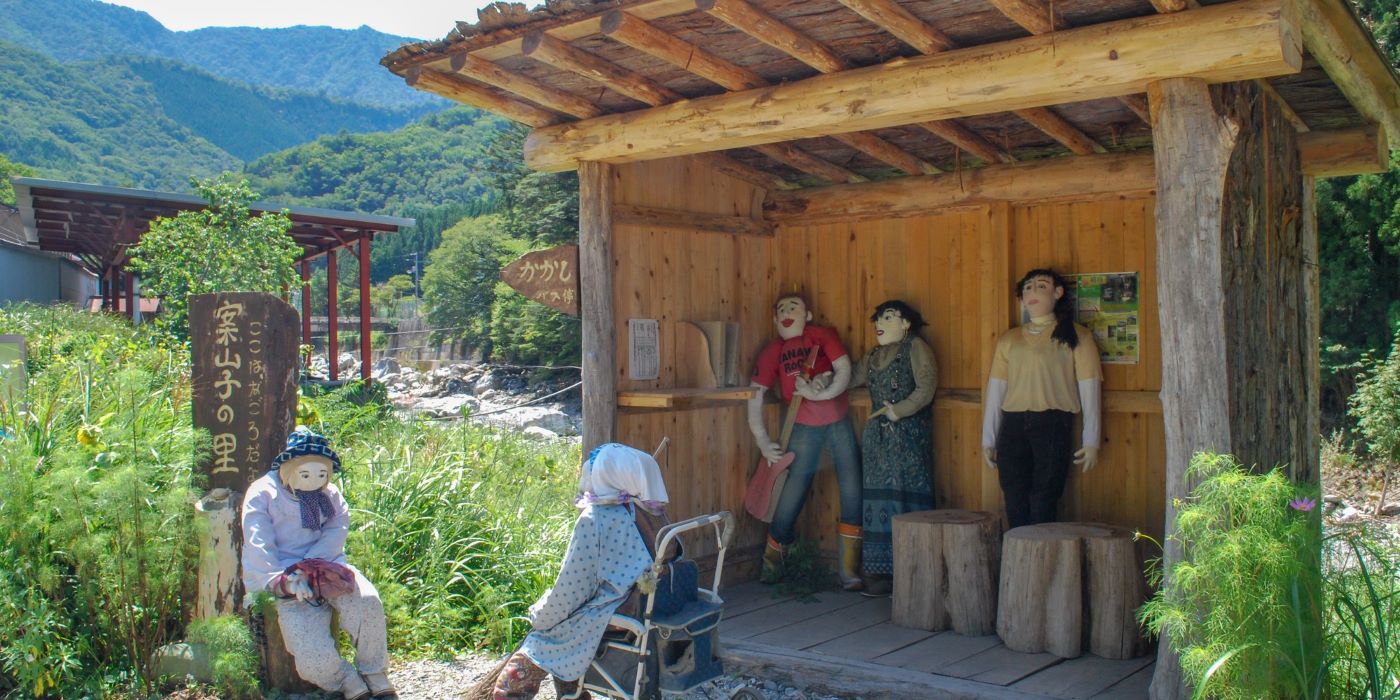
The village sits in one of the most secluded regions of the Japanese archipelago. Deep in the heart of Tokushima, the isolation is physical, acoustic, and absolute. The roads are narrow ribbons of asphalt clinging to cliffs, the ravines are vertiginous, and the silence is heavy enough to be felt as pressure in the ears. It is a place where nature is actively reclaiming the works of civilization, and where the few remaining lights in the windows at dusk are vastly outnumbered by the unblinking eyes of the kakashi (scarecrows) that line the streets. They stand in fields, sit at bus stops, and lean against fences, a silent majority that has replaced the noisy bustle of a community that once thrived here.
Not Just Scarecrows: A Monument to Japan’s Rural Decline
These figures are the life’s work of Ayano Tsukimi, a resident who began crafting them not to frighten, but to fill the crushing void left by neighbors who died or departed for the cities. In the quiet context of modern Japan, Nagoro stands as a visceral, heartbreaking monument to kaso-ka—the severe rural depopulation that threatens to erase thousands of villages from the map. Here, the dolls are not ghosts; they are memories given form, holding the space for those who can no longer occupy it. They are a desperate, beautiful attempt to deny the reality of extinction, a refusal to let the village succumb to the forest without leaving a witness behind.
Exploring the Iya Valley: Japan’s Remote "Tibet"
History of the Iya Valley: A Hidden Refuge for Samurai
To understand why Nagoro exists in its current state, one must first understand the hostile and majestic geography that necessitated its decline. The Iya Valley has historically been known as the "Tibet of Japan," a moniker that speaks to its spiritual and physical removal from the rest of the country. It is a region of jagged peaks and V-shaped ravines cut deep into the earth by the emerald waters of the Iya River. For centuries, this isolation was not a bug, but a feature. It served as the final refuge for the defeated samurai of the Heike clan in the 12th century, following their loss in the Genpei War. The Heike fled into these mists specifically because the terrain was impassable to large armies. They built vine bridges (kazurabashi) that could be cut down at a moment's notice to sever access to their hideouts. The DNA of the valley is built on the concept of hiding.
The Economic Collapse and Rural Depopulation of Shikoku
However, in the industrialized 20th and 21st centuries, this same geography became an economic death sentence. The steep slopes make large-scale, mechanized agriculture impossible. There is no room for factories, no flat land for sprawling housing developments, and the narrow, winding roads sever the valley from the economic engines of Tokushima City and the mainland. As Japan’s economy boomed in the post-war era, the "Japanese Miracle" pulled the youth of the Iya Valley away with the gravitational force of a black hole. They followed the promise of employment, convenience, and modernity, draining out of the mountains like water. The dams built in the region brought temporary money but eventually submerged some communities and altered the ecosystem, further destabilizing the traditional ways of life.
Furusato Lost: The Impact of Modernity on Traditional Japanese Life
What remained were the elderly, the ancestral homes, and a silence that grew heavier with each passing winter. It was into this deepening void that Ayano Tsukimi returned in 2002. Moving back to her childhood home to care for her aging father, she found that the bustling village of her youth had largely evaporated. The school was quiet; the shops were shuttered. The emptiness was not just a lack of noise, but a lack of presence. In rural Japan, the concept of furusato (hometown) is deeply emotional, representing a spiritual anchor. For Tsukimi, returning to her furusato meant returning to a place that was dying. The trauma of Nagoro is not sudden; it is the slow-motion trauma of a community fading out, one funeral at a time, until there is no one left to mourn.
Ayano Tsukimi: The Artist Behind Japan’s Scarecrow Village
Returning to Nagoro: A Daughter’s Journey Home
Ayano Tsukimi did not return to the Iya Valley with the intention of becoming an artist, nor did she intend to become the curator of a surreal open-air museum. Her return was driven by filial piety, the Confucian duty to care for one's parents. She had lived in Osaka, a metropolis of neon and noise, and the transition back to the silence of the valley was jarring. She found herself working the land, attempting to wrestle crops from the rocky, unforgiving soil that had sustained her ancestors. But the village she remembered—a place of festivals, children's voices, and communal labor—was gone.
How the Nagoro Doll Village Began with One Garden Scarecrow
Her artistic intervention began with a single, pragmatic act of agriculture. In 2003, while attempting to grow radishes, she found her crops decimated by birds. To protect the garden, she fashioned a scarecrow using straw and old clothes, a traditional method used by farmers for centuries. However, as she shaped the face and stuffed the body, she realized she was not making a generic figure. She was making a likeness of her father. When she placed it in the field, she was struck by the uncanny presence it possessed. Neighbors passing by would wave at it, mistaking the straw figure for the man himself. It was not merely a tool to scare crows; it was a presence. It occupied space. It looked like a person.
Crafting Memory: How the Life-Sized Dolls are Made
That initial creation sparked a compulsion that would span decades. As neighbors passed away or moved to nursing homes in the city, Tsukimi felt the loss of their physical presence keenly. To combat the loneliness, she began to replace them. She developed a consistent, almost ritualistic method: wrapping wooden bases in newspapers to create volume, using cotton for softness to mimic human muscle, and dressing the figures in the actual clothes of the people they represented. The faces were painted with gentle, often smiling expressions, sewn with a care that belied their humble materials. These were not generic mannequins; they were specific acts of remembrance. The old woman who used to drink tea on the porch was reconstructed and placed back on her bench. The man who smoked by the river was returned to his post. Tsukimi was not building a haunted house; she was repopulating her world, refusing to let the village succumb to total emptiness. She often speaks to them, wishing them "good morning" or commenting on the weather, maintaining the social contract of the village even when the other party is made of straw.
Visiting Nagoro: A Tour of Japan’s Most Surreal Destination
The Kakashi of Nagoro: Encountering the Roadside Watchers
Entering Nagoro feels less like tourism and more like intruding upon a suspended moment in time. The journey usually begins via Route 439, a road so treacherous it serves as a barrier to the casual traveler. As visitors navigate the slender roads, the "residents" appear in the periphery, engaged in eternal labor and leisure. The first encounters are often jarring in their realism. In the fields, figures hunch over plows that will never move, their backs permanently bent in the posture of harvest. Near the river, a fisherman sits patiently with his rod, waiting for a catch that will never come. These are not static statues; they are posed in dynamic relation to the environment. A figure pushing a wheelbarrow looks as though they have just paused to wipe sweat from their brow. A couple on a bench leans in, caught in a whisper. The tableau is so convincing from a distance that visitors often wave to the dolls, only to feel a chill when the wave is not returned.
Inside the Nagoro Elementary School: A Classroom of Dolls
The most poignant and devastating concentration of these figures resides within the shuttered elementary school. The Nagoro Elementary School closed its doors in 2012 when the last two students graduated, a definitive marker of a dying town. In most abandoned villages, the school falls into ruin, reclaiming by moss and rot. In Nagoro, Tsukimi has turned it into a time capsule. Pushing open the rusted doors today reveals a facility that appears fully operational. In the gymnasium, a sports festival is permanently underway. Dolls are frozen in the act of running relay races, cheering from the sidelines, or receiving trophies. The joy on their painted faces stands in stark contrast to the dusty silence of the room.
Walking down the hallways, visitors find the classrooms fully populated. In one room, dozens of child-sized figures sit at desks, their textbooks open to specific pages, pencils poised in hands made of cloth. They are "listening" to a teacher who stands at the blackboard, chalk in hand. The blackboard often bears the date of the school's closing, or a message from the last students. It is a scene of profound melancholy—a simulation of a future that the Iya Valley will never see again. The "children" are dressed in period-appropriate clothing, some with backpacks, some with hats. To stand in that room is to stand in the center of a community's grief over its lost future. It is a memorial to the sound of children's laughter.
Bus Stops and Benches: Finding the Silent Majority of Nagoro
Beyond the school, the communal spaces are equally populated. The village bus stop, a corrugated metal shack, is crowded with figures waiting for the bus. Some are dressed in suits, as if heading to work; others are elderly figures with shopping bags. They sit in a row, staring down the road, waiting for a connection to the outside world that becomes less frequent every year. Further into the village, a group of elderly figures gathers under a large tree, frozen in the midst of a conversation that ended years ago. Near an abandoned construction site, workers in hard hats pause for a "smoke break," leaning against guardrails. These gatherings mimic the social fabric that once existed, creating a visual echo of a community. Every corner of the village offers a vignette of rural life, preserved in straw and suspended in time.
Understanding Kaso-ka: Japan’s Aging Population and Dying Towns
Genkai Shuraku: The Rise of "Marginal Villages" in Japan
Nagoro is frequently sensationalized by the internet as a "cursed" or "creepy" village, but such descriptors fail to engage with the sociological tragedy at play. The dolls are a direct visualization of the demographic crisis gripping Japan, known as kaso-ka. Japan has the oldest population in the world, and its rural areas are emptying out at an alarming rate. This phenomenon has led to the creation of genkai shuraku—"marginal villages"—defined as settlements where more than 50% of the population is over the age of 65. Nagoro is well past that point; it is a "vanishing village." The ratio of dolls to humans is not a quirky statistic; it is an index of loss. Every doll represents a subtraction from the living community.
Preservation through Art: Why the Dolls Aren't "Creepy"
In this light, the dolls are not ghosts, but memories given physical form. They serve a function similar to a photograph or a diary entry, but on a community-wide scale. In a culture that places immense value on ancestry and the continuity of the family line, the end of a village is a spiritual crisis. Who will tend the graves? Who will offer incense at the local shrine? Tsukimi’s work answers this anxiety with presence. They provide comfort to the remaining residents, including Tsukimi herself. They keep the village from feeling abandoned. To dismiss them as "creepy" is to ignore the love and grief required to make them. They are the refusal to be forgotten, a testament to the fact that people once lived, laughed, and worked on this land. They are a protest against the invisibility of the elderly in modern Japan.
Nagoro Travel Guide: Logistics and Visitor Etiquette
Driving Route 439: Reaching the Remote Heart of Shikoku
For those compelled to witness this silent elegy firsthand, the journey is a test of resolve. Nagoro is located along Route 439 (often read as Yo-saku), a road infamous among Japanese driving enthusiasts as one of the most difficult "national highways" in the country. In many sections, the "highway" narrows to a single lane barely wide enough for a kei car, with blind corners and sheer drops into the ravine below. The asphalt is often cracked and covered in moss, indicating the lack of maintenance funds. Public transport is sparse, with buses running infrequently—sometimes only once or twice a day—making a private vehicle or a dedicated tour almost essential. This difficulty of access filters out the casual tourist, ensuring that those who arrive have made a deliberate pilgrimage.
Responsible Tourism: Respecting the Residents of Nagoro
Once in the village, the atmosphere dictates the etiquette. This is a residential hamlet, not a theme park. The few remaining human residents—mostly elderly—live their lives amidst the dolls. They are private people who have found themselves living in a global curiosity. Visitors must treat the area with the solemnity of a living museum or a vast, open-air shrine. Walking onto private porches or touching the figures without permission is a violation of the fragile peace that Tsukimi has curated. There are no ticket booths, no souvenir shops, and no vending machines. There is only the village, the dolls, and the residents. The "Scarecrow Festival," held annually in early October, offers a rare window where the village explicitly invites the outside world in, celebrating the dolls with contests and tours. During this time, the village briefly comes alive with real voices, masking the silence that will inevitably return once the visitors leave.
The Future of Nagoro: What Happens to the Doll Village?
A Fragile Existence: The Decay of the Straw Figures
Ultimately, Nagoro poses a difficult question about the longevity of memory. Ayano Tsukimi is aging. She is now in her 70s, and the physical labor of maintaining hundreds of dolls is immense. The materials she uses—straw, newspaper, cloth—are biodegradable. They are not meant to last forever. They are ephemeral by design. The humidity of the Japanese summer and the snow of the winter degrade the figures, requiring constant repair. When Tsukimi is no longer able to repair them, or when the last human resident finally departs, the dolls will begin to decay. They will slump in the fields, their cotton innards spilling out; they will disintegrate in the classrooms, returning to the earth just as the people they represent have done. The village will eventually be reclaimed by the cedar forests of the Iya Valley, leaving only the stone foundations and the memories of the dolls.
Keeping Nagoro on the Map: The Guardians of History
For now, however, they endure. As one leaves the village, navigating the winding road back toward civilization, the final image that burns into the retina is often the bus stop. There, a group of figures sits on the bench, dressed in their Sunday best, staring down the road. They are waiting for a bus that rarely comes, to take them to a city they will never visit. They are the permanent passengers of the Iya Valley, keeping watch over the road long after the world has stopped stopping for them. They are the guardians of a history that is vanishing, standing vigil in the silence, ensuring that for as long as the straw holds, Nagoro is still on the map.
FAQ: Logistics & Reality
Do people still live in Nagoro, or is it abandoned?
Nagoro is still a functioning residential hamlet, though the population is extremely small (estimated at fewer than 30 residents). The dolls outnumber the living by at least 10 to 1. Visitors must remember they are walking through an inhabited neighborhood, not a ghost town.
How do I get to the Village of Dolls?
Access is difficult. The village is located in the Iya Valley, Tokushima Prefecture. Public transport is scarce; buses run very infrequently from JR Oboke Station (often only on weekends or holidays). The most reliable method is renting a car, but drivers must be prepared for Route 439, a narrow, winding mountain road often called a "blind road" due to its treacherous curves.
Is the village intended to be a horror attraction?
No. Ayano Tsukimi created the dolls as art and acts of remembrance for neighbors who have passed away or moved. While the visual impact can be uncanny to outsiders, the intent is sentimental, not frightening. It is a tribute to community, not a haunted house.
Can visitors meet the artist, Ayano Tsukimi?
Tsukimi is often found at the village community center (known as the "Scarecrow Workshop"), where she maintains the dolls. She is generally welcoming to respectful visitors, but interactions are not guaranteed. She is a private resident, not a paid tour guide.
Is there an entrance fee to visit Nagoro?
There is no entrance fee. The village is open to the public. However, visitors are encouraged to sign the guestbook at the workshop. If a donation box is present, contributions help cover the cost of materials (cloth, cotton) to maintain the dolls.
Sources & References
- The Valley of Dolls, Fritz Schumann (2014). Watch Documentary
- In This Japanese Village, Dolls Outnumber People, The New York Times (2019). Read Article
- Nagoro: The Village of Dolls, Japan National Tourism Organization (2023). Visit Official Site
- The Japanese Village Where Dolls Replace the Departed, National Geographic (2018). Read Article
- Japan’s "Village of Dolls" is decaying, but its spirit lives on, CNN Travel (2020). Read Article
- Ayano Tsukimi and the Scarecrow Village, Nippon.com (2015). Read Article
- Visiting Nagoro: Practical Guide to the Iya Valley, Shikoku Tourism Bureau (2022). Visit Official Site
- Return to the Valley of Dolls, BBC Travel (2016). Read Article
- Shrinking Japan: The Village of Scarecrows, The Guardian (2017). Read Article
- Depopulation in Rural Japan: The Case of the Iya Valley, Journal of Rural Studies (2021). View Abstract