The sun does not rise gently in the Namib; it detonates.
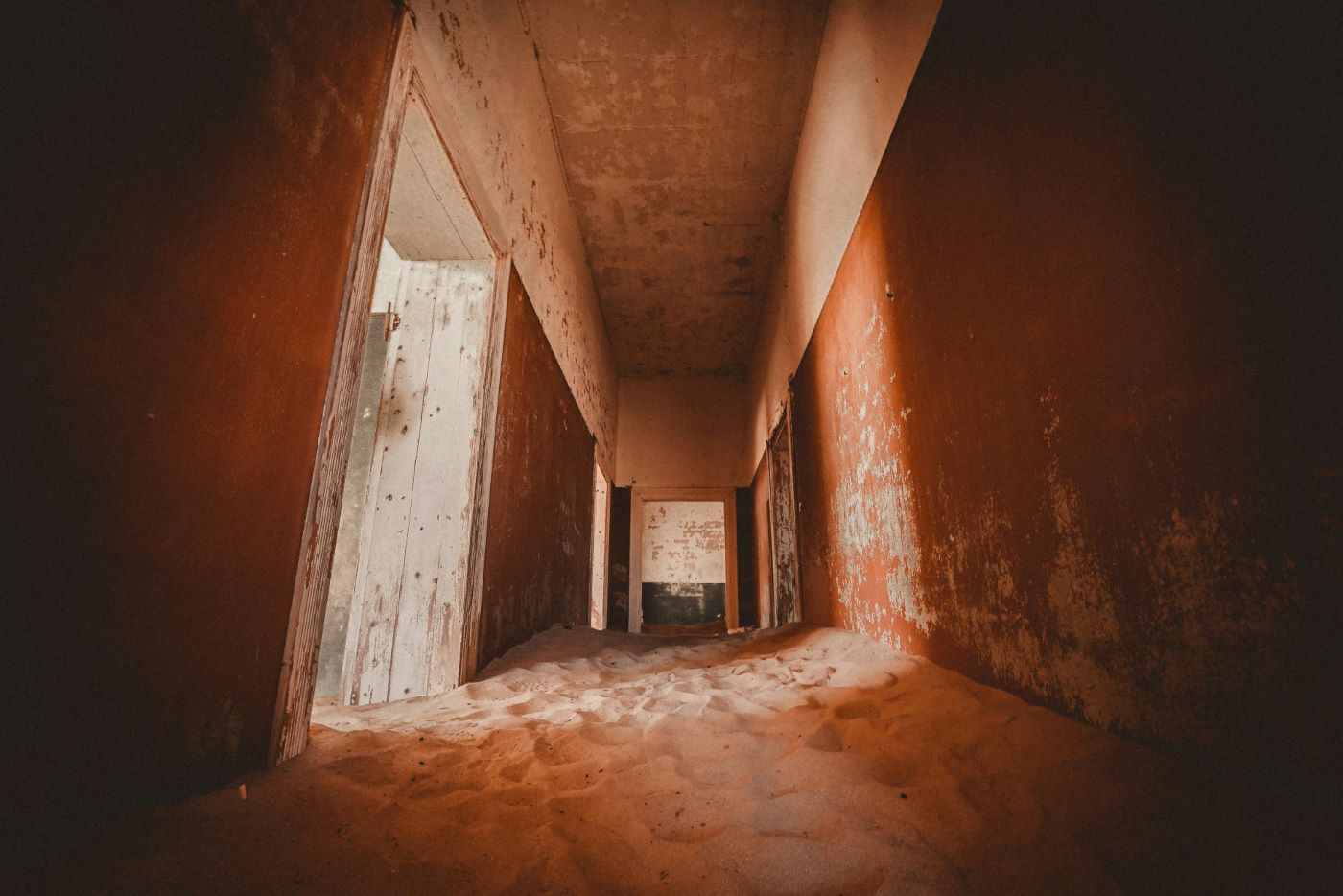
Inside the drawing room of the Mine Manager’s villa, the first light of dawn is not a warmth, but a revelation of violation. It slices through the shattered timber slats of the window frames, casting long, geometric shadows across a floor that no longer exists. Where Persian rugs once muffled the footsteps of Prussian aristocracy, a dune has risen. It is a perfect, sensuous wave of orange silica, cresting against the peeling floral wallpaper, reaching toward the ceiling like a slow-motion flood captured in a freeze-frame.
This is Kolmanskop. It is not merely a ghost town; it is a crime scene where the culprit is time, and the weapon is the relentless, grinding physics of the desert.
To stand here is to experience a profound temporal dislocation. Your eyes register the domestic familiarity of a European home—the architraves, the dado rails, the space where a grandfather clock should stand. But your ears register only the screaming silence of the Sperrgebiet Restricted Area. There is no hum of electricity, no distant traffic, no birdsong. There is only the wind, whistling through the empty sockets of the architecture, sounding uncomfortably like breath moving through a dried throat.
We are here to witness a surreal Memento Mori for colonialism. This town is a structural argument that the imposition of rigid, imperial order upon a hostile wasteland is an act of hubris that the earth will eventually, inevitably, digest.
The Spark: A Stone in the Stardust
The madness began with a single, unassuming gesture.
The year was 1908. The setting was a lonely, wind-scoured railway stop known as Grasplatz (Grass Place), a hopeful misnomer for a stretch of hellscape where the only thing that grew was thirst. Zacharias Lewala, a railway worker from the local area, was shoveling drift sand off the tracks—a Sisyphean task that defined life in the Namib.
Amidst the endless beige monotony, something caught the light. It was a stone, no larger than a fingernail, possessing a cold, internal fire.
Lewala did what honest men do in dishonest times: he took the stone to his supervisor, the German railway inspector August Stauch. Lewala had previously worked in the diamond fields of Kimberley and recognized the glint. Stauch, skeptical but curious, tested the stone against the glass of his wristwatch. It scratched.
In that precise moment, the fate of the Namib changed. The irony of this transaction is the foundational sin of Kolmanskop. Lewala, the man whose eyes first saw the wealth, vanishes from the historical ledger. He received no fortune, no statues, no streets named in his honor. The wealth he held in his palm would go on to build empires, fund wars, and erect the very mansions that are now drowning in sand. Stauch, conversely, quietly resigned from his railway post and staked claims that would turn him into a multimillionaire. The "spark" was struck, and the Namib Desert Diamond Rush ignited a conflagration of greed that would burn for forty years.
Terra Nullius: The Sperrgebiet Restricted Area
To understand Kolmanskop, one must understand the absolute hostility of its container. The town sits within the Sperrgebiet—German for "Prohibited Area." Following the discovery, the German colonial government declared a massive swath of the desert, stretching 100 kilometers inland from the Atlantic coast, as forbidden territory.
This was the privatization of a landscape. It was Terra Nullius reimagined as a bank vault.
The geography here is aggressive. The Skeleton Coast to the north earned its name from the whale bones and shipwrecks that litter the shoreline, but the interior is equally lethal. Rainfall is a statistical error. The wind blows with the force of a sandblaster, capable of stripping paint from steel and flesh from bone. Temperatures swing from baking heat to freezing oceanic fog in the span of hours.
Yet, in this alien topography, the settlers decided to build not a camp, but a civilization. They looked at the shifting dunes, the waterless horizon, and the utter lack of resources, and they saw a blank canvas for the German Empire. They did not adapt to the desert; they attempted to terraform it through sheer force of will and Deutschmarks.
Little Berlin: Architecture of the Absurd
The architectural dissonance of Kolmanskop is so acute it feels like a hallucination. Walking down the main street, one is surrounded by German Colonial Architecture that belongs in the snowy streets of Bavaria, not the sub-Saharan desert.
The houses feature steep, pitched roofs designed to shed heavy snowfall—a weather event that has not occurred here in geologic history. There are large verandas, intricate balustrades, and heavy timber doors. The audacity of the logistics is staggering. Every brick, every window pane, every roll of wallpaper, and every piece of furniture was imported from Germany. They were shipped thousands of miles to the port of Lüderitz, then hauled by mule and rail across the sand.
This was "Little Berlin." It was a deliberate attempt to recreate Heimat (homeland) in a place that rejected human life. The settlers built a town that refused to acknowledge where it was. They planted gardens in imported soil, watered with imported water. They hung heavy velvet drapes to block out the blinding African sun. It was a hermetically sealed bubble of European culture, floating precariously on a sea of diamonds.
The Hydro-Politics of Excess: The Ice Factory
Nothing crystallizes the insanity of Kolmanskop quite like the Ice Factory.
In a region where water was more precious than fuel, and often more expensive than gin, the town boasted a state-of-the-art refrigeration plant. Each morning, a tram would rattle through the sand-swept streets. The "Ice Man" would deliver solidified blocks of frozen water to the households of the mining elite.
Consider the physics of this luxury. Water had to be shipped in barrels from Cape Town (over 1,000 kilometers away) or desalinated at astronomical cost in Lüderitz. To take this scarce, life-sustaining liquid and freeze it so that a mine manager’s wife could keep her meat fresh or her lemonade cold is a level of decadence that borders on the grotesque.
It was a display of dominance. By freezing water in a desert, the colonists were declaring their victory over the elements. They were drinking champagne chilled by the very resource the land denied them. It was a hydro-political statement: We are so rich, we can force the desert to freeze.
The Ballroom of Silence: Leisure at the End of the World
If the Ice Factory was the town's stomach, the Turnhalle (Gymnasium) and the Recreation Hall were its soul.
The ruins of the entertainment complex are massive. Today, the acoustics of the main hall are terrifyingly perfect; a cough echoes like a gunshot. But in 1915, this was the epicenter of high society. The settlers imported opera singers from Europe to perform arias to an audience of roughneck miners and aristocratic officers. They held masquerade balls where women wore the latest Parisian fashions, their silk trains dragging across floors polished with imported wax.
The most surreal artifact remaining is the Kegelbahn—the bowling alley.
It is still there. The wooden tracks, warped by decades of heat but still recognizable, stretch into the gloom. The return mechanism, a complex system of ropes and pulleys, hangs limp. One can almost hear the phantom crash of the wooden balls striking the pins, a sound of leisure that must have rung out bizarrely against the silence of the surrounding dunes.
But this leisure was segregated by a razor-sharp class divide. The balls and operas were for the German masters. The laborers—the men actually digging the wealth from the ground—were ghosts in their own town, visible only when service was required, their own culture and humanity pressed flat under the weight of the colonial boot.
X-Rays and Exploitation: The Medical Panopticon
At the edge of the town stands the hospital. In the guidebooks, this building is often touted as a beacon of progress. It was a fully equipped medical facility, boasting the first X-ray machine in the entire Southern Hemisphere.
On the surface, this speaks to the benevolence of the mining company. They brought cutting-edge technology to the ends of the earth to care for their people.
The truth is far more cynical.
While the X-ray machine was indeed used to set the broken bones of clumsy miners, its primary function was forensic. It was a tool of the Panopticon. The diamond deposits in Kolmanskop were alluvial—the stones were loose in the sand. Theft was the company’s greatest paranoia.
The X-ray machine was the ultimate gatekeeper. At the end of their contracts, or if suspected of theft, African workers were subjected to X-ray scans to ensure they had not swallowed diamonds to smuggle them out. The machine was not there to save lives; it was there to protect capital. It was the intersection of medical advancement and industrial paranoia, turning the human body into just another vessel to be mined and inspected.
Note: The radiation doses used in these early machines were dangerously high. The long-term health effects on the workers subjected to repeated scans were never recorded, another silent casualty of the diamond rush.
The Engine of Empire: Production and Punishment
At its peak in the early 1920s, Kolmanskop was pumping out over 10% of the world's total diamond supply. The wealth generated here was astronomical. It paved the streets of German cities and filled the coffers of the De Beers cartel (which eventually bought the consolidated mines).
But the engine of empire runs on blood as much as oil. The labor force, primarily Owambo men from northern Namibia, lived in squalid barracks far removed from the iced lemonade and bowling alleys. They worked in the "sands of hell," crawling on their bellies in windstorms, sifting through the grit for the glimmer of carbon.
The contrast defines the site: the manicured domesticity of the German villas versus the brutal, extractive reality of the pits. The town was a veneer, a pretty facade painted over a machine of relentless exploitation.
The Slow Exodus: When the Earth Dried Up
Capital is a migratory predator. It feeds on a location until the resources are depleted, and then it moves on, indifferent to the carcass it leaves behind.
The death knell for Kolmanskop rang in 1928, not from war or famine, but from geology. Vastly richer diamond deposits were discovered to the south, on the ancient beach terraces of Oranjemund near the Orange River. The rush shifted.
The decline was not immediate; it was a slow, agonizing hemorrhage. Families packed up their china and their linens and moved south. The shopkeepers followed the money. The bowling pins gathered dust. The ice factory ceased its churning.
By 1956, the town was entirely abandoned. The departure was eerily casual. In many houses, it looks as though the occupants simply stepped out for a walk and never returned. Coffee cups were left on tables; schoolbooks were left on desks. They didn't raze the town; they simply walked away from it, leaving the doors unlocked for the only new tenant that mattered: the Namib Desert.
The Physics of Decay: The Sand Invasion
This is where the story shifts from history to physics.
Once the maintenance stopped—once the humans stopped sweeping the porches and repairing the windows—the desert began its invasion. But "invasion" implies malice; this was simply fluid dynamics.
The sand of the Namib is fine, like distinct grains of flour. Driven by the relentless south-westerly winds, it acts like a liquid. It flows. It sought out the cracks under the doors and the gaps in the window frames.
The process of the town’s burial is a study in structural digestion:
- The Breach: The wind blasts the glass panes with abrasive grit until they shatter.
- The Ingress: The sand pours in, piling up against the windward walls.
- The Weight: Sand is heavy. As it fills the rooms, the weight presses against the floorboards and the internal walls.
- The Polish: The wind swirls the sand inside the rooms, acting as a sandblaster. It strips the wallpaper, then the paint, then polishes the exposed wood to a bone-white, driftwood finish.
The result is a landscape of impossible geometries. In the teacher's house, a dune fills the room halfway to the ceiling, but the door is still on its hinges, blocked forever. The sand has captured the space, preserving it by burying it.
A Surreal Memento Mori
The visual language of Kolmanskop is pure Gothic Surrealism. It is Salvador Dalí directing a documentary.
The color palette is specific and bruising. The walls, once painted in vibrant, optimistic colonial pastels—seafoam green, sky blue, rose pink—are peeling in long, fleshy strips. Beneath the paint, the plaster is crumbling. Against this decay lies the pristine, golden-yellow perfection of the sand.
There is a profound melancholy in the juxtapositions. A cast-iron bathtub sits alone in a corridor, filled not with water, but with drift sand. A light fixture hangs precariously from a ceiling that is slowly bowing to meet a floor that has risen three feet.
It is a Memento Mori—a reminder of death—but on a civilizational scale. It reminds us that our structures are temporary. We build straight lines; nature prefers curves. We build to exclude the elements; the elements always find a way in. Kolmanskop is the ultimate proof that the earth does not care about our borders, our bank accounts, or our architectural styles.
Visiting Kolmanskop Ghost Town: The Logistics
Despite its abandonment, Kolmanskop is not a lawless ruin. It remains firmly within the grip of the Sperrgebiet.
- The Gatekeepers: The area is still monitored by Namdeb (a partnership between the Namibian government and De Beers). The ghosts may be free, but the land is corporate.
- Permits: You cannot simply drive up. Visitors must obtain a permit in the nearby coastal town of Lüderitz. These are checked at the gate.
- The Dark Tourism Appeal: Why do we come here? We are drawn to the ruin because it validates our deepest anxieties: that everything we build will fall. It is a pilgrimage to the end of the world.
The Photographer’s Window: A Guide to the Light
For the photographer, Kolmanskop is both a paradise and a nightmare. It is one of the most photogenic sites on earth, but it fights back.
- The Golden Hour: You must arrive at the gate exactly when it opens (usually 8:00 AM, though photographer passes allow sunrise entry). The harsh midday sun flattens the textures. You need the low angle of the morning sun to rake across the sand ripples, creating the high-contrast "dunes inside rooms" shots that define the location.
- The Hazard to Gear: The sand is omnipresent. It is fine enough to penetrate weather-sealed lenses. Do not change lenses inside the houses. Tape up your focus rings if necessary. The wind will try to sandblast your front element; keep the lens cap on until the second you shoot.
- Composition: Look for the "frames within frames." Use the broken doorways and windows to frame the dunes beyond. The contrast between the geometric rigidity of the human structures and the organic flow of the sand is the visual story.
Hazards of the Skeleton Coast Hinterland
While the ghosts are quiet, the physical dangers are real.
- Structural Instability: These houses have been rotting for seventy years. Floorboards are often paper-thin or entirely missing, hidden beneath a carpet of sand. Roofs collapse without warning. Tread lightly.
- The Fauna: The cool, shaded interiors of the houses are attractive to more than just tourists. Brown Hyenas have been known to den in the outlying structures. More commonly, the Sidewinder Adder and scorpions seek refuge from the heat in the debris of the parlors. Watch where you place your hands and feet.
Conclusion: The Great Equalizer
As you leave Kolmanskop, shaking the sand from your boots and your camera bag, the overwhelming sensation is not one of sadness, but of correction.
The town was an error. It was a glitch in the logic of the desert, forced into existence by the artificial pressure of greed. The sand is merely correcting that error.
Kolmanskop stands as the great equalizer. It mocks the concept of permanence. It shows us that no matter how much marble you ship from Germany, no matter how much ice you freeze, and no matter how many X-ray machines you build to guard your wealth, the wind will eventually blow it all away.
The diamonds are still there, deep in the earth, or locked in vaults in London and New York. But the hands that dug them are gone. The hands that wore them are gone. And soon, the houses that were built on top of them will be gone too, returned to the shifting anonymity of the dunes. Nature doesn't just win; it cleans the board.
Sources & References
- Namdeb Diamond Corporation – History of the Sperrgebiet and Mining Operations.
- National Geographic – "The Abandoned Diamond Town Being Swallowed by Sand."
- The Smithsonian Magazine – "Inside the Ghost Town of Kolmanskop."
- Geological Survey of Namibia – Mineral Resources of Namibia: Diamonds.
- Atlas Obscura – Kolmanskop Ghost Town Field Guide.
- Schneider, G. (2008). The Treasures of the Diamond Coast. A Century of Diamond Mining in Namibia.
- Levinson, O. (1983). Diamonds in the Desert: The Story of August Stauch and His Times.
- Noli, G. (2010). Desert Diamonds: A Brief History of the German Colonial Period.
- UNESCO World Heritage Tentative List – Sperrgebiet.
- Lüderitz Heritage Trust – Archives on Colonial Architecture and Town Planning.
- Dark Tourism Institute – Ethical Considerations in Colonial Ruin Photography.
- Nature Journal – Aeolian Transport and Dune Migration in the Namib Desert.