The Concrete Behemoth: Standing Before the Heaviest Building in the World
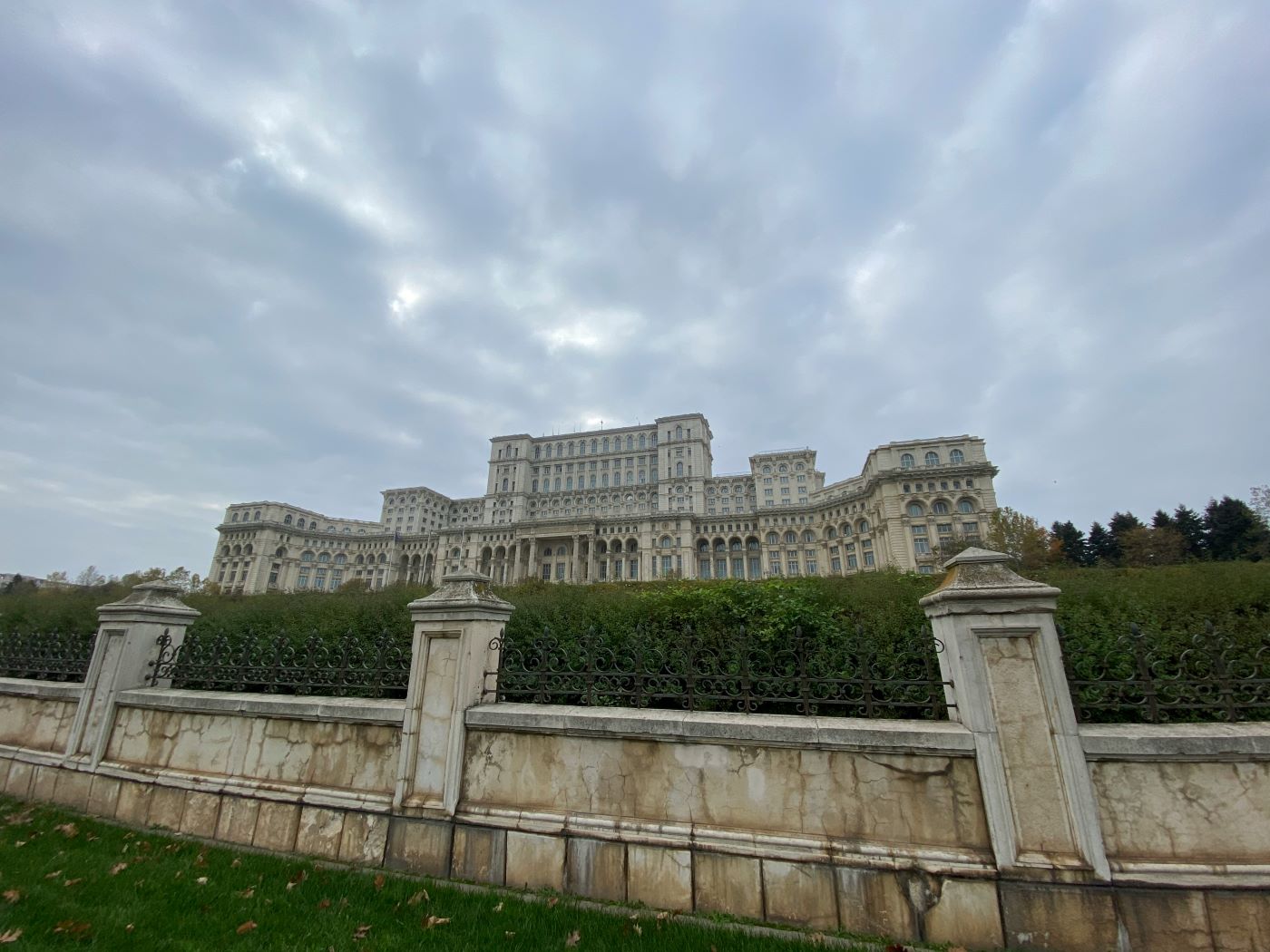
Standing in Constitution Square in Bucharest, the human eye struggles to comprehend the sheer, suffocating mass of the structure before it. It does not soar; it squats. It is a monolithic slab of cream-colored limestone that seems to pull the very sky down toward the earth with its gravitational pull. This is the Palace of the Parliament, formerly known as the House of the Republic (Casa Republicii), and briefly, cynically, as the "People's House" (Casa Poporului).
It is the tangible, terrifying realization of a dictator’s fever dream. Holding the Guinness World Record for the heaviest building in the world—weighing in at an unfathomable 4.1 million tonnes—it is an architectural paradox: a building so large it can be seen from the moon, yet built by a nation that was, at the time, running out of electricity, food, and hope.
To approach the Palace, one must walk down the Boulevard of Unirii (formerly the Boulevard of the Victory of Socialism). It is a stretch of road designed to be exactly one meter wider than the Champs-Élysées in Paris—a petty architectural jab characteristic of the regime that built it. The boulevard is lined with fountains that rarely work and apartment blocks with neoclassical facades that hide the crumbling concrete behind them. At the end of this axis lies the beast itself: 365,000 square meters of floor area, 1,100 rooms, and a volume that exceeds the Great Pyramid of Giza.
For the visitor, standing here offers a unique sensation. It is not the spectral chill of a haunted house, but a crushing sense of administrative dread. It is the weight of a totalitarian state solidified into stone, a monument that demands you feel small, insignificant, and obedient.
Systematization: The 1977 Earthquake and the Pretext for Destruction
To understand the history that birthed this colossus, one must look back to the evening of March 4, 1977. A catastrophic earthquake, magnitude 7.2, rippled through the Vrancea Mountains and struck the Romanian capital with devastating force. Over 1,400 people died, and 33 large buildings in the city center collapsed.
For the grieving populace, it was a tragedy. For Nicolae Ceaușescu, the General Secretary of the Romanian Communist Party, it was a divine intervention. The earthquake cleared the canvas.
Ceaușescu had long harbored a disdain for the eclectic, bourgeois charm of historical Bucharest—often called "Little Paris" for its winding streets and French-influenced architecture. The earthquake provided the perfect pretext for Systematization (Sistematizarea), a ruthless program of urban planning aimed at reconstructing Romania into a "multilaterally developed socialist society." The disaster allowed him to declare a state of emergency not just for rescue, but for total reconstruction. The chaotic, organic heart of the city was to be excised, replaced by a rigid grid of socialist grandeur. The Palace was not just a building; it was to be the anchor of a new world order.
Pyongyang on the Dâmbovița: The North Korean Inspiration
The aesthetic soul of the House of the Republic was not born in Romania, but in East Asia. In 1971, Nicolae Ceaușescu visited the People's Republic of China and North Korea. There, he was seduced by the cult of personality surrounding Mao Zedong and Kim Il-sung. He was particularly mesmerized by the architecture of Pyongyang: the vast, soulless plazas designed for synchronized marching, the boulevards so wide they rendered the individual invisible, and the monumental buildings that projected absolute power.
He returned to Bucharest with a vision of "socialist realism" on steroids. He wanted a civic center that would rival Pyongyang’s, a physical manifestation of his own god-like status. The new architecture would reject the functionalist style of the Soviet Union in favor of a bizarre, neo-classical eclecticism—a style that critics have since labeled "Socialist Classicism" or simply "Ceaușima" (a portmanteau of Ceaușescu and Hiroshima).
The goal was to create a new administrative heart for the country, untouched by the "decadent" past. The Dâmbovița River would be channeled, the streets straightened, and the skyline dominated by a single peak: his palace.
The Erasure of the Uranus District: Bucharest’s Architectural Wound
The construction of the Palace of the Parliament required a sacrifice. The site chosen for the project was not empty land; it was the Uranus district, one of the most historic, hilly, and picturesque neighborhoods in Bucharest. This is the central tragedy of the site, a key focus for those interested in Uranus district destruction.
To clear the footprint for the Palace and the Boulevard of the Victory of Socialism, Ceaușescu ordered an erasure of history that rivals the bombing campaigns of World War II in its scope. An area equivalent to the size of Venice was flattened. Between 1980 and 1984, approximately 7 square kilometers of the historic city center were demolished.
The human cost was immediate and brutal. Roughly 40,000 people were evicted from their ancestral homes. The notices given were often absurdly short—sometimes as little as 24 to 48 hours. Families frantically loaded furniture onto carts and trucks, watching as bulldozers waited at the end of the street to crush the homes they had lived in for generations. The trauma of this displacement left a deep psychological scar on the city's residents, many of whom were relocated to soulless, uncompleted concrete apartment blocks on the city's periphery.
God on Rails: The Moving Churches and Destroyed Heritage
The destruction was not limited to residential housing. The area was dense with cultural heritage. Twenty-seven churches and synagogues were demolished or relocated.
The most heartbreaking loss was the Brâncovenesc Hospital. Built in 1835, it was a masterpiece of Romanian architecture and a vital medical institution. Despite pleas from intellectuals and architects, it was razed to the ground because it stood slightly in the way of the projected boulevard.
However, the demolition sparked a quiet ingenuity among Romanian engineers. To save some of the most precious religious sites, engineer Eugeniu Iordăchescu developed a method of moving churches in Bucharest by placing them on railway tracks and rolling them to new locations.
Churches like Mihai Vodă and the Schitul Maicilor were lifted from their foundations, placed on rails, and slid hundreds of meters away, hidden behind massive communist apartment blocks. Today, these churches still exist, "caged" behind concrete curtains, invisible from the main boulevard. It was a compromise of survival: God was allowed to stay, provided He hid in the shadows of Socialism.
The Architect of Power: Anca Petrescu and the Victory of Socialism
Who designs a monster? In a twist of fate that seems almost literary, the chief architect of this colossal expression of patriarchal totalitarianism was a 28-year-old woman named Anca Petrescu.
In 1980, a competition was held to design the "House of the Republic." The project was codenamed "Noah's Ark." Petrescu, a junior architect, submitted a proposal that was detailed, bombastic, and massive. While other architects tried to mitigate the scale or modernize the style, Petrescu leaned into the dictator’s megalomania. She understood what Ceaușescu wanted: not modernism, but a feudal fortress wrapped in socialist kitsch.
Anca Petrescu became the "Architect of the Palace," commanding a team of 700 architects and 20,000 workers. Her relationship with the Ceaușescus was fraught with tension. Nicolae and his wife, Elena (who fancied herself a scientist and polymath despite being semi-literate), visited the construction site every Saturday. Their whims were law. They would order staircases to be demolished and rebuilt because they were "too steep" or "not grand enough." They demanded larger windows, then smaller ones.
Petrescu spent years navigating the caprices of a couple who treated the national treasury as a personal piggy bank. She remained the head architect until her death in 2013, fiercely defending the building as a work of art, even as the world condemned it as a monstrosity.
The Construction of Hunger: Opulence Amidst Starvation
The true horror of the Palace of the Parliament lies not in its aesthetics, but in its timing.
Construction began in 1984. By this time, Romania had embarked on a brutal austerity program to pay off its foreign debt. Ceaușescu decided to liquidate the country’s agricultural and industrial output to generate cash. Food, fuel, and electricity were exported, leaving the Romanian population to starve and freeze.
While the "House of the Republic" was being clad in 1,000,000 cubic meters of marble from Transylvania, Romanians stood in line for six hours to buy a loaf of bread. While 3,500 tonnes of crystal were being fashioned into 480 chandeliers, Romanian apartments were lit by a single 40-watt bulb, and electricity was rationed to a few hours a day. While the palace was fitted with 200,000 square meters of wool carpets (some so large they had to be woven inside the rooms), the people outside shivered in unheated concrete blocks, wearing coats indoors to survive the harsh winters.
The building is a tomb of resources. It swallowed the nation's glass, steel, bronze, and velvet production for nearly a decade. It is a palace made of the hunger of twenty million people.
Blood in the Mortar: Forced Labor and the Human Cost
The workforce that built the palace was as vast as the structure itself. At peak construction, there were 20,000 to 100,000 people working on site, operating in three shifts, 24 hours a day, under floodlights.
This was not a standard commercial workforce. It was composed largely of soldiers and "patriotic labor"—forced conscription. The human cost of the Palace of the Parliament is a subject of dark rumors and grim realities. Safety standards were practically non-existent.
Official records of deaths on the construction site are scarce, suppressed by the regime. However, witnesses and historians estimate that hundreds died during the construction—crushed by falling masonry, plummeting from unsecure scaffolding, or buried in the pouring of concrete. Urban legends in Bucharest persist that some bodies were never recovered, left entombed in the millions of tonnes of concrete that form the foundation—a literal interpretation of the phrase "blood in the mortar."
December 1989: The Unfinished Dream and the Dictator’s Fall
The supreme irony of the Palace is that its master never got to enjoy it. By December 1989, the building was roughly 60% complete. The exterior was finished, but the interiors were still a chaotic hive of installation and decoration.
When the 1989 Romanian Revolution erupted, sparked by protests in Timișoara and spreading to Bucharest, the regime collapsed with shocking speed. On December 22, 1989, Ceaușescu and Elena fled Bucharest by helicopter—not from the roof of the Palace of the Parliament, but from the Central Committee building nearby.
The Palace stood silent as the streets below erupted in gunfire. The "House of the Republic" became a focal point of anger. Protesters dubbed it the "House of the Devil." There were calls to dynamite it, to blow it up as a symbol of the tyranny that had just ended. But the structure was too massive, too solid to be easily destroyed without leveling half the city.
On Christmas Day, 1989, Nicolae and Elena Ceaușescu were executed by firing squad. The dictator died leaving his pharaonic tomb unfinished.
The King of Pop and the Balcony of Irony
In the years following the revolution, the building sat in a strange limbo. It was eventually renamed the Palace of the Parliament and became the seat of Romania's democratic government—a heavy irony in itself.
But the most surreal moment in the building’s history came in 1992. Michael Jackson, during his Dangerous World Tour, visited Bucharest. He was invited to the Palace.
Ceaușescu had designed the massive central balcony, overlooking the Boulevard of Unirii, specifically for himself. He envisioned standing there, addressing hundreds of thousands of adoring subjects. He never gave a single speech from that spot.
The first person to address the crowds from the dictator's balcony was Michael Jackson. In a moment of cringe-inducing pop-culture history, Jackson stepped out, looked at the sea of Romanian fans, and shouted, "Hello, Budapest!"
He had confused the capital of Romania with the capital of Hungary. The crowd, starved for Western culture, cheered anyway. It was the ultimate farce: the balcony designed for a Stalinist god was christened by the King of Pop making a geography error.
Inside the Beast: A Guide to the Palace of the Parliament Tour
Today, the Palace of the Parliament is one of the primary drivers of tourism in Bucharest. To enter is to step into a time capsule of 1980s totalitarian luxury.
The experience begins with the scale. Everything is too big. The corridors are wide enough to drive tanks through. The staircases are designed not for human strides, but to make the descender look majestic.
You will likely visit the "Hall of Human Rights." The name is a post-1989 invention; originally, it was intended to be a meeting hall for the Communist Party executive committee. The room features a massive oak circular table and a chandelier that weighs two tons.
The sensory experience is one of suffocating opulence. The air is often stale, smelling faintly of dust and old wax. You walk past curtains that are 16 meters tall and weigh 250 kilograms each, woven by nuns in monasteries (the only ones skilled enough to do the gold embroidery). You walk on marble floors that stretch into the vanishing point.
Yet, there is an emptiness. The rooms feel devoid of life. Despite housing the Romanian Senate, the Chamber of Deputies, and the Constitutional Court, the building is so vast that it feels abandoned. It is a museum of hollowness.
The Underground Network: Anti-Atomic Bunkers and Myths
Beneath the visible iceberg lies the submerged danger. The underground of the Palace of the Parliament is the subject of intense fascination and wild conspiracy theories.
The building extends 92 meters (300 feet) below ground. There are eight underground levels, though tourists are rarely allowed past the upper basements.
The reality is as chilling as the fiction. There is indeed a massive anti-atomic bunker constructed for the Ceaușescu family. It features 1.5-meter thick concrete walls and was designed to withstand a direct nuclear hit. It was connected to the rest of the city's elite institutions by a secret network of tunnels, some large enough for electric cars.
Rumors persist of a "line of escape" leading to the airport or a secret metro line, though these remain unverified. The ventilation system was designed with complex filters to prevent chemical or biological attacks, ensuring the dictator could survive while the city above perished.
A Surreal Juxtaposition: The National Museum of Contemporary Art (MNAC)
In a brilliant act of repurposing, the glass wing at the rear of the Palace now houses the MNAC (National Museum of Contemporary Art).
Entering the MNAC is a jarring experience. You approach the totalitarian monolith, pass through security checkpoints, and are suddenly thrust into a space of liberal expression, avant-garde installations, and video art.
The juxtaposition is intentional. Contemporary art in a Communist building serves as a form of exorcism. By filling the dictator’s halls with the very freedom of expression he sought to crush, modern Romania reclaims the space. The view from the MNAC terrace offers one of the best panoramas of the city—and a close-up view of the crumbling limestone facade of the Palace itself, showing that even mountains of megalomania eventually decay.
Planning Your Visit: Logistics, Security, and Stamina
Visiting the Palace requires military-style planning. You cannot simply walk up and buy a ticket.
- Booking: You must book your Palace of the Parliament tickets in advance, usually by phone or through a tour agency. Slots fill up quickly.
- Documents: You must bring your original passport or national ID card. Driver’s licenses or student IDs are not accepted. The security check is identical to airport security: X-ray machines, metal detectors, and bag searches.
- Stamina: The standard tour takes about 45-60 minutes, but you will walk several kilometers. The sheer size of the corridors means a "quick look" is impossible. There are no places to sit.
- Photography: There used to be a steep fee for taking photos ("photo tax"), though this policy fluctuates. Check current regulations at the entrance.
The Stone Albatross: A Symbol of Pride or Shame?
The Palace of the Parliament remains the "Stone Albatross" around the neck of Bucharest. It is a building that generates conflicting emotions: shame for the past, awe at the engineering, and anger at the cost.
The maintenance costs are astronomical. The Palace of the Parliament electricity cost and heating bill is equivalent to that of a medium-sized city. The lights in the thousands of rooms are rarely turned on. The air conditioning is a constant battle against the thermal mass of the stone.
It cannot be demolished; the amount of explosives required would level the surrounding neighborhoods, and the debris would take decades to clear. And so, it stays.
It is a wound that has scarred over into a scar so large it defines the face of the victim. It stands as a permanent reminder of what happens when absolute power meets absolute ego—a heavy, cold, and immovable object that the Romanian people must carry into the future.
Sources & References
- Guinness World Records - Heaviest Building
- The Guardian - "Palace of the Damned"
- Romania Insider - Facts about the Palace of the Parliament
- CNN Travel - Inside the Palace of the Parliament
- ArcGIS StoryMaps - The Demolition of the Uranus District
- Atlas Obscura - The Moving Churches of Bucharest
- Reuters - Obituary of Anca Petrescu
- National Museum of Contemporary Art (MNAC)
- Balkan Insight - The Legacy of Ceaușescu’s Palace
- Radio Free Europe - The 1977 Earthquake and Reconstruction
- Architectural Review - Bucharest's Unfinished Project
- Historia.ro (Romanian History Archives) - Demolarea Cartierului Uranus