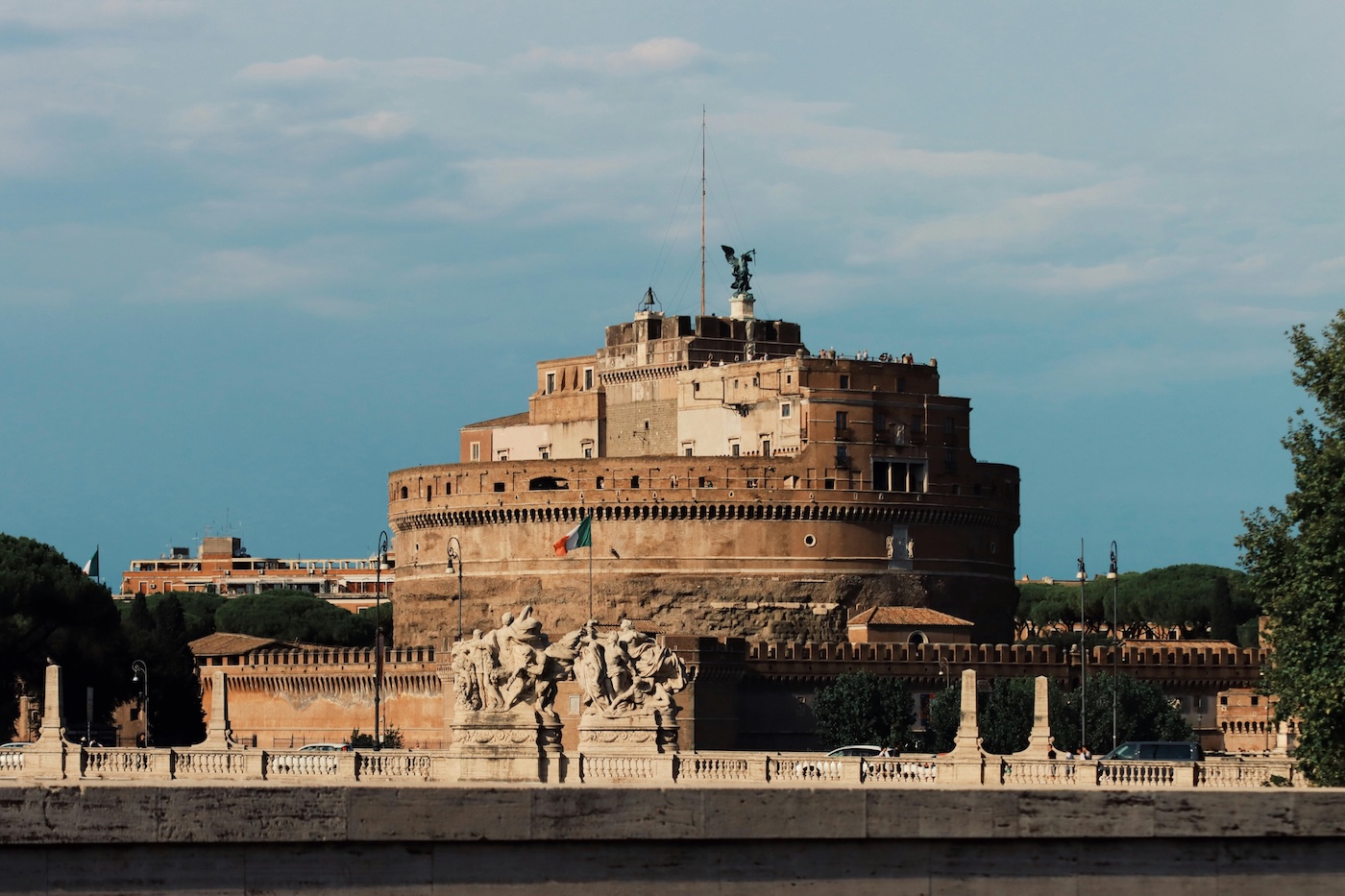
The Metamorphosis of a Tomb: From Hadrian to the Archangel
The Core of the Mausoleum: Ancient Roman Engineering as a Foundation
To understand Castel Sant’Angelo, one must first peel back the layers of medieval brick and Renaissance plaster to reach the original Roman concrete. When Emperor Hadrian commissioned this structure in 135 AD, he did not intend to build a fortress; he was building a house for the dead that would rival the Great Pyramids. The massive cylindrical drum, roughly 64 meters in diameter, was originally faced with Parian marble and crowned with a garden of cypress trees and a golden chariot.
Hadrian’s choice to build such a massive tomb within sight of the city center was a break from tradition. Most Roman elites were buried along the Via Appia, where miles of tombs and catacombs lined the road to the south. By building his mausoleum on the banks of the Tiber, Hadrian was attempting to anchor his legacy to the heart of the capital. While the tombs on the Appian Way were eventually looted and left to the elements, the sheer scale of the Castel’s foundations allowed it to survive as a functional piece of military hardware long after the Appian Way had become a picturesque ruin.
Hadrian’s choice to anchor his legacy in stone on the Tiber mirrored his strategy on the empire's fringes. The same man who built this massive drum in Rome was responsible for Hadrian's Wall, applying the same cold logic of monumental masonry to define the limits of the known world.
The Legend of the Sword: The Plague of 590 and the Naming of the Castle
The transition from the Mausoleum of Hadrian to Castel Sant’Angelo is marked by a moment of psychological and religious crisis. In 590 AD, Rome was being decimated by the plague. According to legend, Pope Gregory the Great was leading a penitential procession across the Aelian Bridge when he saw a vision atop the mausoleum: the Archangel Michael sheathing his sword. This was interpreted as a sign that the plague had ended.
While the story is shrouded in myth, the naming of the castle after the Archangel Michael had a profound tactical purpose. Michael is the "General of the Heavenly Host," the patron saint of soldiers. By placing his image at the highest point of the Roman skyline, the Church was signaling that the old pagan tomb was now the spiritual and military shield of the city. The sword of the angel became a permanent, vertical branding of the Church's right to defend itself through both prayer and steel.
Militarizing the Dead: How a Tomb Became Rome's Citadel
As the Roman Empire collapsed, the mausoleum was integrated into the Aurelian Walls. The transformation of the mausoleum into a fortress was an act of architectural scavengery. During the various sieges of the Middle Ages, the defenders did not have time to quarry new stone; instead, they stripped the marble and travertine from the Roman Forum and the Colosseum. The very blocks that once formed the seats of the Flavian Amphitheatre were repurposed as battlements or ground down into mortar.
This creates a direct, visceral link between the two sites: the Castel is essentially the "recycled" ghost of the Imperial center, a vertical fortress built from the bones of the city’s pagan past. By the 10th century, the "Castellum" was the undisputed key to Rome. Whoever controlled the castle controlled the Tiber, the bridges, and the access to the Vatican. The Papacy recognized that their safety in the open, vulnerable Leonine City depended entirely on this fortified cylinder. They began a centuries-long project of architectural parasitism, building defensive bastions, towers, and moats around the Roman core. It is a building that survived the collapse of one empire only to become the backbone of another.
The Passetto di Borgo: The Vatican’s Secret Escape Hatch
The 800-Meter Lifeline: Linking St. Peter’s to the Fortress
The most critical feature of Castel Sant’Angelo’s relationship with the Vatican is the Passetto di Borgo. This is an elevated, fortified corridor that runs along the top of the old Vatican wall, stretching 800 meters from the Apostolic Palace directly into the heart of the fortress. It is the physical manifestation of papal paranoia—a private, high-security umbilical cord that ensured the Pope was never more than a five-minute run from a fortress that could withstand a months-long siege.
It allowed for the discreet movement of troops and supplies between the seat of religious power and the seat of military power. For the "Secret Army" of Jesuits of Il Gesù, the Passetto was the ultimate safety valve. It represented the Church’s realization that spiritual authority required a back-up plan of reinforced masonry.
1527: Clement VII and the Flight from the Sack of Rome
The Passetto’s most famous utilization occurred during the Sack of Rome in 1527. As the mutinous troops of Holy Roman Emperor Charles V breached the city walls and began slaughtering the Swiss Guard on the steps of St. Peter’s, Pope Clement VII utilized the secret corridor. Witnesses described the Pope sprinting along the Passetto, his robes tucked up, while his guards held off the invaders with arquebuses from the battlements.
He reached the safety of Castel Sant’Angelo just as the enemy reached the Vatican gates. For months, the Pope lived in the castle's upper apartments while the city below was systematically looted and raped. The fortress proved its worth: even as the rest of Rome burned, the "Vertical Bunker" remained impenetrable. The Passetto was the difference between a captured Pope and a surviving one.
Architecture of Emergency: The Logistics of a Papal Retreat
The design of the Passetto and the Castle's entrance was built for speed and exclusion. The corridor enters the castle at a high level, requiring the use of retractable stairs and heavy iron gates to prevent pursuit. Inside the castle, a system of internal drawbridges and narrow, winding staircases created a series of "choke points" where a small number of defenders could hold off an army.
The logistics of survival were built into the very walls. The Castle was equipped with massive grain silos, oil vats, and deep cisterns for water, allowing the papal court to maintain their lifestyle even under total blockade. The Passetto was the entrance to a self-sustaining ecosystem of power, a place where the "Vicar of Christ" could transform into the "Commander-in-Chief" of a besieged citadel.
The Bastions of Fear: The Inquisition’s High-Security Vault
The Sammalo: The Notorious Prison Cells of the Upper Tiers
While the lower levels were for the dead and the middle levels were for the soldiers, the upper tiers contained a darker utility. The "Sammalo" (or San Marocco) was one of the most feared prison sectors in Rome. These were tiny, airless cells designed for high-profile prisoners of the State and the Inquisition. The psychology of these cells was isolation; prisoners were suspended between the sky and the city they were no longer allowed to touch.
The upper cells represented a shift in the mechanics of power. In the Republican era, political rivals were dealt with through the sudden, public violence of assassination, most famously at the Largo di Torre Argentina. By the time of the Papal States, power was maintained through the slow, private dissolution of the prisoner. The Castel was the "Black Box" where the state could disappear an individual without the mess of a public coup, replacing the daggers of the Curia with the silent, stone-walled isolation of the Sammalo.
The Cenci and Giordano Bruno: The Castle as a Pre-Execution Holding Cell
The Castel served as the high-pressure staging ground for the "pedagogy of fear" performed at the Campo de’ Fiori. It was here that Beatrice Cenci was held before her decapitation, and where the philosopher Giordano Bruno spent parts of his eight-year ordeal.
The Jesuits and the Inquisition utilized the Castle's cells for intensive, prolonged interrogation. The goal was to break the prisoner's will in the darkness of the Sammalo so that their eventual public execution in the Campo would be a display of state triumph over a "confessed" heretic. The Castle was the laboratory of the Inquisition; the Campo was its theater. The stone walls of the Castel absorbed the screams that the public was only allowed to hear as "prayers" or "recantations" later.
The "Venticinque": Solitary Confinement in the Darkness of the Tiber
Deep within the base of the castle, near the original Roman level, were the "Venticinque" (The Twenty-Five) and other subterranean pits. These were oubliettes—places where prisoners were "forgotten." Some were so narrow that a man could not sit or lie down, forced to remain in a state of permanent, standing agony.
The proximity to the Tiber meant these lower cells were often damp and prone to flooding, adding a layer of biological torture to the incarceration. This was the "Iron Fist" of the Church. While the facade of the Vatican projected mercy, the internal anatomy of Castel Sant’Angelo was designed for the total psychological and physical dissolution of the enemy. It was a site where the "Body of Christ" was maintained by the systematic breaking of human bodies.
Papal Luxury in a War Zone: The Renaissance Apartments
The Sala Paolina: High-Baroque Propaganda Amidst the Cannons
Perhaps the most jarring aspect of Castel Sant’Angelo is the coexistence of brutal prisons and exquisite Renaissance apartments. The Sala Paolina, commissioned by Pope Paul III, is a masterpiece of frescoed propaganda. The walls are covered in gold leaf and intricate paintings depicting the lives of Alexander the Great and Saint Paul—linking the Pope to both military conquest and divine mission.
This room sits directly above the torture chambers and grain silos. It served as a reminder that even in a bunker, the Pope was a prince. The luxury was not just for comfort; it was a tactical necessity. When hosting rival cardinals during a siege, the Pope needed to project an image of unshakeable wealth and stability. The Sala Paolina signaled that the Church could not be impoverished by war; it was a gilded cage designed to show that the leadership remained in control of the narrative, even if they were trapped in a cylinder.
The Court of Alexander VI: The Borgia Influence and the Fortress Lifestyle
Pope Alexander VI (Rodrigo Borgia) was the man who truly turned the Castel into a habitable palace. He commissioned the lavish "Borgia Apartments" and used the fortress as the primary residence for his family during times of unrest. For the Borgias, the Castle was a tactical asset that protected them from the Roman nobility who hated them.
The Borgia legacy in the Castle is one of hedonism and paranoia. They built gardens and banquet halls atop the ramparts, literally partying on the roof of a prison. This creates the "intellectual vertigo" of the site: the realization that the same hand that signed a death warrant in the dungeon might have been used to toast a wine glass in the apartments an hour later. The architecture was a tool for the Borgias to navigate the treacherous landscape of Renaissance politics. They turned the mausoleum into a private stage for the drama of their dynasty, ensuring that even in the face of death, they were surrounded by the sensory evidence of their own superiority.
The Infrastructure of Defense: Cannons, Silos, and Cisterns
The Bastions of the Four Evangelists: Tactical Sightlines Over the Tiber
In the 16th century, the Castle was updated with four massive corner bastions, each named after one of the Evangelists: Mark, Luke, Matthew, and John. These were not religious symbols; they were heavy artillery platforms designed to provide "enfilade fire"—meaning the cannons could cover every angle of the castle walls, leaving no "blind spots."
From these bastions, the Papal gunners could rain fire down onto the Aelian Bridge and the surrounding streets. The sightlines from these points are clinical; they were designed to turn the beautiful Tiber riverfront into a killing field. This is the "Hard State" of the Vatican—the realization that spiritual authority is best maintained when backed by 32-pounder cannons.
Internal Logistics: How the Castle Survived a Siege
A fortress is only as good as its supply chain. The Castel Sant’Angelo was equipped with an industrial-scale logistics system. Deep in the heart of the Roman core are the "Oliarie" and the "Silo"—massive vats for olive oil and pits for grain that could hold enough food to sustain hundreds of people for up to a year.
The Castle also featured an ingenious water system. Deep wells were sunk into the ground, tapping into the water table of the Tiber but filtering it through the Roman masonry to provide clean drinking water. It was a self-contained ark that could float through the "flood" of a war or a revolution without needing to open its gates. The sheer logistical preparedness of the site explains why it was never taken by assault throughout its medieval and Renaissance history.
Navigating the Fortress: A Tactical Guide
Walking the Passetto: Seeing the Line of Escape
While the interior of the Passetto is rarely open, you can trace its path from the street level by walking along the Borgo Sant'Angelo. Looking up at the wall, you can see the defensive slits and the elevated corridor. It is a "one-way street" of power. To walk along the base of the Passetto is to understand the physical distance between the public ritual of the Vatican and the private survival of the fortress.
The Spiral Ramp: Descending into the Imperial Core
When you enter the Castle today, you begin by walking up the original Roman ramp. This is the most "haunted" part of the structure. The air is noticeably cooler, and the light is filtered through deep, narrow shafts.
As you ascend, pay attention to the transition in masonry. You move from the massive, precise blocks of the 2nd century to the hurried, functional brickwork of the medieval Popes. This is the "Architecture of Desperation." You are literally walking through the timeline of Roman collapse and Papal resurrection. The ramp is the spine of the building, the conduit through which emperors were carried to their rest and popes were carried to their safety.
Looking Toward the Vatican: The Defensive Relationship Defined
Once you reach the upper terrace, stand beneath the statue of the angel and look back toward St. Peter’s Basilica. This is the most important "tactical view" in Rome. You will see the dome of the basilica and the long line of the Passetto connecting it to where you are standing.
From this height, the relationship becomes clear: the Vatican is the "Soul," but Castel Sant’Angelo is the "Body." One cannot exist without the other. The beauty of the dome is only possible because of the brutality of the fortress. The history of Rome is written in this sightline—a line that connects the prayer on the altar to the cannon on the bastion.
FAQ: Castel Sant’Angelo Strategy & Logistics
What is the secret passage between the Vatican and Castel Sant’Angelo?
The secret passage is called the Passetto di Borgo. It is an 800-meter elevated, fortified corridor built into the top of the ancient Vatican walls. It was designed to allow the Pope to escape the Apostolic Palace and reach the safety of the fortress in under five minutes. Its most famous use was by Pope Clement VII during the Sack of Rome in 1527.
Can you visit the prisons in Castel Sant’Angelo?
Yes, the prison cells, including the notorious Sammalo and the Cenci holding rooms, are accessible as part of the standard museum tour. These upper-tier cells were used by the Roman Inquisition for high-profile heretics. Some lower-level "dungeon" pits are restricted due to safety and flooding, but the primary interrogation levels are open to the public.
Why is there a statue of an angel on top of Castel Sant’Angelo?
The statue commemorates a 6th-century legend where Pope Gregory the Great saw a vision of the Archangel Michael sheathing his sword atop the mausoleum, signaling the end of a devastating plague. Today, the bronze angel serves as a symbolic sentinel of Papal authority and a focal point of the Roman skyline.
How was the Mausoleum of Hadrian turned into a castle?
The transformation was an architectural metamorphosis that took 1,500 years. In 271 AD, the tomb was integrated into the Aurelian Walls for defense. By the 10th century, the Papacy added battlements and towers. During the Renaissance, architects built luxury apartments and artillery bastions over the Roman core, utilizing stone scavenged from the Roman Forum and the Colosseum.
What is the best time to visit Castel Sant’Angelo for photography?
The Terrazzo dell’Angelo (the top terrace) offers the most iconic panoramic views of Rome. For the best lighting on St. Peter’s Basilica and the Tiber bridges, visit during Golden Hour (the hour before sunset). This provides a tactical view of the Passetto di Borgo and the defensive sightlines used by Papal gunners.
Is Castel Sant’Angelo part of the Vatican?
Technically, no. While it is physically connected to the Vatican via the Passetto, Castel Sant’Angelo is a National Museum of the Italian State. However, throughout the Middle Ages and Renaissance, it functioned as the de facto military headquarters of the Vatican and the primary sanctuary for the Pope.
Sources
- Castel Sant'Angelo: From Hadrian to the Popes – Mariano Borgatti (2018 reprint of the 1931 definitive study).
- The Architecture of the Roman Empire: An Introductory Study – William L. MacDonald (1982).
- The Sack of Rome: 1527 – André Chastel (1983).
- Papal Logistics and the Defense of the Borgo – Vatican Historical Review (Declassified series).
- Hadrian and the Triumph of Rome – Anthony R. Birley (1997).
- The Inquisition and the Prisons of Rome – Encyclopedia Italiana (2024 update).
- Art and Power in Renaissance Rome – Loren Partridge (1996).
- Engineering the Vertical Fortress: Roman and Medieval Masonry – Soprintendenza Speciale di Roma (2022).
- The Passetto di Borgo: History and Architecture of a Secret Corridor – Italian Ministry of Cultural Heritage (2023).
- Giordano Bruno and the Roman Inquisition – Luigi Firpo (Revised edition 2015).
- Military Evolution of Italian Fortifications: 1400-1600 – Historical Engineering Journal (2020).
- The Statues of the Archangel: A Chronology – Capitoline Museum Research Series (2021).