
Piru Street, 1972: The Meeting That Founded the Bloods
The summer of 1972, Piru Street, Compton. The city is ten square miles of flat, sun-blasted grid — streets broad and unshaded, houses low and close together. Sylvester Scott, a leader of the Piru Street Boys, has called a meeting. The Crips — founded three years earlier in South Central — have been expanding aggressively into Compton. Smaller neighbourhood gangs have been absorbed, coerced, or beaten into alignment. Some Piru Street Boys had once counted themselves Crip-affiliated. That arrangement is finished.
The meeting draws representatives from several non-Crip sets: the Piru Street Boys, the LA Brims, the Bishops, the Athens Park Boys. The men gathered share one concrete thing — they have been on the losing end of Crip violence. What they decide to do about it is simpler and more consequential than anyone in that room probably understood. They choose a color. Red — already associated with Piru Street, already woven into the local identity — becomes the badge of a new alliance. The word "Blood," already common in African American vernacular as an address between brothers, becomes their name.
The Bloods did not emerge from a manifesto or a master plan. They emerged from a geography. By 1972, Compton is a city in freefall — defunded, redlined, stripped of its industrial base, policed like a colony. The structural violence that produced the conditions on Piru Street was not incidental. It was policy. The Bloods are one of the most consequential and most misunderstood organisations in American criminal history, and their story does not begin on a street corner. It begins in a federal housing office, in a bank's loan denial letter, in the decision by white Compton residents to leave and take the tax base with them.
How Redlining and White Flight Destroyed Compton
Compton in 1940 is a working-class white suburb — incorporated in 1888, flat on the Los Angeles plain south of downtown, its residents mostly employed at the factories, refineries, and aerospace plants ringing the city. By the standards of mid-century Southern California suburbia, it is unremarkable. It is also, by law and custom, closed to Black residents.
Federal Redlining in Los Angeles: How the FHA Segregated Compton
The Federal Housing Administration, created in 1934, systematically refused to insure mortgages in neighbourhoods it deemed economically risky. The criteria used to make this determination were racial. Neighbourhoods with Black residents received red borders on FHA assessment maps — the origin of the term "redlining" — and were denied access to the federally backed loans building the white middle class across America. Black families arriving in Los Angeles during and after World War II — drawn by the defense industry boom — were channelled into a narrow band of geography: Watts, South Central, and eventually Compton.
The 1948 Supreme Court ruling in Shelley v. Kraemer struck down racially restrictive housing covenants, but enforcement was slow and resistance was organised. Real estate agents deployed blockbusting — deliberately selling one home in a white neighbourhood to a Black family, warning remaining white residents their property values would collapse, then buying up their homes cheaply and reselling them at profit to Black buyers locked out of federally insured mortgages. Compton was one of the most aggressively blockbusted cities in California. In 1950, Compton was over 95% white. By 1970, it was over 70% Black. The same decade that saw the Civil Rights Act saw a city demographically rebuilt from scratch, not by choice but by the engineered departure of everyone with the means to leave.
How White Flight Drained Compton's Schools, Businesses, and Economy
The white families who left Compton took the tax base with them. Schools that had been adequately funded became overcrowded and underfunded within a decade. Businesses that had served the white community closed or followed their customers to the suburbs. Industrial employers — the backbone of working-class Compton's economy — began relocating through the 1960s and 1970s, drawn by cheaper land further from the city, leaving behind unemployment rates that by the early 1970s reached levels considered catastrophic by any contemporary measure.
The Watts Riots of August 1965 — six days of uprising that left 34 dead, over a thousand injured, and sections of South Central in ash — were the first mass public signal that the pressure had become unbearable. The government's response was the McCone Commission, which documented conditions with precision: high unemployment, failing schools, inadequate housing, aggressive policing. Almost nothing it recommended was implemented. Compton and its neighbouring communities were left to absorb the consequences of decisions made in Sacramento and Washington without the resources to address any of them. The same dynamic played out in cities across America, from Detroit to Newark, as documented in the parallel history of The Rise and Fall of Black Wall Street in Tulsa — a pattern of deliberate economic exclusion followed by institutional abandonment that the state never meaningfully reversed.
The Crips: How a Rival Gang Made the Bloods Necessary
The gang that made the Bloods necessary was itself a product of the same conditions. Raymond Washington was 15 years old in 1969 when he began organising a crew at Fremont High School in South Central Los Angeles. Washington was by multiple accounts a formidable physical presence — strongly built, forceful, with a natural authority over younger men in his neighbourhood. His initial vision drew on the imagery of the Black Panthers: community protection, neighbourhood solidarity. He had no political infrastructure and no institutional support. What he had was the specific credibility of a young man who had grown up in a geography that offered him nothing and respected him accordingly.
Raymond Washington, Tookie Williams, and the Crip Expansion
Stanley "Tookie" Williams co-founded the Crips on the Westside, linking up with Washington to form an alliance between two separate crews. The name's origin remains disputed — accounts range from "cribs" as slang, to the canes some early members carried, to a newspaper description of street youth. What is not disputed is the speed of expansion. By 1971, the Crips numbered in the hundreds. By 1972, they were the dominant street force in South Central and pressing aggressively into Compton.
Crip expansion was not benign. Smaller neighbourhood groups faced a binary choice: affiliate or face sustained violence. The calculus was simple and brutal — a larger, better-networked gang could offer protection but could also deliver punishment. The prison system that would later industrialise this dynamic was already teaching the same lesson at smaller scale on the streets. And the expansion did not stop once the Bloods formed. Through the mid-1970s, new Crip sets continued to emerge across South Central — among them the Rollin' 60s Neighborhood Crips, founded around 1976 out of the Crenshaw district along Slauson Avenue, who would grow into one of the largest and most notorious Crip sets in Los Angeles history.
The Piru Street Boys and the Decision to Break Away
The Piru Street Boys, based on the block of Piru Street between Central and Wilmington in Compton, had a loose early affiliation with the Crip network. It collapsed under the weight of inter-gang violence. By 1972, Sylvester Scott and his associates were looking for a different arrangement — not absorption into a rival structure, but an independent coalition capable of holding its own ground.
The meeting Scott convened is documented in gang histories, former member accounts, and law enforcement intelligence assessments, though contemporaneous journalism is thin. What the available record indicates: he gathered representatives from non-Crip-aligned sets with a specific purpose — collective defence. Red was chosen for the alliance partly because it was already Piru Street's colour, partly as deliberate inversion of Crip blue. The word "Blood" carried existing weight in the community as a term of solidarity between Black men. The meeting produced no constitution, no hierarchy, no treasury. It produced a commitment to mutual defence and a shared identity. The complexity came later.
Crack Cocaine, 1980s Violence, and LAPD Operation Hammer
For most of the 1970s, the Bloods and Crips existed in violent equilibrium. Gang violence in South Central and Compton was serious and sustained, but it remained largely local and contained. The crack cocaine epidemic that swept through American cities from around 1984 changed the arithmetic entirely.
The Crack Economy and the Acceleration of Violence
Crack — cocaine converted to a smokeable form, cheaper per dose than powder, dramatically faster in its effect — created a mass consumer market in poor urban neighbourhoods almost overnight. It also created an economic incentive for territorial control that dwarfed anything that had come before. A street corner or housing project was now a business proposition worth killing for. Ricky Donnell Ross — known as Freeway Rick Ross — operated out of South Central beginning in the early 1980s and built a distribution network that supplied crack throughout Los Angeles and beyond. His operation moved product through the same streets where Bloods and Crips had been fighting territorial battles for a decade, except now the territory had a dollar value attached.
The homicide rate in Compton in the late 1980s reached figures that placed it among the most violent cities in the United States per capita. Drive-by shootings became systematic — not spontaneous acts of rage but tactical operations targeting specific individuals, conducted from moving vehicles to minimise the risk of identification. The victims were not exclusively gang members. Children, elderly residents, and bystanders died in numbers that should have constituted a national emergency. The government's response focused on law enforcement rather than the economic conditions that made crack markets viable.
Operation Hammer and the Criminalization of Compton
LAPD Chief Daryl Gates launched Operation Hammer in 1988 — a series of mass sweeps through South Central and Compton that deployed hundreds of officers simultaneously, set up roadblocks, and arrested anyone matching the department's gang affiliation profile. Young Black men were taken in by the thousands, their names and personal details entered into the CalGang database on the basis of clothing colour, neighbourhood, or an officer's assessment. Many had no gang involvement whatsoever. The database, later subject to state audit, was found to contain names of minors, people with no criminal records, and individuals who had died before their alleged gang affiliation was recorded.
Gates presented Operation Hammer as a public safety measure. For residents of Compton who lived through it, it functioned as a military occupation. The sweeps did not reduce gang violence in any sustained way. They did produce a generation of young men with arrest records, damaged employment prospects, and a hardened distrust of law enforcement — a distrust that became nationally visible when Rodney King's 1991 beating was filmed and his attackers were acquitted in April 1992, igniting the worst civil unrest in American history since the Detroit riots of 1967. The uprising burned sections of South Central less than ten miles from Piru Street.
The parallel with other geographies of state abandonment followed by state violence is difficult to miss. Soweto offers the clearest international comparison — a township created by apartheid policy, policed with systematic brutality, and then mythologised as a site of pathology rather than engineered deprivation. The mechanisms were different. The logic was the same.
N.W.A, Kendrick Lamar, and Compton's Global Cultural Impact
In 1986, five young men from Compton and South Central Los Angeles formed a rap group. Eazy-E (Eric Lynn Wright), Dr. Dre (Andre Romelle Young), Ice Cube (O'Shea Jackson), MC Ren (Lorenzo Jerald Patterson), and DJ Yella (Antoine Carraby) called themselves N.W.A. Their second album, released in August 1988, was Straight Outta Compton. It sold three million copies without a single major radio play and without mainstream promotion, reaching audiences who had never heard a record describe the inside of a police sweep or the specific texture of a street corner at 2 a.m. with this degree of precision.
Straight Outta Compton: How N.W.A Made the City Infamous
N.W.A made Compton legible to the world. That is not the same as making it understood. The album's opening track announces its geography in the first line — a declaration of origin that was simultaneously a warning and an invitation. The FBI's assistant director of public affairs wrote a letter to Ruthless Records expressing concern about "Fuck tha Police." The letter had the opposite of its intended effect, generating press coverage that reached demographics the label's independent distribution never could. The controversy was free advertising for a record that was already selling itself.
What N.W.A described — the police harassment, the constant threat of violence, the economic dead-ends, the particular texture of being young and Black and broke in a city deliberately impoverished — was not invented for dramatic effect. Ice Cube had grown up watching Daryl Gates's officers work his neighbourhood. Dr. Dre had navigated the same geography. Eazy-E had been a drug dealer before he became a record executive. The specificity of Straight Outta Compton was documentary as much as it was artistic. The same city that produced the Piru Street meeting produced the record — both were responses to the same set of conditions, thirteen years apart.
Kendrick Lamar, Compton, and the Pulitzer That Rewrote the Story
The album made Compton famous. It did not fix Compton. The men who made Straight Outta Compton mostly left — to Calabasas, to Bel Air, to the particular California fantasy of money and distance. The residents who couldn't leave stayed in a city whose school system remained among the most underfunded in California and whose homicide rate peaked around 1991.
Kendrick Lamar was born in Compton in 1987, the year before Straight Outta Compton was recorded. He grew up in the section of the city near Rosecrans Avenue, between Crip and Blood territory, and absorbed the specific moral arithmetic of a neighbourhood where survival required constant calculation. His 2018 album DAMN. won the Pulitzer Prize for Music — the first non-classical, non-jazz work to receive it — with language that returned to the same geography N.W.A had mapped thirty years earlier and found something more interior, more theological, and no less specific. The street had not gone away. It had produced a second generation of witnesses.
The cultural output of Compton represents something unusual in American civic life: a community so thoroughly failed by its institutions that its most significant contribution to the national conversation came not through those institutions — through schools, through civic organisations, through political representation — but around them, through art made in spite of everything the city's official structures offered.
How the Bloods Spread Nationwide: From Compton to Every State
The alliance formed on Piru Street did not stay in Compton. It spread through the prison system, through migration, and through the particular magnetism of an identity that offered belonging in conditions where the state offered nothing.
How the Bloods Spread Through the US Prison System
California's prison population grew dramatically through the 1980s and 1990s, driven by mandatory minimum sentencing laws enacted during the crack era. Men from Compton and South Central were incarcerated in facilities where gang affiliation was not simply a street identity but a survival mechanism. The prison environment formalised structures that had been informal on the outside — sets that operated independently on specific blocks were now housed together and compelled to coordinate. The result, over time, was something closer to an organisation than the original Piru Street alliance had ever been.
The Bloods spread to the East Coast through this system — through men who had served time in California and returned to New York, New Jersey, and Connecticut carrying the identity with them. In 1993, the United Blood Nation was founded at Rikers Island by Omar Portee and Leonard McKenzie, creating an East Coast affiliate with its own internal structure and its own relationship to the original Los Angeles sets that was more symbolic than operational. The color red and the word "Blood" had become a franchise — locally specific in its violence, diffuse enough in its structure to resist easy suppression, and recognisable far beyond the ten square miles of Compton that had first given it shape. The dynamic has a grim parallel in how criminal institutions spread through incarceration across the Atlantic, as documented in Goli Otok — prisons designed as instruments of control that instead became academies for the very networks the state sought to destroy.
Blood Gang Sets in Every US State: How a Compton Alliance Went National
By the mid-1990s, the FBI's National Gang Threat Assessment was tracking Blood-affiliated sets in cities across the United States — from Atlanta to Minneapolis to Denver. The expansion was not coordinated from Compton. There was no executive sending orders from Piru Street, no strategic plan driving the spread. What travelled was the identity itself: the color, the codes, the language, the promise of belonging — adopted and adapted by young men in cities facing conditions structurally similar to those that had produced the original in 1972.
Estimates of Blood membership nationally range from 20,000 to 30,000, though these figures are contested and gang membership is notoriously difficult to measure precisely. The number is less significant than what it represents — not the organisational reach of the men who met on Piru Street, but the reproducibility of the conditions that made that meeting necessary. Wherever those conditions exist, the identity finds a foothold. The Bloods are not a Compton export. They are a symptom of a national failure that Compton happened to name first.
Compton Today: Gang Decline, Demographic Change, and What Remains
Compton today is not the city of Straight Outta Compton or the nightly news footage of the late 1980s. The homicide rate has fallen sharply — from a peak of over 90 homicides per 100,000 residents in the early 1990s to figures that, while still elevated, are a fraction of the crisis-era numbers. The city's demographics have shifted again: Compton is now majority Latino, reflecting the broader demographic transformation of South Central Los Angeles over three decades. The Crip/Blood binary — so absolute in the 1980s — has been complicated by the arrival of Mexican and Central American gang structures with different affiliations and different economics.
California Gang Injunctions and Compton's Long Road to Lower Violence
California courts issued civil gang injunctions against named individuals in Compton beginning in the 1990s, restricting movement, associations, and activities under civil rather than criminal law. Critics argued the injunctions amounted to criminalisation without conviction, applied disproportionately to young men of color, and failed to address any of the structural conditions producing gang affiliation in the first place — the same objection levelled at Operation Hammer a decade earlier. California effectively suspended most gang injunctions following legal challenges in the late 2010s.
The Piru-descended gang sets still exist. Their membership and activity levels are dramatically reduced from their peak. The block of Piru Street itself — in the section of Compton near Central and Wilmington — looks like the rest of the city: low single-family homes, a flat grid, nothing that announces its history. There is no marker. Nothing on the street explains that this is where it happened. In that sense it resembles every other geography produced by America's most durable domestic failures — a place that carries enormous history in total silence, because no institution has ever found it in its interest to acknowledge what occurred there or why.
The Atlas Entry — Visiting Piru Street and Compton
Piru Street is not a tourist site. There are no guided tours, no visitor centre, no historical plaque, and no commercial infrastructure for outsiders. The street is a residential block in an active neighbourhood, and arriving as a curiosity is both practically awkward and ethically questionable. The people who live on Piru Street live there because it is their home.
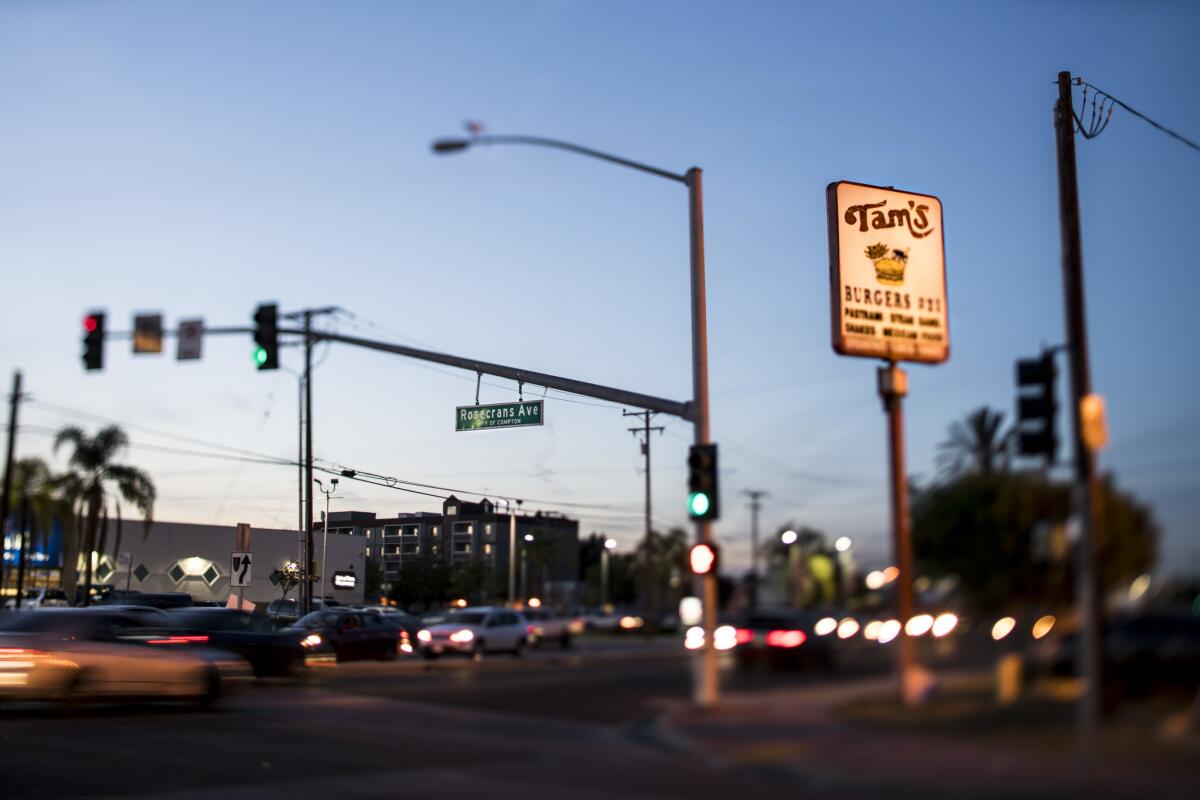
For visitors wanting to understand Compton's history, the city offers more appropriate entry points. The Compton Courthouse and the area around City Hall carry architectural and civic history. The California African American Museum in Exposition Park — about 12 miles north — provides essential context for the postwar housing conditions that shaped the entire region. Tam's Burgers on Central Avenue, open since 1970, appears in oral histories and documentary footage as neutral ground in a city that had very little of it, and is worth visiting for that reason alone.
Compton is accessible via the Metro A Line from downtown Los Angeles; Compton station places you in the center of the city. The drive from downtown takes around 25 minutes on the 110 South. The neighbourhood is safe for attentive visitors during daylight hours, though the same common sense that applies anywhere in a dense urban environment applies here.
What the street asks of anyone who seeks it out is not tourism but a degree of reckoning. The block is ordinary precisely because the forces that shaped it were structural rather than spectacular. No famous battle was fought here. No single catastrophic event occurred on this corner. What happened was quieter and more consequential: a group of men, in a city their country had deliberately abandoned, made a decision to protect each other by any means they could access. The organisation that decision produced spread to every state in the union. The conditions that made it necessary have not disappeared — they have simply moved around, finding new geographies, producing new variations on the same outcome, on streets that don't yet know their own history.
Compton persists. So does everything that made it.
Frequently Asked Questions
What is Piru Street in Compton famous for?
Piru Street is a residential block in Compton, California, widely considered the birthplace of the Bloods gang. In 1972, a coalition of non-Crip-affiliated gang members gathered on or near the street and agreed to form a unified alliance against the expanding Crips, adopting red as their identifying color. The street gave the founding gang its original name — the Piru Street Boys — and its legacy shaped the landscape of American gang history for the following five decades.
Who founded the Bloods gang and when?
The Bloods emerged from a 1972 meeting in Compton, California, organised largely through the leadership of Sylvester Scott of the Piru Street Boys. Representatives from several other non-Crip sets — including the LA Brims, the Bishops, and the Athens Park Boys — attended and agreed to form a collective alliance. The meeting was a direct response to the aggressive territorial expansion of the Crips, who had been founded in 1969 by Raymond Washington and Stanley "Tookie" Williams in South Central Los Angeles.
Why did the Bloods choose the color red?
Red was already associated with Piru Street and the Piru Street Boys before the 1972 alliance was formed. When the coalition of non-Crip sets came together, red became the natural choice for a shared identity — partly because of its existing street currency, partly as a deliberate inversion of the blue associated with the Crips. Over the following decade, the red/blue distinction hardened from a local identifier into a nationwide binary, with serious and often lethal consequences for anyone caught on the wrong street in the wrong colour.
How did redlining and white flight contribute to gang formation in Compton?
Federal Housing Administration policy from the 1930s onward systematically denied mortgage insurance in neighbourhoods with Black residents, restricting Black families arriving in Los Angeles to a narrow set of ZIP codes. Combined with racially restrictive housing covenants and aggressive blockbusting by real estate speculators, this channelled the postwar Black community into Compton and South Central. When white residents left — taking the tax base, businesses, and investment with them — Compton was left with overcrowded schools, collapsing infrastructure, and unemployment rates that climbed through the 1960s and 1970s. The gang formations of the early 1970s were a direct product of this engineered deprivation, not its cause.
How many members do the Bloods have today?
Estimates of Blood membership in the United States range from 20,000 to 30,000, though these figures are contested and difficult to verify precisely. The Bloods are not a centralised organisation — they are a loose network of locally autonomous sets that share an identity, a color, and a set of symbols rather than a unified command structure. The East Coast affiliate, the United Blood Nation, was founded separately at Rikers Island in 1993 and operates with its own internal structure largely independent of the original Los Angeles sets.
Is Piru Street in Compton safe to visit?
Piru Street is a working residential neighbourhood and not a visitor destination. There are no historical markers, guided tours, or infrastructure for outsiders. Compton as a city is broadly accessible during daylight hours and is served by the Metro A Line from downtown Los Angeles. Visitors interested in the history of the area are better directed to the California African American Museum in Exposition Park, which provides essential context on the postwar housing policies that shaped Compton's trajectory, or to Compton's civic centre along Willowbrook Avenue.
Sources
- [The Promised Land: The Great Black Migration and How It Changed America] — Nicholas Lemann (1991)
- [Gang Leader for a Day: A Rogue Sociologist Takes to the Streets] — Sudhir Venkatesh (2008)
- [Original Gangster: The Real Life Story of One of America's Most Notorious Drug Lords] — Frank Lucas & Aliya S. King (2010)
- [The History of Gangs in Los Angeles] — Los Angeles Police Department, Gang and Narcotics Division Historical Archive
- [Compton: A History] — Andrew Wiese, Southern California Quarterly (2004)
- [Making the Second Ghetto: Race and Housing in Chicago, 1940–1960] — Arnold R. Hirsch (1983) — foundational text on FHA redlining mechanics applicable nationwide
- [Straight Outta Compton: The Documentary Record] — various, Los Angeles Times archive, 1988–1995
- [My Infamous Life: The Autobiography of Mobb Deep's Prodigy] — Albert Johnson (2011) — first-person account of Blood/Crip identity transmission to the East Coast
- [Gang Injunctions and Abatement: Using Civil Remedies to Curb Gang Related Crimes] — University of California, Los Angeles Law Review, Vol. 45 (1998)
- [Pulitzer Prize Citation: Kendrick Lamar, DAMN.] — The Pulitzer Prize Board (2018)
- [The Contested Murder of Latasha Harlins: Justice, Gender, and the Origins of the LA Riots] — Brenda Stevenson (2013)
- [United Blood Nation: Prison Gang Profile] — National Gang Center, Bureau of Justice Assistance (2014)


%2C%20Konjic%2C%20Bosnia.jpg)


