
The Prosecutor, the Dynamite Threat, and the Society Hidden Inside a Mountain
Dawn, October 1991. Police helicopters shattered the silence of the Valchiusella Valley in Piedmont, Italy, as 250 armed officers descended on a small commune called Damanhur. Drug-sniffing dogs swept through residential buildings. Camera crews trailed behind. Officers pulled residents from their beds and searched every cupboard, every freezer, every pair of children's shoes. They found no drugs. No weapons. The Damanhurians did not even permit smoking. Nobody mentioned the temples.
Nine months later, in July 1992, state prosecutor Bruno Tinti returned with a smaller team and a larger threat. A former member had sent an anonymous letter to the local police station, confirming what the authorities had only suspected: somewhere inside the mountain beneath the commune, there was an enormous illegal structure. Tinti arrived at the house that concealed the entrance on the morning of July 3, accompanied by three officers and explosives experts. His ultimatum was blunt: show us the temples, or we dynamite the entire hillside.
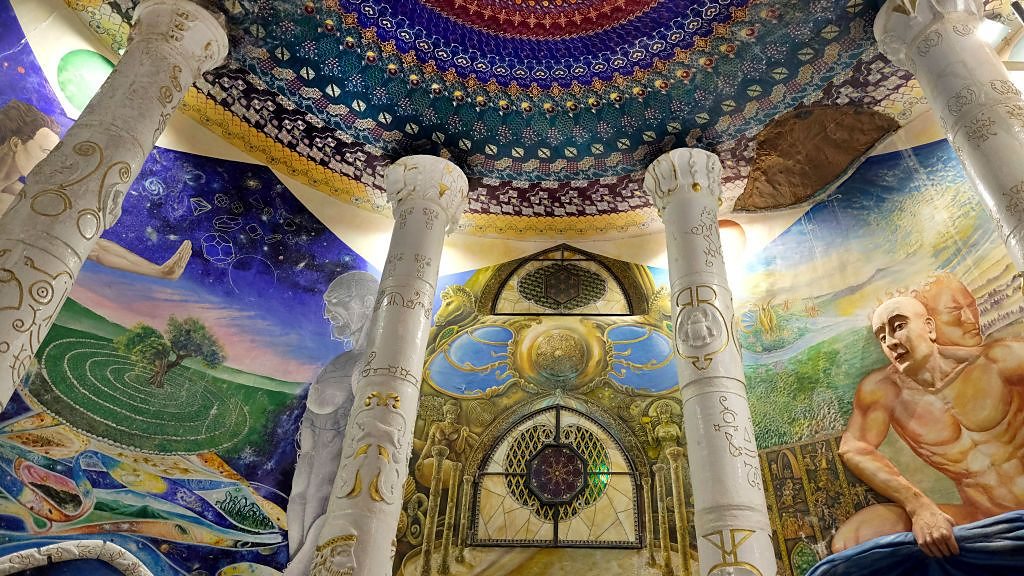
Oberto Airaudi — who went by the name Falco — led the prosecutor through a concealed entrance and down into the rock. What Tinti expected was a cellar. What he found was a civilization. The first chamber, the Hall of the Earth, was a circular room eight meters in diameter, its walls covered in painted scenes depicting the history of humankind. A sculpted column rose to a ceiling of hand-crafted stained glass. Beyond it, corridors branched into further halls: rooms with ceilings over seven meters high, walls sheathed in gold leaf, mosaic floors, Tiffany glass domes glowing under artificial light. One chamber was a four-sided pyramid lined entirely with mirrors. Another contained nine crystal spheres positioned along what the Damanhurians called "synchronic lines" — supposed channels of cosmic energy.
The tour lasted an hour. When the group emerged, the local chief of police was crying. Tinti put his hand on Airaudi's shoulder and said they had to find a way to save what was inside the mountain.
The temples were extraordinary. That was never the question. The question was what kind of organization could produce 16 years of collective secrecy, the total obedience of hundreds of people to one man's vision, and a membership willing to hand over their savings, their labor, and their silence — all to build a monument inside a mountain that most of them would never be allowed to fully see. Damanhur sits on the exact line where devotion becomes control, and no one has ever been able to prove which side it falls on.
Oberto Airaudi and the Founding of Damanhur
Airaudi's Early Life and the Road to Damanhur
Oberto Airaudi was born on May 29, 1950, in Balangero, a small town near Turin. According to his own account and the official Damanhurian biography, he displayed unusual abilities from childhood — healing the injuries of his friends, narrating visions, conducting experiments that blurred what he called the boundary between natural and supernatural law. By his telling, he received detailed visions of ancient temples at the age of ten, blueprints from what he later described as memories of a past life. At sixteen, he published a book of poetry. At nineteen, he petitioned the Juvenile Court for legal emancipation and was declared an adult two years early.
By the early 1970s, Airaudi had left behind an unremarkable career in insurance and reinvented himself as a practitioner of what Italy's New Age subculture called "pranoterapia" — energy healing through touch. He toured the country as a parapsychologist, medium, and hypnotist, building a following among educated, middle-class Italians who were looking for something the Catholic Church wasn't providing. He was charismatic in a way that eyewitnesses describe as deceptively gentle — more soft-spoken teacher than firebrand preacher.
How Airaudi Built a Following Before He Built a Temple
In 1975, Airaudi and roughly 25 followers founded the Horus Centre in Turin, a hub for parapsychological and esoteric research. The philosophy he assembled was a syncretic grab bag — Egyptian mysticism, alchemy, past-life regression, time travel, communication with extraterrestrial intelligences from the star system Aldebaran. The specifics mattered less than the package: Airaudi offered a total worldview, a path to personal transformation, and a community built around it.
The Horus Centre became a recruitment engine. Airaudi did not target drifters or the desperate. The people drawn to Damanhur were professionals — architects, teachers, engineers, artists — people with skills the community would need and resources it could absorb. Within two years, Airaudi had enough followers and enough money to begin searching for a physical site. He drove through the valleys north of Turin until he found a remote hillside in the commune of Vidracco, at the edge of the Valchiusella Valley, bordering the Gran Paradiso National Park. He purchased a house on the hill and, in December 1979, formally opened the community. He named it Damanhur, after the ancient Egyptian city that once housed a temple to Horus.
The name was not accidental. Airaudi was building a temple of his own. He had already started digging.
How Damanhur's Underground Temples Were Built in Secret (1978–1992)
The First Excavation at Damanhur and the Oath of Silence
On a Saturday night in August 1978, Airaudi and a small group of followers gathered around a fire behind the house on Vidracco's hill. According to Damanhurian lore, a star streaked across the sky — unusually bright, trailing golden dust — and Airaudi took it as the signal to begin. The first pickaxe hit the rock that night. The cover story was simple: they were building a basement.
Airaudi had already practiced excavation techniques beneath his parents' house in Balangero, learning the principles of how rock fractures, how weight distributes, how air moves underground. The site at Vidracco was chosen not only for its isolation but for the hardness of the rock — dense enough to hold chambers with high ceilings without steel reinforcement. There were no architects. No geologists. No structural engineers. Airaudi directed every decision.
Every volunteer who joined the dig swore an oath of secrecy. The project was compartmentalized: not all members of the growing community knew the full scope of what was being built. Those who dug worked in rotating four-hour shifts, day and night, chipping away at Alpine rock with hand tools. The excavated rubble was carried out through the house above and dispersed across the property. When the noise of hammering and drilling risked attracting attention from neighbors, the Damanhurians played loud music or pretended to throw parties.
How Damanhur Enforced Sixteen Years of Collective Silence
The logistics of sustained secrecy on this scale defy easy explanation. Over 16 years, an estimated 150 people directly participated in the excavation and decoration of the temples. Hundreds more lived in the surrounding community and were aware, at minimum, that something large was happening beneath the hill. The commune grew steadily through the 1980s — from a few dozen people to several hundred — with new members arriving from across Italy and, eventually, from abroad. Each one entered a social structure designed around loyalty, shared identity, and separation from the outside world.
From 1983 onward, members adopted animal and plant names — Sparrow, Manta Ray, Boa, Swiss Chard — shedding their birth identities in a ritual Airaudi called "conquering" a new self. They lived in communal houses of 12 to 20 people, organized into units called nucleo-communities. Full-time "Class A" citizens shared all resources with the community. They read Airaudi's books. They attended his twice-weekly lectures. They participated in his "School of Meditation," an initiatory path with progressive levels of access to esoteric knowledge. Outsiders were described, in the language of the community, as carriers of "negative energies." The message was clear: the world outside the gates was not to be trusted. The world inside was sacred. And the most sacred thing inside was the secret beneath the mountain.
The secrecy was not incidental to Damanhur's identity. It was foundational. The act of keeping the temples hidden became, in itself, a spiritual practice — a shared conspiracy that bound members together more tightly than any theology could. The longer the secret held, the more invested each person became in maintaining it. To break the silence was not just to betray the community. It was to betray the only world that mattered.
Inside Damanhur's Temples: Murals, Mosaics, and Stained Glass
The excavation was only half the project. As diggers hollowed out chambers, artists moved in behind them. Community members — some trained, many self-taught — painted murals depicting the history of humanity according to Damanhurian philosophy. They laid elaborate mosaic floors using thousands of hand-cut tiles. They crafted Tiffany-style stained glass domes, the largest of which sits atop the Hall of Mirrors like a psychedelic skylight buried 30 meters underground. Ceramic columns were sculpted with figures from a dozen different cultural traditions. Walls were inlaid with copper, wood, crystal, and gold leaf.
The aesthetic is unmistakable — a distinctly 1970s New Age maximalism, every surface covered, every chamber saturated with color and symbol. The seven named halls — the Blue Temple, the Hall of Water, the Hall of the Earth, the Hall of Metals, the Labyrinth, the Hall of Spheres, and the Hall of Mirrors — span five underground levels connected by corridors, hidden doors, and a hydraulic elevator. The total excavated volume reaches 8,500 cubic meters. Some ceilings soar over seven meters. The deepest chambers sit 72 meters below the surface.
The artistic labor served a double purpose. It produced an undeniably spectacular result — one that would later save the temples from demolition. And it functioned as a bonding mechanism, channeling members' creative energy into a project they could never show anyone. Every brushstroke was an act of faith in Airaudi's vision and an act of complicity in the community's secret. The temples were simultaneously a masterpiece and a loyalty test.
The Federation of Damanhur — A Parallel State in the Italian Alps
Damanhur's Own Currency, Constitution, and Government
Above ground, Damanhur grew into something that resembled less a spiritual retreat than a small autonomous state. The community developed its own constitution, its own system of governance with elected representatives and appointed "King Guides" who served under Airaudi's ultimate authority. It minted its own currency, the Credito, which circulated alongside the euro and was theoretically backed by equivalent euro deposits in community bank accounts. Members were expected — and in many cases required — to conduct transactions within the community using Crediti, purchasing groceries from Damanhurian-run shops at prices set by the organization.
The community operated its own schools, where children were educated in Damanhurian philosophy alongside a standard Italian curriculum. It ran vineyards, organic farms, bakeries, and small manufacturing businesses that served both the internal economy and the surrounding valley. It established its own fire department, officially recognized by the Italian state, and its own section of the Red Cross. At its peak around 2000, the Federation of Damanhur claimed approximately 800 citizens, with satellite centers in Europe, the Americas, Australia, and Japan.
The scale of this parallel infrastructure was Airaudi's other masterpiece — less visually spectacular than the temples, but arguably more revealing. Damanhur did not merely ask its members to believe in a spiritual philosophy. It built an entire world around them, complete enough that leaving meant losing not just a faith community but a government, an economy, a school system, a social identity, and in many cases, a name.
Financial Control, Labor, and the Cost of Leaving Damanhur
Full citizens of Damanhur transferred their personal property to the community upon joining. They were expected to fund communal projects from their own resources, take out personal loans to finance building renovations, and in many cases work within Damanhurian businesses under arrangements that, according to multiple investigations, did not always comply with Italian labor law. Former members and Italian journalists have documented cases of citizens employed without formal contracts, without social contributions, without pension rights — arrangements that kept people economically dependent on the community they had already given everything to join.
The community's internal economy was structured to make departure expensive. Members who left forfeited what they had contributed. Their savings were in Crediti, a currency with no value outside the commune. Their professional networks, their housing, their children's education — all were embedded in the Damanhurian system. The 2007 assessment by Patrizia Santovecchi, president of Italy's National Psychological Abuses Observatory (ONAP), identified Damanhur as sharing characteristics typical of psychologically abusive organizations: barriers to leaving freely, suppression of criticism, a siege mentality that portrayed outsiders as threats, estrangement from family members, depersonalization, and submission to the will of the leader. A 2018 academic analysis of interviews with former members found that the process of disillusionment and departure typically took several years and was described as torturous.
Damanhur's response to these accusations was characteristically slippery. The community's official blog acknowledged the criticism by describing Damanhur as an "ethical cult" — a phrase that managed to be simultaneously disarming and chilling.
The 1992 Police Raid and the Discovery of Damanhur's Temples
The Damanhur Defector Who Told the Police
The anonymous letter that reached the police in 1992 came from a former member who had left the community and was attempting to recover possessions he had contributed. The details of his identity and his specific grievances remain partially obscured — Damanhur's official accounts refer to him only as a disgruntled defector, while critical sources describe a person who had seen enough of the community's internal workings to understand the gap between its public image and its private structure.
What he provided was specific enough to give state prosecutor Bruno Tinti legal grounds to act: confirmation that a massive unauthorized structure existed beneath Damanhurian property, built over more than a decade without any of the permits required under Italian law. The first raid, in October 1991, had found nothing because the entrance was hidden inside a residential house and no member would reveal its location. The second attempt, in July 1992, succeeded only because Tinti made a threat dramatic enough to force Airaudi's hand. The dynamite was real. The explosives experts were on site.
How Damanhur Saved the Temples from Demolition
Under Italian law, the temples were straightforwardly illegal. No excavation permits had been sought because, as Airaudi himself acknowledged, no permits would have been granted — Piedmont had no regulatory framework for underground construction on this scale. The initial government response was demolition. The Catholic Church added its voice, demanding the temples be destroyed.
Airaudi and the Damanhur leadership launched a counteroffensive that demonstrated just how sophisticated the community's external operations had become. They invited journalists and television crews to see the temples. They framed the story not as "secret cult hides illegal construction" but as "Italian government threatens to destroy the Eighth Wonder of the World." The strategy worked. Media coverage across Italy and internationally focused on the temples' beauty, their scale, their improbability — the heartwarming tale of ordinary people building something extraordinary with their bare hands. The cult question was acknowledged and then drowned out by the spectacle.
The community fought a legal battle that lasted several years. Italian arts authorities, confronted with the reality of what was underground, recognized the temples as a significant work of art — a designation that made demolition politically untenable. The government ultimately granted retroactive building permission, and Damanhur paid somewhere in the range of 100 to 150 million lire (roughly €60,000–€75,000 at the time) in back taxes and building fees. The temples were legalized. The community had used the sheer beauty of what its members had built as a shield against every accusation about how and why it had been built.
It was, in its way, the most Damanhurian move imaginable: turning a crime into a miracle by making it too beautiful to punish.
Is Damanhur a Cult? The Accusations and the Evidence
Damanhur's Financial Scandals and Airaudi's 115 Properties
The legalization of the temples did not end scrutiny of the organization that built them. Throughout the 2000s, a growing body of evidence accumulated around Airaudi's personal finances and his authority within the community. Italian tax authorities began investigating him in 2007 and uncovered a personal estate that bore no resemblance to the communal poverty his followers practiced. Airaudi owned 115 properties — houses and land holdings spread across multiple Italian provinces. His personal bank accounts held sums that investigators estimated represented over two million euros in evaded taxes for a four-year period alone. He had painted — or in some cases, according to critics, signed paintings made by others — approximately 16,000 works sold to community members and supporters, many in cash transactions without receipts.
In 2010, Airaudi settled with Italian tax authorities, paying €1.2 million. A criminal case for tax evasion was opened. The book Occulto Italia, published by two respected Italian journalists, devoted its first 150 pages to documenting how Damanhur under Airaudi's leadership had infiltrated Italian politics at regional and even national levels, leveraging its concentrated voting bloc — the community allegedly organized electoral migrations of members to local municipalities — to secure political protection and favorable treatment.
The financial picture was damning in its simplicity. Members were required to surrender their property to the community. Airaudi accumulated 115 properties in his personal name. Members worked in community businesses, often without formal employment contracts or pension contributions. Airaudi's estimated personal wealth reached tens of millions of euros. The community preached collective ownership. Its founder practiced personal accumulation on a scale that would have embarrassed a mid-level real estate developer.
Former members who spoke through the anonymous testimonial website Damanhur Inside Out, launched in 2009, described a pattern familiar to researchers of high-control groups: gradual financial entanglement, social isolation, suppression of dissent, and an atmosphere in which questioning Airaudi's authority was treated as spiritual failure rather than rational inquiry. Allegations of sexual relationships between Airaudi and a significant percentage of female members — conducted during weekend "magic journeys" in million-euro motorhomes and framed as "ritual alchemy" — circulated on cult-monitoring forums, though they have not been independently verified in published investigations.
Airaudi died of colon cancer on June 24, 2013, at the Damanhur community of Aval in Cuceglio. He was 63 years old.
Damanhur After Airaudi — The Community That Survived Its Founder
The counter-narrative exists, and dismissing it entirely would be as dishonest as accepting the community's PR at face value. Long-term members of Damanhur describe genuine community, creative fulfillment, and personal transformation. The eco-village has won international recognition for sustainable living. The temples, whatever the conditions under which they were built, represent an artistic achievement that is difficult to dismiss as mere cult production. Academic observers have noted that some members participate at arm's length — "Class C" and "Class D" citizens maintain outside lives and engage with Damanhur on a part-time basis, something that most high-control organizations would never permit.
Since Airaudi's death, the community has become measurably more outward-facing. The temples are open to paying tourists. The governance structure, at least on paper, has distributed authority more broadly. The population has shrunk from its claimed peak of 800 to roughly 600 full-time residents — a number that critics argue has always been closer to 300 — but the community has not collapsed.
The difficulty with Damanhur is that it resists the binary. It is not Jonestown — no one died. It is not Rajneeshpuram — there were no bioterror attacks, no assassination plots, no public implosion. What there was, and what may still be, is a community that asked its members to give everything to a leader who kept everything for himself, and justified the arrangement by pointing to the staggeringly beautiful thing they had built together. The temples are the evidence and the alibi. They prove what Damanhur can produce. They also raise the question of what it costs to produce it.
Visiting Damanhur's Temples of Humankind Today
Damanhur Temple Tours: What to Expect
The Temples of Humankind are open to the public year-round. Visits are by reservation only and begin with a guided walk through Damjl, the main settlement, where guides — current Damanhurian citizens — explain the community's history, philosophy, and organizational structure. The walk is free and lasts roughly 45 minutes. It is, in effect, a soft orientation session. From there, visitors can book tours of varying length: the basic tour covers four of the seven temple halls and lasts approximately three hours. The full-day experience includes all halls, a walk through the Sacred Wood — an open-air temple above the underground complex — and a group meditation session.
The experience of visiting is singular and disorienting. The elevator descends 45 meters into the mountain. The doors open onto rooms of overwhelming visual density — every surface painted, tiled, gilded, or sculpted. The artistic quality varies wildly, from genuinely accomplished mosaic work to paintings that unmistakably recall 1970s psychedelic album art. Guides speak in the language of synchronic lines, divine forces, and cosmic energy with the matter-of-fact tone of museum docents explaining Baroque altar construction. There is a gift shop. It accepts euros.
The strangeness is not the temples themselves — it is the knowledge of what surrounds them. This is not a museum or a heritage site. It is a functioning spiritual compound where people named Barbary Monkey and Shiitake Mushroom live in communal houses, educate their children in Damanhurian schools, and continue to expand the underground complex according to the blueprints left by a dead insurance broker who claimed to have received them from beings of light. The beauty of what they have built is real. The world that produced it requires a tolerance for ambiguity that most visitors do not bring with them.
The Atlas Entry
The Temples of Humankind are located in the commune of Vidracco, approximately 50 kilometers north of Turin in the Piedmont region of northern Italy. The nearest major airport is Turin Caselle (TRN), roughly an hour's drive. A rental car is effectively required — public transit connections to the Valchiusella Valley are minimal. All visits must be booked in advance through the Damanhur website (thetemples.org). Standard tour packages range from approximately €50 to €80 per person. Longer experiences, including overnight stays and multi-day seminars, are available. Pets are not permitted inside the temples. Photography policies vary by tour type and should be confirmed at booking.
The surrounding Valchiusella Valley is striking Alpine countryside — narrow valleys, medieval villages, proximity to the Gran Paradiso National Park. The Paris Catacombs offer the nearest thematic parallel in European underground heritage, though the comparison flatters Damanhur's ambitions more than its transparency. For travelers interested in the intersection of spiritual communities and contested legacies, Rajneeshpuram in Oregon provides the American counterpart — a story of utopian vision, charismatic authority, and the long shadow that founders cast over the communities they create.
Damanhur asks visitors to respect the beliefs of its hosts. That is a reasonable request. It is also worth remembering that respect and credulity are not the same thing. The temples are among the most extraordinary things human hands have built in the last century. The organization that built them has never fully answered the questions that matter most. Both facts can occupy the same room — even one carved 72 meters deep inside a mountain.
FAQ
What are the Temples of Humankind at Damanhur?
The Temples of Humankind are a complex of seven underground halls carved by hand into the Alpine rock beneath the commune of Vidracco in Piedmont, Italy. Construction began secretly in 1978 and continued for 16 years without permits or public knowledge. The halls span five underground levels totaling 8,500 cubic meters, with ceilings reaching over seven meters. They are decorated with murals, mosaics, stained glass domes, gold leaf, and sculpted columns. Italian authorities discovered them in 1992 after a former member broke the community's oath of silence. The temples were retroactively legalized and are now open to the public by reservation.
Is Damanhur a cult?
Damanhur resists easy classification. Italy's National Psychological Abuses Observatory (ONAP) identified the community in 2007 as sharing characteristics typical of psychologically abusive organizations, including barriers to leaving, suppression of criticism, and submission to the will of the leader. Former members have described financial entanglement, social isolation, and difficulty departing. The community's own blog once described Damanhur as an "ethical cult." Supporters point to its democratic governance structure, international recognition for sustainable living, and the fact that part-time membership is permitted. The question of whether Damanhur is a cult depends on which definition is applied and whose testimony is weighted.
Who was Oberto Airaudi (Falco)?
Oberto Airaudi was born in 1950 near Turin and founded Damanhur in 1979 after a career in insurance and parapsychology. He claimed psychic abilities from childhood and directed the secret excavation of the Temples of Humankind from 1978 onward. Italian tax investigations revealed he owned 115 properties and settled a €1.2 million tax debt in 2010. He sold approximately 16,000 paintings to community members, many in undocumented cash transactions. He died of colon cancer in 2013 at age 63. Damanhur continues to operate under collective leadership following his death.
Can you visit the Temples of Humankind?
The temples are open to visitors year-round by advance reservation through thetemples.org. Tours range from a basic three-hour visit covering four of the seven halls to full-day experiences including the Sacred Wood and meditation sessions. Standard tickets cost approximately €50 to €80. The temples are located in Vidracco, about 50 kilometers north of Turin. A rental car is effectively required, as public transit connections to the Valchiusella Valley are minimal. Photography policies vary by tour type.
How did the Italian government discover the temples?
Italian authorities discovered the temples in July 1992 after a former Damanhur member sent an anonymous letter to local police confirming the existence of a massive unauthorized underground structure. State prosecutor Bruno Tinti arrived at the commune with explosives experts and threatened to dynamite the hillside if the community did not reveal the entrance. Oberto Airaudi led Tinti inside. An earlier raid in October 1991 involving 250 officers had found nothing because the entrance was concealed inside a residential house and no member would disclose its location.
Why weren't the temples demolished?
The initial government response was to order demolition, and the Catholic Church supported this position. Damanhur launched a media campaign inviting journalists and television crews to see the temples, reframing the story as the destruction of an artistic wonder rather than the enforcement of building codes. Italian arts authorities recognized the temples as a significant work of art, making demolition politically untenable. The government ultimately granted retroactive building permission, and Damanhur paid approximately 100 to 150 million lire in back taxes and fees.
Sources
* Paradise Found — Magnus Bärtås, Cabinet Magazine, Issue 30 (2008)
* Damanhur: The Story of the Extraordinary Italian Artistic and Spiritual Community — Jeff Merrifield, Hanford Mead Publishers (2006)
* Occulto Italia: Viaggio a fondo nel lato nascosto del Belpaese — Ferruccio Ferrante & Ferruccio Pinotti, BUR Rizzoli (2011)
* The Temples of Humankind: The Art of Damanhur — Esperide Ananas, CoSM Press / North Atlantic Books (2006)
* Assessment of Damanhur's Organizational Characteristics — Patrizia Santovecchi, ONAP (2007)
* Damanhur Inside Out: Anonymous Ex-Member Testimonials — Various Contributors, damanhurinsideout.wordpress.com (2009–present)
* Mystery Behind the Damanhur Temples — Dan Harris & Jenna Millman, ABC News (2008)
* Damanhur: fraud by Oberto Airaudi to the Detriment of Damanhurians and the Revenue Office? — MondoRaro / Rita Cola, La Sentinella del Canavese (2010)
* Disillusionment and Departure from New Religious Movements: A Qualitative Analysis — Academic study (2018)
* The Adventurous History of the Temples of Humankind — Damanhur Foundation (2020)



%2C%20Konjic%2C%20Bosnia.jpg)


