
The Building the Allies Could Not Destroy
In the summer of 1947, two years after the German surrender, a British Royal Engineers demolition team set explosive charges against the southern wall of an unfinished Nazi building in the Grunewald forest west of Berlin. The wall was three meters thick, reinforced concrete, poured to resist a direct hit from heavy artillery. The charges fired. The wall did not come down.
The engineers tried again. They placed larger charges in the basement levels. They tried lateral cuts intended to collapse the structure inward. The building took every blast and kept standing. After several more attempts over the following two years, the British abandoned the demolition entirely. The structure was too solid to remove and too dangerous to leave intact.
The Berlin city authorities began burying it instead.
The building was the Wehrtechnische Fakultät — the Faculty of Defense Technology — an Albert Speer–designed military-engineering college that Hitler had commissioned in 1937 as the centerpiece of a new Nazi university for the war sciences. Construction stopped in 1940. By the end of the war, the shell stood roofless and abandoned in the forest, indestructible. Postwar Berlin had a different problem to solve at the same address. The city had been bombed flat. Roughly half of all buildings inside the old city limits were rubble. The Allied air raids and the Soviet ground assault had reduced central Berlin to an estimated seventy-five million cubic yards of broken brick, ash, concrete, and household debris. Somebody had to put it somewhere.
The somebody was an army of women. The somewhere was the unfinished Nazi college in the Grunewald.
Trains of rubble began arriving at the Wehrtechnische Fakultät in 1950 and continued for twenty-two years. By the time the last load was dumped in 1972, eighty meters of broken Berlin had been piled on top of the Speer building. The pile became a hill, and the hill was named Teufelsberg — Devil’s Mountain. The structure beneath it has never been reopened. It is still down there, sealed inside the largest physical artifact of the postwar German clean-up.
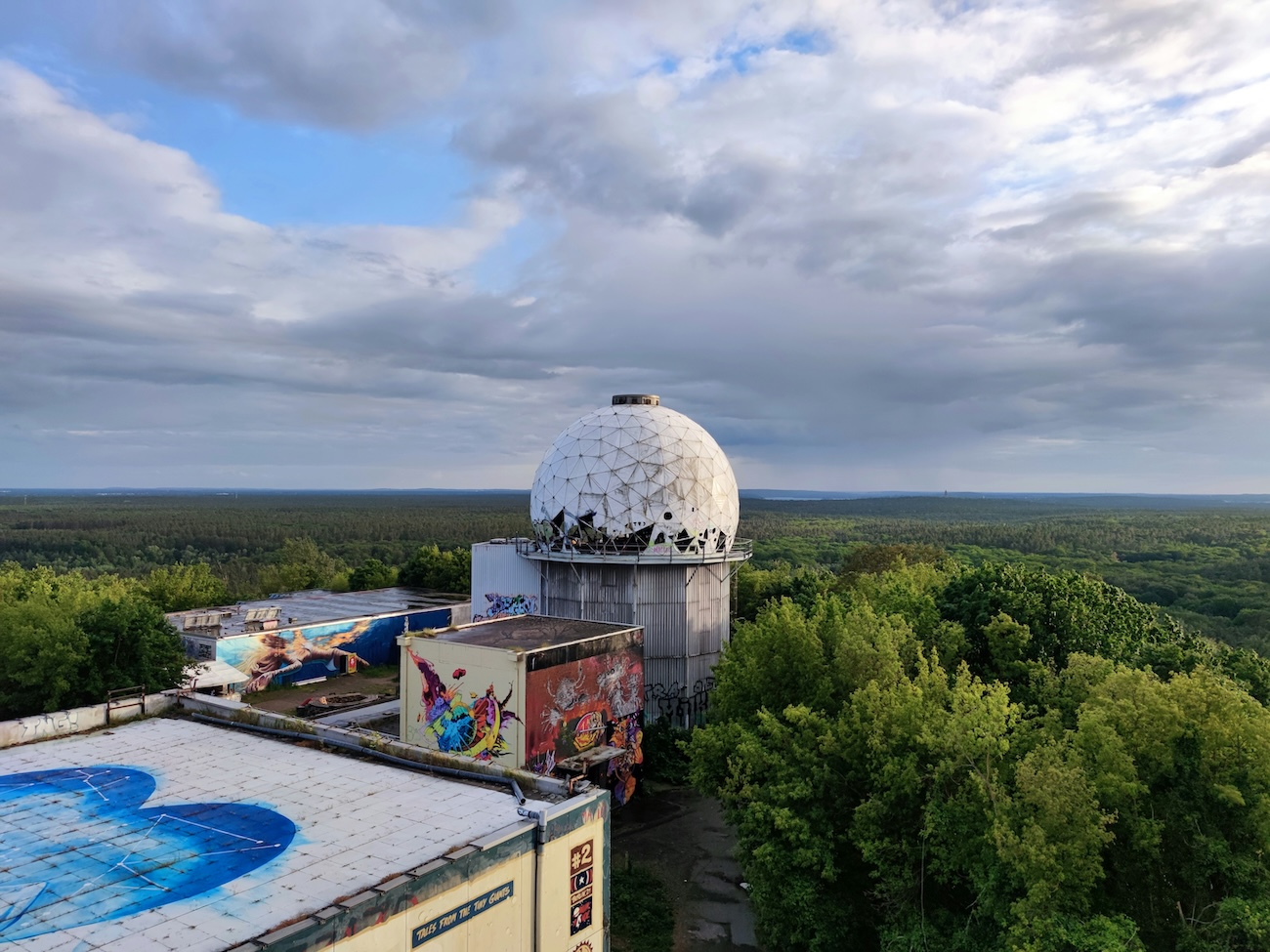
Teufelsberg is the only Cold War listening station in the world built directly on top of the architecture of the war that produced it. The Americans crowned the hill with five white geodesic radomes, filled them with antennas and Russian linguists, and pointed every microphone east. For thirty years they listened to the next war that nobody could be allowed to start. The hill they listened from was the previous war, compacted.
The Rubble Women and the Mountain That Grew
The clearing of bombed Berlin was done largely by women. In 1945, the surviving male population of the city had been killed at the front, taken prisoner, or wounded into uselessness. The Soviet occupation administration registered roughly two million women in Berlin alone, conscripted them into ordnance ranks, paid them in food rations and a small daily wage, and put them to work clearing streets, salvaging bricks, and breaking up the larger pieces of fallen masonry with hammers.
They were called the Trümmerfrauen — “rubble women.” Their work was filthy and dangerous. Buildings collapsed without warning. Unexploded ordnance was common. The wage was 72 pfennig per hour, paid in scrip, with a midday bowl of soup and a meat ration on a card. The women worked in long lines, passing bricks hand to hand down chains that ran the length of a street. Reusable bricks were cleaned and stacked for the reconstruction effort. Broken brick, slate, plaster, and shattered concrete were loaded onto wagons and trucks and carried out of the city.
Most of the broken material went to a small number of designated dump sites at the edges of Berlin. The largest of them, by a wide margin, was the unfinished Nazi building in the Grunewald.
Twelve Years of Daily Deliveries to the Grunewald
The pile rose slowly. In the first years, dump trucks ran several times a day from the central districts west into the forest. After 1953, when the worst of the manual clearance was complete, the deliveries continued at a reduced rate using mechanical excavators and bulldozers operating on what had become a working sanitary landfill. The dump was open most days of the week. Photographs from the period show the new hill being shaped by graders working at the perimeter — a brown, mounded, slightly conical landform rising out of the forest.
The Wehrtechnische Fakultät disappeared from view by 1955. By 1965, the hill had reached the rough silhouette it has today. The Berlin Senate planted grass on the lower slopes. Saplings were added in stages through the late 1960s. By 1972, when the final truckloads were tipped, the mountain rose 120.1 meters above sea level — the highest point in West Berlin and the highest accessible point for nearly a hundred kilometers in any direction.
It was also, by accident, the perfect site for a radio antenna.
The Devil’s Mountain in the British Sector
The line-of-sight geometry of radio reception falls off with the curvature of the Earth. An antenna at sea level can pick up a transmitter perhaps thirty or forty kilometers away. An antenna placed eighty meters higher than its surroundings can reach almost a hundred kilometers — sometimes more, depending on atmospheric conditions and the frequencies involved. For an intelligence service trying to listen to military communications inside East Germany, Poland, and western Soviet Union, a high vantage point was worth more than any number of additional receivers at lower elevations.
Teufelsberg sat in the British sector of West Berlin. The British military had been operating mobile signals-intelligence trucks in the area since the late 1940s, working out of RAF Gatow nearby. By the late 1950s the U.S. Army Security Agency — soon to be folded into the new National Security Agency — had moved its own mobile listening units into the woods at the base of the hill. The arrangement was tense; the Americans wanted the summit, the British technically controlled the sector, and the Berlin Senate technically controlled the landfill that was still active.
The agreement came in 1961. The British formally permitted the Americans to occupy the summit of Teufelsberg under a joint Anglo-American intelligence sharing arrangement. The Berlin Senate accepted that the dump site would be capped and finished as a recreation area but that the summit would remain leased to the United States indefinitely. Construction of permanent antennas began that year.
The Mobile Trucks That Came Before the Domes
The first permanent structures on the summit were utilitarian: a generator building, a small barracks, and an array of pole-mounted antennas. The signature white radomes did not appear until later. Through most of the 1960s, the work of Field Station Berlin — the formal name given to the Teufelsberg site — was done in heated trucks and trailers parked behind antenna farms, with the operators wearing parkas against the wind that ran up the artificial slope.
The view from the summit at night, looking east, was one of the strangest in Cold War Europe. The lights of West Berlin ended at the Wall, fifteen kilometers away. Beyond the Wall, the darker, dimmer grid of East Berlin extended to a horizon line that, on clear nights, was visible all the way to the Soviet airfields outside Brandenburg. Linguists on shift would stand at the edge of the antenna field smoking and watching the lights of Soviet transport aircraft on final approach, twenty miles into another country.
Field Station Berlin: The NSA’s Highest-Altitude Outpost in Europe
The site grew rapidly through the 1970s. The five geodesic radomes that became the visual signature of Teufelsberg were built in stages between 1968 and 1976, each one designed to protect a large rotating dish or fixed array from the weather while letting radio waves pass through almost unaltered. The largest dome was thirty meters in diameter and sat on a tall central tower visible from much of western Berlin. The whole installation, by 1980, employed roughly 1,500 personnel across the U.S. Army Security Agency, the U.S. Air Force Security Service, and the NSA’s civilian SIGINT staff.
Building the Radomes and the Big Ear
The radomes were geodesic — Buckminster Fuller’s pattern of triangular panels assembled into a near-sphere. The design held its shape against the strong westerly winds of the North German Plain without using internal supports that would have interfered with the antennas inside. The fabric used for the panels was a specially formulated plastic membrane that transmitted radio energy almost without loss across the frequency bands the site cared about. Visually, the domes looked like enormous golf balls, and that is what Berliners called them.
The central tower, taller than the others, held the dome that operators referred to simply as the Big Ear. The antenna inside was a large parabolic dish capable of being aimed with high precision at specific points on the eastern horizon. Other domes held arrays tuned to different frequency ranges. The whole complex was wired together through underground cables to operations rooms in the central building, where intercepted signals were demodulated, recorded, transcribed, and forwarded to NSA headquarters at Fort Meade for analysis.
Inside the Antennas: SIGINT, Communications Intelligence, and the Listen Mission
The work at Teufelsberg was almost entirely signals intelligence, abbreviated SIGINT. The site captured radio transmissions of every kind — Warsaw Pact military command channels, East German Volkspolizei traffic, civilian aviation, microwave telephone trunks, encrypted teletype, and the unencrypted talk of Soviet tank crews on training exercises in Brandenburg. The intercepts were sorted by mission. Voice traffic in Russian went to Russian linguists. German traffic went to German linguists. Polish, Czech, Hungarian, Romanian, and Bulgarian traffic each had its own desk. Encrypted material was either decoded on site or shipped back to Fort Meade for the cryptographers there.
What the site was looking for, more than anything else, was indication and warning — the small signal that would precede a Warsaw Pact movement toward the West. A surge in encrypted traffic. A change in radio procedures. A unit going silent. A new frequency entering service. The mission was less about gathering information than about not missing the start of a war.
The Russian Linguists and the Daily Cold War
Most of the staff at Teufelsberg were young. Russian linguists trained at the Defense Language Institute in Monterey, California, arrived in Berlin in their early twenties on three-year tours. They worked twelve-hour shifts in rotation, four days on and three days off, in operations rooms lit only by the green glow of the receivers. The work was repetitive almost to the point of tedium. Most intercepts were routine and were filed without comment. Occasional sessions produced something worth flagging — an unusual exercise, a new piece of equipment coming into service, a name not heard before — and these were typed up, classified, and sent on.
24-Hour Shifts Inside the Domes
The interior of the radomes was insulated against the weather but not against monotony. Linguists worked at consoles that had not changed substantially since the 1960s: a tuning panel, headphones, a paper-tape recorder, a typewriter, and a notebook for the running log. The radomes were unheated except by the body heat of the operators and the warmth of the electronics. In winter, frost sometimes formed on the inside of the membrane. In summer, the same sun-warmed enclosed space could reach forty degrees Celsius. The work continued through both.
The shifts were silent except for the chatter of the intercepts. Eating was done at the desk. Personal radios were forbidden. The headphones carried Russian, German, or whatever target language a particular operator was assigned. Linguists who had spent two years training at Monterey on the textbook formality of broadcast Russian found themselves on shift transcribing the slang of Soviet conscripts complaining about their NCOs.
The Czechoslovakia Invasion and the Warsaw Pact Surge of August 1968
The most important single night in the operational history of Teufelsberg came on August 20, 1968. Throughout the summer, the linguists on the eastern intercept desks had been tracking unusual movements among Warsaw Pact forces in Poland, Hungary, and East Germany. The traffic suggested a major coordinated exercise, but the scale was larger than any previous Pact maneuver. On the evening of August 20, the volume of encrypted military traffic across the eastern horizon surged in a pattern consistent with offensive operations.
By midnight, the Teufelsberg watch officer was reporting tank columns moving south through Poland and East Germany toward the Czechoslovak border. The intercepts arriving in the operations room were among the first solid Western confirmations of what was happening. Soviet armor was crossing into Czechoslovakia to put down the Prague Spring. By dawn, the intervention had begun in full force. Teufelsberg had been listening to the staging of it for hours.
The night was the kind of event the entire facility had been built to detect — a sudden, large, coordinated Warsaw Pact movement. The fact that the operation was internal to the Eastern bloc rather than an attack on the West did not reduce its importance. Teufelsberg had passed the test. The infrastructure worked. For the next twenty-one years, until the system it monitored collapsed almost overnight, the dome on the hill listened for the day a similar surge would point west instead of south.
The Fall of the Wall and the Closing of Teufelsberg
The Berlin Wall came down on the night of November 9, 1989. Most of the personnel at Teufelsberg watched it happen from the operations rooms, intercepting the East German police and military radio traffic as it disintegrated in real time. Within hours, the GDR’s central command structures had effectively stopped issuing orders. Within weeks, Warsaw Pact military communications had begun to collapse across the entire bloc. By the formal dissolution of the Pact in 1991, the principal targets of the Teufelsberg listening mission had simply ceased to exist.
The facility was decommissioned in 1992. The Americans dismantled the most sensitive equipment, stripped the operations rooms, and turned the buildings over to the Berlin Senate. The radomes were left in place. The site stood empty.
The Failed Hannfried Schütte Hotel and the Dalai Lama Visit
A Berlin real-estate developer named Hannfried Schütte bought the site in the mid-1990s with a plan to convert the central building into a luxury hotel and the surrounding land into a conference complex. The plan stalled. Permitting issues, environmental disputes over the unstable substrate of the artificial hill, and a series of investor withdrawals delayed the project through the late 1990s and into the 2000s. The buildings sat empty.
In 2006, the Dalai Lama visited Berlin and toured the site as part of a proposal to convert it into a Tibetan meditation center. The proposal drew international attention but did not produce a deal. By 2010, Schütte’s company had effectively abandoned the development. The site was patrolled by a single security firm, and even that proved insufficient to keep trespassers out.
Graffiti, Trespassers, and the Slow Reclamation
Through the 2010s, Teufelsberg became the largest open-air street-art site in Berlin. Trespassers climbed the perimeter fence at night and painted every available interior and exterior surface — the radomes, the central tower, the long curving walls of the operations buildings. Some of the work was crude. Much of it was technically accomplished and visually striking. The radomes themselves, painted in concentric arcs and faces and stencilled patterns, became one of the most photographed semi-legal locations in the city.
By 2015, a consortium of artists, tour operators, and former staff had negotiated a working arrangement with the property owner. Visitors could now enter on guided tours during the day for a fee, supporting both the site’s slow stabilization and the artists who continued to paint inside it.
The radomes themselves are deteriorating. The fabric is brittle in places. Storms have torn panels off the largest dome. The hill underneath continues to settle, very slowly, on top of the building the British couldn’t blow up.
The Atlas Entry: Visiting Teufelsberg Today
Teufelsberg sits at the western edge of Berlin in the Grunewald forest, about a thirty-minute S-Bahn ride from the city center followed by a fifteen-minute walk through the trees. The hill is open as a public park. The summit, where the radomes stand, is fenced and operates on the rolling agreement between the property owner and the artist consortium. Day tickets are sold at the gate. Guided tours are available in English on most days of the week.
Walking Up the Hill of Broken Bricks
The path to the summit climbs through mature pine and birch forest planted by the Berlin Senate in the 1960s and 1970s. The ground underfoot is soft, mostly leaf litter, but in places along the path the underlying material breaks through — chunks of brick, fragments of tile, the occasional smooth corner of finished masonry. The whole hill is made of those pieces. A casual visitor can pick up a piece of someone’s house from 1944 on the way to the top.
The summit clearing opens unexpectedly. The five radomes stand in a rough arc on the eastern crest, the largest one on its tower at the center, painted now in vast curving swathes of color. The buildings around them are entirely covered in murals. The view east, on a clear day, reaches the spire of the Berlin Television Tower at Alexanderplatz, the Reichstag dome, and beyond them the flat green country that used to be East Germany.
Standing Inside the Big Ear
The radomes can be entered. The interior of the largest dome, the Big Ear, is the most striking space on the site. The antenna inside is gone, but the spherical fabric remains, and the acoustic properties of the chamber are extraordinary. A whisper at one wall is audible at the wall opposite. Visitors test the effect involuntarily within a few seconds of stepping inside. Guides explain that the dome was not designed for acoustics — the perfect resonance is incidental — but the room has become, after a fashion, the ear that the building was named for.
Teufelsberg is one Berlin Cold War site among many. It is not as visceral as the corridors of Hohenschönhausen, the Stasi prison on the other side of the city. It does not carry the symbolic weight of Checkpoint Charlie or the Berlin Wall. What it offers, that the others do not, is the physical proof that the postwar order and the war that produced it were stacked on top of each other in the same place. A Nazi military college sealed under eighty meters of brick. American electronic warfare equipment installed on top of it. Berlin street art covering the equipment forty years later.
The dome on the hill listened east for thirty years. The thing it was listening for never came. The Cold War ended through other channels, in other rooms, and the building that had been built to detect the start of the next war turned out to have been listening to the slow, inaudible end of an earlier one. The bricks of the previous war are still under the asphalt of the access road. They will be there for as long as the hill stands, which is to say, for as long as anyone is going to be reading this article.
Frequently Asked Questions
What is Teufelsberg?
Teufelsberg, meaning Devil’s Mountain in German, is a 120-meter artificial hill in the Grunewald forest of western Berlin, built between 1950 and 1972 from approximately seventy-five million cubic yards of rubble cleared from the bombed city after the Second World War. The hill was constructed directly on top of an unfinished Nazi military-engineering college, the Wehrtechnische Fakultät, which Allied demolition teams had been unable to destroy. From 1961 to 1992, the summit hosted a U.S. National Security Agency and U.S. Army Security Agency listening station known formally as Field Station Berlin, which intercepted Warsaw Pact and Soviet military radio communications throughout the Cold War.
What was Field Station Berlin used for?
Field Station Berlin was a signals intelligence facility operated by the U.S. Army Security Agency, the U.S. Air Force Security Service, and the National Security Agency from 1961 until shortly after the fall of the Berlin Wall. Its primary mission was the interception of military radio traffic from East Germany, Poland, Czechoslovakia, Hungary, and the western Soviet Union. The facility’s high elevation gave its antennas a clear line of sight nearly one hundred kilometers eastward, allowing real-time monitoring of Warsaw Pact training exercises, command channels, encrypted teletype, and microwave telephone trunks. The station’s role was both defensive — providing indication and warning of any sudden Pact movement toward the West — and analytical, building long-term intelligence pictures of Soviet military structure and intentions.
What is under Teufelsberg?
Underneath the artificial hill of Teufelsberg lies the Wehrtechnische Fakultät, an unfinished Nazi military-engineering college designed by Albert Speer and commissioned by Adolf Hitler in 1937. Construction was halted in 1940 when wartime resources were redirected. The shell of the building, with three-meter-thick reinforced concrete walls, proved resistant to British demolition attempts in the late 1940s. The Berlin city authorities then began burying the structure under postwar rubble, eventually piling roughly eighty meters of brick and debris over it. The building is still down there, sealed inside the hill, and has not been excavated.
Who were the Trümmerfrauen?
The Trümmerfrauen, or “rubble women,” were an unofficial workforce of an estimated sixty thousand Berlin women who cleared the bombed city after the Second World War. With the male population killed, imprisoned, or wounded, the Allied occupation administrations enlisted women between the ages of fifteen and fifty to break up fallen masonry, salvage reusable bricks, and load broken debris onto trucks for transport to designated dump sites at the city’s edges. The work was unpaid for several months in 1945, then paid at roughly 72 pfennig per hour with a midday meal and ration cards. Most of the rubble cleared by their work was carried out to landfills like Teufelsberg, where it formed the substance of the artificial hills that mark Berlin’s western forest today.
When did Teufelsberg close?
The U.S. listening station at Teufelsberg was formally decommissioned in 1992, three years after the fall of the Berlin Wall and one year after the dissolution of the Warsaw Pact. The collapse of the Eastern bloc had effectively ended the station’s mission within months. Sensitive equipment was dismantled and removed, classified materials were shipped back to NSA headquarters at Fort Meade in Maryland, and the buildings were turned over to the Berlin Senate. The radomes were left in place. The site has been variously developed, abandoned, repurposed, and reclaimed as an open-air street art venue ever since.
Can you visit Teufelsberg?
Teufelsberg is open to the public as a fenced art and history site managed under an agreement between the property owner and a consortium of artists and tour operators. Day tickets are sold at the gate during normal opening hours, and English-language guided tours run on most days. The hill itself, surrounding the radomes, is freely accessible as part of the Grunewald forest park. The summit is reached by walking trails of approximately thirty to forty minutes from the nearest S-Bahn station, Heerstrasse. Visitors enter all five radomes during tours, including the largest dome at the top of the central tower.
Sources
Body of Secrets: Anatomy of the Ultra-Secret National Security Agency — James Bamford (2001)
The Secret Sentry: The Untold History of the National Security Agency — Matthew M. Aid (2009)
Voices Under Berlin: The Tale of a Monterey Mary — T. H. E. Hill (2008)
A History of the U.S. Army Security Agency — James L. Gilbert, U.S. Army Center of Military History (1990)
Trümmerfrauen: The Rubble Women of Berlin — Leonie Treber, Zentrum für Zeithistorische Forschung Potsdam (2014)
Berlin: The Downfall 1945 — Antony Beevor (2002)
Speer: Hitler’s Architect — Martin Kitchen (2015)
Field Station Berlin: A Cold War Memoir — Bill Gatti, Field Station Berlin Veterans Group (2010)
The Prague Spring and the Warsaw Pact Invasion of Czechoslovakia in 1968 — Günter Bischof, Stefan Karner, Peter Ruggenthaler (eds.) (2010)
Teufelsberg: Geschichte eines Berliner Hügels — Joachim Frank, Berliner Forum für Geschichte und Gegenwart (2003)
NSA Spy Station Teufelsberg — Christopher Lindenberg, Berliner Unterwelten e.V. (2008)



%2C%20Konjic%2C%20Bosnia.jpg)


