The Midnight Fracture: August 13, 1961
Operation Rose began in the silence of 1:00 AM. While Berliners slept, trucks loaded with concrete posts, rolls of barbed wire, and thousands of armed soldiers from the National People's Army (NVA) and the Combat Groups of the Working Class moved into position. There was no grand declaration of war; there was only the sound of jackhammers and the rhythmic unspooling of wire along the sectoral boundary. By dawn, the Anti-Fascist Protection Rampart existed as a jagged, makeshift fence that cut through 193 streets, 8 main roads, and 4 lines of the U-Bahn. The fluid city was dead. People who had gone to bed in one country woke up to find their families, jobs, and futures stranded in another.
Operation Rose and the Logistics of Enclosure
The engineering of the first night was a masterpiece of clandestine mobilization. The GDR leadership had stockpiled thousands of kilometers of barbed wire and concrete pillars in secret depots for months. When the order was given, the city was severed with surgical precision. This was not merely about blocking roads; it was about the immediate termination of the Grenzgänger—the 50,000 East Berliners who worked in the West and the 12,000 West Berliners who worked in the East. By 6:00 AM, the subway lines were cut, and the S-Bahn was halted at the border. Families stood on opposite sides of the wire, tossing suitcases and shouting last instructions, unaware that this temporary fence would solidify into a permanent concrete tomb for the next three decades.
The Jump of Conrad Schumann and the Hardening of the Border
Conrad Schumann provided the first iconic crack in the facade. On August 15, 1961, the 19-year-old border guard stood at the corner of Ruppiner Straße and Bernauer Straße. His job was to watch the wire. He smoked a cigarette, his hands shaking, as West Berliners shouted across the coils. At 4:00 PM, Schumann dropped his cigarette and leapt over the barbed wire into a waiting West Berlin police van. That single leap signaled to the Socialist Unity Party (SED) that wire was not enough. The desertion of their own guards proved that the barrier had to be turned into a total system of containment. Within days, the first hollow breeze blocks were laid, replacing the wire with a permanent wall of stone and mortar.
The Psychological Rupture of the Sectoral Divide
The trauma of the first seventy-two hours cannot be overstated. In the weeks following the closure, the border was a scene of visceral desperation. People jumped from the windows of apartment buildings that sat directly on the border line, such as those on Bernauer Straße. These buildings effectively became the wall itself; the front doors opened into the East, but the windows looked into the West. Residents threw their belongings onto the sidewalk and plummeted into the safety nets held by West Berlin firefighters. Eventually, the Stasi responded by bricking up every window and door, turning the facades of entire neighborhoods into blind, windowless cliffs of masonry.
The Geopolitics of Entrapment: Origins of the Berlin Wall
The German Democratic Republic (GDR) was bleeding to death by 1961. Between 1949 and 1961, approximately 2.7 million people fled from East to West Germany, many of them using Berlin as the final porous exit point. This was not a random migration; it was a Brain Drain of the highest order. Doctors, engineers, professors, and skilled laborers were leaving the socialist experiment in droves. By the summer of 1961, the East German economy was on the verge of total collapse because it lacked the human capital to function. Walter Ulbricht, the General Secretary of the SED, realized that if he could not convince his citizens to stay, he would have to imprison them.
The Economic Collapse and the Republic Flight
The term Republikflucht, or desertion from the republic, became the GDR's greatest fear. The socialist state had invested heavily in the education and training of its youth, only to see them depart for the higher wages and consumer freedoms of the Federal Republic of Germany (FRG). By July 1961, the exodus reached a fever pitch, with over 30,000 people fleeing in that month alone. The Wall was, in clinical terms, an economic tourniquet. It was built not to keep enemies out, but to keep the workforce in. The official propaganda labeled it an Anti-Fascist Protection Rampart, but the direction of the fortifications—the spikes and the guns facing inward—told the true story of state-sanctioned kidnapping.
Khrushchev, Kennedy, and the Nuclear Brinkmanship
Nikita Khrushchev and John F. Kennedy turned Berlin into a nuclear chessboard. For the Soviet Union, West Berlin was a bone in the throat, a capitalist outpost deep within the Eastern Bloc. In October 1961, two months after the Wall's construction began, the world held its breath during the standoff at Checkpoint Charlie. Following a dispute over the right of US diplomats to enter East Berlin, ten American M48 Patton tanks faced ten Soviet T-54s at a distance of only 100 yards. The engines idled for 16 hours. A single nervous finger on a trigger would have initiated a third World War. Ultimately, Kennedy signaled a pragmatic acceptance of the barrier. He famously noted that a wall is a hell of a lot better than a war. This concession effectively signed the death warrants of hundreds of East Germans who would try to cross the concrete in the coming decades.
The Failure of Western Diplomacy and the Status Quo
The West’s response to the Wall was largely performative. While Mayor Willy Brandt and the West Berlin public were outraged, the Allied powers—the US, UK, and France—were secretly relieved. The Wall stabilized a volatile situation. As long as the Soviets did not interfere with Allied access routes to West Berlin, the Allies would not interfere with how the GDR managed its own border. This tacit agreement allowed the GDR to refine its security measures with impunity. The city became a microcosm of the Cold War: a stable, yet horrific, stalemate where the lives of individuals were traded for the prevention of a global thermonuclear exchange.
The Anatomy of the Death Strip: Evolution of the Barrier
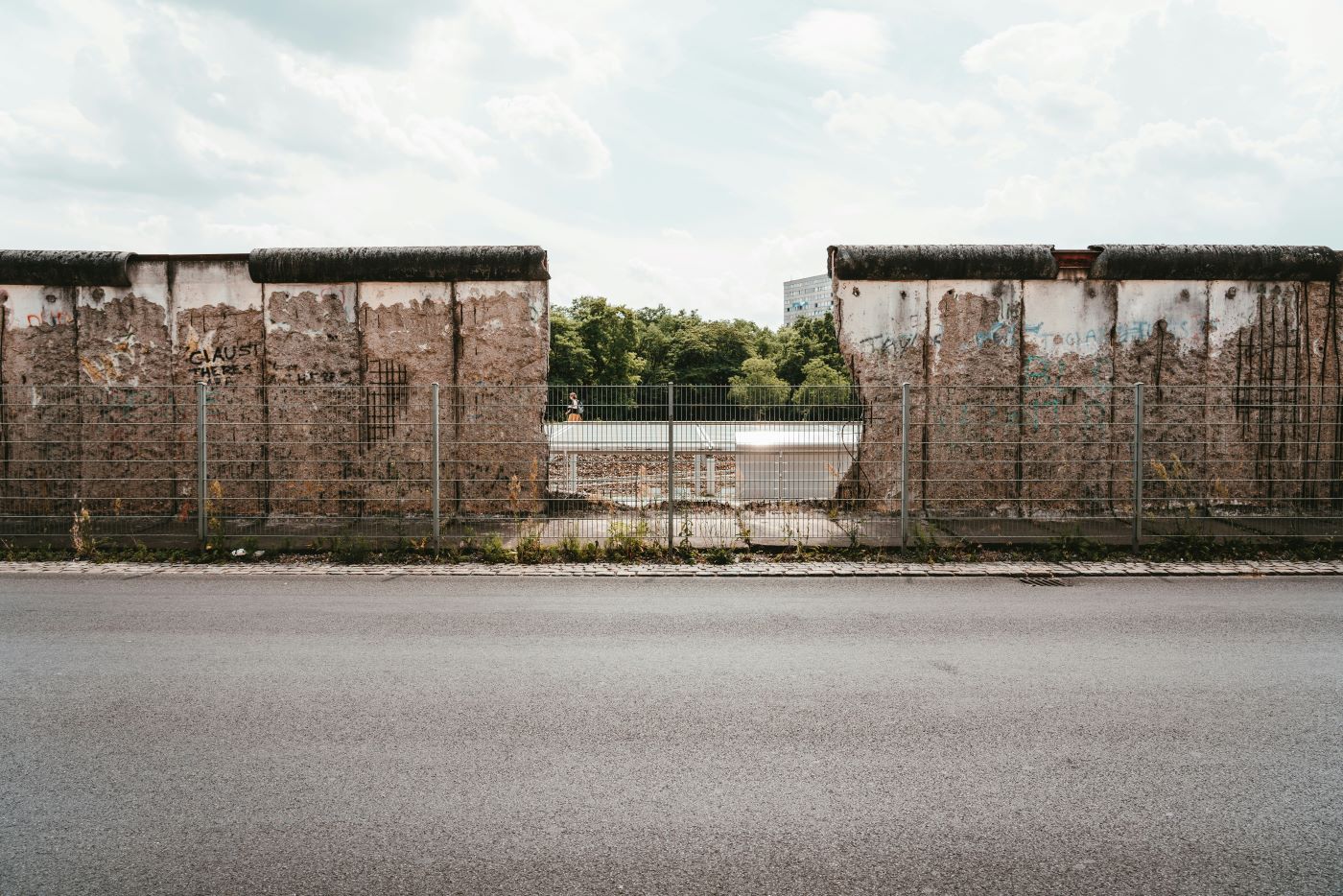
The Wall was never a single object, but an evolving machine of death. By the 1970s, the crude brick walls of the early sixties had evolved into the Grenzmauer 75. This was the fourth generation of the barrier: 3.6-meter-high segments of high-density reinforced concrete, shaped like an inverted L so that the base sat under the ground, making it impossible to ram with a vehicle. The top was crowned with a smooth, round concrete pipe—deliberately polished to ensure no hand could find a grip. This was the Outer Wall facing the West, but the true horror lay behind it in the Death Strip.
Technical Specifications of the Grenzmauer 75
The Grenzmauer 75 was a feat of oppressive engineering. Each concrete segment weighed 2.75 tons and was designed for rapid industrial production and installation. The inverted L-base meant that the weight of the segment itself prevented it from being pushed over by crowds or vehicles. Behind this outer wall lay a meticulously managed landscape of deterrence. The Death Strip was typically 30 to 150 meters wide. It was illuminated by high-intensity sodium lamps that made the area as bright as day, even at midnight. This was not a wall; it was a multi-layered system designed to give the guards multiple opportunities to detect, track, and neutralize any human movement.
The Invisible Wall: Stasi Surveillance and Border Troops
The system was designed to eliminate the human element from the act of killing. Beyond the inner wall lay a sophisticated gauntlet of obstacles. First, there were the signal fences—wires that, when touched, alerted a watchtower and fired flares. Then came the Stalin’s Grass, a carpet of 30,000 upward-facing steel spikes designed to impale anyone jumping from a building or scaling the fence. Beyond that sat the vehicle ditches, the floodlit sand tracks (designed to reveal any footprint), and the Gittermatten (metal gratings) that could be electrified. At the heart of this lay 302 watchtowers, manned by guards with an explicit Schießbefehl (Order to Fire). The state did not want guards to think; it wanted them to function as biological components of a larger, automated execution system.
The Border Guards and the Psychology of the Kill Zone
The Grenztruppen, or border troops, were subjected to intense psychological conditioning. They were rarely stationed with friends from their home villages; instead, the Stasi ensured that guards were paired with strangers to prevent them from colluding to escape together. Every guard was told that an escapee was a criminal and a traitor to the socialist cause. If a guard successfully stopped an escape by killing a citizen, they were often rewarded with medals and extra leave. If they hesitated, they faced imprisonment. This created a culture of lethal vigilance where the fear of the state was greater than the empathy for a fellow human being.
The Human Cost: The Reality of the Death Strip
Peter Fechter became the ultimate symbol of the Wall's clinical cruelty. On August 17, 1962, the 18-year-old bricklayer and his friend Helmut Kulbeik attempted to scale the wall near Checkpoint Charlie. Kulbeik made it over. Fechter did not. As he reached the top, East German guards opened fire, hitting him in the pelvis. Fechter fell back into the Death Strip, just feet away from the Western side. He lay there for 59 minutes, screaming for help, while hundreds of West Berliners and American soldiers watched from the other side of the concrete. Because he was in the No Man's Land of the Eastern sector, American troops were forbidden from intervening for fear of starting a war. The East German guards eventually carried his limp, bled-out body away. His death proved that the Wall was not just a barrier; it was a theater of helplessness.
Engineering Escape: Tunnels and Physics
Escape required the precision of an engineer and the desperation of a ghost. Since the surface was impassable, Berliners went underground. Tunnel 57 remains the most successful civilian-led escape in history. Over six months in 1964, students in the West dug a 145-meter shaft that surfaced in an old bakery on Strelitzer Straße in the East. Over two nights, 57 people crawled through the damp, narrow passage to freedom. The logistics were grueling: they had to dispose of tons of dirt without being seen, deal with groundwater flooding, and maintain oxygen levels in a shaft that was barely large enough for a human body.
The Failed Attempts: A Census of the Dead
The number of people killed at the Berlin Wall remains a subject of debate, but the official count by the Center for Contemporary History (ZZF) stands at 140 victims. These include those shot by guards, those who drowned in the Spree, and those who died in accidents during escape attempts. It also includes 8 East German border guards who were killed in fire-fights with escapees or Western police. Each death was a calculated result of the border's design. The victims were not just political dissidents; they were ordinary people—grandmothers, students, and children—who simply refused to accept the permanence of their cage.
The Industrialization of Capture
For those who didn't die, the cost was still immense. The Stasi operated a massive network of informants and detention centers like Hohenschönhausen. If an escape attempt failed, the individual was subjected to months of psychological torture, sleep deprivation, and interrogation. The state also engaged in the bizarre practice of Freikauf—selling political prisoners to West Germany for hard currency. Between 1963 and 1989, West Germany paid roughly 3.4 billion Deutsche Marks to buy the freedom of 33,755 prisoners. The Wall was not just a prison; it was a commodity market where human lives were traded for Western cash.
The Night the Concrete Cracked: Legacy of 1989
A bureaucratic mistake dismantled the most formidable border in the world. On the evening of November 9, 1989, GDR spokesperson Günter Schabowski was handed a note regarding new, slightly relaxed travel regulations. He had not been briefed. During a live press conference, when asked when these rules took effect, he stuttered, "As far as I know... effective immediately, without delay." Within minutes, the news hit West German television. Thousands of East Berliners surged toward the border crossings. At Bornholmer Straße, the commanding officer, Harald Jäger, faced a choice: open fire on his own people or open the gate. Lacking orders from his superiors, Jäger chose humanity. He ordered the barriers raised. The Wall did not fall because of a bomb; it fell because of a sentence.
The Schabowski Gaffe and the Power of Bureaucratic Error
The press conference was meant to be a minor adjustment to manage the rising civil unrest in the GDR. The leadership intended to require visas and applications, a process they could still control. But Schabowski’s lack of preparation stripped away the state's last defense: its ability to regulate movement. Once the first gate at Bornholmer Straße opened, the pressure at the other crossings became unsustainable. Guards at Checkpoint Charlie and Invalidenstraße followed suit, overwhelmed by the sheer mass of humanity. The GDR’s authority evaporated in a single night of non-violent chaos.
The Mauerspechte and the Physical Deconstruction
The physical deconstruction of the Wall was swift, led by the Mauerspechte (Wall Woodpeckers) who hacked away at the structure for souvenirs. Within weeks, the heavy machinery of the NVA, the same army that had built the wall, began the official demolition. The L-shaped blocks were hauled away, many of them crushed into gravel for new road construction projects in the reunified Germany. The Wall that had stood for 28 years disappeared from the cityscape with shocking speed, leaving behind a jagged scar of empty land that the city is still struggling to fill.
The Ghost Stations and the Scars of Reunification
Reunification brought mass unemployment to the former GDR and a profound sense of Ostalgie (nostalgia for the East) among those who felt abandoned by the new capitalist reality. Even today, if you look at satellite photos of Berlin at night, you can see the divide: the East still glows with the warm yellow of sodium vapor lamps, while the West uses the cooler white of modern LEDs. The city is whole, but the ghost of the border is etched into its very infrastructure. The "Wall in the Head" refers to the psychological barrier that persists between those who grew up under socialism and those who grew up in the West.
The Void of Modern Berlin: Standing in the Machine
Bernauer Straße is the only place where the silence still feels heavy. Most of the Berlin Wall has been erased, replaced by glass-fronted office buildings and the vibrant, if sanitized, murals of the East Side Gallery. But at the Bernauer Straße Memorial, the clinical terror of the border is preserved. Here, you can stand on a viewing platform and look down into a reconstructed section of the Death Strip. You see the inner wall, the sand, the watchtower, and the outer wall. It is a sterile, haunting view. There is no graffiti here. There is only the realization of how narrow the gap was between a life of freedom and a state-sanctioned death.
Bernauer Straße: The Only Authentic Glimpse
The memorial at Bernauer Straße uses rusted steel poles to mark where the wall once stood, allowing visitors to walk through the barrier while still visualizing its scale. The most jarring feature is the Window of Remembrance, which displays the photos of those who died at the wall. This site is not about the celebration of the fall; it is about the mourning of the duration. It forces the visitor to confront the mundane reality of the border: the way it clipped the wings of a city and turned neighbors into enemies.
The Lingering Contrast: Architecture and Mentality
The divide between East and West Berlin is not a memory; it is an active presence. Architecturally, the West is a patchwork of post-war reconstruction and modern glass, defined by the Kurfürstendamm and the remnants of the Kaiser Wilhelm Memorial Church. The East, however, is still dominated by the Plattenbau—the mass-produced, prefabricated apartment blocks that epitomized socialist urban planning. These monolithic structures were designed to promote equality but often resulted in a sense of crushing uniformity. Even the crosswalk signals are different; the East still uses the iconic Ampelmännchen, a hatted figure that has become a cult symbol of Eastern identity.
Beyond the brick and mortar, the mentalities of the two halves still diverge. In the East, there is a lingering skepticism toward the capitalist state, born from the trauma of the 1990s when Eastern industries were liquidated overnight. There is a sense of "Second Class Citizenship" that fuels modern political movements. In the West, there is often a lack of understanding regarding the complexity of life under the Stasi—a tendency to view the GDR as a mere caricature of evil rather than a lived reality for millions.
Standing in Berlin today, you realize that while the concrete is gone, the city is still healing from a compound fracture. The two sides have fused back together, but the point of the break is still sensitive to the touch.
FAQ: Understanding the Berlin Wall
Why was the Berlin Wall actually built?
The wall was a desperate economic measure designed to stop the bleeding of the East German labor force. Between 1949 and 1961, the German Democratic Republic lost nearly one-sixth of its population to the West. Most of those fleeing were the young and the educated, including doctors and engineers whose training had been funded by the socialist state. Without a captive workforce, the GDR faced total industrial and social collapse. The barrier was the only way the Soviet-backed government could ensure the survival of its political experiment.
How many people died trying to cross the wall?
The official death toll recorded by the Centre for Contemporary History in Potsdam is 140 individuals. This list includes 101 East German escapees who were shot, died in accidents, or committed suicide upon failed attempts. It also counts 31 people from both East and West who had no intention of fleeing but were shot or died in the border area, as well as 8 East German border guards killed in the line of duty. Some independent victim groups argue the number is higher, reaching over 200 when accounting for those who died of heart attacks during border checks or in later imprisonment.
Was the wall actually on the border?
In most places, the outer wall seen by West Berliners was built several meters inside East German territory. This was a strategic decision to allow East German guards to perform maintenance on the "Western" face of the wall without technically stepping into the West. It also meant that West Berliners who touched the wall or painted graffiti on it were technically trespassing on GDR soil, a fact that occasionally led to tense diplomatic standoffs or arrests by guards reaching through hidden doors.
What happened to the wall after it fell?
The vast majority of the wall was recycled into the very foundations of the reunified city. In the months following the opening, the East German military began an industrial-scale demolition project. Most of the 45,000 concrete segments were crushed into rubble to build new roads and highways. Approximately 250 segments were sold at auction to international collectors and museums, which is why pieces of the wall can be found everywhere from the Vatican Gardens to the Las Vegas Main Station.
Who gave the order to shoot escapees?
The Schießbefehl (Order to Fire) was a standing verbal and written instruction issued by the GDR leadership. While the government often denied its existence to the international community, border guards were explicitly told that "border violators" must be stopped at any cost, including death. Guards were trained to aim for the legs first, but the high-velocity ammunition and the psychological pressure to prevent any successful escape meant that many shots were fatal. After reunification, several high-ranking GDR officials were tried and convicted for their roles in issuing these orders.
Sources
- The Berlin Wall Memorial (Official Site) - Stiftung Berliner Mauer (2024)
- The Victims at the Berlin Wall 1961-1989 - Hans-Hermann Hertle and Maria Nooke (2023)
- The Rise and Fall of the Berlin Wall - History Channel (2022)
- Berlin Wall: A History from Beginning to End - Hourly History (2018)
- The Berlin Wall: A World Divided, 1961-1989 - Frederick Taylor (2007)
- Operation 7: The Stasi and the Berlin Wall - BStU Federal Archive (2021)
- Tunnel 57: The Story of the Great Escape - BBC News Archive (2014)
- Reunification and the Economic Divide - Deutsche Welle (2020)