The Standoff of 1961: Sixteen Hours on the Edge of Oblivion
The pavement at the intersection of Friedrichstraße and Zimmerstraße is unremarkable today, but in October 1961, it was the most volatile geography on the planet. The crisis was not triggered by a grand invasion, but by a dispute over a theater ticket. On October 22, Allan Lightner, the senior U.S. diplomat in West Berlin, attempted to cross into the East to attend an opera. In accordance with the 1945 Potsdam Agreement, Allied officials were to have unrestricted access across all sectors without showing identification to German police. When East German border guards demanded Lightner’s papers, he refused, triggering a chain of events that nearly vaporized the city.
The Allan Lightner Incident and the Breach of Protocol
The East German leadership, under Walter Ulbricht, was testing the limits of Western resolve. By demanding identification from Lightner, the GDR was attempting to assert sovereign control over a border the U.S. did not legally recognize. Lightner eventually crossed, escorted by armed American military police with fixed bayonets, but the precedent had been challenged. Over the following days, General Lucius Clay ordered M48 Patton tanks to the border. He was not interested in diplomacy; he was interested in the physics of force, even suggesting the use of bulldozers to tear down the Berlin wall's nascent wire.
Tank vs. Tank: The Physics of Nuclear Brinkmanship
On October 27, ten Soviet T-54 tanks clattered down the Unter den Linden and stopped precisely 100 yards from the American Patton tanks. For sixteen hours, the world sat in a state of clinical terror. The crews sat inside their machines, engines idling to keep the hydraulic systems pressurized. A single mechanical failure would have initiated a tactical engagement that both sides knew would escalate to a general nuclear exchange. The standoff ended only when Robert Kennedy and Soviet officer Georgi Bolshakov opened a back-channel communication. They agreed to a "Quiet Withdrawal": the Soviets would pull back one tank by five meters, and the Americans would follow.
The Logistics of the Near-Miss and Diesel Terror
Behind the scenes, the military machinery was in a state of hyper-readiness that the public rarely saw. While the tanks faced off at Checkpoint Charlie, American Air National Guard units were deployed with live armaments, and Soviet forces were prohibited from bringing armored personnel carriers across certain bridges. The air was thick with the smell of diesel and the static of encrypted radio channels. Every soldier on that line knew that their life expectancy was measured in seconds if the order was given. The withdrawal was not just a diplomatic success; it was a mechanical relief for thousands of troops who had spent 16 hours with their fingers hovering over triggers.
The Anatomy of the Gate: The Architecture of Bureaucratic Terror
The physical layout of Checkpoint Charlie was a study in psychological warfare. The two sides built their checkpoints to reflect their competing philosophies: one side projected a "temporary" democratic presence, while the other built a permanent labyrinth of state control.
Sector C: The Allied Perspective of "Charlie"
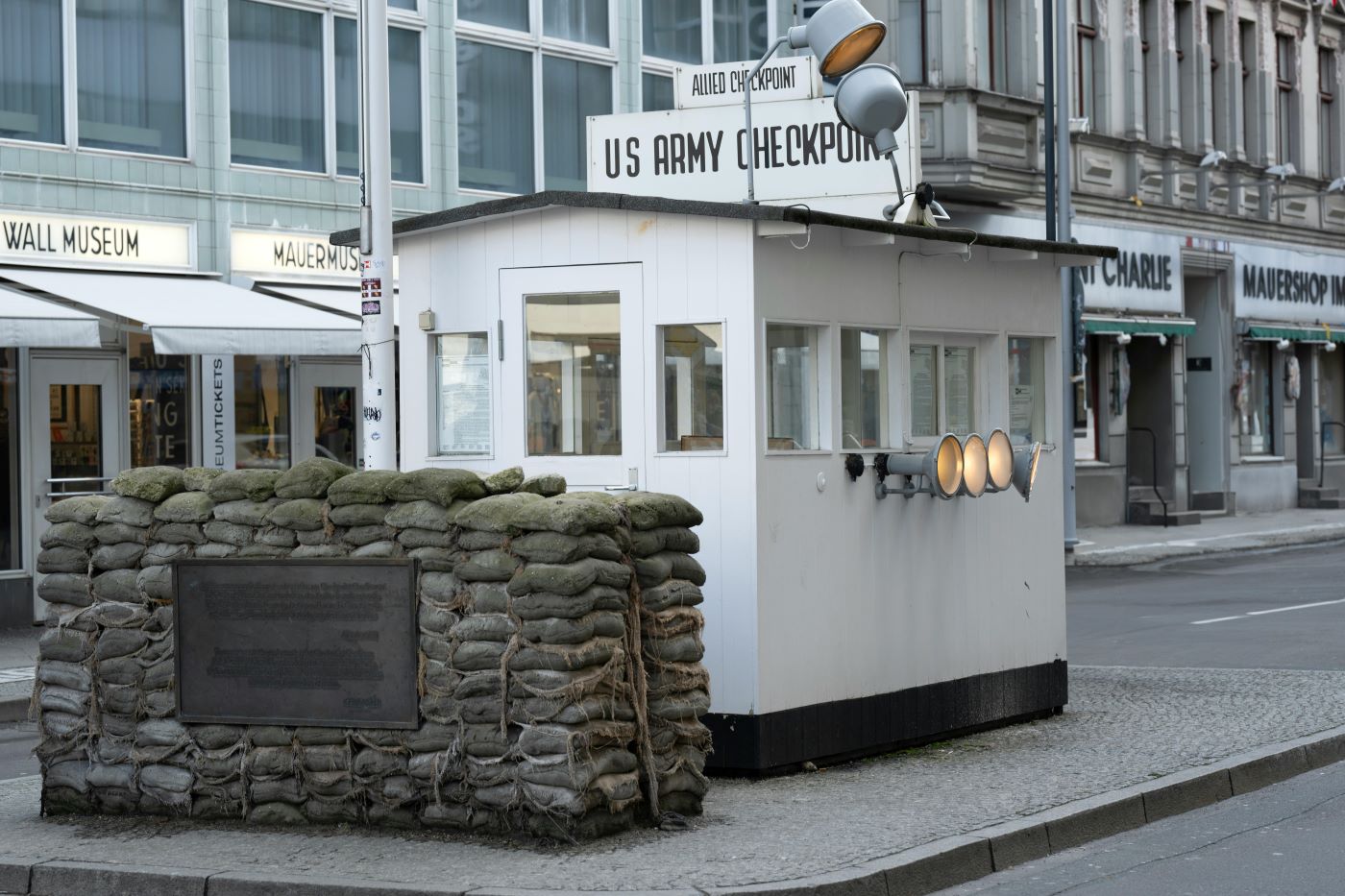
The American side was famously minimalist. Throughout the entire Cold War, the U.S. refused to build a permanent stone or concrete structure at the site, utilizing a small wooden shed to signal that the division of Berlin was an illegal, temporary aberration. This shack sat in the middle of the road, accompanied by the iconic sign that warned in four languages: "YOU ARE LEAVING THE AMERICAN SECTOR". It was a masterpiece of diplomatic theater, projecting an image of Western casualness against the rigid backdrop of the East.
The East German Labyrinth: The Zimmerstraße Gauntlet
Once a traveler crossed the white line into the East, the atmosphere shifted from theater to clinical interrogation. The GDR side was a sprawling complex of zig-zagging concrete barriers, designed to prevent any vehicle from gaining the speed necessary to ram through the gate. Hidden induction loops detected hidden metal, and buildings were equipped with one-way mirrors where Stasi officers recorded every face and license plate. High-intensity lamps were positioned to blind drivers, making it impossible for them to see the guard towers or the positions of the NVA soldiers who were always at "Ready to Fire" status.
The Guardhouse Evolution: From Wood to Metal
The iconic wooden shed that most tourists associate with Checkpoint Charlie was actually replaced in 1976 with a larger metal container. This was not a move toward permanence, but a logistical necessity for the increasing volume of diplomatic traffic. The original wooden hut was eventually moved to the Allied Museum, but its replacement remained a site of intense friction. Guards in these metal boxes lived in a state of high-alert boredom, scanning documents for hours before suddenly being forced to respond to a breach attempt or a high-level diplomatic provocation.
The Hidden Surveillance Machine of the SED
Behind the visible concrete, the Stasi operated a technological panopticon. Every vehicle that passed through Checkpoint Charlie was subjected to carbon dioxide sensors that could detect the breathing of a human hidden in a chassis. Mirrors were wheeled under every car to check for "clinging" escapees, and X-ray scanners were eventually introduced for certain suspicious trucks. The guards themselves were rotated frequently to ensure no "human connection" or empathy could form between the gatekeepers and those they were tasked with containing.
A Theater of High-Stakes Espionage and Human Trafficking
Because Checkpoint Charlie was the only crossing for non-Germans and diplomats, it became the primary valve for the world's shadow wars. While the general public saw a border crossing, the intelligence community saw a marketplace.
The Exchange of Spies: Intelligence in the Crosshairs
Checkpoint Charlie was where the daily grind of espionage occurred. Intelligence officers from the CIA, MI6, and the KGB moved through the checkpoint using diplomatic plates, their cars rarely searched due to protocol. This allowed for the transport of microfilm and high-value defectors. The gate was a filter; the Stasi knew that every third car was likely carrying an operative, and the tension of the "routine" check was a weapon used to rattle the nerves of even the most seasoned field agents.
The Burkhart Veigel Escapes: Modifying the Cadillac
Desperation drove engineering. Burkhart Veigel, a West German medical student, became one of the most successful "escape helpers" by exploiting technical gaps in Stasi search protocols. He used high-end Western cars, like the Cadillac DeVille, and modified them with surgical precision. Veigel would remove the dashboard, the heater, and parts of the engine block to create a "hiding space" that was mathematically impossible according to standard vehicle specifications. People were folded into these gaps, their breathing slowed by sedatives to avoid detection by sensors.
The "Three-Sided" Diplomat and the Sealed Trunk
One of the most complex narratives of spycraft involved using diplomatic immunity as a physical shield for human smuggling. While Allied military police were rarely searched, the Stasi monitored the body language of every car. In one instance, an operative constructed a massive "diplomatic trunk" technically categorized as sensitive correspondence. Inside, a high-ranking defector curled into a fetal position, breathing through a small tube connected to the car's ventilation system. As Stasi dogs circled the vehicle, the guards were legally paralyzed by the diplomatic wax seals and were forced to watch as the car rolled across the white line into the West.
The Disguised Diplomat and the Austin-Healey
Other escapes were even more audacious. In 1964, Heinz Meixner drove a convertible Austin-Healey with the windshield removed, slipping right under the vehicle barrier while carrying his fiancée and her mother. Another man, Hans-Peter Spitzner, and his daughter were among the last to escape in August 1989 by hiding in the trunk of an Allied soldier's car. These stories are often told as thrillers, but the reality was one of sheer terror; a single miscalculation or an unexpected dog search meant immediate imprisonment or death.
The Economics of the Human Toll
The Stasi did not just catch escapees; they commodified them. Failed crossings at Checkpoint Charlie often led directly to Hohenschönhausen prison, where the "Freikauf" system was initiated. This was a state-level human trafficking ring where West Germany paid hard currency to buy the freedom of political prisoners. Every botched escape was a potential payday for the cash-strapped GDR regime, creating a perverse incentive for the guards to be vigilant but the state to keep the prison doors rotating for the right price.
The Reality of the Kill Zone: Public Tragedies in the Spotlight
Tragedy at Checkpoint Charlie was high-definition. Because it was surrounded by residential buildings and media offices, every failed attempt was witnessed by the world.
The Public Execution of Peter Fechter: A View from the West
On August 17, 1962, 18-year-old Peter Fechter was shot while trying to scale the Berlin wall near the checkpoint. He lay in the sand for nearly an hour, screaming for help while American soldiers and West Berlin police watched from mere meters away. The political paralysis was total; soldiers were ordered not to cross the line to avoid sparking a war. Fechter’s agonizing death in the "No Man's Land" turned Checkpoint Charlie into a site of global mourning and fury, leading to spontaneous demonstrations and stone-throwing against Soviet buses.
The Failed Breaches: When the Gate Became a Wall
While some escaped in modified cars, others tried brute force. In 1964, Wolfgang Engels stole an armored personnel carrier and rammed it through the barriers. He survived being shot twice only because West Berliners pulled him through the wire. These "breach" attempts led the GDR to install heavy-duty steel drop-bars and anti-tank obstacles that could be deployed in seconds. By the 1980s, the gate was no longer a gate; it was a reinforced bunker designed to stop a tank, much less a civilian car.
The Final Fatality: Buried Crosses and Unmarked Graves
The legacy of these deaths is preserved at the Checkpoint Charlie Museum, which was founded by Rainer Hildebrandt to document the "monstrosities" of the wall. In 2004, over a thousand wooden crosses were temporarily unveiled near the site to commemorate the victims of the border regime. These crosses were not just symbols; they were a direct confrontation with a past that some in the newly unified Germany were already trying to forget.
The Legacy: From Global Flashpoint to Capitalist Parody
The fall of the Wall in 1989 transformed Checkpoint Charlie from a site of clinical terror to a site of transition. Today, the physical reality of the Cold War has been largely replaced by a sanitized version of history that caters to the tourism industry. This shift is not merely an economic evolution; it is a psychological phenomenon where the "scars" of the city are covered by the bright lights of commercial expansion.
The Disneyfication of the Cold War
In a profound irony, the site where the world almost ended is now a high-traffic commercial hub. Actors dressed in Allied uniforms stand in front of a replica wooden shack, charging tourists five Euros for a photograph. Gift shops sell "original" pieces of the Wall that are often just painted construction rubble sourced from unrelated sites. This "Disneyfication" serves as a psychological shield; it is easier for the modern world to process Checkpoint Charlie as a movie set than as a place where nuclear war was almost born. The commercialization effectively "mutes" the horror of the Schießbefehl (Order to Fire), replacing the smell of diesel and the sound of idling tanks with the mundane noise of a city's retail district.
The Remaining Void: What the Asphalt Still Hides
Despite the heavy commercialism, the "void" of the site persists for those who know how to look. If you look closely at the asphalt between the new office blocks, you can still see the double row of cobblestones that marks the original path of the Wall. This line is the most honest thing at the intersection; it is the ghost of the concrete that divided humanity. The Museum Haus am Checkpoint Charlie remains the only grounded anchor at the site, housing original escape cars with modified engines and the makeshift hot-air balloons used by those who viewed the gate not as a tourist attraction, but as a barrier to their survival.
Architecture of Survival vs. Architecture of Control
A visit today reveals the stark architectural legacy of the checkpoint. To the west sits the GSW high-rise, which once held illuminated display boards to broadcast news to the East. To the east, the monolithic Plattenbau apartment blocks still define the skyline. This contrast is not just visual; it reflects the differing mentalities of the two Berlins—one built on consumerist expansion and the other on centralized containment. Even in a unified Germany, the streetscape at Checkpoint Charlie remains a silent dialogue between two incompatible ways of life.
The Ethics of the "Wall in the Head"
Standing at the Zimmerstraße today is an exercise in navigating the "Wall in the Head"—the lingering psychological divide that persists long after the physical concrete was hauled away. The transition from a kill zone to a photo-op raises fundamental questions about how we remember tragedy. Does the presence of "actors" at the line dishonor the memory of Peter Fechter, or does it ensure that the name "Checkpoint Charlie" remains in the global lexicon, even if its original meaning has been diluted?
The Final Verdict: A Clinical Lesson in Endurance
Ultimately, Checkpoint Charlie is more than a historical footnote; it is a clinical lesson in human endurance and state cruelty. It is a place that demands more than a glance; it demands an investigation into how easily a city can be turned into a cage. To stand at the white line today is to realize that the distance between global annihilation and a peaceful commute is often nothing more than a few meters of asphalt and a moment of bureaucratic clarity. The site remains a warning: the machines of containment can be dismantled, but the ideologies that built them often linger in the architecture and the memories of those who lived through the siege.
FAQ: The Logistics of Checkpoint Charlie
Why was it called "Checkpoint Charlie"?
The name follows the NATO phonetic alphabet. Checkpoint "A" (Alpha) was at Helmstedt on the border between West and East Germany; Checkpoint "B" (Bravo) was at Drewitz at the entrance to West Berlin; and Checkpoint "C" (Charlie) was the third major crossing point, located in the heart of the city at Friedrichstraße. It was specifically designated for use by Allied military personnel and non-German foreigners.
Was Checkpoint Charlie ever a permanent building?
No. From the American perspective, any permanent stone or concrete structure would have been a de facto recognition of the legitimacy of the East German border. The iconic wooden shack was a deliberate statement of transience, maintained to remind the Soviets that the division of the city was considered an illegal and temporary state of affairs by the Western Allies.
Did the "Order to Fire" apply at Checkpoint Charlie?
Absolutely. While the presence of international media and Allied troops made the East German guards more cautious about public optics, the Schießbefehl (Order to Fire) was never suspended. The guards were trained to neutralize any "border violator" before they could reach the white line of the American sector, leading to the highly publicized and tragic deaths like those of Peter Fechter and Marienetta Jirkowsky.
What happened to the original checkpoint booth?
The original 1961 wooden shack was replaced in 1976 by a larger metal container to handle the increasing bureaucratic load of diplomatic travel. When the checkpoint was finally dismantled in June 1990, the 1970s booth was removed by crane in a televised ceremony. The original 1961 hut is now on permanent display at the Allied Museum in Berlin-Zehlendorf, while the one currently at the site is a modern replica.
Sources
- Checkpoint Charlie: The Standoff of 1961 - Allied Museum Berlin (2024)
- The History of the Berlin Wall and its Crossings - State of Berlin Official Record (2023)
- Spy Exchanges and Diplomacy at Friedrichstraße - International Spy Museum (2022)
- Victims of the Border Regime: The Case of Peter Fechter - ZZF Potsdam (2021)
- The Stasi Records: Surveillance at the Zimmerstraße - Federal Archive of the Stasi Records (2024)
- The Cold War: A Military History of the Berlin Crisis - U.S. Army Center of Military History (2019)
- Escaping the East: Engineering Freedom - BBC News History Archive (2014)
- The Disneyfication of History: Checkpoint Charlie Today - Deutsche Welle (2020)