
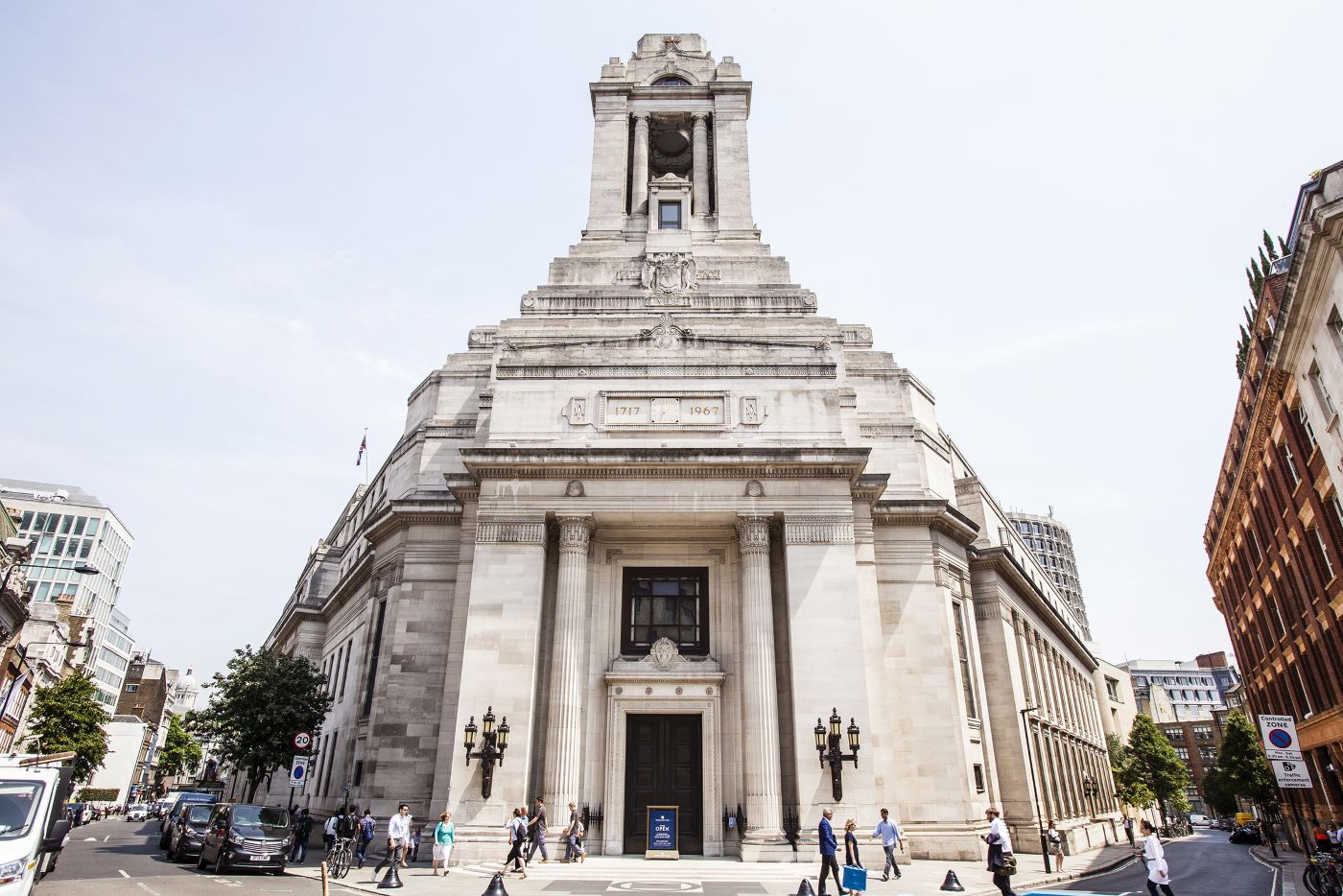
A War Memorial Disguised as a Headquarters
English Freemasonry counted its dead after the First World War and arrived at a staggering number. More than 3,000 Freemasons had been killed in the trenches — brothers from lodges across England and Wales who had gone to France and Flanders and not come back. The order had to decide how to remember them.
It did not hang a plaque.
The United Grand Lodge of England resolved to build them an entire building. It launched the Masonic Million Memorial Fund, a campaign to raise a million pounds from the membership, and hundreds of thousands of individual Masons contributed, many of them buying a small commemorative jewel in return for their donation. The money built a vast new headquarters on the site of the order’s existing hall in Covent Garden, and when it opened in 1933 it carried an official name almost no one uses today: the Masonic Peace Memorial. The administrative heart of English Freemasonry — the offices, the committee rooms, the great ceremonial temple — was conceived from the start as a monument to the war dead, the working building and the memorial fused into one structure. The American wing of the order had gone further, and more literally. The Scottish Rite built its headquarters in Washington as an actual mausoleum, completed in 1915, and in 1944 sealed the body of its founding philosopher inside the wall.
This is the paradox that defines the place. The organization the world imagines as hidden, sinister, and conspiratorial built its global headquarters as a war memorial, put it on a public street, carved its name across the front, and then watched the myth of its secrecy survive completely undented. Freemasons’ Hall is the most visible secret society building on earth. It has spent ninety years proving that visibility changes nothing, because the people who believe in the conspiracy were never going to be persuaded by a museum and a gift shop. They need the Freemasons to be a secret far more than they need them to be real.
What Is Freemasonry? The Order That Set Up Headquarters on Great Queen Street
Freemasonry is a fraternal order that emerged in its modern form in early 18th-century Britain, organized into local “lodges” and built around ritual, moral instruction, and charity. It is not a religion and not a political party, though it has been mistaken for both. Members progress through a series of ceremonial degrees, swear oaths of fraternity and discretion, and use a symbolic vocabulary borrowed from the tools of medieval stonemasons — the square, the compasses, the level — to teach lessons about conduct and mortality. That borrowed vocabulary is the key to everything, including why the headquarters sits where it does.
From Stonemasons’ Guilds to the Grand Lodge of 1717
Freemasonry grew out of the medieval guilds of working stonemasons, the men who actually cut and laid the stone of Europe’s cathedrals and who guarded the secrets of their trade with passwords and signs. Over the 17th century, these working lodges began admitting men who were not masons at all — gentlemen, scholars, antiquarians — drawn to the rituals and the fellowship. This “speculative” Freemasonry, concerned with symbolic rather than literal building, eventually displaced the working kind. In 1717, four London lodges met at a tavern called the Goose and Gridiron and formed the first Grand Lodge, the founding moment of organized Freemasonry and the body that would grow into the United Grand Lodge of England. From a pub table to a 200,000-visitor headquarters took just over two centuries.
Three Halls on One Street: A Century of Masonic Building
The order has occupied the same Covent Garden site since 1775, and the current Art Deco building is the third Freemasons’ Hall to stand on it. The first opened in 1775, the second replaced it in the 1860s, and both were demolished as the organization outgrew them. The choice to keep rebuilding on Great Queen Street rather than retreating somewhere private is itself telling. An organization genuinely committed to secrecy does not maintain a fixed, publicly known address in central London for two and a half centuries. The Freemasons did exactly that, and then built bigger each time.
Inside Freemasons’ Hall: The Grand Temple and the Masonic Peace Memorial
The building that opened in 1933 is one of the finest Art Deco structures in London and one of very few still used for its original purpose. Designed by the architects Henry Ashley and Francis Winton Newman, who won a competition for the commission, it is a Grade II-star listed monument of bronze, marble, mosaic, and stained glass, built on a scale that announces the wealth and confidence of the order at its interwar peak. Behind its stone face are twenty-two lodge rooms, a warren of offices and committee rooms, and at its core, the Grand Temple.
The Masonic Million Memorial Fund and the 3,000 War Dead
The memorial purpose is written into the fabric, not tucked away in a side chapel. Donors to the Masonic Million Memorial Fund received a commemorative jewel, and lodges that gave enough were recognized on the building’s honor rolls, turning the act of construction into a collective act of remembrance spread across the entire membership. Within the building, a shrine and memorial windows honor the more than 3,000 Freemasons who died in the First World War, and the names and the cause are woven through the symbolic program of the interior. The visitor who arrives expecting a temple of secret power finds, at the building’s emotional center, a grief monument to dead soldiers.
The Art Deco Temple: Bronze Doors, Mosaics, and a Ceiling of Symbols
The Grand Temple is the spatial and ceremonial heart of the building, a vast hall seating well over a thousand people beneath a deeply decorated ceiling. Visitors reach it through a processional sequence of vestibules paved in mosaic and lit by stained glass, passing through enormous bronze doors cast with Masonic scenes, each leaf weighing more than a ton. Inside, the ceiling and frieze carry a dense program of symbolic decoration — celestial imagery, allegorical figures, the recurring geometry of the order. The effect is deliberately overwhelming, a stone argument that the men who built it were the inheritors of something ancient and significant, even though the organization itself was barely two centuries old when the doors swung shut for the first time.
The Square, the Compasses, and the Meaning in the Walls
The symbolism the conspiracy theorists treat as hidden code is, in this building, displayed openly on almost every surface. The square and compasses, Freemasonry’s central emblem, derive from the working tools of the medieval mason and stand for moral rectitude and self-restraint. The all-seeing eye, the pillars, the checkerboard floor, the imagery of light and darkness — all of it carries documented meanings within Masonic teaching, and all of it is laid out in the architecture for anyone who walks in to see. The secrets of Freemasonry, such as they are, were never the symbols. They are the specific passwords, handshakes, and ritual words exchanged in the lodge room, and even most of those have been published in exposés for the better part of three centuries.
Secrets, Rituals, and the Conspiracy That Won’t Die
The gap between what happens inside Freemasons’ Hall and what people believe happens inside it is one of the widest in modern culture. The reality is a fraternal organization that meets, performs ceremonies, raises money for charity, and files its accounts. The myth is a shadow government running the world from behind those bronze doors. The building has hosted both, in the sense that the real practice goes on inside while the imagined one is projected onto it from outside.
What Actually Happens Behind the Doors: Degrees, Ritual, and the Blindfolded Initiate
The core of Freemasonry is ritual, and the rituals are theatrical, solemn, and far stranger than a meeting agenda — which is part of why they fuel suspicion. A candidate for the first degree is brought into the lodge blindfolded, with a noose-like cord called a cable-tow around his neck and his clothing deliberately disarranged, symbolizing a man entering the order in darkness and poverty. He is led around the lodge room, made to take an obligation on a sacred text, and then “brought to light” when the blindfold is removed. The three degrees of Craft Freemasonry — Entered Apprentice, Fellow Craft, and Master Mason — each dramatize a stage of moral and symbolic progress, culminating in a ritual reenactment of the legendary murder of Hiram Abiff, the master builder of Solomon’s Temple, the same legend the Victorians read into the Apprentice Pillar at Rosslyn Chapel. To an outsider hearing fragments of this — blindfolds, nooses, oaths, a staged murder — it sounds like exactly the sinister cult the conspiracy theories describe. To a member it is allegory, a centuries-old morality play about humility and death.
The New World Order Lives Here: Freemasonry and the Conspiracy Imagination
Freemasons’ Hall anchors more conspiracy theories than almost any building in Britain. The order has been accused, at various times, of secretly controlling governments, rigging the courts and the police, orchestrating revolutions, and serving as the hidden machinery of a coming “New World Order.” The accusations have a long pedigree — Freemasonry was condemned by the Catholic Church, banned by fascist and communist regimes alike, and treated as a subversive network by dictators who could not tolerate any organization they did not control. Some of the suspicion has real roots: Masonic networks did create bonds of mutual advantage among powerful men, and in certain times and places those bonds shaded into genuine favoritism and corruption. But the leap from a fraternal society with influential members to a secret world government is a leap the evidence has never supported. The United Grand Lodge of England responded to decades of suspicion not by hiding further but by doing the opposite — publishing its membership rules, opening its archives, and inviting the public through the door it had supposedly been guarding. The conspiracy survived anyway, because a building you can tour makes a poor villain, and the myth was never really about the building.
From Secret Temple to Film Set: How Freemasons’ Hall Went Public
Freemasons’ Hall spent much of the twentieth century as a closed and forbidding presence, and then, in a deliberate strategic reversal, threw itself open. Facing a long decline in membership and a persistent reputation for secrecy, the United Grand Lodge of England decided that transparency was a better defense than mystery. The building’s museum and library, holding one of the world’s great collections of Masonic objects and documents, were opened to the public free of charge, and guided tours began taking visitors into the ceremonial heart of the building, including the Grand Temple itself.
The transformation went further than the order may have intended. The building’s spectacular Art Deco interiors made it one of London’s most sought-after filming locations, and its corridors and temple have stood in for ministries, courtrooms, hotels, and assorted halls of power in countless films and television productions. The headquarters of a supposedly secret society became a place you could recognize from a Saturday-night drama. The irony is total and the order has largely embraced it: the mystique that conspiracy theories feed on is precisely what makes the building photogenic, and the income and visibility have helped keep it standing.
The result is a strange equilibrium. Freemasons’ Hall is simultaneously a working ceremonial temple where men in regalia still perform centuries-old rituals behind closed doors, and a public attraction with a gift shop, a café, and a Tripadvisor page. Both things are true at once, in the same building, on the same day. Like Rosslyn Chapel, which a Dan Brown novel turned from a quiet ruin into a Grail-hunting destination, Freemasons’ Hall has learned that the public’s appetite for secret-society mystery can be survived only by feeding it carefully — giving people enough of the temple to satisfy the curiosity without ever quite dispelling it.
Visiting Freemasons’ Hall Today: Inside London’s Open Secret
Freemasons’ Hall sits at 60 Great Queen Street in Covent Garden, a short walk from Holborn and Covent Garden Underground stations, and it remains a fully working building — the active headquarters of English Freemasonry, not a museum that used to be one. The Museum of Freemasonry inside is free to enter and open Tuesday to Saturday, holding a collection that ranges from ceremonial regalia to objects connected to famous members including Winston Churchill and King Edward VII. Guided tours, which run on a paid basis and last around 55 minutes, take visitors beyond the museum into the vestibules and, when it is not in use for Masonic business, the Grand Temple itself.
The experience is contingent in a way most attractions are not. Because the building is genuinely in use, the tour route changes from day to day, and the Grand Temple — the thing most visitors come to see — may be closed without notice when a ceremony is underway behind its bronze doors. That uncertainty is the most honest thing about the place. You are not visiting a reconstruction or a stage set. You are being admitted, conditionally, into the working home of a living organization that is conducting its actual business in the rooms next to the one you are standing in.
Standing in the great vestibule, beneath the mosaics and the symbols and the names of the war dead, the visitor confronts the building’s central joke at their own expense. Everything they were told was hidden is here in plain sight, carved into the walls and explained on a plaque. The secret society put its secrets on public display and trusted that no one would quite believe it had done so. Ninety years on, the tour buses pass, the conspiracy videos rack up their views, and the men in aprons keep meeting upstairs — and the building goes on being exactly what it says it is over the door, which is somehow the one thing nobody can accept.
Frequently Asked Questions About Freemasons’ Hall
Is Freemasons’ Hall really a war memorial?
Freemasons’ Hall was built as the Masonic Peace Memorial to honor the more than 3,000 English Freemasons who died in the First World War. It was funded through the Masonic Million Memorial Fund, a campaign that drew donations from hundreds of thousands of members, many of whom received a commemorative jewel in return. The building combines a working headquarters with a memorial shrine and memorial windows dedicated to the war dead. It opened in 1933 and remains one of the few Art Deco buildings in London still used for its original purpose.
Can the public visit Freemasons’ Hall in London?
The public can visit Freemasons’ Hall, which sits at 60 Great Queen Street in Covent Garden. The Museum of Freemasonry inside is free and open Tuesday to Saturday, and paid guided tours of around 55 minutes take visitors into the building’s ceremonial areas, including the Grand Temple when it is not in use. Because the building is a working headquarters, the tour route can change at short notice and the Grand Temple may occasionally be closed. More than 200,000 people visit each year.
What happens inside a Masonic lodge?
Masonic lodges meet to perform ritual ceremonies, conduct the order’s business, and organize charitable work. New members are initiated through a series of ceremonial degrees that use symbolism drawn from the tools of medieval stonemasons to teach moral lessons. The rituals are solemn and theatrical, including blindfolded initiation and oaths taken on a sacred text. Despite the order’s secretive reputation, the broad outlines of these ceremonies have been published for centuries.
Why is Freemasonry the subject of so many conspiracy theories?
Freemasonry attracts conspiracy theories because it combines secret rituals, oaths of discretion, and historically influential members, which together suggest hidden power to outsiders. The order has been condemned by the Catholic Church and banned by fascist and communist regimes that distrusted any organization outside their control. Theories range from claims of judicial and political favoritism to fantasies of a Masonic world government. While Masonic networks did sometimes create real advantages among members, no evidence supports the idea of a secret society controlling world events.
When was Freemasons’ Hall built and who designed it?
The current Freemasons’ Hall was built between 1927 and 1933 and designed by the architects Henry Ashley and Francis Winton Newman, who won a competition for the commission. It is the third Masonic hall to stand on the Great Queen Street site since 1775. The building is a Grade II-star listed Art Deco landmark featuring bronze doors, mosaics, marble, and stained glass. Its centerpiece is the Grand Temple, a ceremonial hall seating well over a thousand people.
Is Freemasons’ Hall used as a filming location?
Freemasons’ Hall is one of London’s most popular filming locations because of its spectacular Art Deco interiors. Its corridors, vestibules, and Grand Temple have appeared in numerous films and television productions, frequently standing in for government ministries, courtrooms, hotels, and other grand institutional settings. The income and visibility from filming have helped maintain the building. The headquarters of a supposedly secret society is now recognizable to viewers who have never set foot inside.
Sources
The Craft: A History of English Freemasonry — John Hamill (1986)
The Genesis of Freemasonry — David Harrison (2009)
Freemasonry: A Very Short Introduction — Andreas Önnerfors (2017)
The Temple and the Lodge — Michael Baigent and Richard Leigh (1989)
Freemasons’ Hall: The Home and Heritage of the Craft — Museum of Freemasonry / United Grand Lodge of England (2018)
Historic England Listing: Freemasons’ Hall, Grade II-star — Historic England (list entry)
Born in Blood: The Lost Secrets of Freemasonry — John J. Robinson (1989)
Revolutionary Brotherhood: Freemasonry and the Transformation of the American Social Order — Steven C. Bullock (1996)


%2C%20Konjic%2C%20Bosnia.jpg)


