
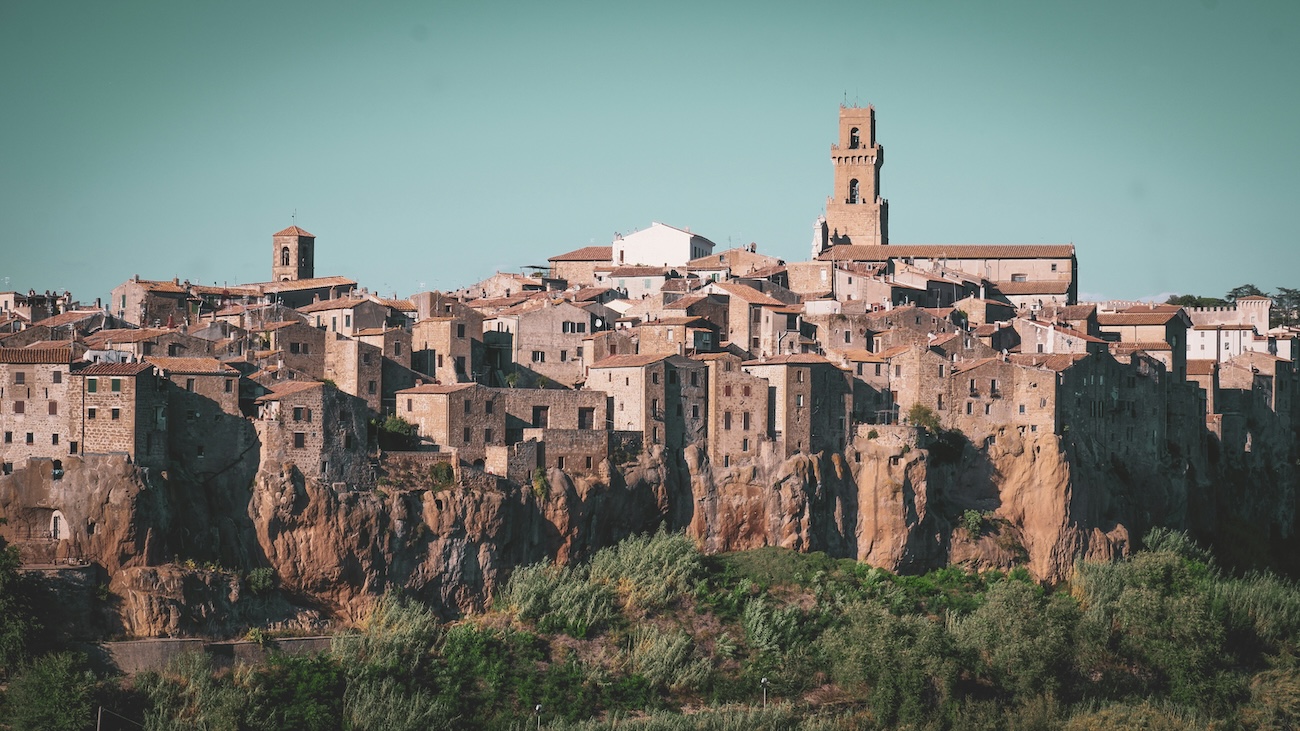
Why Pitigliano Is Called the “Little Jerusalem” of Tuscany
On an evening in the autumn of 1943, friends climbed up to the Servi family’s home in Pitigliano with a warning: the Germans were coming the next day to round up the town’s Jews. Edda Servi was seventeen. That night she walked out of the only town she had ever known, together with her sister and two older brothers, and disappeared down into the tuff hills, into the hands of farmers who could be shot for sheltering them. Her father, rabbi to what was left of the community, refused to leave. He was arrested with his wife and youngest son and taken to a camp.
The town that had protected Jews for four hundred years could no longer keep them safe inside its walls. So it hid them outside, in the rock.
Pitigliano is not a place where a massacre happened. It is the rarer thing, and in some ways the stranger one — a refuge that worked. For five centuries this cliff sheltered the people Rome cast out, let them build a synagogue and a Little Jerusalem, and during the war hid almost all of them from deportation. The darkness here is quieter than a killing field. The community survived its persecutors and vanished anyway — drained by freedom, by emigration, by a racial law, and finally by the slow erosion of the rock itself. The stone that sheltered them outlived them.
The name came from outside. The Jews of Livorno, the nearest great community, looked at this golden cliff-town with its rock walls and its Hebrew quarter and called it La Piccola Gerusalemme — the Little Jerusalem. By then the place had already spent three centuries becoming worthy of the name.
The Tufa Cliff and the Etruscan Roads of the Dead
The Volcanic Rock That Pitigliano Is Carved Into
Pitigliano is made of the same rock it stands on. The spur is tuff — compacted volcanic ash, soft enough to cut with hand tools and quick to harden once exposed to air. Builders quarried downward and outward, hollowing cellars, stairs, storerooms, and stables straight into the cliff, so that the town and its foundation are one continuous body of stone. It belongs to the Città del Tufo, the “tuff city,” a triangle of three rock towns — Pitigliano, Sovana, and Sorano — that share the same geology and the same trick of living inside stone. Southern Italy knows that trick well; the cave dwellings of Matera are its most extreme expression.
Beneath nearly every old house in Pitigliano is a cool, damp cellar cut from the tuff, where families have pressed wine and stored oil for as long as there have been families here. The rock holds a constant temperature year round. It keeps things — wine, grain, secrets — better than anything built above it.
The Vie Cave: Etruscan Sunken Roads and the Necropolis Below the Town
The Etruscans were carving this rock two thousand years before the first synagogue. Between roughly the seventh and second centuries BCE, they cut the Vie Cave — “sunken roads” — corridors driven straight down into the tuff, some of them more than twenty meters deep, narrow trenches walled by sheer cliffs that block out the sky. They radiate from the plateau and link the old settlements to their burial grounds. The walls still carry inscriptions scratched by Etruscan, Roman, and medieval hands, layered over each other across two and a half millennia.
Archaeologists still argue about why the Etruscans dug them. The leading theory is that they were sacred ways — processional routes leading the living down to the dead, since so many of them end at necropolises cut into the cliffs. The tombs are everywhere in the surrounding rock, later repurposed across the centuries as pigeon roosts, tool sheds, and wine cellars. Long before anyone carved a mikveh into this stone, others had carved roads to their graves. The living town has always sat on top of a city of the dead.
How Papal Persecution Turned Pitigliano Into a Jewish Refuge
The 1555 Papal Bull and the Expulsion That Drove Jews to Tuscany
The Little Jerusalem was made in Rome, by men trying to destroy it. In 1555 Pope Paul IV issued the bull Cum nimis absurdum, which locked the Jews of Rome into a single walled quarter, forced them to wear an identifying badge, barred them from most trades, and stripped away the rights they had held for centuries. This was the same Counter-Reformation papacy that turned Campo de’ Fiori into a stage for burning heretics. Pius V went further in 1569, expelling Jews from almost the entire Papal States.
Thousands of people were pushed onto the roads with whatever they could carry. They moved toward the edges of papal power, toward the small territories of lords who had their own reasons to ignore Rome. One of those territories was a cliff-town in the Maremma, ruled by a family of counts who answered to no pope.
The Orsini Family and the Birth of the Pitigliano Jewish Community
The Orsini, counts of Pitigliano, took the refugees in. They granted the newcomers the right to lend money, trade, and practice crafts — privileges that were as useful to a small, cash-poor county as they were to the people receiving them. In 1556 Count Niccolò IV Orsini set aside land for a Jewish cemetery, the first permanent mark of a community that intended to stay.
The community grew, and in 1598 a local weaver named Yehudah ben Shabbetai — known in Italian as Leone de Sabato — put up the money to build a synagogue at the edge of the quarter, cut partly into the rock. The stone epigraph dedicating the building to “Jeudà, son of Shebbetai” still survives inside. A weaver paid for the heart of the Little Jerusalem, and the heart was made of the same tuff as everything else.
The Ghetto Dug Into Rock: Jewish Life in Underground Pitigliano
The Medici Ghetto of 1622 and Two Centuries of Confinement
The refuge tightened the moment its protectors changed. In 1608 Pitigliano passed to the Medici Grand Duchy of Tuscany, and the Medici — who had bought their grand-ducal title partly by pleasing the very pope the Orsini had defied — were less generous hosts. In 1622, under Cosimo II, the Jews of Pitigliano were ordered out of their homes and confined to a defined ghetto, a cluster of blocks they could not leave at night, their movement marked again by the badge.
The eviction survives today in the strangest possible form: a dessert. Grand-ducal officers went door to door enforcing the move with sticks — the old “law of the stick” used to drive out tenants. Generations later, the Jews of Pitigliano baked a honey-and-walnut cookie shaped like that stick and named it the sfratto — “eviction.” They ate it at Rosh Hashanah, the new year, as a charm against the next expulsion. They took the instrument of their humiliation and made it sweet.
The Synagogue, Mikveh, and Matzah Bakery Carved Into the Tuff
Boxed into a few blocks above ground, the community went underground. They cut the rock beneath the ghetto into the working machinery of a full Jewish life: a mikveh fed by the cool seep of the tuff, a kosher butchery, a wine cellar, and a communal matzah oven — the forno delle azzime — fired once a year before Passover. The rock that caged them above gave them a hidden world below, a Jewish Pitigliano the Catholic town overhead never had to see.
That underground oven was the brightest memory of Edda Servi’s childhood — the great cave kitchen where the whole community came to bake matzo before Passover, the smell of it filling the rock. She was born into the ghetto in 1926 and grew up moving through these spaces as ordinary rooms, not relics.
The tuff was prison and sanctuary at the same time, which is the truest thing about Pitigliano. The same softness that let a grand duke wall the Jews in let the Jews carve themselves a world he could not reach.
The 1800s Peak: 400 Jews and the Name “Little Jerusalem”
The nineteenth century was the high-water mark. Napoleonic rule and then Italian emancipation tore down the ghetto restrictions; Jews could finally live anywhere, own property, and enter the professions. By the mid-1800s roughly 400 Jews lived in Pitigliano in a town of about 2,200 — close to a fifth of everyone in it. They worked as doctors, teachers, weavers, tailors, shopkeepers, and photographers, threaded through every layer of the town. It was in these years that Livorno’s Jews gave Pitigliano its lasting name, the Little Jerusalem.
The two Pitiglianos, Jewish and Catholic, grew into each other. The community register recorded distinguished travelers passing through; the famed rabbi and bibliographer Hayim Yosef David Azulai signed the book on his journey across Europe. The sfratto migrated out of the ghetto and onto Christian tables, where neighbors began serving the eviction cookie at weddings. For a few generations, the Little Jerusalem was simply Pitigliano, and Pitigliano was simply home.
The Decline of Little Jerusalem and the 1938 Racial Laws
Emigration After Italian Unification and the Hollowing of the Community
Freedom emptied the town. The cruel arithmetic of emancipation was that once Jews could live anywhere in a unified Italy, the young left — for Livorno, Florence, and Rome, for universities and careers a cliff-town in the Maremma could not offer. The community that papal persecution had built, Italian liberty dispersed. By the 1920s and 1930s only about seventy Jews remained in Pitigliano. In 1931 the community had grown too small to sustain itself and was formally absorbed into Livorno’s.
The Little Jerusalem was already fading before fascism ever touched it. The walls had stopped meaning anything; the people were simply leaving on their own.
Mussolini’s 1938 Racial Laws and the Closing of the Synagogue
Mussolini’s racial laws of 1938 fell on what little remained. The laws stripped Italian Jews of citizenship rights and barred them from schools, professions, and public life, and on a community of a few dozen the effect was quiet and total. Edda Servi celebrated her bat mitzvah in 1938, the year the laws came down — among the last children to grow up Jewish in Pitigliano at all. By 1940 the rabbi had been ordered out of town and the synagogue, after three and a half centuries, was shut.
How Pitigliano Saved Its Jews During the Holocaust
The Farmers Who Hid Jewish Families in the Tufa Countryside
The roundups reached Italy after the September 1943 surrender, when German forces occupied the country and began deporting Jews to the camps. When the warning came to Pitigliano that autumn, its Jews scattered into the countryside they had farmed and walked for generations. Their Christian neighbors took them in at the risk of execution. Pietro Felici and his wife Marina Marchioni, landowning farmers, sheltered twenty-two Jews from Pitigliano on their land — eight of the Servi family, nine Paggi, and five Paserman.
Edda Servi and her siblings were among those who vanished into the hills, passed between farmers and anti-fascist partisans. Her parents and youngest brother, who had stayed behind, were arrested and interned at a camp at Roccatederighi, set up inside a diocesan seminary in the Tuscan hills — but they were never sent on to Auschwitz, and they survived. Of Pitigliano’s roughly seventy Jews, almost all lived, hidden by the people they had lived beside their whole lives.
In the spring of 1944, in hiding, her parents behind barbed wire, Edda Servi watched the moon wax and wane to work out when the first night of Passover would fall, so she could keep the family’s holiday alone in the hills.
“Ambiguous Refuge”: The Complicated Truth Behind the Rescue
The rescue was real, and it was messier than the postcard version. Historians who have studied southern Tuscany in these years call it an “ambiguous refuge,” and the phrase is honest. Survival ran through a tangle of courage, calculation, proximity, and luck rather than a single heroic town deciding as one to save its Jews. The camp that held the Servi parents sat inside a bishop’s seminary, and the local Church’s role was both protective and compromised. Years later, survivors disagreed among themselves about who had truly earned credit. One young woman from the community ended up marrying one of the men who had guarded her family.
People lived because individual farmers chose, one family at a time, to risk everything — not because rescue was guaranteed or universal or clean. That is a harder story than a town that simply did the right thing, and it is the true one. The courage does not need to be sanctified to be remarkable.
The 1944 Allied Bombing and the Damaged Synagogue
The last wound of the war came from the people doing the liberating. In 1944, as the Germans pulled back northward, Allied bombing aimed at the retreating lines fell on Pitigliano and damaged the shuttered synagogue. The building had outlasted three centuries, a grand duke, and the racial laws, and it was the war’s liberation that finally broke its walls.
Pitigliano Today: A Restored Synagogue Without a Congregation
The 1960s Landslide That Destroyed the Synagogue
The rock delivered the next blow itself. In the 1960s a landslide on the soft tuff cliff brought down part of the synagogue — the same friable stone that had given the community its hidden underground world finally gave way beneath its holiest building. For years it stood ruined and open to the weather. In the 1990s it was rebuilt and reopened, its 1598 ark and women’s gallery restored to the way they had looked when a weaver paid for them.
The metaphor had become physical. The cliff that sheltered the Little Jerusalem was the same cliff slowly carrying it into the valley.
A Synagogue Without a Minyan: What Remains of Jewish Pitigliano
The restoration is immaculate, and there is no congregation to fill it. About thirty Jews remained after the war, and one by one they too left. The Servi family went to Florence and then further; Edda Servi sailed for New York in 1958, married, and in 1981 published The Classic Cuisine of the Italian Jews, a cookbook that was also a memoir of a vanished world, followed by a memoir titled Child of the Ghetto. She became, almost by accident, the historian of a place that no longer existed as she had known it. She died in 2019, at ninety-three.
Today Pitigliano has no minyan — not enough Jewish men to hold a traditional service. The synagogue opens for visitors and the rare wedding, with worshippers driving in from Livorno. The museum that now fills the old ghetto, La Piccola Gerusalemme, leads visitors down the rock stairs into the mikveh, the matzah oven, and the cellars, the underground Jewish world preserved in stone.
And in a bakery in the old ghetto — run by people who are not Jewish — they still make the sfratto, the stick-shaped cookie named for an eviction four centuries gone. The bailiff’s stick, turned to honey and walnut and sold to tourists in the empty quarter, is the most durable thing the Little Jerusalem left behind.
Visiting Pitigliano’s Jewish Quarter and Etruscan Sites
Pitigliano sits in the far south of Tuscany, in the province of Grosseto, in the rolling volcanic country of the Maremma. It lies roughly two hours by car from both Rome and Florence, and a car is effectively required; public transport into this corner of Tuscany is sparse. The town first appears as a single dramatic silhouette of rock and stone walls rising sheer from the valley, best seen from the approach road to the east.
The Jewish Quarter museum is the reason most visitors come. A single ticket leads through the restored synagogue and down into the underground spaces cut from the tuff — the ritual bath, the kosher butchery, the wine cellar, and the forno delle azzime. Above ground, the Medici aqueduct’s great arches and the medieval walls and gates, including the Porta della Cittadella, are worth the time. Outside town, the Vie Cave can be walked directly; the Via Cava del Gradone and others descend into the deep Etruscan corridors, and the trail toward Sovana passes rock-cut tombs along the way. The nearby tuff towns of Sovana and Sorano and the surrounding Etruscan necropolises complete the City of the Tuff.
This is not a site of atrocity, and it should not be visited as one. Standing in the empty synagogue or the cool dark of the underground bakery, the feeling is not horror but absence — the particular silence of a place that did almost everything right and lost its people anyway. The Little Jerusalem was a sanctuary that succeeded. It sheltered the hunted for five hundred years, hid them in the rock when the worst finally came, and watched them survive and leave all the same. What remains is the rock, the restored room nobody prays in, and a cookie shaped like a stick.
Frequently Asked Questions About Pitigliano
Why is Pitigliano called the Little Jerusalem?
Pitigliano earned the name La Piccola Gerusalemme because of the large, long-established Jewish community that lived there for roughly five centuries. Jews fleeing papal persecution settled in the town from the mid-1500s onward, and by the mid-1800s they made up close to a fifth of the population — about 400 people in a town of 2,200. The nickname was coined by the Jews of nearby Livorno, who saw in the golden cliff-town and its rock walls an echo of the real Jerusalem. A synagogue, ritual bath, kosher bakery, and Jewish school all operated within the small hill town.
Are there still Jews living in Pitigliano?
Almost none. The community shrank steadily after Italian emancipation drew young people to the cities, falling to around seventy by the 1930s and roughly thirty after the war, and the last families eventually left for Florence and beyond. Today Pitigliano has no minyan — not enough resident Jewish men to hold a traditional service. The restored synagogue opens for visitors and the occasional wedding, with worshippers traveling in from Livorno.
What are the Vie Cave in Pitigliano?
The Vie Cave are ancient “sunken roads” carved by the Etruscans directly into the soft volcanic tuff around Pitigliano, Sovana, and Sorano. Some descend more than twenty meters below the surface, forming narrow corridors walled by sheer rock. Archaeologists believe many functioned as sacred routes connecting settlements to their necropolises, since the paths frequently end at tombs cut into the cliffs. They were dug between roughly the seventh and second centuries BCE using only bronze tools.
Why did Jews settle in Pitigliano?
Jews came to Pitigliano to escape persecution in the Papal States. Pope Paul IV’s 1555 bull Cum nimis absurdum confined Rome’s Jews to a ghetto and stripped their rights, and Pius V expelled Jews from most papal territory in 1569. Refugees moved toward lands ruled by lords beyond papal control, and the Orsini counts of Pitigliano welcomed them, granting rights to lend money, trade, and practice crafts. The community took root and built its synagogue there in 1598.
What is a sfratto cookie?
The sfratto is a stick-shaped cookie filled with honey, walnuts, orange peel, and spices, traditional to Pitigliano. Its name means “eviction,” and its shape recalls the sticks grand-ducal officers used to drive Jewish families from their homes into the ghetto in the 1620s. The Jewish community reclaimed that symbol by baking the cookie and eating it at Rosh Hashanah as a charm against future expulsion. It is still made and sold in the old ghetto today, now by a non-Jewish bakery.
Did Pitigliano’s Jews survive the Holocaust?
Most of them did. When the deportations of Italian Jews began after the September 1943 surrender, Pitigliano’s roughly seventy Jews scattered into the surrounding countryside, where local farmers hid them at the risk of execution. The farmers Pietro Felici and Marina Marchioni alone sheltered twenty-two people. The town’s survival rate was high, though historians describe the rescue as an “ambiguous refuge” — a tangle of individual courage, luck, and proximity rather than a single, clean act of communal heroism.
Sources
The Classic Cuisine of the Italian Jews — Edda Servi Machlin (1981)
Child of the Ghetto: Coming of Age in Fascist Italy, 1926–1946 — Edda Servi Machlin (1995)
Edda Servi Machlin, Holocaust Survivor Who Kept Alive Italian Jewish Cuisine, Dies at 93 — Emily Langer, The Washington Post (2019)
Anniversary of Anniversaries: 400 Years Since the Imposition of the Ghetto in Pitigliano — Jewish Heritage Europe (2022)
A Return to Pitigliano, the “Little Jerusalem” Between Rome and Florence — Samuel D. Gruber, Jewish Art & Monuments (2025)
Cum nimis absurdum (papal bull) — Pope Paul IV (1555)
Jews in Southern Tuscany during the Holocaust: Ambiguous Refuge — Lexington Books (2020)
Sticking It Out: The Story of Sfratti — Tablet Magazine (2022)
Papers in Jewish Demography — U.O. Schmelz, P. Glikson & S. Della Pergola, eds. (1980)
La Piccola Gerusalemme: The Synagogue and Jewish Museum of Pitigliano — Comune di Pitigliano (institutional)



%2C%20Konjic%2C%20Bosnia.jpg)


