The Prime Minister in Matera's Cave
The summer of 1950 was brutally hot in Basilicata, and Alcide De Gasperi had not come to Matera for the weather. Italy's prime minister descended into the Sassi — the tangled labyrinth of cave dwellings that clung to the walls of a limestone gorge on the city's eastern edge — and what he found there would reshape Italian domestic policy for the next decade. Families of eight and ten lived in single-room grottoes with no windows, no running water, and no separation from the donkeys and goats that shared their sleeping space. Open sewage channels, carved into the same rock that formed the walls and ceilings, ran between straw bedding. Children with distended bellies sat in near-total darkness. The infant mortality rate in parts of the Sassi hovered near 50 percent.
De Gasperi climbed back into the sunlight and called Matera la vergogna nazionale — the national shame of Italy.
The phrase stuck. Within two years, the Italian parliament passed a special law to evacuate the Sassi entirely. Within a decade, 15,000 people were relocated to purpose-built housing blocks on the plateau above the gorge. The oldest inhabited district in Europe — a vertical city that had sheltered human beings since the Paleolithic — was emptied, sealed, and left to crumble.
Matera is the story of a place where the right thing and the wrong thing were the same thing. The conditions in the Sassi were genuinely lethal — children dying of malaria, families blinded by trachoma, sewage running through sleeping quarters. Any responsible government that saw those conditions in 1950 would have felt obligated to act, and the Italian state did. The evacuation saved lives. Running water and electric light were not abstractions to a fourteen-year-old girl who had never seen an indoor faucet. But the totality of the response — emptying every cave, sealing the entrances, turning the city's back on the gorge — went beyond public health. Nine thousand years of continuous human habitation were not just remediated but abandoned, as though the oldest settlement in Europe were an embarrassment to be put out of sight. The harder question is whether those two impulses can even be separated: the genuine desire to help and the reflex to erase. Matera suggests they cannot. And the stranger second act of this story is that the state changed its mind.
9,000 Years Carved in Limestone: The Origins of Matera's Sassi
Matera's Paleolithic Origins and the Rise of a Vertical Cave City
The Murgia plateau is a flat expanse of pale tufa limestone that stretches across Basilicata like a tabletop, broken only by the deep ravine of the Gravina river. The rock is soft enough to carve with hand tools but hardens on exposure to air — a geological gift that made it one of the earliest building materials in human history. Paleolithic hunters sheltered in the natural caves along the Gravina's cliffs as early as 7000 BCE, and by the Neolithic period, those shelters had been deepened, widened, and connected into a network of permanent dwellings.
What emerged over the following millennia was not a city in any conventional sense. The Sassi — from the Italian sasso, meaning stone — grew vertically, each generation carving new rooms above or below the last, using the excavated rock to build façades over cave mouths. The roof of one dwelling became the street or courtyard of the dwelling above it. Rainwater was collected through an intricate system of channels, cisterns, and filters carved directly into the limestone — a network so sophisticated that it supplied the entire settlement without a single external pipe. The largest of these cisterns, the Palombaro Lungo, is a cathedral-sized underground reservoir discovered beneath Piazza Vittorio Veneto in 1991, holding an estimated 5 million litres of water. Matera's residents had engineered a complete hydraulic infrastructure inside the body of the rock itself.
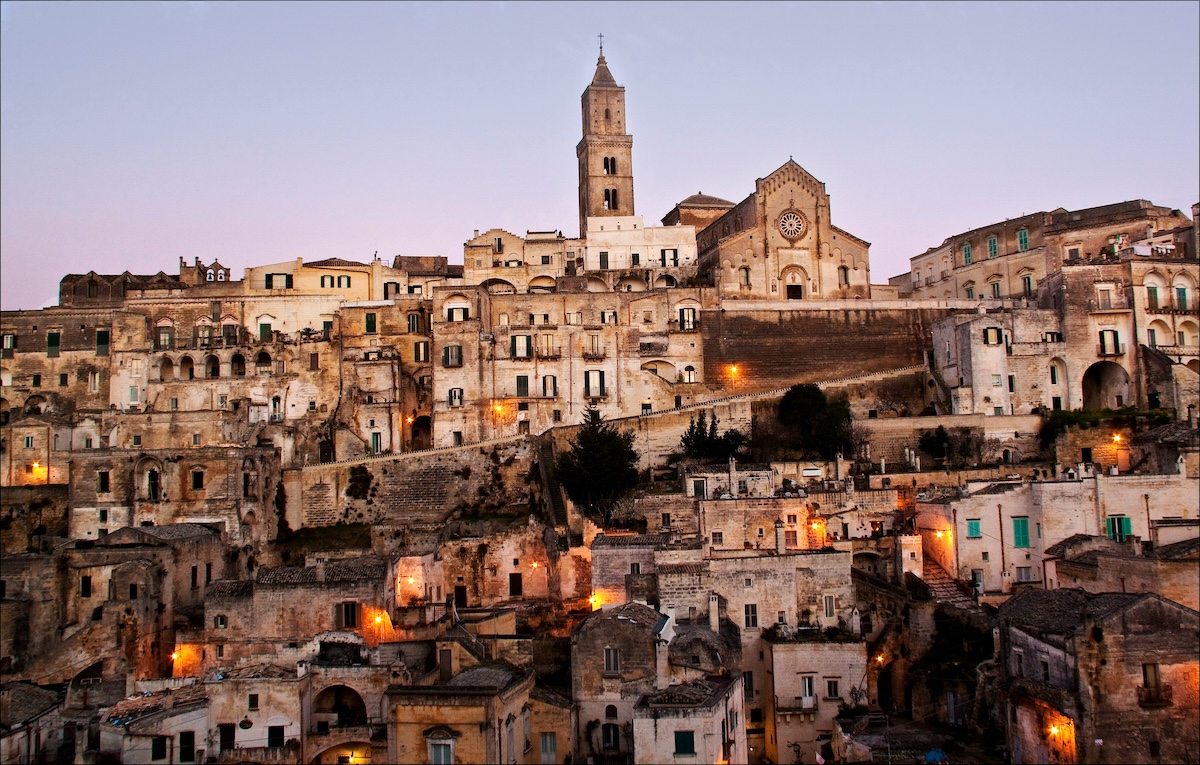
The result, by the medieval period, was a city of roughly 15,000 people living in a vertical labyrinth that European visitors struggled to comprehend. Streets doubled as rooftops. Stairways carved from living rock connected levels that stacked ten deep into the gorge walls. Churches, stables, workshops, and homes occupied the same geological stratum. The two main districts — Sasso Barisano, facing northwest, and Sasso Caveoso, facing south — wrapped around a central rocky spur crowned by the Romanesque cathedral, the whole settlement arranged in a natural amphitheater overlooking the Gravina canyon. No architect ever designed it. Nine thousand years of continuous habitation had produced something no blueprint could replicate.
The Rupestrian Churches and Matera's Byzantine Underground
Buried within the Sassi and scattered across the Murgia plateau are more than 150 rock-hewn churches — carved directly from the limestone between the 8th and 13th centuries. Some are no larger than a closet. Others rival small basilicas, with columns, apses, and barrel-vaulted ceilings cut from solid rock. Their walls carry Byzantine and Latin frescoes that survived precisely because the caves were sealed and forgotten for centuries: images of the Madonna, saints with enormous almond-shaped eyes, and scenes of the Last Judgment painted in ochre and cobalt blue by monks whose names no one recorded.
These rupestrian churches sat at the center of Matera's spiritual life. During the early medieval period, Matera sat on the frontier between Byzantine southern Italy and Lombard territories to the north, and the caves became refuges for monastic communities — Benedictines, Basilians, and hermits who carved their cells into the cliffs of the Gravina. The churches of Santa Lucia alle Malve and Santa Maria de Idris still contain frescoes dating to the 11th century, their pigments preserved by the stable temperature and humidity of the rock. In Lalibela, Ethiopian Christians carved eleven monolithic churches from volcanic tuff as declarations of faith and royal power. Matera's rock churches emerged from a different impulse — not grandeur but concealment. These were places of worship designed to disappear into the landscape, invisible to raiders, known only to those who lived inside the stone.
"La Vergogna Nazionale": How Matera Became Italy's National Shame
Carlo Levi, Malaria, and the South That Italy Forgot
Matera's descent from functioning cave city to public health catastrophe took centuries. The Sassi had always been dense and dark, but for centuries the population remained small enough — and the water system functional enough — to sustain a harsh but viable existence. The collapse began in the 18th and 19th centuries, when feudal land reforms drove dispossessed peasants from the countryside into the city. The cave dwellings, designed for a population of perhaps 5,000, absorbed three times that number. Families subdivided grottoes with cloth partitions. Livestock, previously kept in separate caves, moved into living quarters. The ancient water channels, overwhelmed by waste, became open sewers.
By the 1930s, the Sassi were a slum of medieval density and modern misery. Malaria was endemic. Trachoma — a bacterial eye infection spread by flies breeding in animal waste — blinded children before they reached school age. Carlo Levi, an anti-fascist intellectual exiled to the Basilicata village of Aliano during Mussolini's regime, documented the region's poverty in his 1945 memoir Christ Stopped at Eboli. The title's implication was precise: Christ — meaning civilization, dignity, modernity — had stopped at Eboli, a town north of Basilicata, and never continued south. Levi described a world of peasant fatalism, malaria, and institutional abandonment so total that it seemed to belong to a different century. The book became a literary sensation in postwar Italy, and it forced the urban North to confront what it had spent decades ignoring: an entire region of the country living in conditions that the rest of Europe associated with the 19th century.
Levi never focused specifically on Matera, but his portrait of the Mezzogiorno — Italy's impoverished South — made the Sassi impossible to ignore. When journalists and politicians began visiting, what they found was worse than anything Levi had described. In a 1948 survey, the Italian anthropologist Friedrich Friedmann documented families in the Sassi where parents and children slept alongside donkeys in rooms with no ventilation, no light source beyond the open doorway, and standing water on the floor. Infant mortality in some cave clusters exceeded 40 percent. The children who survived were stunted, malnourished, and frequently blind in one eye from trachoma.
The Political Earthquake of De Gasperi's Visit
De Gasperi's 1950 visit turned a regional scandal into a national crisis. The shock on his face in the caves was, by all accounts, genuine — Italy's prime minister had not expected to find conditions this extreme in his own country. The political dimensions were real too: Italy was deep in the Cold War, and the grinding poverty of the South was feeding Communist support in Basilicata, Calabria, and Sicily. Emptying the Sassi served both impulses — a humanitarian intervention that also proved the Christian Democratic government could deliver modernity to the places where people were desperate enough to vote for revolution.
The Legge Speciale per il Risanamento dei Sassi di Matera — the Special Law for the Rehabilitation of the Sassi — passed in 1952. It did not propose renovation. It proposed evacuation. The Sassi were declared unfit for human habitation, and the government commissioned architect Luigi Piccinato to design a new residential quarter on the plateau above the gorge. Piccinato, a committed rationalist, planned the new neighborhoods — Spine Bianche, Serra Venerdì, La Martella — as model communities: airy, modern, equipped with plumbing, electricity, and the communal facilities that the caves had never possessed. The architecture was self-consciously progressive. Matera's future would be concrete and glass, not limestone and darkness.
Emptying the Oldest City in Europe: The Forced Relocation of Matera's Sassi
The Forced Evacuation of Matera's Cave Dwellers
The relocations began in the mid-1950s and continued through the 1960s. Approximately 15,000 residents were moved from the Sassi to the new housing blocks — some willingly, many under pressure, a few by force. The process was bureaucratic and impersonal. Families received an apartment assignment and a date. They packed what they could carry, loaded it onto carts, and climbed out of the gorge for the last time.
For younger residents, the move was liberation. Running water, toilets, windows that opened onto the sky instead of a rock wall — these were not abstractions. Anna Ferraro, interviewed decades later by the Italian journalist Ferruccio Ferroni, remembered the first time she turned on a tap in the new apartment and watched clean water pour out. She was fourteen. She had never seen an indoor faucet. Her younger brother, who had been blind in one eye since infancy from trachoma contracted in their cave dwelling, stood in the bathroom doorway and stared.
For older residents, the displacement was devastating. Many had lived their entire lives in the Sassi. Their social networks, their daily rhythms, their sense of identity were inseparable from the cave quarter's physical structure — the shared courtyards where women washed clothes, the communal ovens where bread was baked, the steep paths that every resident navigated by memory. The new apartments were clean, bright, and isolating. Families that had lived stacked atop one another for generations were now separated by corridors and concrete walls. Elderly residents, unable to adapt, sat on balconies overlooking the plateau and stared south toward the gorge they could no longer see.
The sociologist Ferruccio Ferroni documented the relocation's psychological toll in his 1959 study of the Matera transition. He found that communal life — the defining social structure of the Sassi, where neighbors functioned as extended family — had no equivalent in the new housing blocks. Women who had spent their days in shared cave courtyards now spent them alone in apartments. Men who had worked collectively in terraced fields along the Gravina commuted to scattered jobs across the plateau. The architecture was modern. The loneliness was total.
What Happened to the Sassi After the Evacuation
By the late 1960s, the Sassi were empty. The Italian government had achieved what it set out to do: the national shame had been cleared, the residents housed, the statistics improved. What remained was a ghost city of extraordinary antiquity — thousands of cave dwellings, rupestrian churches, cisterns, stairways, and streets carved from living rock, all of it abandoned and exposed to the elements for the first time in nine thousand years.
The decay was rapid. Without the daily maintenance that centuries of habitation had provided — patching walls, clearing water channels, reinforcing roofs — the soft tufa began to crumble. Roofs collapsed. Stairways eroded. The intricate water system, no longer cleared of debris, silted up and failed. Squatters occupied some of the larger caves. Stray dogs replaced donkeys. The rupestrian churches, their entrances unsealed, lost frescoes to moisture, vandalism, and neglect.
For two decades, Matera's Sassi existed in a liminal state — not quite ruined, not quite dead, but emptied of the human presence that had defined them for millennia. The new city on the plateau above turned its back on the gorge. Streets were built running away from the Sassi, not toward them. Guide maps of the 1970s sometimes omitted the cave quarter entirely. Italy's oldest inhabited settlement had become its most recent ghost town — not Craco, the skeletal medieval village 40 kilometers to the south that had been emptied by landslides, but something stranger and more deliberate. Craco was abandoned because the ground moved. Matera was abandoned because the government decided that living in caves was incompatible with being Italian.
Matera's Resurrection: From National Shame to UNESCO World Heritage Site
The 1986 Resettlement Law and the Campaign That Saved the Sassi
The reversal began in the 1980s, driven not by the Italian state but by a generation of Matera's own residents who refused to accept that the Sassi were disposable. Local architects, historians, and activists — many of them children of the families who had been relocated — began arguing that the cave quarter was not a relic of backwardness but a masterpiece of vernacular architecture, an unbroken record of human adaptation spanning nine millennia. The argument was as much about identity as preservation: Matera without the Sassi was a provincial town with a concrete housing estate. Matera with the Sassi was unique on Earth.
The 1986 law — formally the law for the conservation and recovery of the Sassi — reversed the 1952 legislation by permitting resettlement and mandating restoration. Property owners could reclaim cave dwellings on the condition that renovations met modern building codes while preserving the original rock structures. The law was a bureaucratic milestone, but it was the UNESCO application that transformed Matera's trajectory. In 1993, the Sassi and the Park of the Rupestrian Churches were inscribed as a World Heritage Site — the first in southern Italy. The UNESCO committee cited the Sassi as the most outstanding example of a troglodyte settlement in the Mediterranean, a living document of human habitation from the Paleolithic to the modern era.
The inscription did what no Italian law could: it made the Sassi valuable. Restoration funding poured in. Architects who had spent decades studying the cave structures — how they managed temperature, light, water, and airflow — finally had the resources to implement sensitive renovations. The principle was straightforward: preserve the rock, upgrade the infrastructure. Electricity, plumbing, and ventilation were threaded through ancient walls without destroying them. The result was a habitable cave city that retained its nine-thousand-year-old skeleton beneath a skin of modern comfort.
European Capital of Culture 2019 and the €400-a-Night Cave
Matera's designation as European Capital of Culture for 2019 completed the transformation from national shame to international destination. The city that De Gasperi had called Italy's disgrace hosted opera in cave churches, art installations in abandoned cisterns, and concerts on the terraces overlooking the Gravina canyon. Tourism, which barely existed in the 1990s, became the economic engine of the entire Basilicata region.
The most visible symbol of this reversal is the cave hotel. Dozens of former grottoes in Sasso Barisano and Sasso Caveoso have been converted into boutique accommodations — the same rooms where families slept on straw beside livestock now feature climate control, rainfall showers, and designer furniture arranged around exposed limestone walls. Nightly rates in peak season reach €400 and higher. The irony is not subtle, and Matera's residents are acutely aware of it. The caves that their grandparents were told were unfit for human habitation are now marketed as exclusive experiences for wealthy travelers seeking "authentic" southern Italian charm.
The transformation has not been without friction. Gentrification — the displacement of working-class residents by tourism infrastructure — echoes the original evacuation in uncomfortable ways. Long-term Matera residents who returned to the Sassi in the 1990s now compete with hotels, restaurants, and vacation rentals for space. Property values in the cave quarter have increased tenfold since the UNESCO inscription. Some families who were evacuated from the Sassi in the 1950s, relocated to housing blocks, and then returned after the 1986 law have been priced out a second time. The national shame has become a luxury brand. Whether that constitutes rescue or a different kind of erasure depends on whom you ask.
Mel Gibson chose Matera's Sassi as the primary filming location for The Passion of the Christ in 2004, using the cave city's ancient streetscapes as a stand-in for biblical Jerusalem. The production brought global attention and cemented Matera's visual identity as a place that looked like the ancient world because, in fundamental ways, it still was. Subsequent productions — including scenes from the James Bond film No Time to Die — have reinforced the association. Matera is now one of the most photographed cities in Italy, its terraced grottoes appearing on travel magazine covers with the same frequency as Pompeii's Forum or Rome's Colosseum. The difference is that Pompeii's inhabitants died in a single afternoon. Matera's were simply told to leave.
The Atlas Entry — Visiting Matera's Cave City
How to Explore the Sassi di Matera
Matera is located in Basilicata, southern Italy, roughly 65 kilometers inland from the coast. The nearest major airports are Bari (70 km) and Naples (260 km). The city is accessible by car, bus, or regional train via Ferrandina-Matera station, with a connecting shuttle bus to the center.
The Sassi are divided into two main districts. Sasso Barisano, the larger and more commercially developed of the two, contains the majority of cave hotels, restaurants, and shops. Sasso Caveoso, quieter and steeper, preserves more of the original cave-dwelling atmosphere and contains several of the most important rupestrian churches. Both districts are best explored on foot — sturdy shoes are essential, as the streets are steep, uneven, and carved from rock. A thorough walk through both Sassi takes a minimum of three to four hours.
The Casa Grotta di Vico Solitario is a preserved cave dwelling furnished as it would have appeared in the mid-20th century — a single room containing a bed, a manger, a cistern opening, and the tools of daily subsistence. Standing inside it is the closest a visitor can come to understanding what De Gasperi saw in 1950: the density, the darkness, the nearness of human and animal life. The Palombaro Lungo, the enormous underground cistern beneath Piazza Vittorio Veneto, is open for guided visits and offers a visceral sense of the engineering that sustained the Sassi for millennia — a vaulted space of pale limestone columns rising from still water, silent and cathedral-like.
The rupestrian churches require more effort to reach but repay it. Santa Maria de Idris and the connected San Giovanni in Monterrone, carved into a limestone cone overlooking the Gravina, contain frescoes spanning the 12th to 17th centuries. The Cripta del Peccato Originale — the Crypt of Original Sin — located in a cave outside the city, holds an 8th-century fresco cycle sometimes called the "Sistine Chapel of rupestrian art," though it requires a separate ticket and advance booking.
The Belvedere viewpoints along the road to the Murgia plateau offer the definitive panorama of the Sassi — the entire cave city visible as a single organism clinging to the gorge wall, the cathedral on its rocky spur, the Gravina canyon dropping away below. The view is most powerful at sunset, when the tufa limestone turns gold and the sheer age of the settlement becomes legible in its layered, organic form: no grid, no plan, just nine thousand years of human beings carving shelter from the rock beneath their feet.
Matera is not a ruin. It is not a museum. It is a city that was occupied for ninety centuries, condemned as uninhabitable, abandoned for forty years, and then brought back to life — a cycle of habitation, shame, erasure, and reinvention that has no parallel anywhere in Europe. The caves are still here. The question of who they belong to — and what they mean — is still being answered.
Frequently Asked Questions About Matera
Why Was Matera Called the Shame of Italy?
In 1950, Italian Prime Minister Alcide De Gasperi visited Matera's Sassi cave quarter and found roughly 15,000 people living in conditions of extreme poverty — families sharing windowless grottoes with livestock, infant mortality rates near 50 percent, and endemic malaria and trachoma. He declared Matera la vergogna nazionale (the national shame of Italy). The phrase catalyzed the 1952 Special Law that mandated the complete evacuation of the Sassi, relocating all residents to modern housing on the plateau above the gorge.
How Old Is Matera and Is It Really the Oldest City in Europe?
Matera is one of the oldest continuously inhabited settlements in the world. Archaeological evidence places human habitation in the caves along the Gravina canyon as early as 7000 BCE, during the Paleolithic period. The claim that it is the oldest city in Europe is widely cited, though some scholars note that sites in Greece and the Balkans have comparable antiquity. What makes Matera's case distinctive is the unbroken continuity of cave habitation across nine millennia — the same limestone grottoes were occupied from the Stone Age through the 20th century.
What Are the Sassi di Matera?
The Sassi di Matera are two ancient cave-dwelling districts — Sasso Barisano and Sasso Caveoso — carved into the limestone walls of a gorge on the eastern side of the city. The name comes from the Italian word sasso, meaning stone. Over thousands of years, residents expanded natural caves into a dense, multi-level city where the roof of one dwelling served as the street for the one above. The Sassi were evacuated by government order in the 1950s and 1960s, left abandoned for decades, and then restored after receiving UNESCO World Heritage status in 1993.
Can You Stay in a Cave Hotel in Matera?
Dozens of former cave dwellings in both Sasso Barisano and Sasso Caveoso have been converted into boutique hotels and guesthouses. These accommodations preserve the original limestone walls and vaulted rock ceilings while adding modern amenities including climate control, plumbing, and electricity. Prices range from modest B&B rates to upwards of €400 per night for luxury cave suites. The contrast with the poverty that led to the Sassi's evacuation in the 1950s is one of the most discussed aspects of Matera's modern identity.
What Movies Were Filmed in Matera?
Matera's ancient streetscapes have served as filming locations for several major productions. Mel Gibson's The Passion of the Christ (2004) used the Sassi as a stand-in for biblical Jerusalem, bringing the city to global attention. Scenes from the James Bond film No Time to Die (2021) were also shot in Matera. The city's appeal to filmmakers lies in its authenticity — the cave architecture has changed so little over millennia that it convincingly doubles for ancient settings without requiring extensive set construction.
What Is the Palombaro Lungo in Matera?
The Palombaro Lungo is a massive underground cistern discovered beneath Piazza Vittorio Veneto in 1991. Carved from the limestone bedrock, it is estimated to hold approximately 5 million litres of water and features vaulted ceilings supported by rock columns. The cistern was part of an elaborate water collection and filtration system that sustained the Sassi for centuries, channeling rainwater through carved conduits into storage chambers throughout the cave city. It is now open for guided visits and is one of Matera's most striking attractions.
Sources
- [Christ Stopped at Eboli] - Carlo Levi (1945). English translation by Frances Frenaye, Farrar, Straus and Giroux.
- [Matera: The Sassi and the Park of the Rupestrian Churches] - UNESCO World Heritage Centre, Advisory Body Evaluation (1993)
- [The Sassi of Matera: From Shame to Heritage] - Pietro Laureano, in Conservation and Management of Archaeological Sites, Vol. 4, No. 3 (2001)
- [I Sassi di Matera: Il Recupero e la Conservazione] - Ferruccio Ferroni, published by Edizioni Laterza (1959)
- [Matera: A City Between Rocks and Sky] - Ludovico Quaroni, Institute of Urban Planning, University of Rome (1958)
- [The Subterranean Water System of Matera's Sassi] - Antonio Ferraro and Giuseppe Ferraro, in Journal of Water Resources Planning and Management (2006)
- [Piano Regolatore di Matera] - Luigi Piccinato, commissioned urban plan for the resettlement of Sassi residents (1955)
- [Matera: European Capital of Culture 2019 – Impact Assessment Report] - Fondazione Matera Basilicata 2019 (2020)
- [Rupestrian Churches of the Murgia Plateau] - Italian Ministry of Cultural Heritage, site documentation and restoration reports (2012)
- [The Southern Question Revisited: Poverty, Development, and the Mezzogiorno] - Anna Ferraris, in Modern Italy, Cambridge University Press, Vol. 11, No. 2 (2006)