The Young Corporal Who Arrived at Beelitz-Heilstätten in 1916
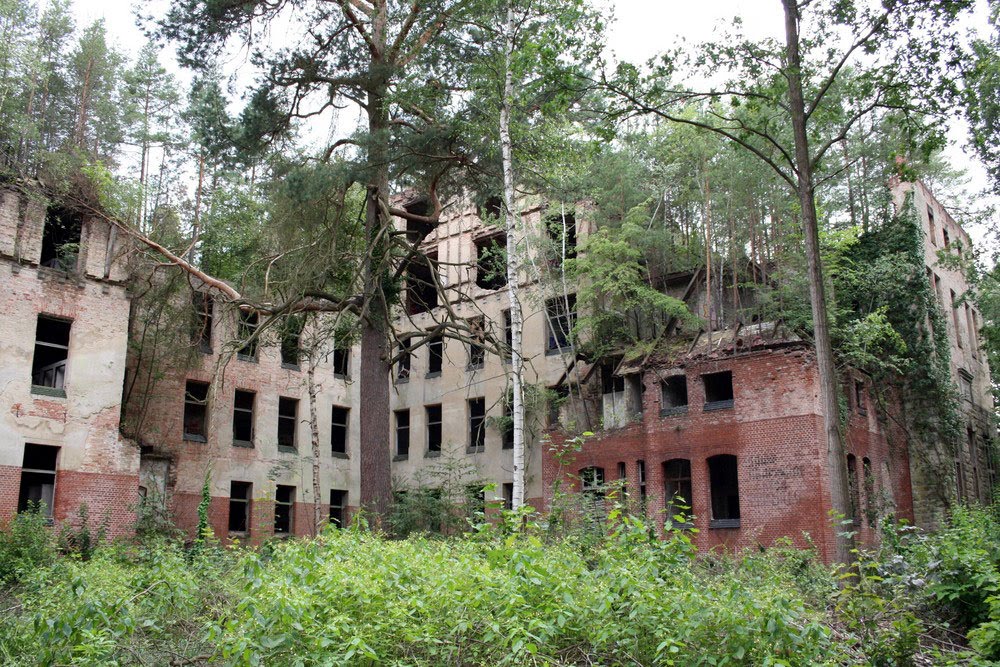
A hospital train pulled into Beelitz station in early October 1916, unloading men carried in from the slaughter of the Somme. Among the stretchers was a 27-year-old Austrian corporal of the 16th Bavarian Reserve Infantry Regiment, shrapnel lodged in his left thigh from a British shell that had detonated outside a dispatch runners' dugout near Bapaume. He was admitted to the Red Cross military ward in one of the red-brick pavilions and would remain for almost two months. His name was Adolf Hitler, and the pavilion where he convalesced still stands in the forest today — windows shattered, birch saplings pushing up through the tiled floor of its ground floor solarium.
Beelitz-Heilstätten has outlived every German state of the twentieth century. The complex was built in 1898 as a utopian workers' sanatorium by Imperial Germany, requisitioned by the Kaiser's army during World War I, converted into a Luftwaffe field hospital under the Nazis, captured by the Red Army in April 1945, and operated for five decades as the largest Soviet military hospital outside the USSR. Each regime that took the place inherited the corridors of the one before it, pushed their own beds into the same wards, and eventually walked away. The final Russian soldier locked the gate in 1995. Thirty years on, roughly half of the 60 original buildings remain too unstable to enter, and the forest is winning.
The site's story is the story of twentieth-century Germany compressed into 200 hectares of pine forest — hubris, war, occupation, collapse, forgetting. Every horror and every utopian scheme that rolled across the country between 1900 and 1994 passed through these wards and left something behind.
The Tuberculosis Crisis That Built Beelitz-Heilstätten
Berlin's White Plague and the Workers' Insurance Fund
Berlin at the close of the nineteenth century was dying of a single disease. Tuberculosis killed roughly one in seven adults in the industrial districts of Moabit, Wedding, and Friedrichshain, where families of six and eight shared two-room tenements with no ventilation and tap water shared between floors. The German medical establishment called it the White Plague. Robert Koch had identified the bacterium in 1882, but a cure was still sixty years away. The only known treatment was the sanatorium method pioneered in the Swiss Alps: fresh air, sunlight, rest, and protein-heavy food for months or years at a time.
The sanatoriums of Davos and the Black Forest were for the wealthy. The Landesversicherungsanstalt Berlin — the municipal workers' pension insurance fund — set out to build one for the working class. The calculation was cold and modern: a locksmith or a tram driver restored to health would pay into the pension system for another twenty years, while a dead one was a net loss. In 1898 the fund bought 140 hectares of pine forest at Beelitz, a town on the rail line from Berlin toward Leipzig, chosen for its dry sandy soil, pine-scented air, and proximity to the capital. Construction began the same year.
The 60-Building Complex Carved Into the Brandenburg Pines
The complex that emerged between 1898 and 1902 was, on opening, the most ambitious medical facility ever built in Germany. The architect Heino Schmieden designed it as a self-contained garden city of healing, with 60 individual buildings spread across 200 hectares rather than concentrated into a single hospital block. Patients were meant to feel as though they were at a health resort, not a ward. The pavilions were built in a loose neo-Renaissance style with half-timbered gables and glassed-in solarium porches facing south for the cure.
The infrastructure behind the architecture was industrial in scale. The complex had its own power station with two coal chimneys, its own water tower, its own bakery, its own butchery, its own post office, its own chapel, its own laundry processing hundreds of kilos of bed linen a day, and a network of underground service tunnels connecting the pavilions so staff and laundry carts could move between buildings in winter without crossing the grounds. By 1930 a second expansion had raised the total to more than 60 structures and a peak patient capacity approaching 1,200. Nothing like it had existed in Europe before.
Inside Imperial Germany's Most Advanced Sanatorium
The Four-Quadrant Gender and Disease Segregation System
The layout of Beelitz was a fixed diagram of imperial medical thinking. The site was cut into four quadrants by the Berlin–Leipzig railway line running east–west and the main Beelitz road running north–south. Each quadrant had a single designated population and a dedicated set of pavilions, kitchens, and bathhouses. Men with tuberculosis occupied the southwest. Women with tuberculosis occupied the southeast. Men with non-infectious conditions — convalescing, recovering from surgery, rebuilding lung capacity after pneumonia — occupied the northwest. Non-infectious women occupied the northeast. The four quadrants never mixed. Staff, supplies, and patients moved within a quadrant only.
The segregation was total. A married couple arriving with the same diagnosis would be split across the tracks and see each other only by appointment in the central administration building. The design was partly epidemiological — pulmonary tuberculosis spreads through airborne droplets, and the four-quadrant system contained the vectors — but also profoundly moralized. The 1902 pavilions were a statement about what a modern industrial society owed its workers and what it still expected of them.
Daily Life for Tuberculosis Patients in the Age Before Antibiotics
The cure at Beelitz was a regimen, not a treatment. A patient admitted in 1905 with active pulmonary tuberculosis could expect to remain for six to nine months. The day began at 6:30 in the morning and was divided into fixed blocks of rest, feeding, and supervised outdoor air exposure in all weather. Patients were wheeled onto the glassed-in verandas in steamer chairs and wrapped in wool blankets at -10°C. They were required to eat five meals a day, each one heavy with butter, cream, and meat, on the theory that weight gain strengthened the lungs. A patient who did not gain weight was considered to be losing the cure.
The mortality rate at Beelitz in its first decade ran close to one in three, which was considered excellent for the era. The rest left with their lungs scarred but functional and returned to Berlin's tram depots, machine shops, and sewing floors. The Landesversicherungsanstalt tracked them for decades. The figures confirmed what the planners had gambled on: a worker who survived the cure paid back the cost of his treatment within four years of returning to the workforce.
Adolf Hitler's Two Months at Beelitz-Heilstätten
The Wound at the Somme and the Journey to Brandenburg
On the evening of 5 October 1916, a British shell exploded in the entrance of a dispatch runners' dugout at Le Barqué, near Bapaume in northern France. Hitler, serving as a regimental messenger in the 16th Bavarian Reserve Infantry Regiment — the List Regiment — caught shrapnel in his left upper thigh during the closing weeks of the Battle of the Somme, the five-month offensive that killed more than a million men on both sides. He was pulled from the position, triaged at a casualty clearing station behind the lines, and sent back down the German military medical chain. After transfers through field hospitals in France and Belgium, he was loaded onto a hospital train that crossed the Rhine and rolled east. The train reached Beelitz station in the first week of October.
Hitler was assigned to the Red Cross military hospital that had been carved out of the sanatorium's Lungenheilstätte für Männer — the tuberculosis ward for working-class men — which had been requisitioned by the Imperial Army on the outbreak of war in 1914. The pavilion where he recovered is building B-I, still standing in the southwestern quadrant of the site. He spent roughly two months there before being transferred to a reserve battalion in Munich for further convalescence. The wound was his first of the war. The second, the mustard gas attack at Ypres in October 1918, would blind him temporarily and reach him in a different military hospital in Pomerania.
What Hitler Carried Out of Beelitz-Heilstätten
The two months at Beelitz are almost entirely undocumented in Hitler's own later writings. Mein Kampf skips the period with a single sentence about being wounded and shipped to a hospital in Germany, and the detail he chose to record from his rear-area convalescence was that the sight of civilians and hospital staff who were, in his view, defeatist and inadequately patriotic had enraged him. He made no recorded reference to the architecture of the pavilions or to the forest around them. He was one of roughly 17,500 soldiers processed through Beelitz during the First World War, and the Imperial Army kept no special file on him.
The pavilion itself would become one of the few structures on the grounds that both Nazi and later Soviet medical authorities kept continuously in use. During the Third Reich it was absorbed into the Luftwaffe hospital system. During the Cold War it served as a Soviet officers' ward. The building was never marked, never signposted, never turned into a memorial. It still stands unmarked in the forest today, slowly collapsing — a red-brick pavilion identical to twenty others on the site, where a history that bent the century around it briefly passed through.
Beelitz-Heilstätten Under the Nazi Regime
The Luftwaffe Military Hospital, 1939–1945
The sanatorium returned to military use in 1939. The Wehrmacht took direct control of the entire complex at the outbreak of the Second World War and handed operational authority to the Luftwaffe medical service, which needed rear-area hospital capacity for air crew, paratroopers, and wounded from the Eastern Front. The four-quadrant civilian system was dissolved. Men and women, infectious and non-infectious wards, surgical theaters and recovery pavilions were all reassigned by military category. At peak operation between 1942 and 1944, Beelitz handled upwards of 1,500 military patients at a time, with convoys of ambulances and hospital trains arriving weekly from the Eastern Front.
The Luftwaffe built additions — a new surgical pavilion, ammunition storage, an air raid bunker — and painted the red-tiled rooftops dark to reduce their visibility from Allied bombers. The camouflage held until the last weeks of the war. On 20 April 1945, as the Red Army closed on Berlin from the east, Beelitz was directly in the path of the Soviet First Belorussian Front's southern flank. The Luftwaffe evacuated what staff and patients they could toward the western Elbe. Those too wounded to move were left in their beds.
The Red Army Arrival of April 1945
Soviet forces reached Beelitz-Heilstätten on 28 April 1945, two days before Hitler's suicide in the Führerbunker. The pavilions were captured without significant combat, but the grounds had already been shelled during the breakthrough fighting south of Berlin. Three buildings were heavily damaged — the Alpenhaus surgical pavilion in the northwest quadrant took a direct hit and burned — and the power station chimneys survived intact. Soviet military engineers surveyed the site within 72 hours of capture and sent a report back to the First Belorussian Front: the complex was usable immediately, and the infrastructure, from the water tower to the service tunnels, was undamaged enough to begin operations within weeks.
The decision was made on the spot. Beelitz would not be demobilized or returned to German civilian authority. The Soviet Army was about to occupy roughly a third of prewar Germany, and it needed a central military hospital. The red-brick sanatorium in the forest would hold its wounded, its occupation garrisons, its intelligence officers, and eventually its dying leaders for the next fifty years.
The Largest Soviet Military Hospital Outside the USSR
A Closed Russian City Inside East Germany
The scale of the Soviet takeover of Beelitz exceeded anything the site had seen before. By the late 1940s it was operating as the central military hospital of the Group of Soviet Forces in Germany — the 500,000-strong occupation army stationed in East Germany — and was classified as a closed military zone under direct authority of the Soviet Ministry of Defense in Moscow. East German civilian authorities had no jurisdiction. The fence was patrolled. Signs in Cyrillic warned of guard dogs. When the Berlin Wall went up in 1961, Beelitz was already sixteen years into its life as a sealed Russian compound inside East Germany.
Behind the fence the complex functioned as a small Russian town. A Soviet school operated on the grounds for the children of medical officers. A Russian Orthodox chapel was established in one of the former sanatorium buildings. The cinema screened Mosfilm releases from Moscow. The bakery produced black bread to Russian recipes. Staff and their families numbered in the thousands at peak, and most of them spent their entire East German tours without leaving the compound. The surrounding German town of Beelitz knew the Soviets were in the forest — the military convoys were unmissable — but for half a century no East German civilian was admitted to the grounds. The geography of the Cold War ran straight through the pine trees. Plokštinė was built into a Lithuanian forest by the same army in the same decade, under the same doctrine of military invisibility.
Erich Honecker's Final Refuge, 1990
On the evening of 30 January 1990, a small convoy pulled through the Beelitz gate carrying the 77-year-old former General Secretary of the Socialist Unity Party of Germany, Erich Honecker, and his wife Margot. Honecker had ruled East Germany for eighteen years and had signed off on the Stasi's system of political imprisonment for most of them. He had been removed from office in October 1989 as the regime collapsed, hospitalized for kidney cancer surgery in December, and discharged in January 1990 to find that West German prosecutors, East German prosecutors, and a growing portion of the Berlin public all wanted him arrested. The Lutheran pastor who briefly took him in was receiving death threats within 72 hours. The Soviets at Beelitz took him next.
Honecker spent eleven weeks in a ward inside the Soviet hospital, hidden in plain sight inside a Russian enclave that German police could not legally enter. He was, for those eleven weeks, a man who had governed a country of 16 million people and who now existed only under the protection of a foreign army that was itself packing to leave. On 13 March 1991, a Soviet military aircraft flew him from a nearby airfield to Moscow, smuggling him out of Germany against the explicit demand of the Federal Government. It was the last meaningful political act of the Soviet military presence in Germany — a dictator extracted in a hospital bed while the state around him dismantled itself.
The Soviet Withdrawal of 1994
The last trainload of Russian military equipment left Beelitz in 1994, part of the final withdrawal of the Group of Soviet Forces in Germany negotiated between Mikhail Gorbachev and Helmut Kohl in 1990. The Russian Orthodox chapel was stripped of its icons. The school was emptied. The cinema was shuttered. A small detachment remained through most of 1995 to complete the handover of the physical site to the Federal Republic of Germany, and on a rain-soaked day in the summer of 1995, the last Russian officer signed the paperwork, locked the main administration building, and drove out of the forest.
Roughly 60 buildings across 200 hectares were left behind. No plan existed for what to do with any of them.
The Abandonment of Beelitz-Heilstätten
60 Buildings, 200 Hectares, and No Buyer
The reunified German government inherited Beelitz in 1995 and immediately recognized the problem. The site was too large and too historically contaminated to turn into a single hospital or a single housing development. The buildings were protected as historical monuments — Imperial-era architecture from 1902 cannot be demolished in Brandenburg — but also riddled with asbestos, lead paint, and the chemical residue of a century of military pharmacies. The restoration cost for even a single pavilion ran into the tens of millions of Deutsche Marks. Buyers inspected the site, walked the grounds, and walked away.
A few of the buildings on the eastern edge of the complex found users. The surgical pavilion was reopened as a neurological rehabilitation clinic in 2000 and still operates. A small section was converted into a Parkinson's disease treatment center. The remaining 80 percent of the site was sealed behind fencing, declared off-limits, and left to collapse on its own timeline. The pine forest, which had been cut back during the 1902 construction and kept trimmed through a century of military occupation, began walking back in. Birch saplings pushed through the tiled floors of the bathhouses. Moss ate the plaster. The boiler house chimneys became nesting towers for birds.
The Beelitz Ripper Murders of 1989–1991
A second darkness had crept over the site during the final Soviet years. Between 1989 and 1991, a West Berlin freight-train dispatcher named Wolfgang Schmidt used his knowledge of the rail network — the same network that ran through the sanatorium grounds — to stalk and attack women in the forests around Beelitz. Schmidt was convicted of five murders, including that of a pregnant woman and her infant son, and was linked to several attempted killings. He became known in the German press as the Beelitz Ripper.
Schmidt was arrested in 1991 and sentenced to life in prison in 1994. His killing ground had extended across the pine forest around the Soviet compound during precisely the years the Russian garrison was packing up to leave and the German state had not yet arrived. For roughly 24 months the forest around Beelitz-Heilstätten belonged to no functioning police authority at all, and one man exploited that gap. The killings remain the darkest counterpoint to the site's medical history: a complex built to keep Berlin's working class alive became, briefly, the hunting ground of a man who preyed on the same population.
The Film Set Afterlife — from The Pianist to Valkyrie
The abandoned corridors of Beelitz found an unexpected second life in the early 2000s. Roman Polanski filmed interior scenes of The Pianist in the ruined pavilions in 2001. Bryan Singer filmed portions of Valkyrie — the Tom Cruise picture about Claus von Stauffenberg's 1944 plot to assassinate Hitler — inside the complex in 2007, in a dark historical loop no location scout could have missed: a film about killing Hitler, shot in the hospital that saved him. Gore Verbinski shot much of A Cure for Wellness in the Alpenhaus in 2015. German horror and thriller productions have used the corridors for two decades.
The filmings brought no restoration with them. The production crews arrived, rewired single buildings for three weeks, and left. The ruins stayed ruined. The arrangement suited everyone. The Brandenburg government collected modest location fees. The filmmakers got an aesthetic they could not have built for any budget. The forest kept doing its work.
Visiting Beelitz-Heilstätten Today
The Baumkronenpfad Treetop Walk Over the Alpenhaus Ruins
A section of the complex reopened to the public in 2015 as the Baumkronenpfad Beelitz-Heilstätten — the Beelitz-Heilstätten Tree Canopy Walk — a 320-meter elevated steel walkway that runs 23 meters above the ground through the pine canopy and directly over the roofless shell of the Alpenhaus, the surgical pavilion that burned during the 1945 Soviet capture. The walk is the only legal way to see the core of the abandoned complex from above. A 40-meter observation tower at the walkway's midpoint gives a view across the full 200 hectares: red-brick pavilions half-swallowed by trees, the boiler house chimneys rising out of the canopy, the roofs of the pavilions caved in or patched, and the tracks of the Berlin–Leipzig railway still cutting the site into quadrants a century after Heino Schmieden drew them.
Guided tours of a limited number of ground-level buildings are offered by the site's operators. The tours cover the men's tuberculosis pavilion — including the Hitler ward — the central bathhouse, and several corridors in the Soviet-era section. Unaccompanied access to the ruins is forbidden and the fencing is patrolled. Several urban explorers have been seriously injured on the grounds over the years after falls through rotten floors, and prosecutions for trespass are routine.
Standing Inside a Forest Hospital That Outlived Five Regimes
The experience of Beelitz-Heilstätten is different from the experience of other abandoned places. Sites like Pripyat or Oradour-sur-Glane are defined by a single catastrophic moment that emptied them. Beelitz was never emptied by a disaster. It was emptied by the slow exit of five successive German states, each leaving behind their own layer — Imperial tile work under Nazi paint under Soviet linoleum under West German fencing — and then walking out. Standing in the Hitler ward, the Honecker ward, or the children's school where Russian was taught to Soviet officers' children until 1993, what a visitor sees is not the end of a single history but the accumulated residue of several.
The pine forest is finishing the job. Within thirty or forty years, unless a buyer appears with the hundreds of millions of euros needed for a full restoration, the buildings will be uninhabitable even as ruins. The trees will take the roofs, then the walls. The red-brick workers' sanatorium that Berlin built in 1898 to keep its industrial class alive, that healed Adolf Hitler back into fighting shape, that sheltered Erich Honecker from his own collapsing state, and that hid half a century of Soviet medicine inside a sealed Russian city in the Brandenburg pines, will be gone. The forest will still be there.
Frequently Asked Questions
Where is Beelitz-Heilstätten located?
Beelitz-Heilstätten is located in the town of Beelitz in the state of Brandenburg, Germany, roughly 50 kilometers southwest of central Berlin. The site covers approximately 200 hectares on the southern side of the Berlin–Leipzig railway line. It is reachable by regional train from Berlin in under an hour, with a dedicated station — Beelitz-Heilstätten — that was built to serve the sanatorium when it opened in 1902.
Was Adolf Hitler really treated at Beelitz-Heilstätten?
Hitler was treated at Beelitz-Heilstätten from early October to early December 1916, recovering from a shrapnel wound to his left thigh sustained at the Battle of the Somme. He was serving as a dispatch runner in the 16th Bavarian Reserve Infantry Regiment when a British shell detonated outside a German dugout near Bapaume. German military records confirm his admission to the Red Cross military hospital that had been established inside the sanatorium's men's tuberculosis pavilion. The pavilion where he stayed still exists on the site today.
How long was Beelitz-Heilstätten a Soviet military hospital?
The Soviet Army operated Beelitz-Heilstätten as a military hospital from April 1945 until its final withdrawal in 1994, a period of roughly 49 years. At its peak it was the largest Soviet military hospital outside the borders of the USSR, serving the 500,000-strong Group of Soviet Forces in Germany. The site was a closed military zone for the entire period, accessible only to Soviet personnel and their families, with its own Russian school, bakery, cinema, and Orthodox chapel.
Why was Erich Honecker hidden at Beelitz-Heilstätten?
Erich Honecker was hidden at Beelitz-Heilstätten from January to March 1991 because the Soviet military hospital was one of the few places inside reunified Germany where German police could not legally enter. After his removal as East German leader and his release from kidney cancer surgery, Honecker faced arrest by both East and West German authorities. He was flown to Moscow from a nearby airfield in March 1991 aboard a Soviet military aircraft, over the explicit objection of the German Federal Government.
Who was the Beelitz Ripper?
The Beelitz Ripper was Wolfgang Schmidt, a West Berlin freight-train dispatcher convicted in 1994 of five murders committed between 1989 and 1991 in the forests around Beelitz. Schmidt used his professional knowledge of the rail network — the same network running through the sanatorium grounds — to access remote stretches of forest where the attacks took place. His killings occurred during the transitional period when the Soviet garrison was withdrawing and reunified German police authority had not yet fully replaced East German jurisdiction.
Can you visit Beelitz-Heilstätten today?
Portions of Beelitz-Heilstätten can be visited through authorized guided tours and the Baumkronenpfad treetop walkway, which opened in 2015 and runs above the ruined Alpenhaus pavilion. Unaccompanied access to the abandoned buildings is illegal and the site is patrolled. Several urban explorers have been seriously injured falling through rotten floors in the ruins. The functioning rehabilitation clinics on the eastern edge of the complex — built inside restored sanatorium pavilions — are hospitals and not open to tourists.
Sources
* [Beelitz-Heilstätten: Die Geschichte der größten Lungenheilstätte Deutschlands] - Katrin Christine Hoppe, Berlin Story Verlag (2017)
* [Hitler: 1889–1936 Hubris] - Ian Kershaw, W. W. Norton & Company (1998)
* [The First World War] - Hew Strachan, Viking (2003)
* [Die Geschichte des Sanatoriums Beelitz-Heilstätten] - Landesdenkmalamt Brandenburg, State Office for Heritage Conservation publications (2012)
* [Honecker: Die Biographie] - Martin Sabrow, S. Fischer Verlag (2016)
* [The Group of Soviet Forces in Germany, 1945–1994] - Silvio Pons and Stephen White, Journal of Cold War Studies (2005)
* [Robert Koch and the Cult of the Bacteriologist] - Christoph Gradmann, Bulletin of the History of Medicine (2001)
* [Heino Schmieden: Leben und Werk des Architekten] - Hans-Dieter Nägelke, Berlin Architecture Archive (2008)
* [The Withdrawal of Soviet Forces from Germany: A Documentary History] - Hope M. Harrison, National Security Archive (1999)
* [Der Beelitzer Mörder: Die Chronik eines Serientäters] - Der Spiegel archive, investigative reporting (1991–1994)
* [Abandoned Berlin: Beelitz-Heilstätten] - Ciarán Fahey, field documentation and photographic archive (2014)