A Poet’s Forty Days in a Stone Cell
May 1811. Lord Byron, twenty-three years old and already famous, sits in a limestone cell on Manoel Island. He has been here ten days. He has fourteen more to go. The Mediterranean light comes through a high window. The bells of the Lazaretto ring the hours.
He writes to John Cam Hobhouse with the controlled fury of an English gentleman discovering that the Mediterranean does not recognize his title. He is, he complains, “in this cursed Lazaretto,” held not as a prisoner of any crime, but as a possible carrier of plague. The Maltese physicians do not particularly care who he is. They have a system. He is a number on a register. He has the standard duration, reduced for clean papers from Greece. He passes the time the way every aristocrat passed the time in the Lazaretto. He scratches his name into the wall.
The wall still exists. So does the name.
The Lazaretto was the place where the Mediterranean’s global economy was forced to wait. For three centuries, every ship, every bale of silk, every diplomatic envoy, and every pilgrim moving westward had to anchor in Marsamxett Harbour, surrender to a Maltese physician’s register, and serve a duration measured in days. The fortress made time itself into the cure. The deeper truth is uncomfortable. The Mediterranean ran on commerce, commerce carried plague, and the only defense civilization could invent was to make the world stop and count.
Why Malta Became the Quarantine Capital of the Mediterranean
The Plague Routes That Forced Europe to Build Quarantine Stations
Plague entered Europe through ships. The Black Death of 1347 had arrived in Sicilian harbours aboard Genoese galleys returning from the Crimea. After 1347, no Mediterranean port could pretend not to know how the disease moved. It came on rats. It came on cloth. It came on grain. And it came at the speed of sailing ships from Constantinople, Alexandria, Smyrna, and Tunis — the Levantine cities where bubonic and pneumonic plague never fully disappeared.
Ragusa was the first city to invent quarantine, in 1377. Venice followed soon after, building its lazzaretti on islands in the lagoon. The system was crude and obvious. Hold the ship offshore for forty days — quaranta giorni — and if no one fell sick, the disease was assumed dormant. The number forty came not from medicine but from theology. It was a Biblical span, the duration of Christ’s fast, of Lent. It happened to also approximate the period a disease could incubate. The bureaucracy of plague borrowed its calendar from the church.
Venice’s plague island of Poveglia became the prototype. By the 16th century, every major Mediterranean port had built a version. Marseille had one. Genoa had one. Livorno had one. The Mediterranean was a checkerboard of forced waiting rooms.
The Knights of St. John and Malta’s First Quarantine in 1592
The Knights of St. John arrived in Malta in 1530. They were a Catholic military order with a thousand-year history of running hospitals, their lineage running back to the Crusader fortress of Krak des Chevaliers and the founding hospitals of Jerusalem. Medicine was, for them, a religious obligation. So was warfare. They were uniquely positioned to run a quarantine.
The first formal quarantine arrangements on Malta date to 1592, during an outbreak of plague that killed around 3,000 islanders. The Order set up makeshift isolation on a small offshore islet then called Isolotto del Vescovo — Bishop’s Island — in Marsamxett Harbour, opposite Valletta. Wooden huts. Tents. A few stone storerooms. It was crude and temporary. The dead were buried in lime pits on the same island.
For the next fifty years, this remained the pattern. Each plague scare meant a hasty rebuilding. The Order knew it needed something permanent.
Grand Master Lascaris and the 1643 Construction of the Lazaretto
Grand Master Jean Paul Lascaris-Castellar was a Provençal aristocrat who took control of the Order in 1636. He was austere, frugal, and unsmiling. The Maltese still use the phrase wiċċ Laskri — Lascaris face — to mean a sour expression. He saw what every Grand Master had seen: that the island’s wealth depended on its harbours, that its harbours depended on trade, and that trade was indefensible without a quarantine that worked.
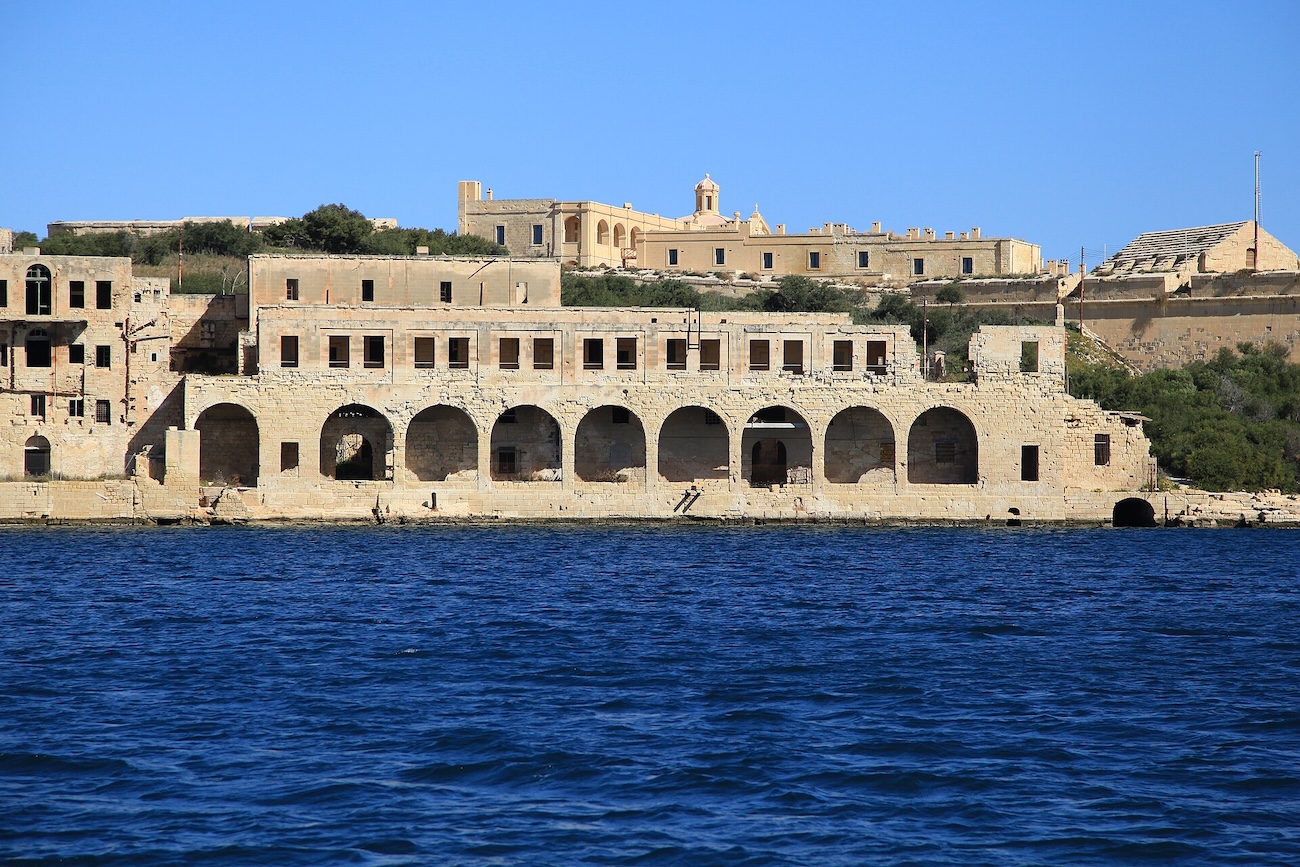
Construction of the permanent Lazaretto began in 1643. The buildings rose along the eastern shore of the island, facing Valletta across the water. Long, low halls of golden Maltese limestone. A massive parate — an esplanade — running along the waterfront so ships could anchor directly alongside. Separate wards for clean and suspect passengers. Vaulted storerooms for goods. Two parlatori — parlour rooms — where the quarantined could speak through iron grilles to family members or merchants on the free side, never touching, voices carrying across a gap of cold air.
By the time the complex was finished and expanded in the late 17th century, the Lazaretto of Malta was the largest and most sophisticated quarantine station in the Mediterranean. Its bills of health were trusted from Lisbon to Odessa. A ship leaving Malta with clean papers could enter almost any European port with reduced detention. Malta had turned isolation into a service. The Order charged for it.
Inside the Lazaretto: The Architecture of Forced Isolation
The Daily Routine of a Quarantine Prisoner
Quarantine on Manoel Island began with a small ceremony of inspection. A guardian — a salaried officer of the Lazaretto, contractually unable to leave his post during the duration — boarded the arriving ship in Marsamxett Harbour. He counted the passengers, examined the bills of lading, asked about deaths during the crossing, and noted the last port of call. Then he assigned the duration. A clean ship from a clean port: ten days. A ship from a suspect port: twenty-one to forty. A ship that had buried a body at sea: eighty, with goods burned.
Passengers stepped off onto the parate and were led to their wards. The poor went into communal halls. The middling sort took shared cells. The rich rented private apartments and brought their own servants — who were also quarantined, in adjoining rooms. The quarantined cooked their own food, paid their own expenses, supplied their own bedding. The Lazaretto was a building and a bureaucracy. It did not feed you.
A bell ran the day. Bells for the dawn count. Bells for the airing of goods. Bells for visiting hours at the parlatori. Twice a day the guardians walked the wards and counted heads. A single fever among a ship’s passengers reset the clock for everyone aboard. A death restarted the duration entirely, often with the addition of new days. The mathematics of plague was unforgiving and well understood. Any sign of illness meant the disease was still present, and the count had to begin again.
What the prisoner did with the time was their own business. The middling sort played cards. Merchants wrote letters. The clergy read. The bored aristocrat carved his name into the wall.
The Goods Warehouse Where Mediterranean Trade Was Forced to Wait
The quarantine of bodies was only half the system. The other half was the quarantine of goods. Plague was carried, the physicians believed, in soft materials — wool, silk, cotton, fur, paper. The Lazaretto’s sperone warehouses received these cargoes from the holds of merchant ships and laid them out on long racks in the open air. Workers turned the bales daily. Sunlight and air were the supposed disinfectants. A bale of Levantine silk might spend forty days being unrolled and refolded by spedizionieri — guild-licensed Maltese labourers who had taken the work knowing they could not go home until the duration expired.
For a major Levantine convoy, the warehouses held cargo worth more than the annual budget of the Order. The Maltese economy ran partly on this enforced pause. Innkeepers, suppliers, laundresses, carpenters, and physicians all earned their living from the friction of waiting. A merchant’s loss was a Maltese tradesman’s wage.
The system also produced a vocabulary that survived the buildings. In libera pratica — “in free practice” — was the certificate issued at the end of a clean quarantine, allowing a ship to enter port and trade. The phrase passed into the international maritime law of the 18th and 19th centuries, and remains in use today. Every modern ship that radios a port for permission to dock is asking, in language inherited from the Lazaretto, for pratique.
Class and Hierarchy Inside the Quarantine Cells
The Lazaretto enforced a strict three-tier hierarchy. The communal wards on the lower floors held sailors, soldiers, pilgrims, and the unaffiliated poor, sometimes a hundred bodies in a single hall, sleeping on straw, sharing a single privy. The middle floors held merchants, professionals, and minor officials in shared chambers of four to eight. The upper apartments — sometimes called the quartieri nobili — held aristocrats, diplomats, and senior clergy in suites of two or three rooms, with a private balcony onto the harbour.
The hierarchy was not a courtesy. It was paid for. The Lazaretto charged daily rates that ranged from a few grani for the wards to several scudi for the apartments. A wealthy traveller could pass forty days in relative comfort, with books, wine, and a manservant. A Greek sailor could pass the same forty days on a straw mat in a hall that smelled, after three weeks, of unwashed bodies and bilge water.
The plague did not respect the hierarchy. When it broke containment, it killed the apartments and the wards with equal efficiency. Until that moment, the Lazaretto preserved every distinction of European class. A Venetian noble dying of fever in 1813 died in a private suite. A Sicilian fisherman dying of the same fever in the same week died in a hall of forty men.
The Plague of 1813: When the Lazaretto Failed and Malta Buried 4,500
The Ship San Nicola and the Disease That Slipped Through
The brig San Nicola arrived in Marsamxett Harbour on 28 March 1813, from Alexandria. Her master reported one death during the voyage. The body had been disposed of at sea. The crew were healthy. The cargo was cotton, hides, and Levantine textiles. The Lazaretto’s guardians assigned the ship to its standard plague-port duration: forty days, with the cargo to be aired in the warehouses.
The standard procedure failed. A Maltese cobbler named Salvatore Borg, who lived in Valletta, somehow came into contact with goods or persons connected to the ship. The precise route was never established, though black-market handling of quarantined cotton was the leading suspicion. He fell ill in early April. He died on 19 April. His daughter died two days later. Within a week, fever was spreading through the streets of Valletta.
The Maltese had not seen plague since 1675. The new British governor, Sir Thomas Maitland, had been in his post for eight months. He was a Highland Scot with no medical training and a reputation for blunt authoritarian decisiveness. The troops called him “King Tom.” He grasped immediately what was happening. He ordered the harbour closed, the cordons drawn, and the entire island sealed.
The Cordons, the Mass Graves, and the Collapse of Civil Order
Maitland’s response became one of the most studied case studies in the history of public health. He divided Malta into zones. Movement between zones was forbidden on pain of death. Soldiers patrolled the boundaries with orders to shoot. Villages were sealed off behind stone walls hastily piled across roads. Food was delivered by carts that approached the cordon, dropped supplies, and withdrew before the village’s collectors emerged.
Inside the sealed zones, the dying began. Plague killed in five to seven days. The bodies were collected by becchini — designated grave-diggers, themselves quarantined and forbidden from contact with the living — who carted them to mass graves dug at the edges of Floriana and on the slopes outside the main towns. Lime was thrown over the corpses. Priests offered absolution from a distance, shouting prayers over the cart as it passed.
The death toll has been estimated at around 4,500 across Malta and Gozo, on a population of roughly 100,000. The village of Qormi lost nearly a fifth of its inhabitants. Żebbuġ was so completely sealed that food riots broke out inside the cordon. A British soldier who tried to slip out of a quarantined village to visit a lover was shot dead by his own regiment, on Maitland’s standing order. The cordons held. By March 1814, the last cases had been recorded. The outbreak had lasted just under a year.
In one village, a family of seven sealed themselves inside their house at the first sign of fever in a neighbour. They posted a child at the window to receive food and pass back coins. When the cordon was lifted, all seven were alive. The neighbouring families, who had remained sociable, were mostly dead. The Maltese remembered this kind of story for generations. The lesson was simple. The only thing that worked was distance.
The British Reforms That Made Malta’s Quarantine the Strictest in Europe
The plague of 1813 destroyed the Order’s old assumptions and rebuilt the Lazaretto under British administration. Maitland concluded that the failure had been bureaucratic, not architectural. The guardians had been corruptible. The merchants had bribed their way to early release. The cobbler Borg had touched goods he should not have touched, and someone in the Lazaretto had let him.
The British reforms of 1814 doubled the size of the staff, raised their salaries to make bribery less attractive, and established the office of Superintendent of Quarantine as a senior colonial post. Penalties for cordon violation were codified into Maltese law. A new sanitary infrastructure was built on Manoel Island. The Lazaretto buildings were extended, new warehouses constructed, the cemetery formalized.
By 1820, Malta’s bills of health were the most trusted in the Mediterranean. A ship cleared at Malta could enter any British port without further detention — a privilege Marseille and Livorno did not extend to each other. The reforms turned the Lazaretto into the central node of the western Mediterranean’s plague defence for the next sixty years.
The Literary Prisoners and the Graffiti They Left Behind
Lord Byron and the 1811 Quarantine
Byron’s confinement in May 1811 produced some of the most quotable misery in the history of quarantine. He was returning from Greece, where he had written the first cantos of Childe Harold’s Pilgrimage. He had come ashore at Malta expecting hospitality. He got the Lazaretto. His letters from this period — to Hobhouse, to his mother, to his banker — are a sustained complaint against the indignity of being treated like everyone else.
He carved his name. The act was unremarkable. The building’s walls were already covered with the names of bored Englishmen and Italians and Frenchmen who had served their durations before him. The Lazaretto’s graffiti was a kind of guest book, accumulated over a century and a half. Byron’s contribution survived because, by the 19th century, the building’s later custodians had learned not to scrub the famous names.
He left Malta in late May 1811 still complaining. He did not return.
Sir Walter Scott’s 1831 Detention on His Final Voyage
Sir Walter Scott arrived at the Lazaretto on 22 November 1831, aboard HMS Barham. He was sixty years old, partially paralyzed from a series of strokes, and on the journey his physicians had prescribed as a last attempt to restore his health — a winter in the Mediterranean. He was the most famous novelist alive. The Maltese authorities held him for the standard duration anyway.
He passed the days writing. Two unfinished novels — The Siege of Malta and Bizarro — were begun in the Lazaretto, drawing on the history of the Knights and on a Calabrian bandit chief whose story he had heard during the voyage. Neither was published in his lifetime. The Siege of Malta remained unfinished and was not printed until 2008, almost two centuries after its author put it aside. Scott was released in early December, travelled to Naples, and worsened steadily. He died at Abbotsford on 21 September 1832, ten months after leaving the Lazaretto. The detention in Malta was the last sustained writing of his life.
John Henry Newman and the 1832 Cholera Quarantine
John Henry Newman arrived at the Lazaretto in December 1832, with his friends Hurrell Froude and the elder Archdeacon Froude, on a Mediterranean voyage they had undertaken partly for Hurrell’s failing health and partly for Newman’s intellectual reasons. He was a young Oxford fellow on the verge of the movement that would reshape the Church of England. The duration this time was not for plague but for cholera, which was sweeping Europe. The category of disease had changed. The architecture of waiting had not.
Newman left an account of the experience in his letters. He found the Lazaretto cold, the food poor, and the company adequate. He read. He prayed. He drafted lines that would later be reworked into some of the great Tractarian writings. The hymn for which he is now best known, “Lead, Kindly Light,” was composed not in the Lazaretto but on a ship off Sicily a few months later — though Newman’s biographers have noted that the contemplative discipline of the quarantine fed directly into the writing.
The Lazaretto, by this point, had a literary clientele. Benjamin Disraeli passed through. William Makepeace Thackeray would later make a comic episode of the Maltese quarantine in his travel writing. The walls accumulated names. The Mediterranean continued to wait.
From British Naval Hospital to Abandoned Ruin
The Decline of Quarantine in the Age of Steamships
Quarantine, as a system, began to die in the 1860s. Steam shortened the Mediterranean. A voyage from Alexandria to Marseille that had taken three weeks under sail now took six days under steam. The forty-day duration became economically intolerable. In the same decade, Louis Pasteur’s germ theory began to shift the medical understanding of contagion away from the miasmatic and time-based model that had justified the Lazaretto’s existence for three centuries.
The International Sanitary Conferences, which began in Paris in 1851 and continued through the late 19th century, slowly dismantled the old system. Durations shortened. Inspections replaced detentions. By 1900, the Lazaretto of Malta was handling a fraction of the traffic it had received in 1850. The vast warehouses stood empty. The wards filled only during cholera scares, which came less and less frequently. The same logic of forced island isolation reappeared, briefly, in places like North Brother Island in New York, where the Americans built their own quarantine station for tuberculars and typhoid carriers. By then the Maltese system was already in retreat.
The last formal quarantine on Manoel Island was recorded in 1929. After that, the buildings were repurposed.
The Royal Naval Hospital Years
The British Admiralty took over the Lazaretto site in the late 19th century and converted parts of it into a Royal Naval Hospital. During both World Wars, the buildings treated sailors and airmen wounded in Mediterranean operations. In 1940 and 1941, during the German and Italian bombing of Malta — the most intensive air assault any island has ever endured — the old quarantine wards held men with shrapnel injuries, burns, and psychological collapse. The British Mediterranean Fleet’s medical operations on Manoel Island continued until the Royal Navy reduced its presence after Maltese independence in 1964.
The site passed to the Maltese government. The hospital function ended. The buildings, never converted to any clear successor use, began to deteriorate.
The Decay of Manoel Island and the Restoration Fight
The Lazaretto entered a long period of neglect that has not yet ended. The roofs failed in places. The limestone, exposed for centuries to harbour spray, began to erode. The graffiti walls — the carved names of Byron and Scott and a hundred other detainees — survived because they were inside, but the buildings around them slowly emptied of purpose.
In 2000, the Maltese government granted a 99-year concession over Manoel Island to a private consortium known as MIDI, which proposed a large-scale residential and commercial redevelopment of the island. The plan included restoration of the Lazaretto. It also included luxury apartment blocks, a marina, and the kind of mixed-use scheme that has reshaped harbour cities across the Mediterranean from Barcelona to Beirut.
The plan stalled for two decades, kept in limbo by litigation, public opposition, and the slow grinding of Maltese politics. Activist groups including Flimkien għal Ambjent Aħjar — “Together for a Better Environment” — and the Kamp Emerġenza Ambjent campaign have fought to limit the scale of construction and preserve the historical fabric of the Lazaretto. The fight continues. Parts of the Lazaretto remain derelict, scaffolded, or sealed behind hoarding. Other parts have been partially restored. The site has become a study in slow decay overlaid with intermittent intervention, a kind of architecture common across the post-imperial Mediterranean.
The graffiti walls survive. The names are still there. So is the silence — the strange acoustic dryness of stone rooms that once held men counting days, and now hold only their handwriting.
The Atlas Entry: Visiting the Lazaretto on Manoel Island Today
Manoel Island sits in Marsamxett Harbour, connected to the mainland at Gżira by a short causeway. The walk from Sliema along the harbour promenade takes about twenty minutes and offers, on the way, the most photographed view in Malta — the long limestone profile of Valletta rising across the water. The Lazaretto buildings face Valletta directly. They were designed to be seen.
Public access to the Lazaretto itself is partial and changes with the construction work on the island. Heritage Malta and various civic groups offer occasional guided tours, particularly during cultural festivals such as Notte Bianca and the Malta Heritage open days. The graffiti rooms — the chambers where Byron and Scott carved their names — are the central interest for most visitors, and access to them is generally arranged through these scheduled tours rather than walk-in entry. The MIDI redevelopment work has, at various points, closed sections of the site entirely. Anyone planning a visit should check current access through Heritage Malta before travelling.
Fort Manoel, on the same island, is worth the walk. Built between 1723 and 1755, it sits a short distance north of the Lazaretto and has been partially restored. Together the fortress and the quarantine station tell the older story of the Order of St. John on Malta — the dual obsessions with defence and disease, the twin architectures of the wall and the gate.
The Lazaretto rewards attention rather than reverence. It is not a museum of a single dramatic event. It is the residue of three centuries of forced waiting, and its texture is in the small things. The iron grille of a parlatorio. The worn step of a guardian’s office. The smoke-blackened wall of a kitchen. The name of an English poet scratched into limestone in 1811. The building does what it was designed to do. It slows time down. The Mediterranean ran on commerce, commerce carried plague, and on Manoel Island the world was forced to stop and count. The counting is over. The stones remember the arithmetic.
Frequently Asked Questions
What was the Lazaretto of Malta used for?
The Lazaretto of Malta was a quarantine station that detained arriving ships, passengers, and cargo to prevent plague and other epidemic diseases from entering Europe. Built by the Knights of St. John on Manoel Island from 1643 and operated until 1929, it held travellers for periods ranging from ten to eighty days depending on the perceived danger of their port of origin. Every major Mediterranean shipping route passed through its registers. By the 19th century it was the largest and most trusted quarantine facility in the western Mediterranean.
Where is the Lazaretto located and can you visit it?
The Lazaretto sits on Manoel Island in Marsamxett Harbour, directly opposite Valletta and connected to the town of Gżira by a short causeway. Public access is partial and changes with ongoing redevelopment and conservation work on the island. Heritage Malta and civic groups offer occasional guided tours, particularly during cultural events such as Notte Bianca. Anyone planning a visit should check current access through Heritage Malta before travelling, as parts of the site are intermittently closed.
Why was Lord Byron held at the Lazaretto?
Lord Byron was detained at the Lazaretto in May 1811 on his return journey from Greece, where he had been writing the first cantos of Childe Harold’s Pilgrimage. His detention was routine — every traveller arriving from the eastern Mediterranean had to serve a quarantine duration regardless of rank, and Byron’s papers from Greece earned him a reduced term rather than the full forty days. He spent the time writing furious letters of complaint and carved his name into the wall of his cell. The graffiti survives.
What happened during the Maltese plague of 1813?
The plague of 1813 entered Malta through the brig San Nicola from Alexandria after a cobbler named Salvatore Borg came into contact with quarantined goods or persons connected to the ship. Around 4,500 people died across Malta and Gozo on a population of roughly 100,000. The British governor Sir Thomas Maitland sealed the island into cordoned zones patrolled by soldiers with orders to shoot violators, and the outbreak was contained by March 1814. The episode became one of the most studied case studies in the history of public health.
Who else was famously quarantined at the Lazaretto?
Sir Walter Scott was detained in November 1831 on his final Mediterranean voyage and began two unfinished novels in his cell, The Siege of Malta and Bizarro. John Henry Newman passed through in December 1832 during a cholera quarantine with Hurrell Froude, and the contemplative discipline of the detention fed directly into the writings of the early Oxford Movement. Benjamin Disraeli and William Makepeace Thackeray were also held during their Mediterranean travels. The Lazaretto’s walls accumulated their carved names alongside Byron’s.
Where does the word quarantine come from?
The word comes from the Italian quaranta giorni, meaning forty days, which was the standard detention period set by Venice and Ragusa in the 14th and 15th centuries. The number derived from the Biblical span of Christ’s fast and the duration of Lent rather than from any medical evidence, though it happened to approximate the incubation period of plague. The related phrase in libera pratica — “in free practice” — was the certificate issued at the end of a clean quarantine, and the term pratique remains in use today in international maritime law.
Sources
Plague and the Poor in Renaissance Florence — Ann G. Carmichael (1986)
A History of Public Health — George Rosen (1958)
The Order of Malta and the Defense of Tradition: Medical Charity in the Knights Hospitaller — Henry Sire (1994)
A Concise History of Malta — Carmel Cassar (2000)
Quarantine: Local and Global Histories — Alison Bashford, ed. (2016)
The Last Plague of the Mediterranean: Malta 1813 — Paul Cassar, Medical History vol. 11, no. 4 (1967)
Medical History of Malta — Paul Cassar (1964)
Byron’s Letters and Journals, Volume II: Famous in My Time, 1810-1812 — Leslie A. Marchand, ed. (1973)
The Journal of Sir Walter Scott — W. E. K. Anderson, ed. (1972)
The Letters and Diaries of John Henry Newman, Volume III — Ian Ker and Thomas Gornall, eds. (1979)
Manoel Island and Lazaretto: A Heritage Impact Assessment — Din l-Art Ħelwa and Flimkien għal Ambjent Aħjar (2017)
Contagion: How Commerce Has Spread Disease — Mark Harrison (2012)