The March to Denizli
In November 1917, two thousand women, children, and elderly residents of Levissi and the surrounding villages were given forty-eight hours to prepare for departure. The men were already gone — conscripted into Ottoman labor battalions months earlier, sent to build roads and dig trenches for a war that was grinding the empire into dust. What remained in the village was a population of grandmothers, mothers, and children under ten.
They were allowed to take only what they could carry. Families sold their furniture, their linens, their olive oil at a fraction of its value to neighbors who would inherit their houses by morning. Then the march began — fifteen days on foot toward the town of Acıpayam, near Denizli, 220 kilometers inland through the Taurus Mountains in winter. The guards set the pace. They did not permit stops for burial. The roads filled with the bodies of children who collapsed from cold and hunger. Mothers were seen placing infants beneath stones along the roadside — not graves, just markers of where they had let go.
The village they left behind stood intact. The olive presses were oiled. The churches were painted. The fountain in the center of town still ran. The houses, built of local stone and positioned so carefully that no roof blocked another’s sunlight, waited on their terraced hillside as if the occupants had stepped out for the afternoon and would return by evening.
They did not return. Another 900 families were marched out in April 1918. By the time the Greco-Turkish War began in 1919, Levissi was already a shell. The final handful of Greeks boarded ships at Fethiye harbor in September 1922, bound for a country most of them had never seen. The Treaty of Lausanne, signed the following year, made their exile permanent and gave their empty houses to strangers who did not want them.
Kayaköy is the physical residue of the 20th century’s most efficient act of social surgery — the compulsory population exchange between Greece and Turkey that uprooted nearly 1.6 million people by religion rather than nationality. The village was not destroyed by war. It was not leveled by earthquake. It was emptied by a treaty signed at a conference table in Switzerland, and then abandoned a second time when the people sent to fill it found the hillside too steep, the architecture too foreign, and the silence too heavy. What remains is a landscape from which coexistence has been surgically removed — 500 houses still holding the outline of lives that were lifted out of them and set down somewhere else entirely.
Levissi Before the Silence: A Greek Orthodox Town on the Lycian Coast
Ancient Karmylessos, Byzantine Bishopric, and the Greek Revival
The site where Kayaköy stands has been inhabited since antiquity. The ancient Lycians knew it as Karmylessos, later shortened to Lebessos. Lycian rock tombs are still visible on the hillside north of the village, carved into the same limestone that the later Greek inhabitants would use to build their houses. The settlement appears in Byzantine ecclesiastical records as a Christian bishopric — a suffragan of the metropolitan see of Myra, the capital of the Roman province of Lycia — listed in the Notitia Episcopatuum attributed to Emperor Heraclius around 640 AD and again under Emperor Leo VI in the early 10th century.
The modern village of Levissi was founded in the 18th century, primarily by Greek-speaking Christians who migrated from the Dodecanese Islands. They settled on a south-facing hillside above the valley floor, building upward in terraces along the slope. The location was strategic in the oldest sense — elevated enough to discourage pirate raids from the coast, close enough to Fethiye (then known as Makri) to access its harbor and markets.
By the mid-19th century, Levissi had undergone an intellectual reawakening common to Greek communities across Ottoman Anatolia. Michail Konstantinou, a local educator, spearheaded the construction of schools throughout the region. The village supported a primary school, a girls’ school, a library, and eventually a local newspaper. The residents were not subsistence farmers on marginal land. They were tradesmen, craftsmen, stonemasons, and olive growers — a skilled professional class whose economic output was sophisticated enough to sustain institutional life. The Young Turk Revolution of 1908, with its promise of equality for all Ottoman citizens regardless of religion, briefly raised hopes that this prosperity would be protected by law.
500 Houses, Two Churches, and a Fountain from the 17th Century
The village that reached its peak in the early 1900s contained approximately 500 stone houses, more than twenty churches and chapels, multiple schools, shops, and a fountain dating from the 17th century that still stands in the center of the settlement.
The domestic architecture reveals a community that thought carefully about shared space. The houses are two stories — ground floor for storage, kitchen, and livestock; upper floor for living quarters — built of local limestone with timber-framed ceilings and positioned on the terraced hillside so that every dwelling received direct sunlight and an unobstructed view of the valley. The windows and doors were oriented to maximize airflow in the Mediterranean heat. The narrow cobblestone lanes that wind between the houses follow the natural contours of the slope, creating a settlement that feels organic rather than planned, as if the village grew out of the hillside the way the olive trees did.
The two principal churches anchored the community’s spiritual and social life. The Taxiarchis Church — the Upper Church, dedicated to the Archangels — sits on a hill near the center of the village. Its stone carvings and arched windows survive. The Panayia Pyrgiotissa — the Lower Church, dedicated to the Virgin Mary — dates from the 17th century and retains fragments of its original frescoes and black-and-white pebble mosaic floors. An ossuary beside the Lower Church holds the remains of villagers who died before the exodus — bones that were never collected by the families who left.
The architecture of Kayaköy is not grand. There are no mansions, no civic monuments, no ostentatious displays of wealth. The sophistication is in the collective — in the careful terracing, the shared water systems, the positioning of each house relative to its neighbor. The village was designed by people who expected to live in it for generations, who built with the assumption that their children would inherit the walls.
The Persecution of Levissi: Genocide, Labor Battalions, and the Death Marches
1914–1916: The First Wave and the Intercepted Letter
The destruction of Levissi did not begin with a single event. It arrived in stages, each one removing another layer of the population until the village was a husk.
The persecutions were part of a broader Ottoman campaign against Anatolian Greek and Armenian Christian populations that escalated dramatically after 1914. In the Fethiye region, the campaign began with economic strangulation. Following a tour of the district’s seventy villages, local Ottoman officials passed secret messages to mosques instructing Muslims to seize Greek-owned fields, to refuse to buy or sell goods to Greeks, and to distribute confiscated property among themselves. The intent was to make life untenable without formally ordering expulsion — to engineer a voluntary departure through systematic theft and intimidation.
Hundreds of Greeks in the region were murdered during these early offensives. Women were assaulted, their clothing and shoes taken. In 1916, a group of Levissi and Makri Greeks composed a letter in Greek addressed to Sir Alfred Biliotti, the Consul General of Great Britain at Rhodes, documenting the killings and requesting his intervention. The letter was intercepted by Turkish authorities at Levissi before it could be sent. Later that year, many families were deported on foot to Denizli, 220 kilometers away, where they endured what survivors described as extreme atrocities.
The 1917 Death March and the Final Emptying of Levissi
The deportations of 1917 and 1918 completed the evacuation. In November 1917, 400 families were marched out. In April 1918, 900 more followed. The deportees were overwhelmingly women, children, and the elderly — the men having been removed to labor battalions where many died of disease, exhaustion, and summary execution. Families received forty-eight hours’ notice. The two thousand women and children of the first group were permitted to carry only what they could hold. They sold their remaining possessions at derisory prices in a market flooded with the furniture of the condemned.
The fifteen-day march to Acıpayam was conducted in winter, through mountain terrain, without adequate food or shelter. Guards enforced the pace. Bodies accumulated along the route — children who stopped walking, elderly men and women who sat down and did not rise. The guards would not permit burial stops for fear of delaying the column’s advance. Mothers who could no longer carry their infants were seen abandoning them along the roadside, placing them under rocks or in ravines.
By the time the Greco-Turkish War broke out in 1919, Levissi was already nearly empty. The few remaining Greeks who had survived the deportations or returned were forced to leave definitively in September 1922, when the war ended with a Greek defeat. They walked to Fethiye harbor and boarded ships for Greece. Some founded the refugee settlement of Nea Makri — New Makri — outside Athens, roughly 40 kilometers from the capital, on land that reminded them of what they had lost.
The Treaty of Lausanne and the Exchange That Erased a Civilization
Fridtjof Nansen and the Surgical Separation of Two Million People
The Treaty of Lausanne, signed on July 24, 1923, formalized what violence had already accomplished. Its most consequential provision was the compulsory population exchange between Greece and Turkey — organized by the League of Nations under the supervision of Fridtjof Nansen, the Norwegian polar explorer, diplomat, and Nobel Peace Prize laureate who had been appointed High Commissioner for Refugees.
The exchange was defined by religion, not language or national identity. Greek Orthodox Christians in Turkey — many of whom spoke Turkish as their first language — were classified as “Greek” and deported to Greece. Muslim citizens of Greece — many of whom spoke Greek as their first language — were classified as “Turkish” and sent to Turkey. The exchange affected approximately 1.2 million Greeks from Turkey and 400,000 Muslims from Greece. It was, by design, irreversible. The treaty barred permanently the return of any Orthodox Christian refugee to their home in Turkey.
The logic was the logic of ethnic homogeneity — the belief that stable nation-states required populations unified by faith, and that the centuries of mixed settlement across Anatolia and the Balkans were an aberration to be corrected by administrative force. The villages, towns, and neighborhoods where Greeks and Turks had shared markets, water sources, and festivals for generations were emptied and refilled with strangers.
Levissi became Kayaköy. The name itself was a kind of erasure — “Rock Village,” a geographic descriptor stripped of the centuries of Greek habitation that the stone still held.
Nea Makri: The Settlement That Carried the Name
The refugees from Levissi and nearby Makri arrived in a Greece that was struggling to absorb more than a million displaced people. Housing was scarce. Work was scarcer. The government assigned them land, and they chose a site 40 kilometers east of Athens, on the coast of Attica, that resembled — however faintly — the Lycian landscape they had left behind.
They named it Nea Makri — New Makri — after the harbor town of Fethiye, which they had known as Makri. The name was an act of preservation, a refusal to let the geography of their former life disappear entirely. Nea Makri exists today as a suburb of Athens. Its residents are descendants of people who were told, by international treaty, that the place where their grandparents’ bones rested in an ossuary beside a church on a hillside in Anatolia was no longer theirs, and could never be again.
The Village That Was Abandoned Twice
The Muslim Refugees Who Refused to Stay
The population exchange was meant to be symmetrical. The empty Greek houses of Kayaköy were assigned to Muslim Turks arriving from Macedonia — families who had been uprooted from their own villages in Greece under the same treaty provisions. They arrived at the hillside settlement and found stone houses built for a different climate, a different economy, a different way of life. The terraced slopes that the Greeks had cultivated for generations were steep and unfamiliar. The houses, designed for craftsmen and tradesmen, sat on land that was poor for agriculture.
The Macedonian Turks did not stay. Some sources cite the terrain. Others cite the ghost stories — rumors that the spirits of the Greeks who had been killed during the deportations still inhabited the houses, that the village was cursed. Whatever the reason, within a few years the replacement population had drifted away to flatter, more productive land in the valley below or in other parts of the region. Kayaköy was emptied for the second time — not by force but by refusal. The village had been built by one people and offered to another, and the second people said no.
The double abandonment is what makes Kayaköy singular among the ghost towns of the exchange. Across Anatolia, hundreds of Greek villages were emptied and refilled by Turkish Muslims who adapted the houses, converted the churches into mosques, and built new lives inside the old walls. At Kayaköy, that cycle failed. The village fell through the administrative machinery of the new Turkish state and landed in a silence that no one claimed.
The Earthquake, the Stripped Roofs, and the Final Indignity
Decay would have come eventually. The Mediterranean climate is relentless — winter rains, summer heat, the slow work of root systems prying stone from stone. But the decay was accelerated by two interventions that had nothing to do with weather.
In the 1950s, the Turkish government authorized the removal and sale of the roof tiles from the abandoned houses. The tiles — handmade clay, fired to last centuries — had commercial value. Stripping them was efficient. It was also a death sentence for every building it touched. Without roofs, the interior walls were exposed to direct rainfall. Timber beams rotted. Plaster dissolved. Stone courses that had been held in compression by the weight of a roof spread and collapsed. The government sold the skeleton of a village for the price of its tiles.
Then, on April 25, 1957, an earthquake measuring 7.1 on the Richter scale struck the Fethiye region, killing 67 people and damaging thousands of structures across the district. The already-roofless houses of Kayaköy absorbed the shock without the structural bracing that intact buildings possess. Walls cracked. Facades fell. The earthquake did not destroy Kayaköy — it was already too far gone for that — but it gave the ruins the appearance of antiquity. Visitors arriving decades later assumed they were looking at something ancient. They were looking at the 1950s.
Walking the Ruins of Kayaköy Today
The Taxiarchis Church, the Faded Frescoes, and the Pebble Mosaic Floors
The two churches are the only structures in Kayaköy that retain anything close to their original form. They were built with heavier stone, thicker walls, and vaulted construction that survived the loss of roofing better than the domestic architecture around them. They are also the structures that most directly confront the visitor with what was taken.
The Taxiarchis Church — the Upper Church — sits on a rise near the center of the village. Its arched windows frame the valley below. Fragments of painted frescoes cling to the interior walls — saints’ faces half-erased by a century of rain and sun, the pigments fading from ochre and cobalt to a uniform grey. The stone carvings above the doorways and around the window frames are still sharp enough to read: leaf patterns, crosses, geometric borders executed by masons whose training stretched back through Byzantine tradition to antiquity.
The Panayia Pyrgiotissa — the Lower Church — is the larger of the two, positioned closer to the village entrance. Its floors retain sections of the original black-and-white pebble mosaics, intricate geometric patterns laid stone by stone. An ossuary beside the church holds human remains — the bones of villagers who died and were buried in Levissi before the deportations. The ossuary was never emptied. The bones belong to people whose descendants live in Nea Makri, 40 kilometers from Athens, separated from their ancestors by 700 kilometers of sea and a treaty that cannot be reversed.
The churches were briefly repurposed — the Lower Church reportedly served as a mosque until the 1960s — but both have been largely untouched for decades. They stand as the only buildings in Kayaköy where the interior still speaks: where paint and stone and mosaic preserve the aesthetic vocabulary of a community that no longer exists in the place that made it.
500 Roofless Houses and the Architecture of a Lost Community
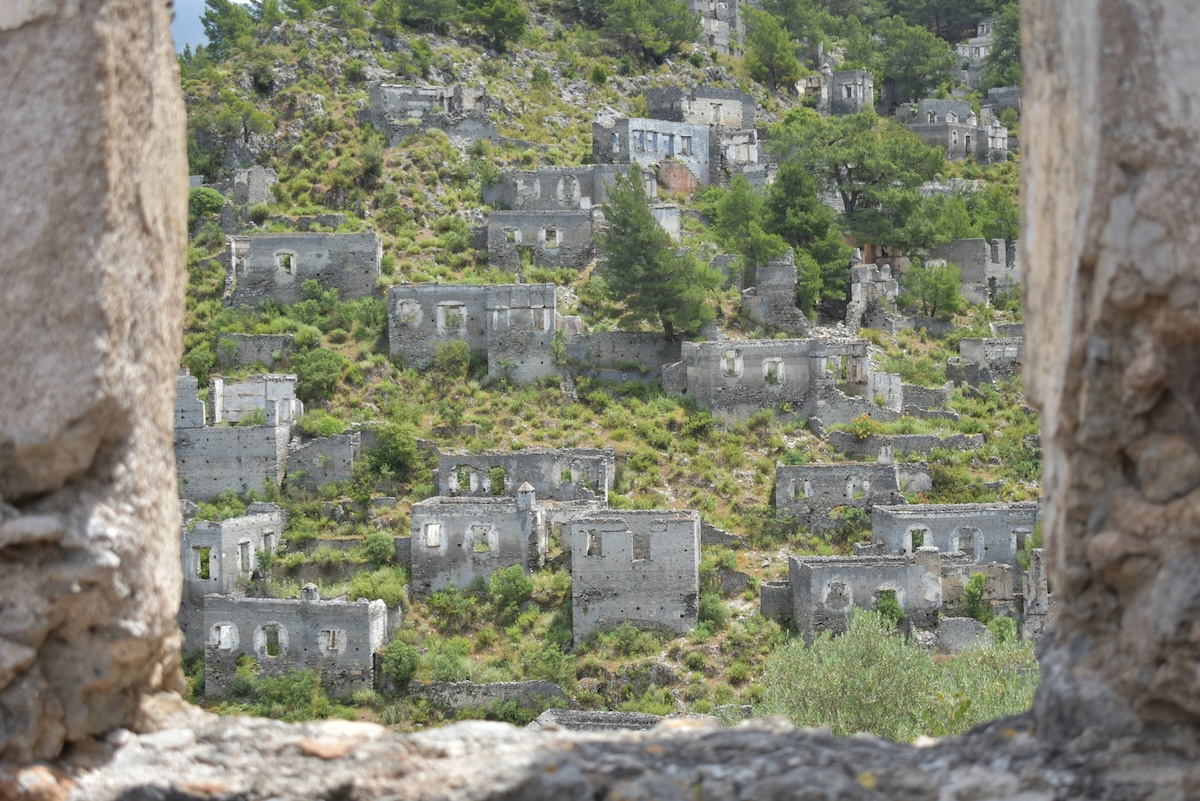
The domestic ruins cover the hillside in a dense cascade of grey stone. The roofless walls define rooms, corridors, staircases. Doorways open onto nothing. Windows frame views of the valley that the original inhabitants selected with care — each house positioned to receive sunlight and air, each terrace stepping down the slope so that no family lived in another’s shadow.
The ground floors are identifiable by their heavier construction: storage rooms, kitchens, spaces for livestock. The upper floors, where families lived, are often collapsed entirely — the timber that supported them long since rotted or scavenged. Fireplaces are visible in the exposed walls, their flues rising through stone to chimneys that no longer have a roof to sit on. Niches cut into the walls held oil lamps, icons, household objects. They are empty now, but their shapes remain — small rectangular absences in the stone that once held the daily artifacts of ordinary life.
The overall effect is not of a ruin but of a blueprint. The village’s social structure is legible in its remains: the clustering of houses around shared courtyards, the paths that connected neighborhoods to the churches, the fountains that served as communal gathering points. The 17th-century fountain in the village center — the oldest surviving structure — still stands, its stone basin dry. It is the only element of Kayaköy that predates the community that built everything else around it, and it will likely be the last thing standing when the walls finally give way.
The silence is the defining sensory experience. Kayaköy sits in a natural amphitheater of hills that blocks wind and absorbs sound. On a weekday morning outside peak season, the only audible presence is birdsong and the crunch of a visitor’s footsteps on loose stone. The quiet is not peaceful. It is the quiet of a place that was built for 6,000 voices and now holds none.
Visiting Kayaköy: The Atlas Entry
How to Reach Kayaköy from Fethiye and Ölüdeniz
Kayaköy sits eight kilometers south of Fethiye in Muğla Province, southwestern Turkey. The village is accessible by dolmuş (shared minibus) from Fethiye’s central otogar, with departures running regularly during the tourist season and less frequently in winter. The drive takes approximately fifteen minutes. From Ölüdeniz, the village is roughly the same distance to the northwest. A car or taxi offers more flexibility, particularly for visitors who want to combine Kayaköy with the hiking trail to Gemiler Bay — a scenic three-kilometer walk that descends from the village through pine forest to a small beach facing Gemiler Island, where the ruins of Byzantine churches sit on a rocky outcrop offshore.
The museum village charges a small entry fee. The site is open daily from morning to evening, with hours varying seasonally. There are no facilities inside the ruins — no shade structures, no water points, no restrooms. The terrain is uneven, steep in places, and composed of loose stone. Sturdy footwear is essential. The Mediterranean sun is punishing between June and September; early morning or late afternoon visits are strongly recommended during summer months.
A handful of restaurants and small guesthouses operate in the modern settlement of Kaya village at the foot of the ruins. The atmosphere is quieter and less commercial than Fethiye or Ölüdeniz — a holdover from the days when the site attracted more backpackers than tour groups.
Kayaköy lies on the Lycian Way, Turkey’s most celebrated long-distance hiking trail, which runs 540 kilometers along the coast from Fethiye to Antalya. Hikers walking the trail’s western sections pass directly through the village, making it one of the route’s most emotionally charged waypoints.
A Village That Belongs to No One
Kayaköy was registered as an archaeological conservation area in 1988 following a campaign by the Turkish-Greek Friendship Association and architects from Istanbul. The Turkish Ministry of Culture granted the site museum status. Some sources, including several guidebooks and the village’s own signage, describe Kayaköy as a UNESCO “World Friendship and Peace Village.” The designation is not officially recognized by UNESCO — it appears to have originated with a local tourism council and propagated through repetition.
In 2014, the Turkish government announced plans to develop the village, offering a 49-year lease that would open approximately one-third of the archaeological site to construction, including a hotel and tourist facilities. The proposal drew opposition from preservationists and from Louis de Bernières, the British novelist whose 2004 book Birds Without Wings — a story of a fictional Anatolian village destroyed by nationalism and the population exchange — was widely understood to be inspired by Kayaköy. De Bernières expressed cautious concern that development would compromise the site’s integrity.
The village appeared in Russell Crowe’s 2014 film The Water Diviner, which used the ruins as a filming location. The production brought temporary infrastructure and brief international attention, but no lasting restoration.
Standing at the top of the village, looking down over 500 roofless houses toward the valley and the distant Mediterranean, a visitor confronts the specific melancholy of a place that was not destroyed but vacated. Oradour-sur-Glane was frozen by a massacre — its ruins preserved as evidence of a crime committed in a single afternoon. Kayaköy was emptied by a process that took nine years, from the first persecutions of 1914 to the final ships of 1923, and the crime was not a massacre but an erasure — the administrative removal of a people from the landscape they had shaped for centuries. The houses were not burned. The churches were not bombed. Everything was simply left, intact and waiting, for inhabitants who were legally prohibited from returning.
The bones in the ossuary beside the Lower Church are the oldest continuous residents of Kayaköy. They have been here longer than the treaty, longer than the Turkish Republic, longer than the silence. They belong to a village that belongs to no one — not to the Greeks who built it, not to the Turks who inherited it, not to the tourists who photograph it. The stone holds the shape of what was here. The stone does not explain why it left.
Frequently Asked Questions
Why was Kayaköy abandoned?
Kayaköy was abandoned through a multi-stage process spanning nearly a decade. Beginning in 1914, Ottoman authorities persecuted the Greek Orthodox population of the village — then known as Levissi — through economic pressure, deportation, and forced marches. By 1918, most of the population had been expelled. The remaining Greeks were forced to leave definitively following the Greco-Turkish War and the compulsory population exchange mandated by the 1923 Treaty of Lausanne, which required all Orthodox Christians in Turkey to relocate to Greece. Muslim refugees from Greece who were sent to replace them chose not to settle in the hillside village, leaving it permanently empty.
How many houses are in Kayaköy?
Approximately 500 stone houses remain standing in various states of ruin on the hillside, along with two major Greek Orthodox churches, more than twenty smaller chapels, schools, shops, and a 17th-century fountain. The houses are two-story limestone structures arranged in terraces along the slope. Most are roofless — their tiles were removed and sold by the Turkish government in the 1950s, and additional damage was caused by the 1957 Fethiye earthquake.
What are the two churches at Kayaköy?
The two principal churches are the Taxiarchis Church (Upper Church), dedicated to the Archangels and located near the center of the village, and the Panayia Pyrgiotissa (Lower Church), dedicated to the Virgin Mary and situated closer to the village entrance. Both retain fragments of original frescoes, stone carvings, and in the case of the Lower Church, black-and-white pebble mosaic floors. An ossuary beside the Lower Church holds the remains of villagers who died before the deportations.
What is the connection between Kayaköy and the novel Birds Without Wings?
British novelist Louis de Bernières’ 2004 novel Birds Without Wings is widely believed to have been inspired by Kayaköy. The book portrays a fictional Anatolian village called Eskibahçe where Greek Christians and Turkish Muslims live in harmony until nationalism, war, and the population exchange destroy their community. De Bernières has acknowledged visiting the ghost town and being deeply affected by the site, though he has not explicitly confirmed that Kayaköy is the model for his fictional village.
Can you visit Kayaköy year-round?
Yes. The museum village is open daily throughout the year. Peak tourist season runs from June through August, when temperatures are highest and crowds are largest. Spring (April–May) and autumn (September–October) offer the best combination of comfortable temperatures and fewer visitors. The site has no shade structures, so summer visits are best undertaken early in the morning or late in the afternoon. A small entry fee applies.
Where did the Greek residents of Kayaköy go?
Most of the Greek refugees from Levissi and the neighboring town of Makri (Fethiye) settled in mainland Greece. A significant number founded the settlement of Nea Makri (New Makri) approximately 40 kilometers east of Athens, in a coastal area of Attica that reminded them of their former home. Nea Makri exists today as a suburb of Athens, its name preserving the memory of the harbor town the refugees left behind.
Sources
* [Kayaköy and Fethiye (Levissi and Macri): Documentation of the Greek Genocide] — Greek Genocide Resource Center (greek-genocide.net)
* [Birds Without Wings] — Louis de Bernières, Secker and Warburg (2004)
* [The Exchange of Minorities: Bulgaria, Greece and Turkey] — Stephen P. Ladas, Macmillan (1932)
* [Twice a Stranger: The Mass Expulsions That Forged Modern Greece and Turkey] — Bruce Clark, Harvard University Press (2006)
* [Ionian Vision: Greece in Asia Minor, 1919–1922] — Michael Llewellyn Smith, University of Michigan Press (1998)
* [The Lycian Shore: An Archaeological Travel Guide] — George E. Bean, John Murray (1978)
* [Kayaköy: A Ghost Village Near Fethiye] — Turkish Ministry of Culture and Tourism, official site documentation
* [The Greco-Turkish War and the Population Exchange] — Renée Hirschon (ed.), Crossing the Aegean: An Appraisal of the 1923 Compulsory Population Exchange, Berghahn Books (2003)
* [Not Even My Name: A True Story] — Thea Halo, Picador (2001)
* [The 1957 Fethiye-Burdur Earthquake Sequence] — Bulletin of the Seismological Society of America (1958)
* [Kayaköy (Levissi) Abandoned Village] — Lonely Planet, Turkey guide entry
* [Nansen and the Population Exchange] — League of Nations Archive, Geneva