The Context
The Haute-Vienne is a region of soft, rolling green hills and chestnut forests, a landscape that typically swallows sound and history in equal measure. But in the Glane river valley, approximately 20 kilometers northwest of Limoges, the silence has a different weight. Here lies the original village of Oradour-sur-Glane, a place that exists in a permanent, suffocating stasis. It is a settlement of stone and iron that has not aged, developed, or breathed since the mid-afternoon of June 10, 1944.
To understand Oradour, one must first discard the notion of a museum. A museum curates history; Oradour is the history, frozen in the violent moment of its interruption. It is a "Martyr Village," a designation that carries legal and spiritual weight in France. On that Saturday in 1944, a company of the 2nd SS Panzer Division "Das Reich" encircled this unassuming market town and systematically murdered 642 civilians—men, women, and infants—before incinerating the buildings. The stakes of this location are absolute: it is the largest mass killing of civilians committed by German troops on French soil during the war. It remains an open wound on the landscape, a place where the physical geography serves as the only grave marker for hundreds of families who vanished in a single afternoon.
The "Pompeii of World War II"
The site defies the standard logic of war memorials, which usually seek to heal or to glorify resistance. Oradour does neither. It preserves the horror. The blackened walls, the melted glass, and the personal artifacts left rotting in the open air force the visitor to confront the mundane reality of the victims. This was not a strategic stronghold; it was a community of farmers, grocers, and children. The village stands as a "Pompeii of World War II," but unlike Pompeii, the catastrophe here was not an act of nature, but a calculated, bureaucratic decision made by men.
The Geography of Isolation
The tragedy of Oradour was facilitated by its very obscurity. The village sits on the banks of the Glane, a minor tributary that winds through the Limousin countryside. In 1944, this was a region of agricultural quietude, seemingly removed from the brutal coastal defenses of the Atlantic Wall or the chaotic urban warfare of the Liberation. The village was built along a primary north-south axis, with a tramway line connecting it to Limoges, making it a hub for the surrounding hamlets but small enough to feel insular and protected.
The Trap
This geography of isolation, which had sheltered the village for the first four years of the war, ultimately became its trap. The layout of the town featured a central market square, the Champ de Foire, which acted as a natural funnel. When the SS convoy arrived, they did not have to hunt for the population; the topography of the streets and the dependency on the tramway meant that life concentrated naturally in the center. The surrounding terrain—dense hedgerows and wooded hills—offered few escape routes for a population caught unaware. The village was not a fortress; it was an open palm that the SS simply closed into a fist.
The False Security
The psychological geography was just as important as the physical. Oradour was considered a "quiet" zone. While the Maquis (French Resistance) were active in the wider Limousin region—sabotaging rail lines and ambushing patrols—Oradour itself had no significant Resistance presence. It was a place where people felt safe enough to send their children for the summer. This false sense of security was lethal. When the trucks appeared, the instinct was curiosity, not flight. The villagers believed in the rules of civilized engagement, unaware that the unit approaching them had just come from the Eastern Front, where the rules of war had long been abandoned in favor of annihilation warfare.
The Prelude: The March of Das Reich
To understand why the clock stopped in Oradour, one must look at the movements of the 2nd SS Panzer Division "Das Reich." This was an elite, hardened unit, notorious for its brutality in the Soviet Union. Following the Allied landings in Normandy on June 6, 1944, the division was ordered to move north from its station in Montauban to reinforce the German lines against the American and British beachheads.
Terror as Strategy
Their journey was not a simple deployment; it was a fighting retreat through hostile territory. As they moved through the Dordogne and Corrèze, they were harassed incessantly by the Maquis. Bridges were blown, convoys were ambushed, and officers were kidnapped. The frustration within the German command grew into a murderous rage. The strategy shifted from military engagement to terror. The logic was brutal: if the population feared the SS more than they supported the Resistance, the attacks would stop.
Just the day before arriving in Oradour, on June 9, units of the Das Reich had entered the town of Tulle. In reprisal for a Resistance attack, they hanged 99 men from balconies and lamp posts across the town. This context is crucial. The soldiers arriving in Oradour on June 10 were already operating in a mode of collective punishment. They were not looking for specific combatants; they were looking to send a message to the entire region. The specific choice of Oradour remains a subject of historical debate—some historians argue it was mistaken for Oradour-sur-Vayres, a known Resistance hub, while others suggest it was chosen precisely because it was peaceful and wealthy, offering a "fat" target that would maximize the shock of the atrocity.
The Day the Clocks Stopped
The morning of June 10, 1944, was indistinguishable from any other Saturday in the Limousin. The sun was high, and the village was swelling with activity. In addition to the regular residents, Oradour was hosting refugees from the Spanish Civil War and families fleeing the impending combat in Nice and Alsace. The population had swollen, and the restaurants were preparing for the midday meal. The war felt distant, a rumor carried on the radio.
The Intrusion (14:00)
At approximately 2:00 PM, the low rumble of half-tracks shattered the peace. The 4th SS Panzer Grenadier Regiment, led by Sturmbannführer Adolf Diekmann, rolled into the village. They did not attack; they simply arrived. The soldiers executed the operation with a terrifying, bureaucratic calm. They ordered the town crier to announce that all inhabitants must assemble on the Fairgrounds for an identity check.
The compliance of the villagers is often the most heartbreaking detail of the narrative. Believing this to be a routine inspection, mothers woke babies from naps, bakers left dough rising, and the schoolmaster marched his pupils to the square. Within minutes, the entire living pulse of Oradour was concentrated on the gravel of the Champ de Foire. The SS set up machine guns on tripods, facing the crowd.
The Separation
The deception continued for nearly an hour. The soldiers spoke little. The villagers, nervous but hopeful, chatted in low voices. Then, the order came. The men were separated from the women and children. The men were told they would be held in barns while the houses were searched for weapons. The women and children were told to go to the church for safety. This separation was the tactical hinge of the massacre. It removed the men, who might have physically resisted, and preyed on the protective instincts of the mothers to keep the children compliant.
As the men were marched away, the women looked back. It was the last time families would see one another. This moment of cleavage marks the psychological ground zero of the site, a final severance before the violence began.
The Architecture of Slaughter
The massacre was not a chaotic frenzy but a spatially organized demolition. The geography of the village was weaponized against its inhabitants. The men, numbering around 190, were divided into smaller groups and marched toward six specific locations—barns, garages, and wine cellars—that the SS had identified as suitable containment zones. These structures, built of thick Limousin granite, would become ovens.
The Barns: Fire and Fusillade
Inside the barns, the men were forced to wait. The soldiers set up machine guns at the doorways. At a synchronized signal—likely a pistol shot or an explosion—the guns opened fire. The aim was to incapacitate, not necessarily to kill instantly. The enclosed spaces amplified the noise and the carnage. Following the fusillade, soldiers moved amongst the bodies, firing pistols at anyone who moved or moaned. They then covered the piles of humanity with straw and fagots of wood before setting them alight.
The Laudy Barn offers the only window into the horror of those final moments. Five men—Robert Hébras, Jean-Marcel Darthout, Yvon Roby, Clément Broussaudier, and Mathieu Borie—managed to survive the initial hail of bullets. As the fire took hold, they feigned death. When the flames became unbearable, they crawled through a small gap in the granite wall, hiding in a rabbit hutch until nightfall. They were the only male survivors from within the village. Their testimony provided the forensic details of the execution: the casual manner of the soldiers, the smell of cordite and burning straw, and the agonizing screams of those who were burned alive.
The Church: The Sanctuary Betrayed
While the smoke began to rise from the barns, the women and children—247 women and 205 children—were herded into the church of Saint-Martin. The sanctity of the church was used as a lure to prevent panic. Once they were packed inside, the doors were locked. Two soldiers carried a heavy crate into the nave, placed it near the confessional, and ignited a fuse. The device was an asphyxiating smoke bomb, intended to suffocate the victims in panic.
As the church filled with choking smoke and the terrified screams of children, the plan devolved into raw brutality. The soldiers realized the gas was not working fast enough. They opened the doors and raked the interior with machine-gun fire. They tossed hand grenades through the windows. The shrapnel tore through the pews and the mass of bodies. Finally, they brought in straw and wood, setting the church on fire. The roof eventually collapsed, crushing the victims and melting the church bells.
Only one woman, Marguerite Rouffanche, escaped. She leaped from a window behind the altar, breaking her hip, and crawled into a pea patch where she lay hidden for twenty-four hours. She heard the soldiers return to the church to finish off the wounded. She was the sole witness to the agony inside the sanctuary, a guardian of a memory so traumatic it defined the rest of her life.
The Aftermath and the Decree
The Germans left Oradour in the evening, leaving behind a smoldering ruin. But the horror was not quite over. A tram from Limoges arrived later that evening, carrying residents returning from work. The SS stopped the tram, checked the IDs, and terrifyingly, told them to go back. Those passengers saw the smoke and the empty village, unaware that their families were already ashes a few hundred meters away.
The Preservation of Destruction
In the wake of the Liberation, the fate of Oradour became a matter of national consciousness. When General Charles de Gaulle visited the site in March 1945, he was confronted with a dilemma: rebuild the community or preserve the evidence. He chose a path that was unique in post-war reconstruction. He declared that the ruins of Oradour should be classified as a historical monument and left exactly as they were. A "New Village" would be built nearby, on the other side of the road, but the "Old Village" would remain a ghost town.
This decree created a strange, dual existence for the survivors. They had to rebuild their lives in modern, grey concrete houses just a few hundred meters from the scorched shells of their former homes. The preservation was not passive; it was an active curation of decay. Walls were stabilized to prevent collapse, but the mess was left. The goal was to ensure that future generations would be forced to confront the visual reality of the massacre, not just read about it in textbooks.
The Trauma of Justice
The memory of Oradour is further complicated by the trials that followed. In 1953, a military tribunal in Bordeaux convened to try the surviving members of the Das Reich unit involved in the massacre. However, the trial opened a deep fissure in French national unity. Among the accused were 14 "Malgré-nous"—French citizens from Alsace who had been forcibly conscripted into the SS after Germany annexed the region.
The trial pitted the Limousin (the victims) against Alsace (the forced perpetrators). The verdict, which convicted the Alsatians, caused riots in Alsace, leading the French parliament to pass a hasty amnesty law to preserve national cohesion. To the survivors of Oradour, this was a betrayal. They felt the government had sacrificed justice for politics. For years, the families of the victims refused to have official government representatives at the annual commemorations, creating a bitter silence that lasted for decades. The ruins, therefore, stand not just as a memorial to Nazi cruelty, but to the messy, painful compromises of post-war reconciliation.
Walking the Ruins Today
Visiting Oradour-sur-Glane today is a sensory experience defined primarily by what is missing. You enter through a concrete underground center, the Centre de la Mémoire, which acts as a decompression chamber between the living world and the dead one. As you emerge into the ruins, the first thing that strikes you is the scale. This was not a hamlet; it was a substantial town. The tram tracks still run down the center of the main street, the overhead cables long gone, but the iron rails embedded in the asphalt.
Artifacts of Life
The preservation offers hauntingly intimate vignettes of interrupted lives. The sign for the hairdresser still hangs crookedly above the door. In the skeleton of a dentist's office, the chair still sits, rusting. In the bakery, the brick oven remains open. Sewing machines, warped by the heat of the incendiaries, sit on tables in roofless rooms. Bedframes, stripped of their mattresses, stand in rows where second-floor bedrooms used to be, now exposed to the sky.
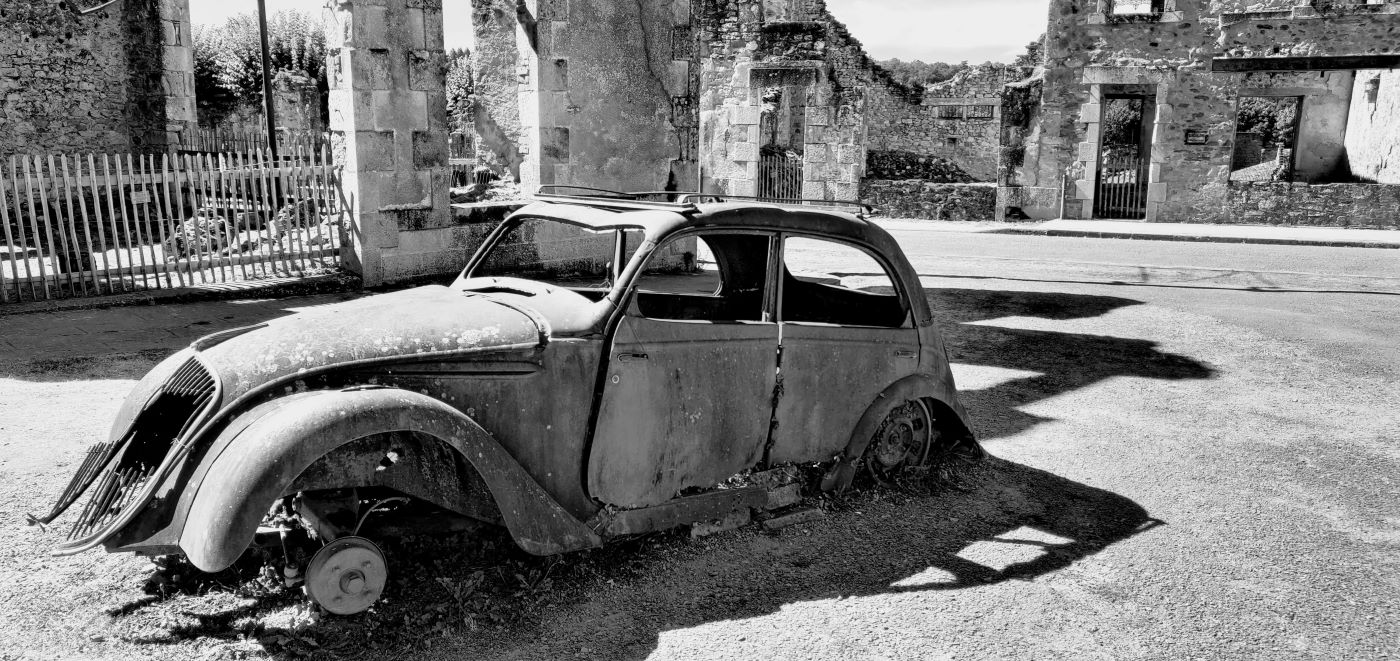
Perhaps the most famous artifact is the car of Doctor Desourteaux. It sits in the village square, a Peugeot 202, slowly disintegrating. The tires are gone, the metal is flaking, but the shape is unmistakable. It is a mundane object that has become a sacred relic, a tangible connection to the moment the doctor returned from his rounds and drove into an ambush.
The Atmosphere of Silence
The atmosphere is strictly controlled. Signs demand silence (Silence), and visitors generally comply. There are no tour guides shouting through megaphones; the horror speaks for itself. The only sound is the wind moving through the empty window frames and the crunch of gravel underfoot. It is a landscape of grey stone and green grass, where the nature that once isolated the village is now slowly reclaiming it, moss creeping over the blackened sills.
The cemetery, located at the northern edge of the village, contains the ossuary where the unidentified bones are buried. It is a stark contrast to the chaotic ruins—ordered, clean, and filled with the photographs of the victims. Seeing the faces on the porcelain medallions—faces of laughing young men, stern grandmothers, and toddlers holding toys—strips away the anonymity of the numbers.
Conclusion
The ruins of Oradour-sur-Glane serve as a brutal counter-argument to the concept of closure. There is no closure here. The "Martyr Village" is a static scream, a place where the clock was smashed at an hour that will never pass. While other battlefields have been plowed over or built upon, Oradour refuses to move on.
In an era where the Second World War is slipping from living memory into the realm of legend, the physical reality of Oradour becomes increasingly vital. It bridges the gap between the intellectual understanding of a war crime and the visceral shock of seeing it. The silence of the Limousin countryside does not hide the tragedy; it amplifies it. By leaving the village broken, France ensured that the story could never be sanitized. The empty streets of Oradour remind us that civilization is fragile, and that a peaceful Saturday afternoon can be turned into a charnel house in the span of a few hours, leaving nothing behind but stone and silence.
FAQ
Can you visit the ruins of Oradour-sur-Glane?
Yes, the ruins are open to the public seven days a week, year-round, except for a brief closure period in mid-winter (usually January). Access to the "Martyr Village" itself is free of charge. Visitors must enter through the Centre de la Mémoire (Center of Memory), a museum built underground to preserve the sightlines of the landscape. While the museum exhibition requires a ticket, walking through the ruins does not. It is a place of reflection, and visitors are strictly required to maintain silence and respectful behavior.
Why was this specific village chosen for the massacre?
The specific reason remains a subject of historical debate. The prevailing theory is that the SS intended to target Oradour-sur-Vayres, a nearby town known for high levels of Resistance activity, and simply confused the names. However, other historians argue that Oradour-sur-Glane was chosen deliberately because it was wealthy, well-fed, and easily enclosed, making it a "soft target" that would provide maximum shock value to the region without risking significant German casualties during the operation.
Who was responsible for the massacre?
The massacre was perpetrated by the 4th SS Panzer Grenadier Regiment of the 2nd SS Panzer Division "Das Reich." The operation was commanded by SS-Sturmbannführer Adolf Diekmann. Diekmann requested the court-martial of his own volition shortly after the event, but he was killed in action in Normandy just a few weeks later, never facing justice. The division itself was en route to the Normandy front to fight Allied forces following D-Day.
Were there any survivors?
From within the village center, there were only six survivors. Five men (Robert Hébras, Jean-Marcel Darthout, Yvon Roby, Clément Broussaudier, and Mathieu Borie) managed to escape the Laudy barn. Only one woman, Marguerite Rouffanche, escaped the church. Approximately 20 other villagers managed to flee the town before the cordon was fully established or hid in locations the SS failed to check, but the vast majority of the population present that day was killed.
What is the "New Village"?
After the war, General Charles de Gaulle ordered that the ruins be preserved as a permanent memorial. Consequently, a "New Oradour" was built nearby, completed in the early 1950s. It lies just a few hundred meters from the ruins. Today, it is a functioning town with schools, shops, and residents, living in the shadow of the preserved "Old Village."
Sources & References:
- Oradour-sur-Glane 10th June 1944 - Michael Williams (2023)
- Centre de la Mémoire d'Oradour - Official Site (2024)
- The SS Massacre at Oradour-sur-Glane - The National WWII Museum (2021)
- Oradour: The Village of the Dead - History Today (2014)
- Martyred Village: The War Crimes of Oradour-sur-Glane and Their Aftermath - Sarah Farmer (University of California Press, 2000)
- SS-Das Reich: The History of the Second SS Division, 1941-45 - Gregory L. Mattson (Staplehurst, 2002)
- Das Reich: The March of the 2nd SS Panzer Division Through France - Max Hastings (Zenith Press, 2013)
- The Fire: The Bombing of Germany 1940-1945 (Context on aerial warfare vs. ground reprisals) - Jörg Friedrich (Columbia University Press, 2006)