The Middle Passage and Arrival at Valongo Wharf
The year is 1811. The air in the bay of Rio de Janeiro is thick, not just with the tropical humidity, but with a stench so potent it was said to signal the arrival of ships long before they crested the horizon. It is the smell of unwashed bodies, disease, and rot—the olfactory signature of the tumbeiros, or "floating tombs."
When a ship docked here, it did not unload crates of spices or barrels of wine. It unloaded human beings. They stumbled down the wooden gangplanks, blinded by the sudden equatorial sun after months in the crushing darkness of the hold. Their legs were often atrophied from lack of movement; their skin was stretched tight over ribs that threatened to puncture. They were the survivors of the Middle Passage, and their feet were touching the stones of the Valongo Wharf (Cais do Valongo) for the first time.
For nearly a million men, women, and children, this stone jetty in Rio de Janeiro was the door of no return. It was the largest single disembarkation point for enslaved Africans in the history of the world—receiving more captives than all the ports in the United States combined. Yet, for over a century, if you walked down this street, you would not have known it existed.
To visit Valongo Wharf today is to stare into an open wound in the pavement of the "Marvelous City." It is a site that demands silence. It is not a monument built to honor the dead, but a crime scene that was deliberately buried, paved over, and hidden, only to be accidentally ripped open again in the 21st century. This is the story of the Transatlantic slave trade in Brazil, the calculated erasure of Black history, and the resilient spirit of the region now known as "Little Africa" (Pequena África).
The Atlantic Terminal
Between 1811 and 1831, Valongo’s only true rival in volume and brutality was the port of Havana. If Valongo was the warehouse for the South Atlantic, Havana’s Plaza Vieja was the terminal for the North. Ships frequently shared the same investors—men who treated the distance between Rio and Havana as a simple logistical calculation. While Valongo specialized in arrivals from Angola and Mozambique, the markets of Havana processed the West African interior. Together, these two sites formed the backbone of a global "Black City" network.
The Logic of Concealment: Why the Slave Market Was Moved
To understand the Valongo Wharf history, it is important to understand the geography of 19th-century Rio de Janeiro. Before 1811, the slave trade operated openly in the city center, primarily around the bustling Rua Direita (now Rua Primeiro de Março). The sights of shackled captives and the public floggings were woven into the daily tapestry of the colonial capital.
However, in 1808, the Portuguese Royal Court fled Napoleon’s armies in Europe and relocated to Rio, transforming a colonial outpost into the center of the Portuguese Empire. The presence of the Prince Regent and the nobility brought a desire to "civilize" the city. The raw brutality of the slave market was deemed an eyesore—visually offensive to the delicate sensibilities of the court, though they were entirely dependent on the labor it provided.
The Marquis de Lavradio, Viceroy of Brazil, ordered the trade to be moved away from the administrative center. He chose the Valongo valley, a marshy, peripheral area tucked between the hills of Conceição and Livramento. The logic was one of sanitary hypocrisy: the trade was not reduced, but rather quarantined. By pushing the market to the edge of the city, the elite could continue to profit from the trafficking of human souls without having to witness their suffering during their morning promenades. It was the first step in a centuries-long project of concealment.
The Trans-Imperial Mirror: Rio and Havana
This sanitary hypocrisy wasn't unique to Rio. While the Portuguese court was hiding its shame at Valongo, Havana’s Plaza Vieja was operating as its urban counterpart in the Spanish Caribbean. In Havana, the commerce of bodies happened in the literal heart of the city—a grand, baroque square where the same merchants who funded the Valongo-bound ships bought and sold human lives alongside sacks of sugar. Both cities shared a specific sociological blueprint: port cities designed to swallow millions of people while maintaining a veneer of colonial elegance.
The Lazarettos and Warehouses: The Infrastructure of Trafficking
Once established in Valongo, the infrastructure of trafficking industrialized. The wharf was not merely a docking point; it was the mouth of a complex commercial machine designed to transform human beings into merchandise.
Surrounding the wharf were the 'lazarettos'—euphemistically termed hospitals, but effectively fattening houses. While the vast majority of captives arrived via the Portuguese pipelines from Angola and Mozambique, the wharves of Rio also processed souls trafficked from Gorée Island in Senegal and the Lagos Coast. Regardless of their origin, these humans were skeletons, ravaged by scurvy, dysentery, and dehydration. Before they could be sold at market prices, they had to be 'restored.
In these warehouses, the enslaved were shaved, fed calorie-dense frantic mixtures to hide malnutrition, and their skin was greased with oil to simulate health and vigor. They were kept in these holding pens until they were deemed presentable enough to be marched to the nearby showrooms. The history of slavery in Rio is physically etched into the architecture of this neighborhood; many of the charming colonial facades standing today in the Port Zone were once the walls of these prisons. The scale of the operation was staggering. Between 1811 and 1831, the Valongo Wharf processed an estimated 900,000 Africans, creating a demographic shift that would make Brazil the country with the largest African population outside of Africa today.
A Palimpsest of Stone: The Stratigraphy of Valongo
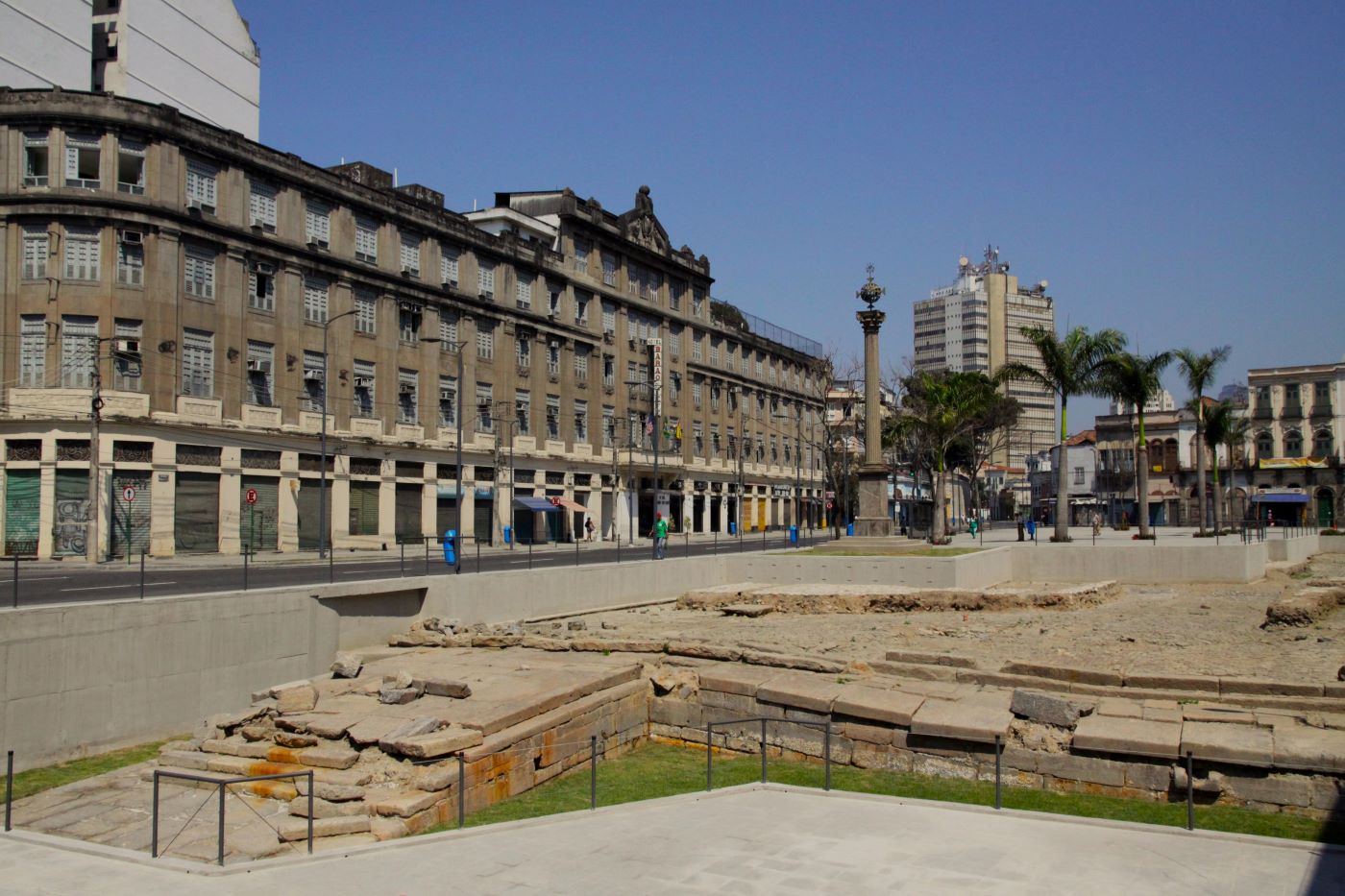
When you look down into the archaeological pit at Valongo today, you are looking at a palimpsest—a historical manuscript that has been scraped clean and written over multiple times. The site is a layer cake of Brazilian history, with each stratum representing a different era’s attempt to deal with its past.
The excavation reveals three distinct epochs, physically stacked on top of one another. At the deepest level lie the pé de moleque ("boy's foot") stones. these are the rough, irregular, hand-hewn rocks of the original slave wharf, laid by enslaved workers for enslaved feet to tread upon. They are dark, uneven, and visceral.
Directly on top of them, in some sections, lie cleaner, rectangular cut stones. Above that, the asphalt of the modern city. The site is a physical timeline of concealment. The archaeology does not just show us the wharf; it shows us the literal mechanism of erasure. We can see exactly how the city tried to bury its sins under layers of granite and dirt, raising the street level to hide what lay beneath.
The First Erasure: Cais da Imperatriz and the Masking of History
The first major act of erasure occurred in 1843. By this time, the Transatlantic slave trade was under immense pressure from the British, though it continued illicitly. However, the Valongo Wharf was about to receive a very different kind of visitor.
Princess Teresa Cristina of the Two Sicilies was sailing to Brazil to marry Emperor Pedro II. It was deemed unacceptable for the future Empress to disembark at a site synonymous with the "ugly trade" and the misery of black captives. The solution was a cosmetic renovation of total erasure.
The city commissioned a new wharf to be built directly on top of the old one. The rough stones of the slave trade were buried under rubble, and a new, elegant landing was constructed with neat, polished granite slabs. The site was renamed the Cais da Imperatriz (Empress Wharf). Statues of Greek goddesses were erected, and the area was decorated to mimic European grandeur.
The symbolism was stark: the suffering of millions of Africans was literally paved over to provide a smooth, clean walkway for European royalty. For over a century, historians and locals knew the Cais da Imperatriz as a site of imperial arrival, conveniently forgetting that the foundation of that arrival was the bedrock of slavery.
The Second Erasure: Urban Renewal and the "Paris in the Tropics"
If the Imperial renovation hid the wharf, the Republic buried it alive. In the early 20th century, particularly around 1911, the Mayor of Rio, Pereira Passos, launched a massive urban renewal campaign. Inspired by Haussmann’s renovation of Paris, Passos aimed to transform Rio into a "Paris in the Tropics."
This modernization project required widening avenues, demolishing colonial tenements (often home to the poor and formerly enslaved), and reclaiming land from the sea. The port area was filled in with massive amounts of earth to create new docks deep enough for modern steamships.
The Cais da Imperatriz—and the Valongo Wharf beneath it—was completely swallowed by this landfill. The coastline was pushed outward, and the location of the wharf moved inland, buried meters deep under a new plaza, the Praça do Jornal do Commercio. A column was erected, gardens were planted, and the site of the world’s largest slave port was effectively erased from the map. For a hundred years, cars drove over the heads of the ghosts of Valongo, and the city forgot.
This renewal didn't just hide the past; it catalyzed the future. As tenements were razed to build the 'Paris of the Tropics,' the displaced were forced into the hills to create the foundations of Rocinha or later trucked to the swampy outskirts of Cidade de Deus. The modern favela is the physical aftermath of Valongo's erasure.
The Rediscovery: Porto Maravilha and the Accidental Excavation
The silence was broken by the ambition of the 2016 Rio Olympics. As part of the preparations, the city launched "Porto Maravilha," a multi-billion dollar project to revitalize the decayed Port Zone. The plan involved tearing down an elevated highway and installing a new drainage system and light rail network.
In 2011, as heavy machinery began digging up the square, workers hit stone. Archaeologists were brought in, expecting to find remnants of the Imperial Wharf. They found them. But as they dug deeper, past the granite slabs of the Empress, they uncovered the rough, chaotic stones of the Valongo.
It was a moment of profound reckoning. The two wharves were preserved perfectly, sandwiching a layer of history. The city faced a choice: document the find and cover it back up to continue the construction of the plaza, or halt the project and expose the site. Pressure from the Afro-Brazilian movement and historians was immense. The decision was made to leave the pit open. The wound would not be stitched up this time.
Artifacts of the Spirit: Archaeological Evidence of Resistance
The excavation of Cais do Valongo yielded more than just heavy stones; it unearthed the spiritual life of the enslaved. In the dirt between the rocks, archaeologists sifted out over 400,000 small objects.
They found copper coins, buttons, and broken ceramics, but they also found items that defied the narrative of mere victimhood. They found cowrie shells (buzios), beads made of seeds and glass, rings, earrings, and amulets known as figas.
Initially, these might look like trash dropped in the mud. But their density suggests something far more powerful. These items are widely believed to be spiritual protections. Despite being stripped of their names, their clothes, and their freedom, the Africans who stepped onto this wharf carried their gods with them. They hid these small amulets to protect their bodies and spirits in a hostile land.
The presence of these artifacts—some associated with the Orixás of Candomblé—proves that the "social death" intended by the slave trade was never fully successful. Even in the moment of their arrival, in the depths of their trauma, they were practicing acts of spiritual resistance.
UNESCO World Heritage: Recognizing the Site of Conscience
In July 2017, the United Nations Educational, Scientific and Cultural Organization (UNESCO) recognized the Valongo Wharf Archaeological Site as a World Heritage site. This designation was crucial. It moved Valongo out of the category of "local history" and into the global pantheon of "Sites of Conscience."
It now sits alongside places like the Hiroshima Peace Memorial, Auschwitz-Birkenau, and Gorée Island in Senegal. The UNESCO listing acknowledges that the Transatlantic slave trade connection is key to understanding the formation of the modern world. It serves as a permanent physical reminder of one of humanity's greatest crimes and the immense contribution of African peoples to the cultural fabric of the Americas.
The Cemetery of New Blacks (Instituto de Pesquisa e Memória Pretos Novos)
To fully understand the horror of Valongo, you must walk a few blocks inland to the Cemitério dos Pretos Novos (Cemetery of the New Blacks). Not everyone survived the lazarettos. Those who died after arrival but before sale were considered "damaged goods." They were not given Christian burials.
Their bodies were carted to a boggy plot of land nearby, crushed, and thrown into mass graves. For decades, this site was also lost to history, covered by private homes. In 1996, a couple, Merced and Petruccelli, were renovating txheir house when they found bone fragments in the garden. They thought it was a recent crime; it was, in fact, an ancient one.
Today, their home has been transformed into the Institute of New Blacks (Instituto de Pesquisa e Memória Pretos Novos - IPN). It is perhaps the most moving museum in Rio. Inside, pyramidal glass windows are cut into the floor. Looking down, you see the soil mixed with thousands of bone fragments and teeth. It is estimated that between 20,000 and 30,000 bodies were dumped here. Standing in that living room, hovering over the remains of the forgotten, is a harrowing experience that contextualizes the sheer disposability of black life in 19th-century Brazil.
Pedra do Sal: The Living Legacy of Little Africa
Yet, the story of Little Africa of Rio de Janeiro is not only one of death. Just a short walk from the wharf lies Pedra do Sal (Salt Stone). This large rock face was originally at the water's edge, where enslaved men unloaded salt from ships.
After the abolition of slavery in 1888, this area became a sanctuary. Freed slaves from Bahia migrated here, forming a community of stevedores, dockworkers, and musicians. It was in the houses surrounding Pedra do Sal that the "Tias" (Aunties)—matriarchs of the Candomblé religion—hosted parties that blended African rhythms with Portuguese influences.
It is widely accepted that Samba was born here. The rhythm that defines Brazil to the world was forged in the shadow of the slave port, created by the descendants of those who arrived at Valongo. Today, Pedra do Sal is the beating heart of Afro-Brazilian culture. On Monday nights, the rock comes alive with a Roda de Samba, where locals and tourists crowd the streets to sing, drink caipirinhas, and dance—a vibrant, living testament to survival.
Experiencing Little Africa Today: The Atmosphere of the Region
Walking the "Pequena África" circuit today is an exercise in sensory contrast. The area has been heavily influenced by the Porto Maravilha revitalization. You will see the gigantic, colorful mural "Etnias" by the artist Kobra—a world record-holding piece of street art depicting indigenous faces from five continents—looming over the street.
The atmosphere is a blend of the ancient and the urban. The heat radiates off the cobblestones. There are no manicured lawns here; the beauty lies in the textures—the peeling paint of colonial mansions, the gritty industrial vibe of the docks, and the sudden, arresting sight of the archaeological pit. It feels lived-in, raw, and undeniably powerful.
Visiting Valongo Wharf: What to Expect at the Memorial
When you arrive at the Valongo Wharf today, do not expect a museum with audio guides or velvet ropes. The site is an open-air archaeological park. You stand at a railing, looking down into the excavated earth.
There are informational totems explaining the layers of the Cais da Imperatriz and the Cais do Valongo, but the primary experience is visual. The emptiness is the monument. The lack of grand statues allows the rough stones to speak for themselves. Visitors often report a feeling of heaviness here; it is a place for reflection, not recreation. It is recommended to visit in the late afternoon when the sun is less punishing, allowing the shadows to deepen the contours of the stones.
Logistics and Safety: Navigating the Port Zone
While the Port Zone revitalization has made the area much more accessible, it is still a working urban environment in a complex city.
- Getting There: The safest and easiest way to reach Valongo is via the VLT (Veículo Leve sobre Trilhos), Rio’s modern light rail system. Take Line 1 (Blue Line) towards Praia Formosa and disembark at the Parada dos Navios / Valongo. The wharf is directly across the street.
- Safety: During the day, the main boulevards (Avenida Rodrigues Alves and the Olympic Boulevard) are patrolled and generally safe for tourists. However, the side streets leading up into the hills (Morro da Conceição and Morro da Providência) can be unpredictable. It is advisable to stick to the main "Little Africa" circuit and avoid wandering into deserted alleys, especially with expensive camera gear. At night, the area can empty out quickly, except for specific event spots like Pedra do Sal on Mondays.
- Guided Tours: To truly understand the layers of history, hiring a guide specialized in Afro-Brazilian history is highly recommended. Organizations like the IPN offer walking tours that provide safety in numbers and invaluable context.
Connecting the Dots: MAR and The Museum of Tomorrow
To round out your understanding of the region, two nearby museums offer contrasting perspectives. The Rio Art Museum (MAR), located near the start of the boulevard, often features excellent exhibitions on the history of the port and the African diaspora.
Just a few hundred meters away sits the Museum of Tomorrow (Museu do Amanhã), a futuristic, skeletal structure designed by Santiago Calatrava. The irony of its location is palpable. The museum is dedicated to the future of the planet and humanity, yet it sits almost within sight of the Valongo Wharf, the place where humanity's past was most brutally compromised. Visiting both creates a powerful dialogue between what Rio was, and what it hopes to become.
Conclusion: Uncovering the Scar as an Act of Healing
For centuries, Rio de Janeiro tried to be a city of surfaces—beautiful beaches, lush mountains, and paved boulevards that hid the mud and blood of its foundation. The excavation of the Valongo Wharf ended that illusion.
Uncovering this site was not just an archaeological achievement; it was a necessary act of social surgery. By ripping the pavement off the Valongo, Rio has finally allowed the scar to breathe. It is a painful place, yes, but it is also a place of immense power. It reminds us that memory is a form of resistance.
Sources & References
- UNESCO World Heritage Centre: Valongo Wharf Archaeological Site Listing
- IPHAN (National Institute of Historic and Artistic Heritage): Dossier on Cais do Valongo
- Instituto de Pesquisa e Memória Pretos Novos (IPN): Official Museum Website
- World Monuments Fund: Valongo Wharf Conservation Project
- The Guardian: Rio's race to uncover its slave past
- New York Times: Grim History Traced in Sunken Slave Ship Found Off South Africa (Context on Transatlantic Trade)
- Slave Voyages Database: Trans-Atlantic Slave Trade Database
- ArchDaily: The Urban renovation of Rio's Port Zone
- Smithsonian Magazine: Uncovering the History of Slavery in Rio
- BBC News: Brazil's slave past unearthed at Olympic port