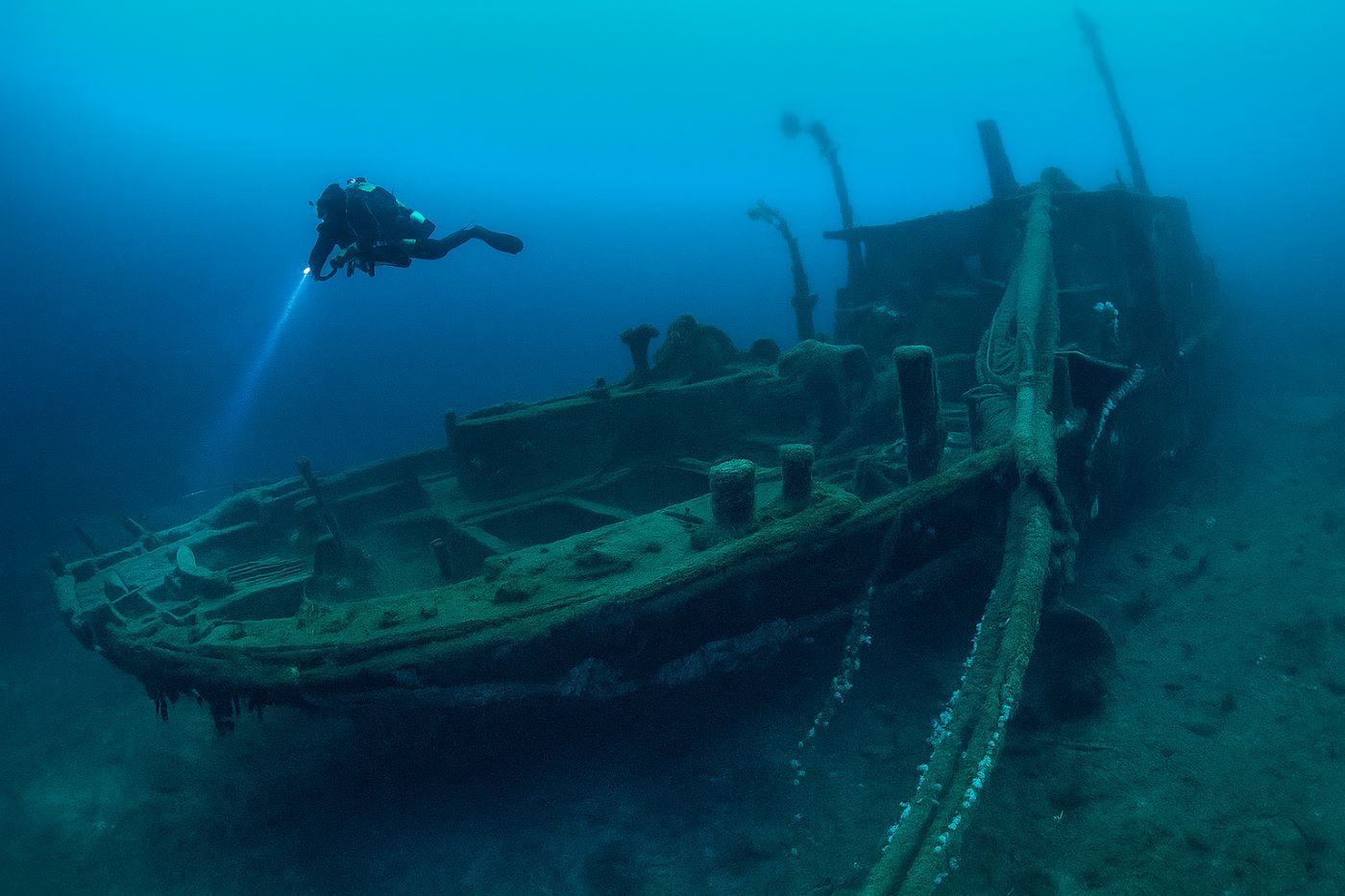
June 21, 1919: The Day the Sea Boiled
It was a Saturday morning in the Orkney Islands, and the weather was uncharacteristically mild. On the calm waters of Scapa Flow, a natural harbor enclosed by a ring of bleak, heather-covered islands, a group of local schoolchildren were on a boat trip. They were there to gawk at the enemy. For seven months, the horizon had been dominated by the grey, iron silhouettes of the German High Seas Fleet—74 of the most advanced warships ever built, caged in the north of Scotland, awaiting the end of the Great War.
Then, at noon, the ocean began to boil.
Without warning, the massive dreadnought Friedrich der Grosse, the flagship of the fleet, began to list violently to starboard. White foam churned around its hull as air vented from its bowels with a sound like a screaming locomotive. To the horror of the British guards on nearby trawlers and the amazement of the schoolchildren, the 24,000-ton leviathan rolled completely over, exposing its red, barnacle-encrusted belly to the sun, before sliding beneath the surface.
It was not an accident. Across the miles of the Flow, Imperial German flags were suddenly hoisted on every mast. One by one, battleships, battlecruisers, and destroyers began to turn turtle. It was a synchronized industrial suicide on a scale never before seen in history. By 5:00 PM, the pride of the Kaiser’s navy—52 ships in total—rested on the seabed.
Today, Scapa Flow remains one of the world’s most haunting underwater sites. It is a place of submerged dread and industrial awe, where the history of the First World War is not written in books, but frozen in rusting steel beneath the cold, green gloom of the North Sea.
The Strategic Geography of Scapa Flow
Scapa Flow is a geological fortress. Located in the Orkney Islands, just ten miles off the northern tip of the Scottish mainland, it is a vast expanse of water roughly 120 square miles in area, sheltered by a ring of islands: Mainland, Graemsay, Burray, South Ronaldsay, and Hoy.
The Vikings knew the value of this place, calling it Skalpeid in the Old Norse sagas. It offered a deep, sandy anchorage protected from the violent swells of the Atlantic and the North Sea. For centuries, it was a staging ground for invasions, but in the 20th century, it became the "Locker of the North."
During World War I, Scapa Flow served as the primary base for the British Grand Fleet. Its northern position allowed the Royal Navy to enforce a suffocating blockade on Germany, bottling up the enemy fleet in their Baltic ports. It was the strategic pivot point of the naval war—a bleak, windswept unassailable fortress.
It was only fitting that when the Armistice was signed in November 1918, the Allies demanded the German High Seas Fleet be interned here. They were to be held in the very heart of their enemy’s territory while the diplomats in Versailles decided their fate.
The Cage: Internment and Mutiny in the North Sea
The seven months leading up to the scuttling were a psychological nightmare for the German sailors. This was "The Cage." When the fleet arrived in November 1918, they were stripped of their wireless radios, their guns were disabled, and their fuel supplies were cut to a minimum.
The ships became floating prisons. Discipline collapsed. The German Revolution was sweeping through the homeland, and "Red Flag" mutinies broke out aboard the interned ships. Officers were stripped of their authority, often confined to their cabins by sailor councils who roamed the steel corridors.
The physical conditions were wretched. The food was poor, coal for heating was scarce, and the damp, penetrating cold of the Orkney winter seeped into the iron bones of the ships. The British refused to allow the sailors ashore, fearing they would spread communist ideology to the local population. So, thousands of men sat in the grey mist, staring at the barren hills of Hoy, rotting in boredom and uncertainty. They caught seagulls to supplement their rations and traded scrap metal with local drifters for cigarettes. It was a slow, rusting death of morale.
Admiral von Reuter and the Secret Order
Amidst this squalor sat Rear Admiral Ludwig von Reuter. He was a proud Prussian officer, commanding the interned fleet from the flagship Emden. He watched his ships turn into slums and his men into mutineers, but he held onto one final strategic objective: the German fleet would never fly the British Union Jack.
Von Reuter was almost entirely cut off from news of the peace negotiations. By June 1919, he believed that the Armistice was about to expire without a treaty and that hostilities would resume. He was convinced that the British intended to seize his defenceless ships the moment the peace talks failed.
He prepared a secret plan. He circulated orders to the loyal officers remaining on each ship. The code was simple. If he signaled "Paragraph 11," it meant: Scuttle at all costs.
On the morning of June 21, von Reuter saw his opportunity. The British Grand Fleet, lulled into complacency after months of inactivity, left Scapa Flow for training exercises in the North Sea. The harbor was left guarded by only a few small destroyers and trawlers.
At 10:30 AM, von Reuter walked onto the deck of the Emden. The signal flags fluttered up the halyard.
The Grand Scuttle: Mechanics of the World’s Largest Naval Suicide
The execution of the "Grand Scuttle" was a masterpiece of sabotage. Below decks, German engineers opened the seacocks—the large valves that let seawater in to cool the engines. But they didn't just open them; they smashed the valve wheels with sledgehammers and threw the turning handles overboard so they could not be closed again. They loosened condenser doors and hammered out rivets.
As the water rushed in, the ships began to settle. The British guard ships initially didn't understand what was happening. When they realized the fleet was sinking, panic ensued. British destroyers rushed back into the Flow, sirens wailing. They attempted to board the sinking ships to close the valves, but the Germans had done their work too well.
The scene turned violent. In their desperation to stop the sinking, British soldiers opened fire on German sailors who were abandoning their ships in lifeboats. Nine German sailors were killed and sixteen wounded—the final, tragic casualties of World War I, dying seven months after the fighting had officially stopped.
Despite the British efforts to beach the ships, gravity won. The battleships turned top-heavy as they flooded. One by one, the Seydlitz, the Moltke, the Derfflinger, the König, and the Markgraf rolled over and plunged into the abyss. By the end of the day, over 400,000 tons of naval engineering lay at the bottom of Scapa Flow. Admiral von Reuter had successfully denied the Allies their prize.
The Greatest Salvage in History: Ernest Cox and the High Seas Fleet
The story of Scapa Flow did not end with the sinking. In the 1920s, it became the site of the greatest marine salvage operation in history, driven by a man named Ernest Cox.
Cox was a scrap metal merchant with no experience in marine salvage, but he was a man of immense ambition. He bought the rights to the sunken fleet from the British Admiralty for a pittance. The experts told him it was impossible to raise the ships; they were too deep, too heavy, and upside down. Cox ignored them.
He bought a floating dry dock from the Germans, cut it in half, and used it to hoist the smaller destroyers. But for the massive battleships, he engineered a solution that bordered on madness. His teams descended into the wrecks, patching every hole and seacock in the hull. They then built giant airlocks—tubes stretching from the surface down to the submerged hulls. Workers would climb down these tubes, pressurize the ship, and pump compressed air into the upturned hull.
Essentially, Cox turned the sunken battleships into massive balloons. As the air displaced the water, the 25,000-ton giants rose to the surface, still upside down.
The visual was surreal: the rusted, barnacle-covered keels of WWI dreadnoughts breaking the surface like surfacing whales. Cox then towed these inverted monsters all the way south to Rosyth to be scrapped. It was an industrial spectacle that employed hundreds of Orkney locals and made Cox a legend. He raised 32 destroyers and 6 battleships, but eventually, the returns diminished, and he sold the operation. Seven of the fleet’s largest ships were left behind, too deep or too difficult to salvage. These are the ghosts that remain today.
The Tragedy of HMS Royal Oak and the U-47 Raid
For twenty years, Scapa Flow was a graveyard of German ships. But in 1939, as the world plunged into war once again, it became a British graveyard.
On the night of October 13, 1939, a German U-boat, U-47, commanded by the ace Gunther Prien, pulled off a feat of incredible daring. Utilizing high tides and the cover of darkness, Prien navigated his submarine through Kirk Sound, a narrow channel between the islands that the British believed was impassable due to blockships sunk during WWI.
Prien slipped into the heart of Scapa Flow. There, he found the battleship HMS Royal Oak at anchor. He fired a salvo of torpedoes. The first struck the bow, waking the crew but causing little panic; many thought it was an internal explosion. Prien circled, reloaded, and fired again.
Three torpedoes struck the Royal Oak amidships. The magazine ignited. The ship rolled over and sank in minutes, taking 833 men and boys down with her. It was a devastating blow to British morale and proved that the "impregnable" harbor was vulnerable. Today, the Royal Oak is a designated war grave, marked by a buoy from which an oil slick still perpetually leaks—the bleeding heart of the Royal Navy.
The Churchill Barriers and the Italian Chapel
The sinking of the Royal Oak enraged Winston Churchill. He was determined that no U-boat would ever enter Scapa Flow again. He ordered the construction of the Churchill Barriers—four massive concrete causeways linking the eastern islands to the mainland, permanently sealing the channels.
To build these cyclopean walls, Britain utilized the labor of Italian prisoners of war captured in North Africa. The work was brutal, pouring tons of concrete blocks into the freezing currents.
Yet, amidst this harsh labor, a miracle of art emerged. The prisoners of Camp 60, led by an artist named Domenico Chiocchetti, asked for permission to build a place of worship. Using two Nissen huts joined end-to-end, scrap metal, and concrete, they created the Italian Chapel. The interior is a masterpiece of trompe-l'œil painting, transforming corrugated iron into a baroque sanctuary. It remains standing on the island of Lamb Holm today, a poignant symbol of peace and beauty created by the hands of the enemy.
Low-Background Steel: A Scientific Legacy from the Deep
There is a strange scientific coda to the Scapa Flow story. The German ships that remain on the bottom—and the scraps salvaged in later years—possess a unique quality known as "low-background steel."
Steel production requires large amounts of air. Since the first atomic bomb was detonated in 1945 (the Trinity test) and the subsequent attacks on Hiroshima and Nagasaki, the Earth’s atmosphere has been contaminated with trace amounts of radionuclides, specifically cobalt-60. All steel produced after 1945 contains this atmospheric radiation.
However, the steel of the German High Seas Fleet was forged before the atomic age. It is radioactively pure. For decades, scientific instruments that require extreme sensitivity to radiation—such as Geiger counters, medical devices, and sensors for space satellites—have been built using steel harvested from the Scapa Flow wrecks. The armor of the Kaiser’s battleships is literally protecting modern humanity from radiation and helping us understand the universe.
Diving Scapa Flow: Into the Cold, Green Gloom
For the modern diver, Scapa Flow is the Holy Grail. But it is not a tropical paradise; it is a serious, sombre undertaking. The water is a consistent 50°F (10°C), necessitating drysuits and thick thermal undergarments. The visibility varies, often clouded by plankton or silt, creating a green, twilight atmosphere that enhances the spookiness of the wrecks.
Descending the shot line, the light fades quickly. The first thing you feel is the silence. Then, the shadows materialize. These are not broken fragments of ships; they are intact mountains of steel. Because of the way they were scuttled, the three remaining battleships (König, Markgraf, Kronprinz Wilhelm) lie upside down. This means divers descend onto the hull, swimming along the massive armored plating before dropping over the side to see the casemate guns pointing aimlessly into the dark.
It is a sensory experience of immense weight. The scale of the dreadnoughts makes you feel insignificant. You are swimming next to the machines that were designed to rule the world, now reduced to quiet reefs.
The Sleeping Giants: SMS Markgraf and SMS Kronprinz Wilhelm
The crown jewels of the Flow are the König-class battleships. The SMS Markgraf is perhaps the most impressive. Lying at a depth of 45 meters (147 feet), she is a dive for the experienced technical diver.
As you swim along the overturned hull, you can descend to the seabed to look up at the main armament. The 12-inch guns are still there, vast tubes of steel vanishing into the gloom. You can peek through the casemates to see the secondary guns, still on their mounts, encrusted with soft corals and brittle stars. The teak decking, though eroding, is still visible in places.
The SMS Kronprinz Wilhelm offers a similar profile but is slightly shallower. Here, the sheer violence of the sinking is evident in the cracks in the hull. These dives are claustrophobic for some—the ships create massive overhangs, blotting out the little surface light that penetrates this deep. It is a true "wreck diver’s wreck," indistinguishable from the geology of the seabed until you are right on top of it.
The Light Cruisers: SMS Köln, Karlsruhe, and Dresden
For those not qualified for the deep technical dives, the light cruisers offer a hauntingly beautiful alternative. Ships like the SMS Köln lie on their sides in about 35 meters of water. Because they are on their sides, they are more recognizable as ships to the human eye.
You can swim past the control towers, the bridges, and the armored shields. The Karlsruhe is famous for its peeling decking and the abundance of marine life. In the nutrient-rich currents of Orkney, these weapons of war have been colonized by massive plumose anemones. Their fluffy, white and orange heads cover the sharp edges of the gun turrets, softening the industrial lines. It is a stark contrast: the machinery of death supporting a vibrant, living ecosystem.
Beyond the Water: The Scapa Flow Visitor Centre and Lyness
The Scapa Flow experience is not limited to those who can breathe underwater. A pilgrimage to the island of Hoy is essential. Here, at Lyness, the former Royal Naval headquarters has been converted into the Scapa Flow Visitor Centre and Museum.
The museum is housed in the original oil pumping station. It smells of old machinery and history. Outside, you can see massive propellers and guns salvaged from the wrecks. A short walk away is the Royal Naval Cemetery. It is a sobering place. Here lie the sailors from the Battle of Jutland, the victims of the HMS Hampshire (which sank carrying Lord Kitchener), and the German sailors who died during the scuttling.
Standing on the shore at Lyness, looking out over the grey, chopping waters of the Flow, you can almost visualize the phantom fleet at anchor. The vast emptiness of the harbor today belies the crowded, iron city that floated here in 1919.
Travel Logistics: Planning Your Trip to the Orkney Islands
Reaching Scapa Flow requires determination, which keeps the crowds away and preserves the atmosphere.
Getting There: Most travelers take the ferry from Scrabster on the Scottish mainland to Stromness. As the ferry passes the Old Man of Hoy—a massive sea stack—you enter the dramatic landscape of the archipelago. Alternatively, flights land in Kirkwall, the capital.
Base of Operations: Divers usually base themselves in Stromness, a picturesque stone town with winding, narrow streets. The harbor is filled with dive boats—converted trawlers equipped with diver lifts and compressors.
Diving Requirements: This is cold water diving. A drysuit is mandatory. For the battleships, certification to 40 meters or deeper (Deep Diver, Nitrox, or Decompression Procedures) is highly recommended. The cruisers are accessible to Advanced Open Water divers.
The Future of the Wrecks: Rust, Oil, and Time
Time is running out for the German High Seas Fleet. For a century, they have withstood the currents, but the structural integrity of the ships is failing. The weight of the hulls is crushing the superstructures. Reports from recent years indicate that the Markgraf is beginning to collapse on itself.
There is also the environmental time bomb. These ships still contain bunker oil. As the steel corrodes, leaks become inevitable. A delicate balance exists between preserving them as historical monuments and managing them as environmental hazards.
Divers visiting today are witnessing the final stage of these ships’ recognizable existence. In another fifty years, they may be little more than piles of scrap metal on the seabed. The urgency to visit is real.
Conclusion: The Ocean as a Keeper of Secrets
Scapa Flow is more than a dive site; it is a submerged monument to the folly and grandeur of the early 20th century. It captures the transition from the age of empires to the modern world, frozen in the cold salt water.
The ocean has a way of claiming human history and making it its own. The guns that were built to destroy British towns now shelter crabs and conger eels. The steel that was meant to project German power now protects medical patients from radiation.
To dive Scapa Flow is to touch the past in a way that museums cannot offer. Down in the dark, hovering over the upturned keel of a dreadnought, you feel the weight of the silence. It is a graveyard, yes, but it is also a sanctuary—a place where the fury of the "Grand Scuttle" has finally found peace.
Sources & References
- Orkney Harbours - Scapa Flow History
- Scapa Flow Museum (Lyness)
- The Scuttling of the German Fleet (National Records of Scotland)
- HMS Royal Oak Association
- Scapa Flow Wrecks (Detailed Dive Info)
- Scientific American: Low-Background Steel
- Imperial War Museum - The Scuttling of the German Fleet
- The Orcadian - Historical Archives
- Dive Scapa Flow - Charter Information
- Historic Environment Scotland - Scapa Flow Wrecks Designation
- Naval History.net - World War 1 at Sea
- Visit Scotland - The Italian Chapel
- U-Boat.net - Gunther Prien and U-47
- Orkney Jar - The Heritage of the Orkney Islands
- The Man Who Bought a Navy (Book Reference/Review)