Chernobyl Nuclear Disaster: The Fatal Night in Control Room 4
The air inside Control Room 4 tasted like ozone and burnt dust. At 01:23:40 on April 26, 1986, the night shift watched a display of flickering lights that signaled the end of the world. There was no screeching alarm at first, only the low-frequency hum of a giant machine vibrating out of its skin. This room, a beige-paneled horseshoe of buttons and dial gauges, was the brain of a beast that had just become brain-dead. The operators were not monsters; they were tired men following a flawed test procedure on a machine they had been told was as safe as a samovar.
Why the AZ-5 Emergency Shutdown Triggered the Explosion
The AZ-5 button was supposed to be the emergency brake. When Leonid Toptunov pressed it, he intended to drop 211 boron carbide control rods into the reactor core to absorb neutrons and kill the reaction. Instead, he triggered a detonator. Because of a lethal design flaw, the tips of these rods were made of graphite. In an RBMK reactor, graphite increases reactivity. As the rods entered the overheated core, the graphite tips displaced the cooling water, causing a massive, instantaneous power surge.
The power did not just rise; it spiked to 100 times the reactor's nominal capacity in three seconds. The fuel rods shattered under the thermal shock. The pressure within the cooling channels turned the water into high-pressure steam instantly. Inside the control room, the floor began to heave. The men heard a series of thuds that sounded like heavy objects being dragged across the roof. It was the sound of the reactor's biological shield—a 2,000-ton concrete and steel lid nicknamed Elena—bouncing on a cushion of steam.
Structural Failure: How the 2,000-Ton Reactor Lid Blew
When the first explosion occurred, it wasn't a nuclear blast in the Hiroshima sense, but a massive steam explosion. It blew the 2,000-ton lid clean through the roof of the reactor hall, flipping it like a coin. The lid landed at an angle, wedged into the mouth of the reactor, exposing the burning core to the night sky. The second explosion, occurring seconds later, was likely a hydrogen-oxygen reaction. It was loud enough to be heard in Pripyat, three kilometers away, waking families who thought a storm was rolling in.
The atmosphere in the control room shifted from confusion to a terrifying, metallic reality. The windows had blown inward. A strange, shimmering blue light—Cherenkov radiation—was visible through the smoke, ionizing the very air the men were breathing. The shift supervisor, Alexander Akimov, refused to believe the reactor was gone. He spent his final hours ordering men into the ruins to pump water into a core that no longer existed, standing in radioactive water until his skin turned black.
RBMK Reactor Design Flaws: The Physics of a Meltdown
The RBMK-1000 was a masterpiece of Soviet frugality and engineering hubris. It was designed to produce both electricity and weapons-grade plutonium, and it was too big to be encased in a standard containment building. This lack of a shell meant that once the roof was gone, there was nothing to stop the radiation from riding the wind across the European continent. The disaster was not an accident of operation alone; it was a disaster of physics.
Understanding the Positive Void Coefficient in Soviet Reactors
To understand why Reactor 4 exploded, you must understand the Positive Void Coefficient. In most Western reactors, as the water gets hotter and turns to steam (creating voids), the nuclear reaction slows down. The system is self-limiting. The RBMK was the opposite. In this design, steam actually increases the reaction rate. More steam leads to more heat, which leads to more steam. It is a runaway feedback loop. On that April night, the reactor entered a low power state where this instability became uncontrollable.
The operators had pulled almost all the control rods out of the core to keep the power up for their test. This left the reactor like a car at the top of a steep hill with no brakes. When they finally tried to stop it, the graphite-tipped rods provided the final push over the cliff. The physics of the Soviet Union had prioritized output and cost-cutting over the fundamental laws of thermodynamics, and at 1:23 AM, the bill came due.
The Graphite Fire: A Nine-Day Radioactive Inferno
With the roof gone, the reactor became a volcanic chimney. The graphite blocks that moderated the reaction caught fire, creating an inferno that reached 1,200°C. This fire acted as a delivery system, lifting isotopes like Iodine-131 and Cesium-137 high into the atmosphere. For nine days, the core remained open, glowing with a malevolent beauty. Local residents gathered on a railway bridge to watch the pretty colors of the burning chemicals, unaware that the air they were breathing was a death sentence.
The Soviet authorities scrambled to put out a sun. They flew Mi-8 helicopters directly over the open maw of the reactor, dropping 5,000 tons of lead, sand, and boron. The pilots hovered in a column of radiation so intense that many would not live to see the end of the year. The lead melted and boiled, adding toxic fumes to the radioactive smoke, but eventually, the fire was smothered, leaving behind a tomb of molten debris.
Chernobyl Liquidators: The Human Cost of Containment
The cleanup of Reactor 4 was a war fought with human bodies. Over 600,000 people, known as Liquidators, were drafted from across the USSR to liquidate the consequences of the accident. These were soldiers, firemen, and miners who were told that their country needed them to perform the impossible. They worked in an environment where a single minute of labor could shave years off a lifespan.
The Chernobyl Divers: Preventing a Second Steam Explosion
Two weeks after the blast, a new nightmare emerged. The molten core—now a lava-like substance called corium—was burning through the concrete floor. Below the floor lay massive pools of water used for fire suppression. If the corium hit that water, it would trigger a thermal explosion so massive it could have leveled the remaining three reactors and made most of Europe uninhabitable.
Three men—Alexei Ananenko, Valeri Bespalov, and Boris Baranov—volunteered to go into the pitch-black, flooded basement. They wore wetsuits and held failing flashlights, wading through radioactive water to find the release valves. They found them by touch, turned the wheels, and drained the pools. Contrary to popular myth, they didn't die immediately; they lived for years afterward, but their 15-minute walk through the dark prevented a continental catastrophe.
Bio-Robots on the Roof: Shoveling Graphite by Hand
The most irradiated spot on the planet was the roof of Reactor 3, which was showered with chunks of highly radioactive graphite from the explosion of Reactor 4. The Soviets tried using West German and Japanese robots to clear the debris, but the high-intensity gamma radiation fried the electronic circuits within minutes. The solution was the Bio-robot. Soldiers were given lead aprons—often homemade—and told to run onto the roof, shovel one load of graphite into the hole, and run back. Each man was allowed only one shift, which lasted roughly 90 seconds. In that minute and a half, they received a lifetime's dose of radiation. Many reported a metallic taste in their mouths and the sensation of pins and needles on their skin before they even finished their task. Over 3,000 men cleared the roof this way, one shovel-full at a time.
The Elephant’s Foot: The World’s Most Dangerous Radioactive Mass
Deep in the bowels of the ruins, beneath the reactor hall, lies the most terrifying byproduct of the disaster. As the fuel rods melted, they mixed with sand, concrete, and metal to form a synthetic lava. This corium flowed through the pipes and burned through the floors before solidifying into a mass that looks like the wrinkled hide of an animal. It is known as the Elephant’s Foot.
Corium Lava and the Deadly Reality of the China Syndrome
The Elephant's Foot is a monument to the China Syndrome—the theoretical fear of a reactor core melting through the earth. While it didn't reach the water table, it did melt through several meters of reinforced concrete. When it was first discovered six months after the blast, the Foot was so radioactive that it emitted 10,000 roentgens per hour. To put that in perspective, 30 seconds of exposure would cause dizziness and fatigue; two minutes would cause the cells in your body to begin hemorrhaging; five minutes would be a fatal dose.
The mass was so hard that when scientists needed a sample, they couldn't drill it. They eventually used an AK-47 to shoot a piece off. Even today, the Foot remains thermally hot, a lump of man-made magma that continues to decay in the darkness. It is a place where human biology is systematically dismantled at the molecular level. To stand there is to witness the ultimate end of the industrial age: a hunk of slag that will remain lethal for tens of thousands of years.
The Famous Photograph of the Elephant's Foot Corium
There is a famous photo of the Elephant’s Foot taken in 1996, showing a worker standing next to the mass. The image is grainy and distorted, not because of a bad camera, but because the radiation was actively destroying the film as the shutter clicked. The man in the photo, Artur Korneyev, survived despite his repeated visits to the basement, but his survival is a statistical anomaly.
New Safe Confinement: How the Sarcophagus Protects Europe
The original sarcophagus, built in a desperate rush in late 1986, was never meant to last. It was a leak-prone box of steel and concrete held together by its own weight. By the early 2000s, it was riddled with cracks, and the roof was in danger of collapsing, which would have kicked up a fresh cloud of radioactive dust. The world’s response was the New Safe Confinement (NSC).
Engineering the World's Largest Movable Steel Structure
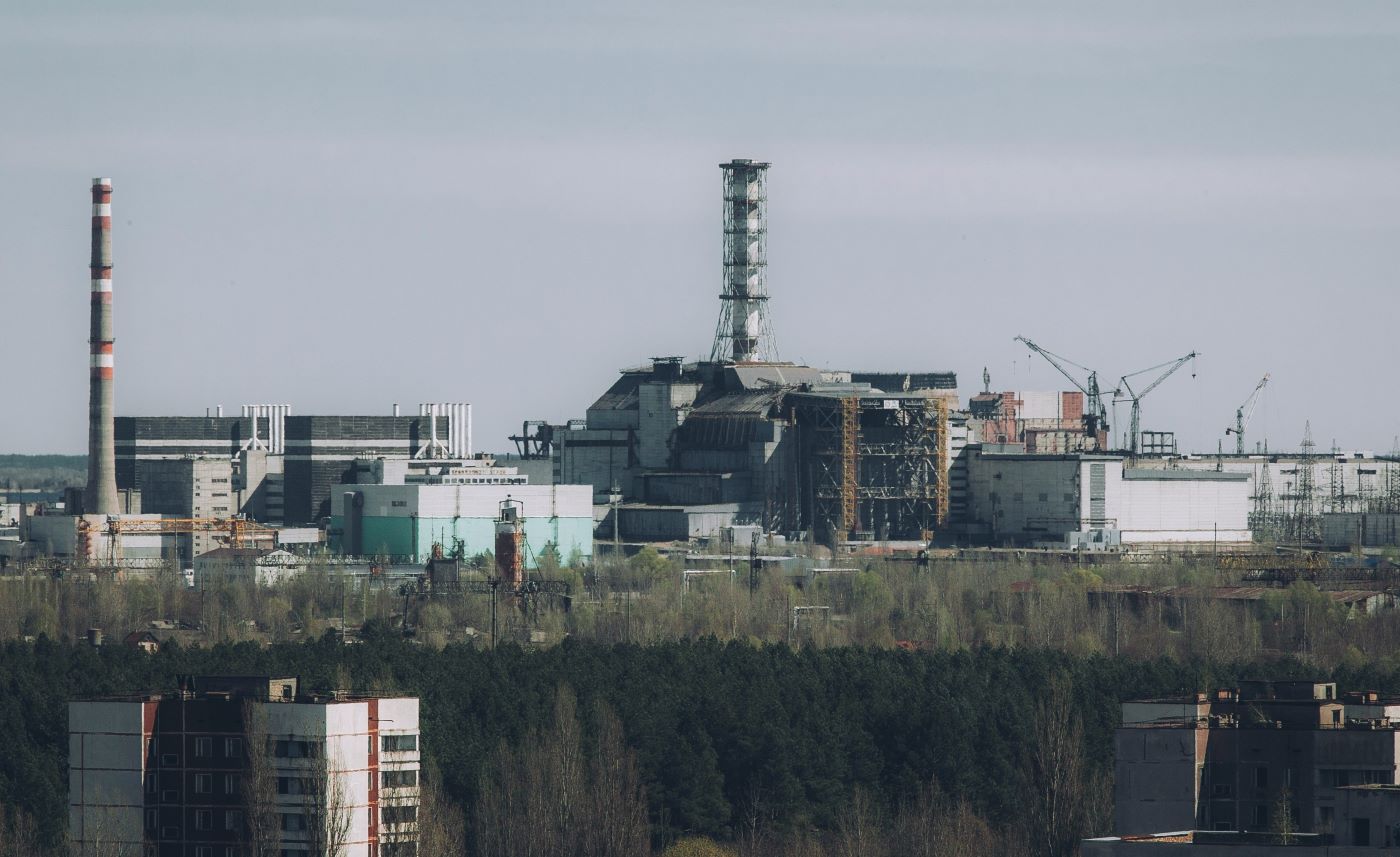
The NSC is the largest movable land-based structure ever built. It is a silver arch, tall enough to house the Statue of Liberty and wide enough to cover a football stadium. Because the area around the reactor was too radioactive for workers to stand in for long, the arch was built 180 meters away and then slid into place on massive Teflon rails.
This 1.6 billion dollar shield is a masterpiece of modern engineering. It is designed to last 100 years and is equipped with heavy-duty cranes to eventually begin the process of dismantling the old sarcophagus and the unstable reactor remains inside. It is a clean tomb for a dirty corpse. However, even this structure is only a temporary fix. It buys us a century to figure out how to handle the 200 tons of nuclear fuel that still sit inside.
Monitoring the Heartbeat of a Dead Nuclear Core
Today, the reactor site is a place of intense industrial activity. There are thousands of sensors monitoring temperature, humidity, and neutron activity. If the neutrons spike, it could mean that rainwater has leaked in and is acting as a moderator, potentially restarting a chain reaction. The site is not dead; it is on life support.
Engineers work in the Shadow of the Arch, monitoring the heartbeat of Reactor 4. The goal is no longer to produce power, but to maintain silence. They are the guardians of a mistake, ensuring that the isotopes of 1986 stay locked behind 30,000 tons of steel. The cost of this maintenance is a permanent tax on the Ukrainian economy and the international community.
The Architecture of Extortion: Russian Aggression and the New Safe Confinement
The 100-year guarantee of the New Safe Confinement was designed for a world at peace; it did not account for the arrival of the 21st-century battlefield. During the ongoing invasion of Ukraine, the Russian military has effectively weaponized the site’s vulnerability, utilizing the exclusion zone as a shield for artillery and launching targeted drone strikes that treat a nuclear tomb as a tactical pawn. In 2024 and 2025, fragments from Russian "Shahed" UAVs and deliberate "loitering" munitions have repeatedly struck the plant's auxiliary systems, demonstrating a calculated indifference to the risk of a new radiological release.
By targeting the infrastructure that maintains the Arch’s negative pressure and cooling, Russia is not just attacking a building; they are holding the European continent hostage. A breach in these systems would halt the stabilization of the 200 tons of fuel below, turning a passive tomb back into an active, unmonitored chimney of radioactive dust—proving that even 36,000 tons of steel is no match for state-sponsored recklessness.
Visiting Chernobyl Power Plant: Logistics and Expectations
Visiting Reactor 4 is not like visiting a museum. It is an exercise in bureaucracy and biological risk management. You do not simply go to the power plant; you are processed through it. The experience is defined by the tension between the mundane and the catastrophic.
Checkpoints and Radiation Safety Protocols for Visitors
To get within sight of the reactor, you must pass through multiple checkpoints. The first is Dytyatky, at the edge of the 30km Zone, and the second is Leliv, at the 10km mark. Your passport is checked against a pre-approved manifest. You are forbidden from touching the ground, sitting on the grass, or placing your camera bag on any surface.
As you approach the plant, the Dosimeters—the small devices that measure radiation—begin to chirp. The sound is a rhythmic reminder that you are entering an invisible minefield. The closer you get to the Arch, the faster the chirping becomes. It is a psychological pressure that makes the air feel heavier than it is. You are standing at the epicenter of a historical fracture.
Eating in the Chernobyl Canteen: A Surreal Experience
The most surreal part of a visit is eating lunch at the Plant Canteen. You must pass through a full-body radiation scanner before entering. Once inside, you eat borscht and cutlets alongside the current plant workers. They treat the site like a 9-to-5 job. They laugh, they complain about the weather, and they drink tea in the shadow of a building that nearly ended European civilization.
Standing in front of the Monument to the Brave, just 300 meters from the Arch, the silence is what hits you. There are no birds here. There is only the hum of the ventilation systems and the realization that you are looking at the most expensive and dangerous tomb in human history. It is a place of hollow silence, where the sheer scale of the engineering serves only to highlight the scale of the human error.
FAQ: Common Questions Regarding the Chernobyl Site
What exactly caused the explosion at Reactor 4?
The disaster was the result of a flawed reactor design combined with human error during a low-power safety test. The RBMK-1000 reactor had an unstable "positive void coefficient," meaning as water turned to steam, the nuclear reaction accelerated instead of slowing down. During the test, operators disabled emergency systems and withdrew almost all control rods. When they finally attempted an emergency shutdown by pressing the AZ-5 button, the graphite tips of the control rods caused a massive power surge that vaporized the cooling water and blew the 2,000-ton lid off the core.
How many people died as a direct result of the accident?
The official Soviet death toll remains 31 people, most of whom were plant workers and firefighters who died within months from Acute Radiation Sickness (ARS). However, estimates for long-term deaths due to radiation-induced cancers range from 4,000 (according to UN agencies) to over 60,000 (according to independent organizations like the Chernobyl Union). Tens of thousands of liquidators have since suffered from chronic health issues, though connecting these directly to the accident remains a point of intense scientific and political debate.
Is the Elephant’s Foot still dangerous today?
Yes, though its potency has decreased significantly since 1986. When it was first discovered, the mass emitted 10,000 roentgens per hour, which was a fatal dose in roughly 300 seconds. Today, the radiation has decayed to a point where a person could stand near it for several minutes without immediate death, but it remains a "forever" hazard. The mass is also physically changing, becoming less like solid glass and more like a pile of radioactive sand or dust, which increases the risk of inhalation if it were to be disturbed.
Can you go inside the New Safe Confinement arch?
Regular tourists are strictly forbidden from entering the interior of the New Safe Confinement. Access is restricted to specialized engineers, scientists, and decontamination crews who must undergo rigorous medical checks and wear full protective gear. Visitors are permitted to stand at a designated observation point roughly 300 meters away from the structure, provided they are accompanied by a licensed guide and have passed through the 10km zone checkpoints.
How long will the site remain radioactive?
The area immediately surrounding Reactor 4 will not be safe for human habitation for at least 20,000 years. While short-lived isotopes like Iodine-131 decayed within weeks, others like Cesium-137 and Strontium-90 have half-lives of about 30 years and will persist for centuries. The most dangerous elements, such as Plutonium-239, have half-lives of 24,000 years, essentially making the site a permanent exclusion zone on a human timescale.
Sources and Citations
- Frequently Asked Chernobyl Questions - International Atomic Energy Agency (2023)
- Health Effects of the Chernobyl Accident: An Overview - World Health Organization (2006)
- The New Safe Confinement: Project Facts and Figures - European Bank for Reconstruction and Development (2019)
- Chernobyl: Record of the 1986 Disaster - World Nuclear Association (2022)
- The Elephant's Foot of the Chernobyl Disaster - Nautilus (2021)
- Liquidators: The Heroes of Chernobyl - The Chernobyl Gallery (2024)
- Radioactive Waste Management at Chernobyl NPP - SSE Chernobyl NPP Official Site (2025)
- UNSCEAR 2008 Report: Sources and Effects of Ionizing Radiation - United Nations Scientific Committee on the Effects of Atomic Radiation (2011)