The Day Uranium City Died — December 3, 1981
The corporate jet landed on a runway built to receive heavy cargo transports — Hercules freighters loaded with drill rigs, casing pipe, and the industrial machinery needed to pull uranium oxide out of Precambrian rock. The tarmac at Uranium City airport stretched 1,200 metres across the boreal forest, absurdly oversized for the small prop planes that made the daily run from Saskatoon. On December 3, 1981, the runway received something worse than equipment. It received N.M. Edgar, president of Eldorado Nuclear Limited.
Edgar gathered the workforce. The rumour mill had been grinding for weeks — maybe a cutback, maybe a temporary layoff, maybe a shift reduction to ride out soft prices. Edgar did not offer a cutback. He announced that the Beaverlodge mine — the operation that had kept Uranium City alive for three decades — would close permanently on June 30, 1982. The ore grade was declining. The global uranium market had collapsed. The mine was no longer economically viable. Eldorado would offer severance packages and free flights south for anyone who left promptly.
The room went silent. Eldorado Nuclear was not merely the town’s largest employer. It was the reason the town existed. Without the mine, there was no tax base, no funding for the water treatment plant, no heat for the schools, no justification for the hospital. The company offered condolences and exit logistics. It did not offer a plan to save the community. The “Model City” — the phrase Saskatchewan’s planners had used when they designed it — was being decommissioned like a spent fuel rod.
Uranium City is what happens when a nation builds a community not for the people who live there but for the element underneath them. The town was conceived as infrastructure for extraction, and when the extraction ended, the infrastructure was written off. The Cold War did not just produce warheads and fallout shelters. It produced places — entire civilizations of concrete and curriculum and curling leagues — that existed only as long as the arms race needed feeding. When the demand curve dropped, the places were abandoned with the same bureaucratic efficiency that had built them. The ore from Beaverlodge Lake fuelled the weapons that kept the Western world safe for forty years. The people who mined it were given six months’ notice and a one-way ticket south.
How the Cold War Created Uranium City, Saskatchewan
Canada’s Secret Role in the Manhattan Project and the Hunt for Uranium
The story begins in the 1930s, when prospectors combing the shores of Great Bear Lake and later Lake Athabasca found pitchblende — a dense, black, uranium-rich mineral — mixed in with the gold deposits they were actually looking for. For years, the discovery was a footnote. Uranium’s only commercial application was extracting radium for medical use, a niche market that sustained a single operation: Eldorado Gold Mines, which processed pitchblende at Port Hope, Ontario.
The Second World War changed the math overnight. The Manhattan Project needed uranium, and it needed it in quantities that no existing source could provide. The Canadian government quietly nationalized Eldorado in 1944, converting it from a private mining company into a Crown corporation — Eldorado Mining and Refining Limited — with a classified mandate to supply uranium to the Allied nuclear weapons program. Canadian uranium, processed at Port Hope, contributed directly to the bombs that fell on Hiroshima and Nagasaki. The northern Shield was no longer a geological curiosity. It was a strategic asset of the highest order.
The post-war arms race made the demand permanent. The United States and the Soviet Union entered a competition that required thousands of tonnes of uranium oxide — “yellowcake” — to fuel weapons programs and, eventually, civilian reactors. The Canadian government turned its attention to the rich deposits around Beaverlodge Lake, in the extreme northwest corner of Saskatchewan, 48 kilometres south of the Northwest Territories border. By the early 1950s, the Athabasca region was crawling with prospectors. The 1954 edition of the local newspaper, The Uranium Times, noted that 52 mines were operating and 12 open-pit operations had sprung up along the lake’s shoreline. The problem was no longer finding uranium. The problem was housing the people who mined it.
Founding Uranium City — The “Model Town” on Lake Athabasca (1952)
Saskatchewan’s provincial government faced a choice familiar to every jurisdiction that discovers a commodity in the middle of nowhere: scatter workers across a dozen rough camps near each mine site, or build a single centralized town with proper services. The government, determined to avoid the squalor associated with small mining camps in northern Ontario, chose the second option. The template was Arvida, Quebec — a planned company town built by Alcan for its aluminum smelter workers, with a proper grid, zoned residential and commercial districts, and municipal services that functioned like any southern city.
Construction of Uranium City began in 1952. The site sat on the northern shore of Lake Athabasca, on granite ridges interspersed with muskeg — the raw surface of the Canadian Shield in its most primal form. The town was laid out with wide boulevards, sidewalks, fire hydrants, and underground sewers buried deep enough to survive the permafrost. The Saskatchewan government passed the Municipal Corporation of Uranium City and District Act in 1956, creating a unique chartered “district” with authority over education, health, and welfare — an administrative structure that reflected the ambition of the project. This was not a camp. It was an experiment in permanent northern habitation.
The first families arrived to find a construction site. Many lived in tents through their first winter, temperatures dropping to minus 40, the nearest paved road hundreds of kilometres to the south. They built a civilization from nothing on the edge of an inland sea. The Uranium City Hotel went up — a brick institution that became the social nucleus of the north, its bar legendary among miners, pilots, and prospectors. Schools followed: Ben McIntyre Elementary, Gilchrist School, and eventually Candu High School — the name a double pun on the Canadian-designed CANDU reactor and the frontier spirit of the people building the town. A curling rink, a movie theatre, a hospital, and churches filled in the grid. By the late 1970s, architecture-award-winning condominiums and apartment complexes lined the streets, and the population approached 5,000 with infrastructure planned for double that. The Atomic Age had built itself a model suburb at the edge of the world.
The Mines That Fuelled the Nuclear Arms Race — Uranium City’s Eldorado and Gunnar Operations
The Gunnar Mine and the Beaverlodge Operation
Two operations dominated the Athabasca uranium fields. The Gunnar Mine, located on the Crackingstone Peninsula jutting into Lake Athabasca, was an open-pit colossus that operated from 1955 to 1964 — a decade of furious extraction that produced the yellowcake destined for American warheads. The Gunnar operation was a marvel of isolation engineering: its own townsite, its own airstrip, its own power plant, all built on a rocky peninsula accessible only by boat or ice road. When the ore ran out, Gunnar closed and its satellite community emptied, leaving behind a mill, a tailings field, and contaminated shoreline that would take decades to address.
The heart of the region, though, was Eldorado’s Beaverlodge operation — a sprawling complex of underground shafts and surface mills that ran 24 hours a day, 365 days a year, for thirty years. Beaverlodge was a city unto itself, with satellite bunkhouses, a mess hall, and heavy infrastructure that hummed through the subarctic darkness of winter. The ore hauled out of Beaverlodge kept the lights on in Uranium City. It funded the school trips, paid for the hockey jerseys, maintained the water treatment plant, and paved the streets. By the 1960s, Canadian uranium could no longer be used for military purposes under revised government policy, and the Beaverlodge output pivoted to supplying fuel for Canada’s domestically engineered CANDU reactor program — a transition from weapons to energy that extended the mine’s life by two decades.
What Uranium Mining Did to the Miners — Radon, Lung Cancer, and the Beaverlodge Cohort
The rock gave up its ore, and the ore gave back radiation. The early decades of uranium mining at Beaverlodge were not known for safety. Underground workers inhaled radon progeny — the radioactive decay products of radon gas — in concentrations that would be illegal today. The ventilation was inadequate. The monitoring was sporadic. The miners did not fully understand what they were breathing.
The Saskatchewan Uranium Miners’ Cohort Study, analysing workers employed from 1948 onward, found lung cancer to be the only malignancy with statistically significant excess rates among Beaverlodge workers. A detailed analysis of 8,487 miners employed between 1948 and 1980 recorded 65 observed lung cancer deaths against 10.6 expected — a sixfold increase, rising linearly with cumulative radon exposure and compounded by cigarette smoking. The risk was concentrated among underground workers. Surface employees showed no significant elevation.
The contamination was not confined to the shafts. Residents discovered years later that mine backfill — crushed rock from the milling process — had been used as fill material for the foundations of schools and homes. Gerald Martin, who worked for Eldorado from 1977 to 1982, was diagnosed with pernicious anaemia after leaving Uranium City. His wife Andrea, who taught at Gilchrist School, later connected his condition to his years underground. “We loved Uranium,” she wrote in an online forum for former residents, “but were upset to find that the mine backfill was used for the schools’ foundations and our home foundations.” The families who had moved north to build a life in the Atomic Age discovered that the Atomic Age had been building underneath them.
Life Inside Uranium City at Its Peak — Isolation, Community, and the Atomic Dream
Uranium City’s Schools, Hockey Rinks, and the Architecture of Optimism
For three decades, Uranium City was a place of high wages and fierce community pride. The isolation that made the town logistically absurd also made it socially intense. Families bought boats to explore the labyrinth of islands in Lake Athabasca. They formed bowling leagues and curling teams. The bar at the Uranium City Hotel was a crossroads where miners, bush pilots, and geologists swapped stories over Labatt Blue while the subarctic wind rattled the windows.
Candu High School — opened in the late 1970s, just years before the end — was a state-of-the-art facility with a sprawling gymnasium, modern science labs, and heavy, expensive fire doors. The name captured everything the town believed about itself: that the future was nuclear, that Canada’s north was not a wasteland but a frontier, and that the children educated here would carry the atomic torch forward. The school was built to serve a community that expected to grow. Award-winning housing went up — modern condominiums and apartment complexes designed by architects who understood that attracting professionals to a latitude where the sun disappeared for months required more than bunkhouses and gravel roads. The investment in the final years before closure was enormous, a fact that would make the abandonment feel not just sudden but personally insulting to the people who had just unpacked.
No Road Out — How Isolation Shaped Uranium City’s Identity
Uranium City had no all-season road connecting it to the rest of Canada. The fact bears repeating because it is the single most important thing about the town. Everything — every bag of flour, every textbook, every piece of furniture, every human being — arrived by air or, in summer, by barge across Lake Athabasca. The airport, with its oversized military-grade runway, was the town’s umbilical cord. Norcanair and later Transwest Air (now Rise Air) flew the scheduled routes from Saskatoon and Prince Albert, hopping through Stony Rapids and Fond du Lac before touching down on tarmac built for jets that would never come again.
The only exception was the ice road — the Athabasca Seasonal Road — which opened for a few weeks in February and March, when the lake froze thick enough to support heavy vehicles. For those brief weeks, the town came alive with a different energy. Fuel trucks ground across the ice. Families drove out to buy a year’s supply of non-perishable goods or a new pickup truck. The ice boomed and cracked beneath the tires, the sound carrying across miles of frozen whiteness. When the road closed, the isolation returned, absolute and defining.
This geographic severance created bonds that former residents describe with a consistency that borders on grief. The community was tight not because people chose closeness but because the landscape demanded it. There was no driving to the next town for a change of scenery. There was no next town. The people who stayed planted gardens in the subarctic soil, built cabins on the lakeshore, and raised children who knew the sound of a floatplane engine better than a freight train. The permanence felt real. The world would always need uranium.
The 1982 Closure of Eldorado Mine and the Collapse of Uranium City
Why Eldorado Nuclear Closed the Beaverlodge Mine
The death of Uranium City had proximate and distal causes. The proximate cause was economic: by the late 1970s, the grade of ore at Beaverlodge was declining, requiring more rock to be processed for less yellowcake. The distal cause was geopolitical. The Three Mile Island accident in March 1979 — a partial meltdown at a nuclear reactor in Pennsylvania — triggered a global retreat from nuclear energy. Uranium prices, which had spiked during the energy crises of the 1970s, cratered. Contracts dried up. The CANDU program, which had absorbed Beaverlodge’s output for two decades, could source cheaper uranium elsewhere.
Eldorado Nuclear, a Crown corporation answerable to the federal government, ran the numbers and found a mine that was bleeding money in a market that showed no signs of recovery. The decision to close was corporate, bureaucratic, and — from Ottawa’s perspective — unremarkable. Mines close. Commodity cycles turn. The fact that an entire town depended on this particular mine was, in the calculus of federal resource policy, someone else’s problem. Los Alamos built the bomb and Uranium City fuelled it — but Los Alamos became a national laboratory, and Uranium City became a line item on a balance sheet.
The Great Exodus — How 90% of Uranium City Left in Six Months
The logistics of evacuating a town with no road were chaotic and heartbreaking. Moving vans were barged across Lake Athabasca in summer and driven over the ice road in winter, but there were never enough. Families sold their houses for a dollar — the architecture-award-winning condominiums, the bungalows with the deep-set sewers, the homes where children had grown up — or simply walked away, leaving the dishes on the table, the clothes in the closets, the family photographs on the walls.
Eldorado offered free flights out for those who left quickly. The airline schedules swelled with one-way passengers. Teachers cleared their classrooms. Doctors packed their instruments. The last hockey game was played. The last class at Candu High emptied its desks. The curling rink went dark. The Uranium City Hotel served its final round.
Mark, a teenager from the Lashburn Bantam Hockey team, was billeted with a local family during one of the last tournaments played in the town. “A lot of the houses were boarded up already,” he recalled years later. “It was a state of the art facility. Just a little piece of history.” The rink had been renovated in 1978 — four years before the town was killed. The strangeness of that juxtaposition — state-of-the-art and already dead — defined the final months.
The Uranium City Act was repealed on October 1, 1983, reducing the community from a chartered municipal corporation to an unincorporated “northern settlement.” The legal identity of the town was erased with a signature. The physical identity would take longer, but the boreal forest was patient.
Uranium City’s Radioactive Legacy — Tailings, Contamination, and Project CLEANS
Radioactive Tailings and Contaminated Waterways Around Beaverlodge Lake
The miners left. The radiation stayed. Decades of uranium extraction had produced millions of tonnes of tailings — the ground-up rock left over after the yellowcake was extracted — dumped into unlined repositories on the shores of Beaverlodge Lake. The tailings contained radium, arsenic, selenium, and residual uranium. Groundwater near the tailings showed uranium levels up to 40 times the maximum contaminant level. Local creeks ran red — oxidized iron and dissolved minerals leaching from the waste rock, visible scars cutting through the boreal landscape like rust-coloured veins.
The ecological damage was pervasive. Sediment in Beaverlodge Lake was loaded with uranium and selenium, degrading benthic habitat and affecting the invertebrate communities that formed the base of the food chain. Fish showed selenium toxicity — a contaminant that causes deformities and reproductive failure. Terrestrial soils around the waste rock piles were enriched with radionuclides, limiting vegetation regrowth and increasing erosion that dispersed contaminated particles via wind. The Sillamäe uranium processing plant in Soviet Estonia left a similar legacy — 12 million tonnes of radioactive tailings on the shore of the Baltic Sea, threatening catastrophic contamination of an entire marine ecosystem. The pattern was identical on both sides of the Iron Curtain: extract the strategic mineral, dump the waste in the nearest body of water, leave the cleanup for the next generation.
Project CLEANS and the Remediation That Will Never End
The next generation arrived in the form of the Saskatchewan Research Council and its remediation program, Project CLEANS (Cleanup of Lands Environmentally Affected by Nuclear Sites). The Gunnar mine pit was capped and covered. The Lorado mine site, another abandoned operation in the region, received similar treatment. The Beaverlodge properties were delisted from Canadian Nuclear Safety Commission licensing in May 2025, after decades of monitoring confirmed compliance with release criteria.
The work is ongoing, and in a fundamental sense, it is eternal. Uranium tailings cannot be “cleaned.” They can only be managed — capped under water or rock, monitored for seepage, watched for erosion — for timescales measured in millennia. The half-life of uranium-238 is 4.5 billion years. The town that mined it lasted thirty. The tailings will outlast every structure human beings have ever built. The cleanup crews working the shores of Beaverlodge Lake are engaged in the slowest, most patient form of atonement: watching a wound that will never fully close, hoping that the dressing holds.
Uranium City Today — The 70 People Who Stayed Behind
Life in the Ruins — First Nations, Métis, and the Holdouts of Uranium City
Uranium City is not empty. A population of roughly 70 to 91 people — depending on the survey and the season — still calls this place home. The 2021 Canadian census recorded 91 residents living in 41 of the settlement’s 59 remaining private dwellings. They are a mix of First Nations and Métis residents, along with a handful of non-Indigenous holdouts who prefer the solitude to anything the south can offer.
They live in the few structurally sound houses clustered in the centre of town, near what residents call the “active zone.” There is no grocery store. Food is flown in at prices that would stagger a southern shopper, or hunted and fished from the land. There is no gas station. Fuel arrives by barge in summer or by truck over the ice road in winter. The airport — that enormous, lonely runway — remains one of the few sources of employment. Rise Air still flies the route from Saskatoon, stopping at Prince Albert, Points North, and Stony Rapids before landing on tarmac designed for a city that no longer exists.
In June 2016, the community of Uranium City, along with the First Nations of Black Lake, Fond du Lac, and Hatchet Lake, and the communities of Stony Rapids, Wollaston Lake, and Camsell Portage, signed the Yá thi Néné Collaboration Agreement with Cameco and Orano — a framework for workforce development, environmental stewardship, and community investment in the Athabasca Basin. The agreement was a recognition that the uranium industry had not finished with the region, even if this particular town had been finished by it.
Alex Adams, a young man who lived most of his life in Uranium City, celebrated his nineteenth birthday in 2024 with a tour of Rise Air operations in Saskatoon. He had been fascinated with flying since childhood — a fascination born, inevitably, from growing up in a place where the airplane was the only connection to the outside world. Gina Gaida, another Uranium City resident, published her first book, The Little Pink Cabin, a memoir rooted in the landscape that most Canadians have never seen. The holdouts are not relics. They are the curators of the ruins, maintaining a semblance of order in the shell of the failed experiment.
Candu High School and the Ghost Suburbs — What Uranium City’s Ruins Look Like Now
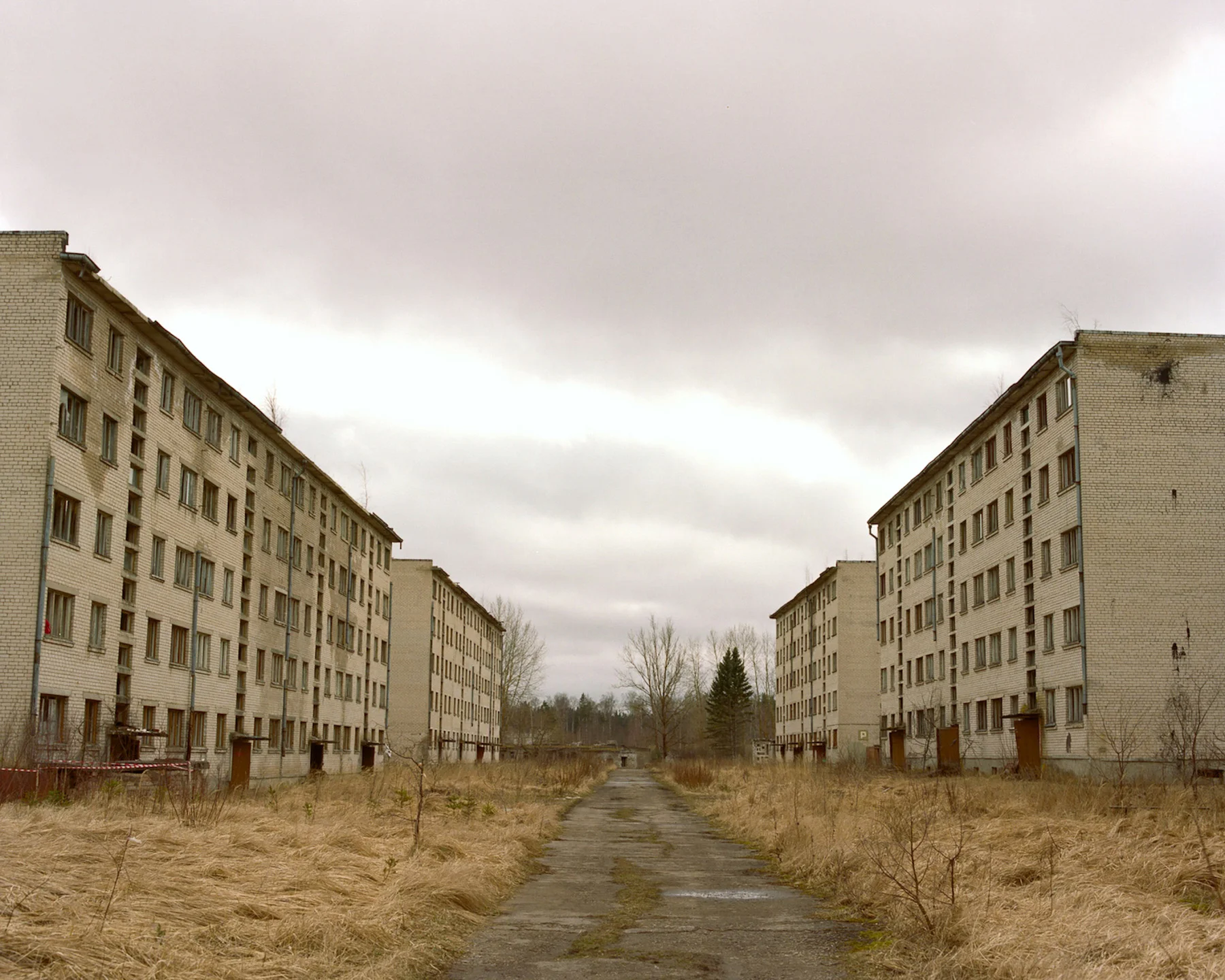
The ruins of Uranium City are unlike anything else in North America. The scale of the abandonment is what shocks — not a single building or a mine site, but an entire suburban grid, complete with paved roads, sidewalks, fire hydrants, and street signs, slowly being digested by the boreal forest.
Candu High School is the defining image. The gymnasium floor is warped and buckled, deflated basketballs sitting where they were left. Textbooks collect decades of dust on classroom desks. Lockers stand open, rusting in the damp subarctic air. The heavy fire doors — the ones that cost so much money, installed just years before the closure — still swing on their hinges. The building was not stripped or demolished. It was paused. The bell could ring for recess and the hallways would be ready, if anyone were left to walk them.
The residential suburbs are worse, because they are more intimate. Bungalows that would not look out of place in Saskatoon or Winnipeg stand with shattered windows, peeling siding, and birch trees growing through the living room floors. Shag carpet from 1978 buckles under the moisture. Wood stoves rust in corners. The peeling wallpaper preserves the taste of a decade — the 1970s, frozen in a place that was already frozen. The comparison to Pripyat is inevitable: both are modern towns abandoned suddenly enough to preserve the texture of daily life. Pripyat was killed by a reactor explosion in the middle of the night. Uranium City was killed by a man in a suit reading numbers from a balance sheet. The aesthetic of the aftermath is the same — the domestic objects of a functioning life, suspended in the silence of a life that stopped — but the cause is quieter, and in some ways more unsettling. A nuclear disaster is an act of physics. A mine closure is an act of arithmetic.
The Uranium City Hotel burned down — the exact date varies in local memory, but the loss of the town’s social centre was felt as a second death. The hospital scaled down to a clinic, then closed entirely in the spring of 2003. The infrastructure that was designed for 5,000 people now serves fewer than a hundred, and the gap between design capacity and reality is visible in every building, every boulevard, every empty parking lot slowly cracking under the frost.
Visiting Uranium City, Canada — The Atlas Entry
How to Get to Uranium City — Flights, the Ice Road, and What to Expect
Uranium City is one of the most logistically challenging destinations in North America. There is no all-season road. The primary access is by air: Rise Air (formerly Transwest Air) operates scheduled flights from Saskatoon, stopping at Prince Albert, Points North, and Stony Rapids before landing at Uranium City’s airport. Tickets are expensive. Flights are subject to the absolute authority of northern weather — cancellations for fog, ice, or wind are routine and can last days.
The only alternative is the Athabasca Seasonal Road, the ice road that opens for a few weeks in February and March when Lake Athabasca freezes solid enough to support vehicles. Driving it is a commitment: miles of white nothingness, the ice booming and cracking beneath the tires, the knowledge that hundreds of feet of freezing water lie beneath the surface. The ice road connects Uranium City to Fond du Lac and eventually the all-weather road at Stony Rapids. For the residents, it is a lifeline — the annual window when fuel trucks arrive and supplies can be driven in. For the visitor, it is one of the most surreal driving experiences on the continent.
Once in Uranium City, there are no rental cars, no hotels in any conventional sense, and limited cell service. Accommodation and vehicle access must be arranged in advance with local residents. The community is small, private, and weary of outsiders who treat their home as a theme park. Respect is the currency of the north.
The ghost suburbs — the residential areas abandoned since 1982 — are extensive and accessible on foot, but structurally dangerous. Collapsing roofs, floors rotted by decades of moisture and frost heave, black mould in damp basements, and bears that roam the streets are all real hazards. The mine sites and tailings ponds are fenced and genuinely hazardous — background radiation in the townsite itself is comparable to other locations on the Canadian Shield, but the specific waste areas carry risks from radon inhalation and contaminated dust. The distances are vast, the nearest hospital is far away, and a broken leg in a ruined basement means waiting a very long time for help.
Uranium City and the Ethics of Exploring Canada’s Abandoned North
Uranium City occupies a strange position in the geography of abandonment. For the urban exploration community, it is a holy grail — the sheer scale of the ruins, the preservation of domestic interiors, the subarctic setting — unmatched anywhere in North America. For the people who live there, it is home. The tension between those two realities is real and unresolved.
The residents are not museum docents. They drive trucks down the decaying boulevards, maintaining a semblance of community in the skeleton of a city built for fifty times their number. They are resilient, tough, and deeply connected to the land — hunting, fishing, and living in a way that makes the “Model City” ambitions of the 1950s planners seem like a fever dream from another civilisation. They have watched photographers come and go, watched YouTube creators film their homes without asking, watched the outside world treat their daily life as content.
Bodie, California, preserved as a state park in the dry desert air, charges admission and posts rangers at the doors. Humberstone, Chile, another commodity-bust ghost town, has UNESCO protection and a visitor centre. Uranium City has neither. It has the people who stayed, and the forest that is slowly, patiently, taking it all back.
The tarmac at the airport is still absurdly long. The runway was built for a future that lasted thirty years and ended with a corporate jet. The planes that land there now are small — twin-engine turboprops carrying mail, groceries, and the occasional visitor who has come to see what happens when a nation builds a city for a mineral and then walks away when the price drops. The silence that greets them on the ground is not the silence of emptiness. It is the silence of a place that remembers being full, and has not yet decided whether to grieve or to grow over the memory.
Frequently Asked Questions
What is Uranium City and why was it abandoned?
Uranium City is an unincorporated settlement in extreme northwestern Saskatchewan, Canada, on the northern shore of Lake Athabasca. It was founded in 1952 as a planned service town for the uranium mines operating in the Beaverlodge Lake region during the Cold War. The town grew to nearly 5,000 residents with full municipal infrastructure — schools, a hospital, paved roads, and a hotel. On December 3, 1981, Eldorado Nuclear Limited announced the permanent closure of the Beaverlodge mine due to declining ore grade and collapsing uranium prices following the Three Mile Island accident. Ninety percent of the population left within six months. The Uranium City Act was repealed in October 1983, and the settlement has had no municipal status since.
How many people still live in Uranium City?
The 2021 Canadian census recorded 91 residents living in 41 of the settlement’s 59 remaining private dwellings. The population includes First Nations and Métis residents as well as a small number of non-Indigenous holdouts. There is no grocery store, no gas station, and no all-season road. Food and fuel are flown in or transported over the seasonal ice road that opens for a few weeks each winter.
Is it safe to visit Uranium City?
Background radiation levels in the townsite itself are generally comparable to other locations on the Canadian Shield and do not pose a significant risk during a short visit. The genuinely hazardous areas are the fenced former mine sites and tailings ponds, where radon gas, contaminated dust, and residual radioactive materials remain present. The greater dangers for visitors are structural — collapsing roofs, black mould in abandoned buildings, rotted floors, and wildlife including bears. The nearest hospital is far away, and emergency services are limited.
How do you get to Uranium City?
There is no all-season road to Uranium City. The primary access is by air: Rise Air operates scheduled flights from Saskatoon, stopping at Prince Albert, Points North, and Stony Rapids. Flights are expensive and frequently cancelled due to weather. The only ground access is the Athabasca Seasonal Road — an ice road across frozen Lake Athabasca that opens for a few weeks in February and March. Once in Uranium City, there are no rental cars, no hotels, and limited cell service. All arrangements must be made in advance with local residents.
What happened to the uranium mines around Uranium City?
The Gunnar Mine operated from 1955 to 1964 and was abandoned with its tailings left on the Crackingstone Peninsula. The Eldorado Beaverlodge operation ran from the early 1950s until its closure in June 1982. Both sites left significant radioactive contamination. The Saskatchewan Research Council’s Project CLEANS has been remediating the sites for decades. The Beaverlodge properties were delisted from Canadian Nuclear Safety Commission licensing in May 2025.
Did the uranium from Uranium City go into nuclear weapons?
Canadian uranium from the Athabasca region contributed to the Allied nuclear weapons program during World War II, with ore processed at Port Hope, Ontario, under the classified operations of Eldorado Mining and Refining. After the war, Beaverlodge uranium supplied Cold War stockpiles. By the 1960s, Canadian government policy prohibited the use of domestically mined uranium for military purposes, and the Beaverlodge output shifted to fuelling Canada’s civilian CANDU reactor program.
Sources
- Eldorado: Canada’s National Uranium Company — Robert Bothwell, University of Toronto Press (1984)
- Uranium City: A Short History — UraniumCity-History.com, community history archive (2023)
- Saskatchewan Uranium Miners’ Cohort Study (Part I): Cancer and Mortality, 1948–2006 — Saskatchewan Ministry of Health / Health Canada epidemiological report
- Project CLEANS: Cleanup of Lands Environmentally Affected by Nuclear Sites — Saskatchewan Research Council, official program documentation (ongoing)
- Beaverlodge Mine and Mill Site — Institutional Control Program — Canadian Nuclear Safety Commission (2025)
- Uranium Mining and Hydrogeology — Broder J. Merkel & Andrea Hasche-Berger (Eds.), Springer (2008)
- Planning for Growth Northern Program: Uranium City — Saskatchewan Ministry of Government Relations
- Yá thi Néné Collaboration Agreement — Cameco Corporation / Orano joint announcement (2016)
- 100 Days in Uranium City — Ariane Dénommé, graphic narrative (2021)
- The Uranium Times — Local newspaper archive, Uranium City (1954–1982)
- Community Profile: Uranium City — Cameco Northern Saskatchewan (cameconorth.com)
- Uranium City, Saskatchewan — The Canadian Encyclopedia (2021)