The Drone That Exposed What New York Had Always Known
April 2020. A drone operator contracted by Reuters climbs above the eastern tip of Hart Island and captures footage that will reach hundreds of millions of viewers within 24 hours. Below him, men in white Tyvek hazmat suits lower plain pine coffins into a long rectangular trench, moving with the practiced efficiency of a municipal operation. The men doing the lowering are inmates from Rikers Island, paid 50 cents an hour for the work detail. The coffins stack two deep, two across. The trench is big enough for more.
The footage shocks the world. New York City — the most photographed, most covered, most documented city on Earth — has been burying its unclaimed dead in mass graves a mile offshore for 151 years, and for a moment it looks like a secret. It is not a secret. Journalists had documented it for decades. Advocates had fought over it for years. The Hart Island Project had published a searchable database of the dead. What the footage did was force the information into the one context where it could not be dismissed: a global pandemic, overwhelmed hospitals, refrigerated trucks parked outside morgues, and a world already primed to see death handled at scale.
Hart Island is not a tragedy in the way that North Brother Island is a tragedy — no single disaster produced its million dead. What produced them was quieter and more systemic: the ordinary arithmetic of a city that generates, every year, a certain number of people who die without money, without documentation, or without anyone to claim them. Hart Island is what New York built to process that arithmetic. Not a memorial. An administrative solution. A city reveals itself most clearly in what it does with its dead — and New York, for more than 150 years, buried the poorest million in numbered trenches on a restricted island, dug by prisoners, closed to families, managed by a jail.
Hart Island's Civil War Origins: POW Camp, the 31st USCT, and the First Burial
Hart Island as a Civil War Prison and Military Training Ground
The United States Army arrived on Hart Island in 1864. The island's geography — isolated, difficult to reach, close enough to Manhattan to be logistically useful — made it suitable for a prisoner-of-war camp, and the Union Army established one there in the final year of the Civil War to hold captured Confederate soldiers. The camp was short-lived and poorly documented, but it produced Hart Island's first cemetery: more than 235 Confederate soldiers buried in its soil before the war ended.
The island's next function arrived almost immediately. In 1865, the 31st United States Colored Troops drilled on Hart Island in the months before the regiment mustered out of service — one of the tens of thousands of Black Union soldiers whose training and sacrifice were systematically excluded from the monuments and commemorations the postwar decades produced. The Army returned the island to New York City, which had to decide what to do with a piece of land that nobody particularly wanted and everybody understood could be used for things the mainland preferred not to see.
The city's answer, four years later, was to make it a potter's field.
The First Hart Island Burial: Louisa Van Slyke, April 20, 1869
The first person buried at Hart Island under the new system was a 24-year-old woman named Louisa Van Slyke. She had died at Charity Hospital on Blackwell's Island — the city's municipal hospital for the indigent, on what is now Roosevelt Island — without family, without money, and without anyone to claim her body. On April 20, 1869, a work crew of inmates from the Blackwell's Island workhouse rowed her coffin across the water to Hart Island and lowered it into the ground. No ceremony was recorded. The grave was marked with a numbered stake.
Van Slyke was not unusual. She was simply first. The city had been burying its unclaimed dead in a series of Manhattan potter's fields since the 17th century — the current site of Washington Square Park in Greenwich Village served as one of them — and Hart Island was simply the latest and largest iteration of that practice. Behind Van Slyke came the procession that has not stopped since: immigrants who died before word could reach their families, men who froze in doorways, infants who survived a week or a day, people whose names no one wrote down, people whose relatives were too poor to arrange anything different.
Who Gets Buried on Hart Island: The Demographics of "Unclaimed"
The legal category of "unclaimed" sounds neutral. The demography of Hart Island reveals what it has always meant in practice. Throughout the late 19th and early 20th centuries, the island received disproportionate numbers of recent immigrants who died before their families could be located, Black New Yorkers whose relatives lacked the financial resources or institutional access to secure a private burial, and residents of the city's almshouses, psychiatric wards, and charity hospitals. A dedicated section near the island's center received tens of thousands of stillborn infants and children who died in public institutions — each trench in that section held up to a thousand small coffins.
The city's definition of "unclaimed" also operated under a time limit. Families who could not be reached, could not pay, or could not navigate the bureaucracy within a specified window found their relatives transferred to Hart Island regardless of their intentions. For working-class immigrant families in the early 20th century — dealing with institutions that functioned in a language they may not have spoken, during a time when many recent arrivals had every reason to distrust government agencies — that window was often impossible to meet.
Bobby Driscoll arrived on Hart Island through a different route, and his story cuts through the island's anonymity more sharply than most. Driscoll had been a Disney child star — the studio's first contract actor, the voice of Peter Pan, the face that appeared on lunch boxes and magazine covers across America in the early 1950s. By his mid-twenties he was struggling with addiction and unemployable in Hollywood. He died alone in an abandoned Greenwich Village tenement in March 1968, aged 31, and his body was found by children playing in the building. No identification was found on him. New York City buried him on Hart Island in an unmarked trench, logged as an unidentified male. His mother spent eighteen months not knowing what had happened to him. He was eventually identified through fingerprints, after the fact, and she was told where he lay. She never saw the grave.
Hart Island's Abandoned Buildings: TB Pavilion, Reformatory, and Nike Missiles
A Century of Institutions That Failed and Left Their Ruins Behind
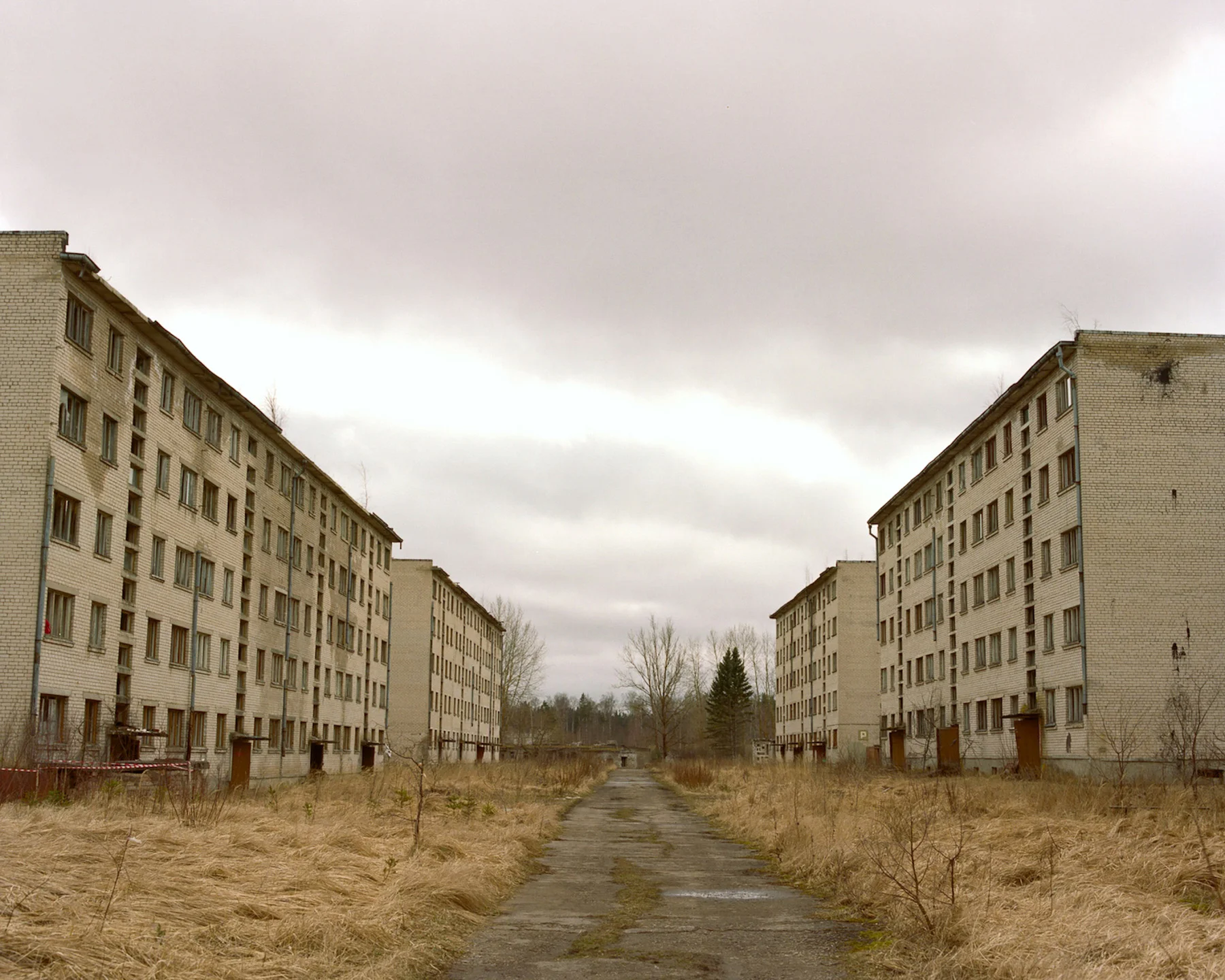
Hart Island's history as a cemetery is only part of its story. The city used the island for a succession of other purposes across the 19th and 20th centuries, each of which eventually failed and left its physical remains standing in the vegetation. A tuberculosis pavilion opened in the 1880s to isolate patients from the mainland population; it was repurposed several times and eventually abandoned, its roof long since collapsed. A boys' reformatory housed juvenile offenders for decades in conditions that ranged from neglectful to brutal. A workhouse for adult male prisoners operated there at various points. A residential drug treatment facility opened in the 1950s and closed within a few years.
During the Cold War, the U.S. Army installed a Nike missile battery on the island's northern end — one of dozens ringing New York City as part of the continental air defense network against Soviet bombers. The missiles were removed when the program wound down in the 1970s, but the concrete launch structures remain, sitting in overgrown clearings a few hundred meters from the civilian cemetery they were never intended to share space with. The island's layered institutional history — cemetery, prison, hospital, missile base — reflects a consistent logic: Hart Island was a place for things the city needed to do but preferred not to look at.
How the Department of Correction Ran Hart Island for 63 Years
In 1956, administrative control of Hart Island passed from the Department of Public Charities to the New York City Department of Correction, a transfer that would define the character of the place for the next 63 years. The DOC managed the cemetery as an extension of its incarceration operations: inmates from Rikers Island were ferried to Hart Island on work details to dig the graves, lower the coffins, and backfill the trenches. The pay was 50 cents an hour. The assignment was considered relatively desirable — it moved inmates off Rikers, into open air, away from the overcrowding of the jail complex — which communicates something precise about the conditions that made digging mass graves an attractive alternative.
The institutional logic was coherent in a narrow bureaucratic sense and incoherent in every other. A corrections department exists to manage people the state has determined need to be confined. A public cemetery exists to serve the living who lost someone. These two functions do not belong in the same agency, and for six decades the DOC's instinct toward security, restriction, and control governed every decision about how Hart Island operated. The result was a public cemetery that ran like a prison — with the dead inside and their families kept out.
Hart Island and the AIDS Crisis: The Epidemic's Forgotten Burial Ground
How the AIDS Epidemic Transformed Hart Island in the 1980s
No chapter in Hart Island's history produced more burials in a shorter time, or revealed more starkly how the city's definition of "unclaimed" functioned under pressure, than the AIDS epidemic of the 1980s and early 1990s. As the disease tore through New York City's gay communities, Hart Island began receiving the dead at a pace that had no modern precedent. By the mid-1980s, the island was burying AIDS victims at a rate of several per day. By the end of the decade, it had received thousands of them.
Many of these men had families — parents, siblings, partners — but families who had refused to claim them. The stigma surrounding AIDS, and around the gay men who were dying of it, meant that some families made an active choice not to collect their relative's body. Others had already severed contact years before the diagnosis. Some men had been effectively orphaned by their illness long before they died: discharged from hospitals, evicted from apartments, cut off from support networks. They ended up on Hart Island not because no one knew them, but because the people who knew them would not come.
The city tracked the AIDS burials in the same ledgers as every other Hart Island death — a number, a row, a trench, a date. What the ledgers did not capture was the specific geography of abandonment they represented. A number of advocacy organizations, including the AIDS activist network ACT UP, began documenting the Hart Island AIDS burials in the late 1980s as part of a broader effort to force the city to account for how it was treating the epidemic's dead. The records they assembled through Freedom of Information requests revealed burial totals that the city had never publicized and had no interest in publicizing.
The Hart Island AIDS Memorial and the Fight to Name the Dead
The Hart Island AIDS burials produced one of the most specific grievances in the broader campaign for family access to the island. Partners and friends — people who in many cases had been the sole caregivers for men dying of AIDS, who had sat at hospital bedsides when families refused to come — discovered that they had no legal standing to claim a body or visit a grave. In the legal and social landscape of the 1980s, a same-sex partner was a stranger. The DOC's criteria for visitation required a family relationship the city recognized. The people who had actually loved these men did not qualify.
This specific injustice — the denial of grief to the people who had most earned the right to it — energized the campaign for Hart Island reform in ways that extended beyond the AIDS community. By the time Melinda Hunt founded the Hart Island Project in the 1990s, the AIDS burials had made visible what the island's administration had always produced: a system that defined who counted as family, and then used that definition to keep the wrong people out. The Project's database eventually made it possible for survivors to locate specific burials for the first time. For some, the trench numbers they found represented the first concrete information they had received about where someone they loved had gone.
How Families Were Denied Access to Hart Island for Over 60 Years
Hart Island Visitation Under the Department of Correction
For most of the DOC era, the families of people buried on Hart Island could not simply visit. The island was a corrections facility. Access required a formal petition to the Department of Correction, which reviewed requests on its own timeline and by its own criteria, and which granted supervised visits rarely and always with a corrections officer present. Many families who tried to find out where their relatives were buried discovered that the burial records were not publicly accessible. Others were told they could apply for a visit and then waited months, or years, or received no response at all.
The cruelty of this arrangement was not primarily procedural. It was the specific experience of grief being processed through a jail bureaucracy. A mother whose infant was buried on Hart Island in 1974 and who wanted to place flowers at the grave had to submit a written request to the Department of Correction and wait to be told whether she was permitted to do so. Many were denied. Many more never tried because they did not know they had any standing to ask. The families of the Hart Island dead were, by the city's administrative logic, an inconvenience to a corrections operation — not the reason the place existed.
Melinda Hunt and the Hart Island Project's 30-Year Campaign for Access
Melinda Hunt is an artist and researcher who has spent more than thirty years doing what the city refused to do: document every person buried on Hart Island and make that information publicly accessible. Hunt founded the Hart Island Project in the 1990s after visiting the island on a photography assignment and understanding what she was looking at — trenches holding 150 adult coffins each, stretching across acres of ground, with no corresponding public record that families could use to find their relatives.
The Hart Island Project spent years using Freedom of Information requests to obtain the DOC's burial ledgers, then digitizing and publishing them in a searchable online database. The work required sustained legal pressure and produced results that were consistently inadequate: records released in formats designed for administrative rather than public use, names misspelled, entries incomplete, database structures that resisted the kind of searching a grieving family member would actually attempt. Hunt also documented the families directly — interviewing people who had spent years not knowing where their relatives were buried, or who had known and been turned away at the ferry.
The campaign built around this documentation eventually moved the legislature. After years of advocacy from the Hart Island Project and allied organizations, New York City in 2019 transferred administrative control of the island from the Department of Correction to the Department of Parks and Recreation. The corrections ferry became, in principle, a public ferry. Families could now request visits without petitioning a jail. The change was significant and long overdue, and it left unresolved every structural question about how a city properly memorializes a million people it spent 150 years burying without ceremony.
Hart Island During COVID-19: When the Mass Graves Became Global News
The April 2020 drone footage did not reveal anything new. The trench burials, the pine coffins, the Rikers inmates in work details — all of it had been documented by journalists and researchers for decades. The footage's impact came from context, not disclosure. New York was in the first catastrophic weeks of its COVID-19 surge. Hospital morgues were full. Refrigerated trucks were parked on side streets. The daily death toll was running above 800. The footage arrived into this atmosphere and became the image of pandemic mortality in America.
City officials responded by pointing out, accurately, that Hart Island had been New York's potter's field for 151 years and that the COVID burials followed standard procedure. Families of COVID victims who recognized the footage found this argument inadequate. Some had already discovered what made the 2020 moment particular: relatives who had died during the hospital surge — people who had families, who were not legally unclaimed, but whose bodies could not be immediately retrieved amid the chaos — had been transferred to Hart Island during the crisis period. The 2019 Parks transfer had opened the ferry in principle. The island's institutional gravity had not changed.
Hart Island Today: The Cemetery, the Ruins, and the Unfinished Transition
Hart Island stretches roughly a mile long and a quarter mile wide. Most of it is cemetery — row upon row of plain white grave markers, each inscribed with a number rather than a name, arranged in the grid that a century and a half of DOC logistics produced. The southern end holds the oldest graves; the northern end received the most recent burials. Between them, the ruins of the island's other lives accumulate: the TB pavilion with its collapsed roof open to the sky, the reformatory buildings half-consumed by vegetation, the Nike concrete launch pads sitting silent in overgrown clearings.
The Parks Department transfer made the island more accessible than it has ever been. The ferry runs on a limited schedule from the City Island Avenue pier in the Bronx, and the Hart Island Project maintains a searchable database at thehartiislandproject.org where families can look up burial locations by name. General public visits are available on scheduled days. Families of the buried have separate access for grave visits.
What visitors find is not what most cemeteries look like. There are no inscribed headstones, no flowers, no personal objects. The markers are numbered. The ruins stand unrenovated — partly because restoration is expensive, partly because the city has not resolved what Hart Island should become now that it is no longer purely a corrections operation. The island sits in an incomplete transition between what it was and what it might be, and the question of how to memorialize a million people who were buried, by design, without memorialization has no obvious answer.
Visiting Hart Island: Access, Ferries, and What to Expect
The ferry to Hart Island departs from the City Island Avenue pier at the northern end of City Island in the Bronx — accessible by the BX29 bus from Pelham Bay Park station on the 6 train. The Parks Department operates scheduled public visits; check the NYC Parks website before traveling, as availability changes seasonally and dates fill up. The crossing takes approximately ten minutes. There is no admission charge.
The island is open to general visitors on public access days and to families of the buried on dedicated family visit days — the distinction matters logistically, and the scheduling is separate. Families using the Hart Island Project database can identify section and row numbers for specific relatives before the visit. The Project's staff have spent years assisting families with this process and are a more reliable resource than the city's own information channels.
Walking the island is quietly disorienting. The scale — a million burials compressed into 101 acres — is not immediately legible. The markers look sparse until the arithmetic arrives: each numbered stake represents a trench below, and each trench holds up to 150 adult coffins stacked two deep and two across. The reformatory is structurally unsafe and closed to visitors. The Nike launch structures are fenced. The TB pavilion can be seen but not entered.
City Island itself is five minutes from the ferry pier and functions as a working neighborhood — seafood restaurants, a nautical museum, residential streets — and makes a practical base for a visit. North Brother Island, the other sealed island in New York's archipelago of institutional abandonment, is not publicly accessible but its ruins are visible from parts of the eastern Bronx shoreline.
Hart Island is not comfortable to visit. It was not designed to be visited at all. Standing at the numbered markers, understanding what is stacked beneath — understanding that a million people lie here in pine boxes because the city needed somewhere to put them and preferred not to be asked about it — produces a specific feeling that is not quite grief and not quite anger. It is what you feel when you realize that a system is working exactly as it was designed to work.
Frequently Asked Questions About Hart Island
How many people are buried on Hart Island?
More than one million people have been buried on Hart Island since the cemetery opened in 1869, making it the largest publicly funded burial ground in the United States and one of the largest in the world. Burials continue to this day, with the island receiving around 1,000 new interments per year. Each adult trench holds approximately 150 coffins, stacked two deep and two across in rows. A separate section near the island's center was designated for stillborn infants and children who died in public institutions, with individual trenches holding up to a thousand small coffins.
Who gets buried on Hart Island?
Anyone who dies in New York City and whose body is not claimed within a legally specified window may be transferred to Hart Island. In practice, this includes people who die without family or whose families cannot be located, individuals whose relatives lack the financial means to arrange a private burial, unidentified remains, and stillborn infants. The category has always tracked closely with poverty, immigration status, and race. During the AIDS epidemic, many of the men buried on Hart Island had living family members who refused to claim them due to stigma — meaning "unclaimed" sometimes described a social rejection rather than an absence of kin.
Can you visit Hart Island?
Yes, though access remains more limited than a standard public cemetery. Since New York City transferred administrative control from the Department of Correction to the Department of Parks and Recreation in 2019, Hart Island has been open to scheduled public visits. The ferry departs from the City Island Avenue pier in the Bronx, accessible by the BX29 bus from Pelham Bay Park station on the 6 train. General public visits and family-specific grave visits are scheduled separately — check the NYC Parks website for current dates. There is no admission charge. Families of the buried can use the Hart Island Project's searchable database at thehartiislandproject.org to locate specific burial sections before visiting.
Why were families denied access to Hart Island for so long?
From 1956 until 2019, Hart Island was administered by the New York City Department of Correction, which treated the island as a corrections facility rather than a public cemetery. Access required a formal petition to the DOC, which granted supervised visits on its own terms and at its own pace — with a corrections officer present. Many families were denied outright or simply never received responses to their requests. The rationale was operational, but the effect was that grief required a security clearance. The 2019 transfer to the Parks Department ended DOC control, though advocates note that bureaucratic obstacles to family access did not disappear overnight.
How did the AIDS epidemic affect Hart Island?
During the AIDS epidemic of the 1980s and early 1990s, Hart Island received thousands of victims of the disease — many of them gay men whose families had refused to claim their bodies due to stigma, or who had been effectively abandoned before they died. At the height of the crisis, the island was burying AIDS victims at a rate of several per day. Advocacy groups including ACT UP documented the burials through Freedom of Information requests and revealed totals the city had never publicized. The epidemic also exposed a specific injustice in the DOC's visitation policy: same-sex partners, who in many cases had been the sole caregivers for dying men, had no legal standing to visit their graves because the city did not recognize them as family.
Who was Bobby Driscoll and how did he end up on Hart Island?
Bobby Driscoll was a Disney child actor — the studio's first contract player, the voice of Peter Pan, and a prominent screen presence in the early 1950s. By his mid-twenties he was struggling with addiction and had become unemployable in Hollywood. He died alone in an abandoned Greenwich Village tenement in March 1968, aged 31, with no identification on him. New York City buried him on Hart Island as an unidentified male. His mother spent eighteen months not knowing what had happened to him. He was eventually identified through fingerprints, but by then he had already been interred in an unmarked trench. His trajectory — from Disney contract star to numbered grave on a restricted island — is among the most documented individual stories in Hart Island's history.
Sources
- The Hart Island Project — Melinda Hunt (ongoing; thehartiislandproject.org)
- "Hart Island: A Universal History" — Melinda Hunt and Joel Sternfeld (2011)
- "Buried Alive: Hart Island's Unclaimed Dead" — Jennifer Gonnerman, The New Yorker (2016)
- "City of the Dead: New York's Potter's Field on Hart Island" — New York Times Investigative Report (2020)
- "COVID-19 and the Surge at Hart Island" — Reuters Special Report (April 2020)
- "The Long History of Hart Island" — Gotham Gazette (2019)
- "Reclaiming Hart Island: The Campaign to Open New York's Forgotten Cemetery" — Columbia Journalism Review (2018)
- Hart Island Burial Records, 1874–Present — NYC Department of Records and Information Services / Hart Island Project digitization
- "The 31st United States Colored Troops" — National Archives and Records Administration
- "Bobby Driscoll: The Life and Death of a Child Star" — Robert Heide and John Gilman (1994)
- New York City Administrative Code §17-201 et seq. — NYC Health Code provisions governing disposition of unclaimed remains
- "Potter's Field: The History of Public Burial in New York City" — Edwin G. Burrows and Mike Wallace, Gotham: A History of New York City to 1898 (1999)