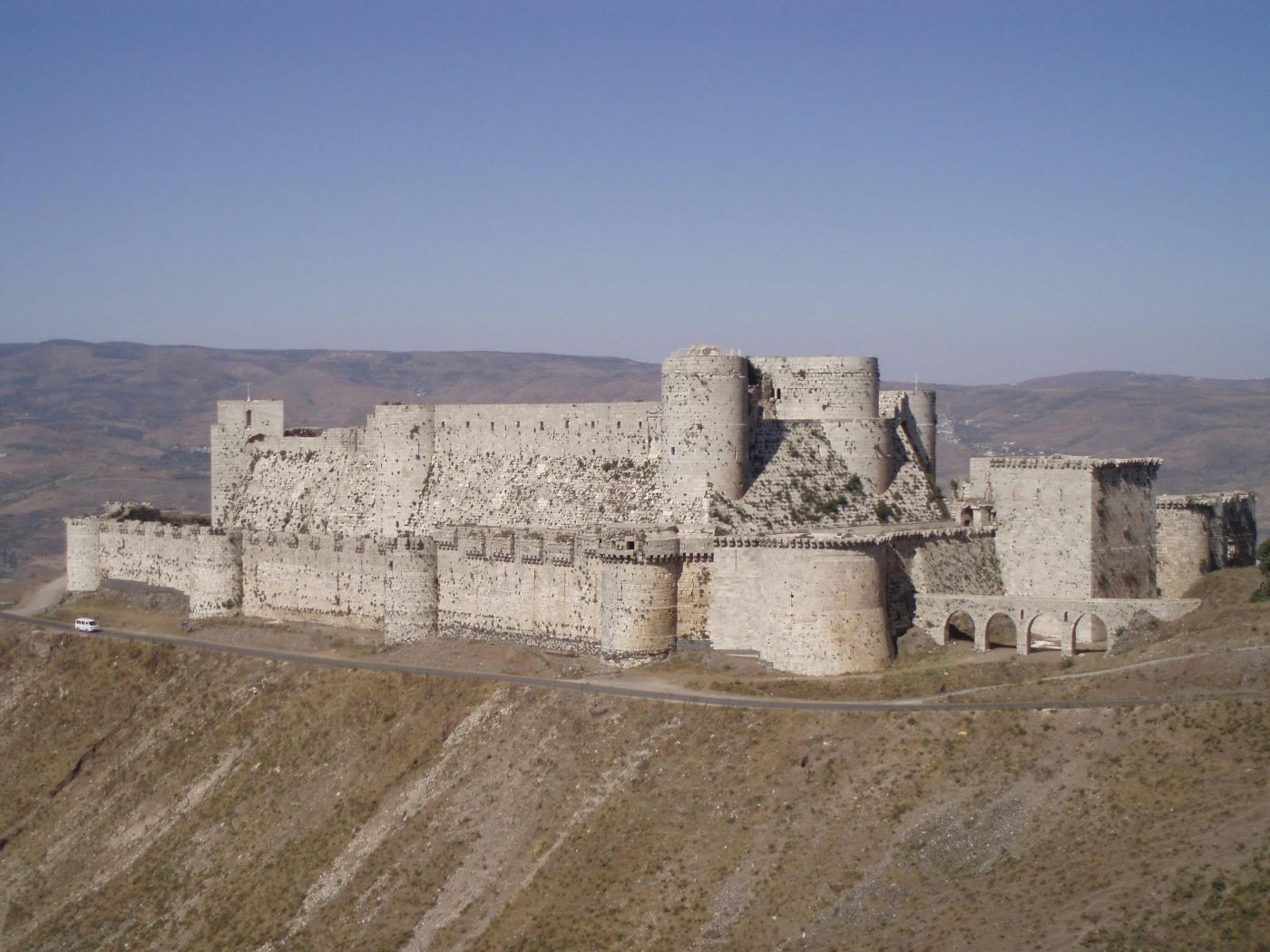
The Stone Leviathan
From the mist of the Orontes Valley, it does not rise like a building; it rises like a geological event. Krak des Chevaliers, known to the locals as Qal'at al-Hosn, is a limestone behemoth that dominates the horizon of western Syria. At dawn, when the low clouds cling to the spurs of the An-Nusayriyah Mountains, the fortress appears to float—a detached island of white stone suspended above the green patchwork of the valley floor.
It is a structure of terrifying scale. To approach it is to feel the weight of eight hundred years of military obsession. The walls are not merely thick; they are mountainous, battered outwards at the base to deflect the earth-shaking blows of siege engines. The silence here is absolute, broken only by the high-altitude wind whistling through the arrow slits and machicolations. It is a silence that feels heavy, pregnant with the memory of the thousands of men who lived, prayed, killed, and died within this stone leviathan. This is not a ruin that asks for pity; it is a sleeping beast that demands respect.
The Throat of Syria
Geography is the architect of war, and nowhere is this truer than at the Homs Gap. This depression between the coastal mountain ranges and the interior deserts is the only natural gateway connecting the Mediterranean Sea to the cities of the Syrian interior—Homs, Hama, and Damascus. It is the wind tunnel of the Levant, a strategic choke point that has dictated the flow of armies since the Bronze Age.
Whoever holds the Gap holds the throat of Syria. For the Crusaders establishing their Latin states in the 12th century, controlling this passage was not optional; it was existential. It was the lifeline to the sea and the barrier against the Muslim armies of the east. They did not build Krak des Chevaliers for vanity or prestige. They built it because they were a terrifyingly small minority in a hostile land, and they needed an anchor that could weather the fiercest storms of the Islamic world.
Monks of War
In 1142, the Count of Tripoli, overwhelmed by the cost of defending the frontier, gifted the site to the Knights Hospitaller. These were not the romanticized knights of Victorian fiction, rescuing damsels in shining armor. They were the Fratres Hospitalis—warrior-monks bound by vows of poverty, chastity, and obedience.
Their life inside the Krak was a grueling duality of monastic silence and military violence. They were men who washed the feet of the sick in Jerusalem and then rode north to sever the limbs of their enemies in the Syrian hills. Inside the fortress, the atmosphere was rigid and austere. They slept in communal dormitories, ate in silence while scripture was read, and trained relentlessly. They were the special forces of the medieval world, disciplined, fanatical, and terrifyingly efficient. To the Muslim chroniclers of the time, they were the most hated of enemies because they could not be bought, and they rarely surrendered.
A Machine for Living and Dying
At its peak, Krak des Chevaliers housed a garrison of 2,000 men along with their horses. It was not just a castle; it was a self-contained city designed to survive the apocalypse. The Hospitallers knew that when a siege came, it could last for years.
To survive isolation, they turned the fortress into a machine of sustainability. They built a massive windmill on the ramparts to grind grain when the valley mills were destroyed. They constructed a stone oven the size of a modern apartment, capable of baking bread for an army every morning. Most impressively, they carved vast cisterns into the bedrock, utilizing the castle’s aqueduct system to store millions of liters of rainwater—enough to keep the garrison and their horses alive for five years without a single drop from the outside world. It was a masterpiece of logistics, an unsinkable stone ship anchored on a mountaintop.
Geometry of Survival
The genius of Krak des Chevaliers lies in its paranoia. The Hospitallers trusted nothing, not even their own walls. They expanded the fortress into a concentric castle—a fortress within a fortress. If the enemy breached the massive outer wall, they would simply find themselves trapped in a killing zone—a narrow, open-air ditch overlooked by the even higher, thicker walls of the inner ward.
The architects weaponized gravity itself. The base of the inner walls features a massive talus—a sloping skirt of solid masonry. This served two brutal purposes: it prevented sappers from digging beneath the foundations, and it acted as a ricochet board. When defenders dropped heavy stones from the machicolations above, the stones would hit the talus and bounce horizontally into the charging infantry, shattering legs and morale with unpredictable violence. The entrance was a "bent gate," a winding, dark tunnel with hairpin turns that prevented battering rams from building momentum, forcing attackers to fight hand-to-hand in pitch darkness while boiling oil and arrows rained from holes in the ceiling.
The Lion at the Gates
By 1271, the Crusader states were crumbling. The man who came to finish them was Sultan Baibars. Baibars was a figure of nightmares for the Franks—a former Kipchak slave who had risen through the ranks of the Mamluk military caste to become the Sultan of Egypt and Syria. He was a brilliant strategist and a ruthless conqueror, known as "The Panther."
Baibars arrived at the Homs Gap not with a raiding party, but with a nation on the move. His army covered the valley floor. He brought with him heavy mangonels—massive counterweight trebuchets capable of hurling 300-pound stones. For weeks, the sky rained granite. The outer walls, for all their strength, began to crack under the relentless pounding. The Hospitallers, their numbers depleted by years of attrition, watched from the inner towers as the "Lion of Egypt" dismantled their outer defenses stone by stone.
The Art of Deception
The end of Krak des Chevaliers did not come in a blaze of suicidal glory. It came through a masterstroke of psychological warfare. By the end of March 1271, Baibars’ forces had breached the outer ward. The surviving knights retreated into the inner castle, the unconquerable core. Baibars knew that taking this final redoubt would cost him thousands of men and months of time he did not have.
So, he used a pen instead of a sword. Mamluk spies forged a letter, purportedly from the Grand Master of the Hospitallers in Tripoli. The letter was smuggled into the castle. It read, effectively: "Aid is not coming. You have done your duty. Surrender with your lives."
Exhausted, starving, and believing they had been granted permission by their superior to yield, the knights opened the gates on April 8, 1271. They were allowed to leave safely, marching to the coast under a safe-conduct pass. Baibars sat in the Great Hall, having conquered the unconquerable not by force alone, but by breaking the will of its defenders.
The Crescent on the Tower
Baibars did not raze the fortress; he respected strength too much for that. Instead, he appropriated it. He repaired the damage his mangonels had caused, reinforcing the walls with even heavier masonry. On the towers, he ordered his emblem—the lion—carved into the stone, marking the castle as Mamluk property.
The greatest transformation occurred in the castle’s spiritual heart. The austere Gothic chapel, where the monks had chanted Latin mass, was converted into a mosque. The Mamluks did not destroy the Christian architecture; they simply repurposed it. They smashed the altar and added a mihrab (prayer niche) into the southern wall to indicate the direction of Mecca. For centuries afterwards, the call to prayer echoed off the same vaulted ceilings that had once amplified the Gregorian chant.
A Dream in Stone
In the summer of 1909, a young Oxford student named T.E. Lawrence—years before he would become "Lawrence of Arabia"—walked across Syria on foot to study Crusader architecture. When he reached the Homs Gap, he was spellbound.
He famously wrote that Krak des Chevaliers was "perhaps the best preserved and most wholly admirable castle in the world." For the Western world, Lawrence’s romantic descriptions cemented the Krak as the ultimate symbol of the Crusades—a "dream in stone" that represented the zenith of military architecture. It became a monument to a romanticized past, visited by tourists and scholars who saw it as a relic, safe and frozen in time. They were wrong.
The Sleeping Giant Wakes
History is not a line; it is a circle. In 2011, as the Arab Spring mutated into the Syrian Civil War, the strategic logic of the 12th century suddenly applied to the 21st. The Homs Gap was still the throat of Syria.
Rebel factions, including the Free Syrian Army, seized the castle. They were not historians; they were fighters who needed the high ground. For the first time in 800 years, Krak des Chevaliers was an active military fortress. The village of Al-Hosn, huddled at the base of the walls, became a kill zone. The rebels barred the great iron gates, set up snipers in the arrow slits, and slept in the vaulted dormitories of the knights. The fortress had awoken from its museum slumber to resume its original function: war.
Siege of the 21st Century
From 2012 to 2014, the Syrian government laid siege to the castle. It was a surreal echo of 1271, but with infinitely more destructive power. Instead of mangonels, the Syrian Arab Army used MiG fighter jets and heavy artillery.
The damage was heart-breaking. A regime airstrike punched a hole through the roof of the "Hall of the Knights," bringing daylight into the Gothic loggia. Mortar fire pockmarked the pristine limestone façade. During intense firefights, the inner staircase—a masterpiece of medieval masonry—was scorched black by burning tires and debris. For two years, the castle absorbed the punishment. It proved the Hospitaller engineers right: the structure was so over-engineered that even modern high explosives could wound it, but could not destroy it.
The Silence After the Storm
In March 2014, following a heavy bombardment, government forces recaptured the fortress. The rebels retreated into Lebanon, and the Syrian flag was raised over the donjon.
When the smoke cleared, the silence returned—but it was a different silence. It was the silence of a crime scene. The courtyards were littered with spent shell casings, MRE rations, and bandages. The walls were scarred by shrapnel. The soot from the fires coated the delicate Gothic arches in a layer of greasy black grime. The castle had survived, but it had lost its innocence. It was no longer just a relic of ancient holy wars; it was a victim of a modern civil war.
Dark Tourism I: Entering the Void
Visiting Krak des Chevaliers today is a haunting experience. The journey usually begins in Tartus or Homs, driving through checkpoints manned by teenage soldiers with Kalashnikovs. As the castle comes into view, the first thing you notice is the isolation. Before the war, tour buses lined the parking lot. Now, you are likely to be the only soul there.
Walking through the dark gatehouse feels like entering a tomb. The wind howls through the empty corridors with a mournful intensity. There is no ticket booth, no audio guide, no safety railing. You are alone with the stone. The sheer emptiness amplifies the scale of the place; your footsteps echo loudly in the Great Hall, bouncing off walls that have seen everything from Crusader feasts to modern firefights.
Dark Tourism II: The Logistics of Return
Travel to Syria is currently possible but complex. It requires a security clearance from the Ministry of Tourism and a guided visa. You cannot simply backpack to the Krak. You must move with a licensed guide and driver, navigating a landscape that is technically "post-conflict" but still heavily militarized.
The road up to the castle winds through the village of Al-Hosn. This is the most confronting part of the journey. The village was devastated during the siege. You drive past the skeletons of concrete houses, some flattened by airstrikes, others riddled with thousands of bullet holes. The contrast is jarring: the medieval castle remains standing, defiant and largely intact, while the modern concrete homes of the villagers lie in ruin.
Dark Tourism III: Reading the Wounds
For the dark tourist, the walls of the Krak are now a palimpsest of violence. You can trace the history of warfare by the scars on the stone.
The large, rough gouges near the base are from Baibars’ trebuchets in 1271. The neat, circular pockmarks higher up are from Doshka heavy machine guns in 2013. In the cloister, you can see where shrapnel from a modern mortar shell chipped the Latin inscriptions carved by a monk eight centuries ago. UNESCO and Hungarian archaeologists have begun restoration work, but the debate continues: do you scrub away the soot of the civil war, or do you leave it as the latest chapter in the castle’s biography?
The Chapel of Two Faiths
The most spiritually resonant space in the fortress remains the chapel. Standing in the nave, the lighting is dim and dusty. On one side, you see the soaring Gothic arches and the faint outline of frescoes painted by the Crusaders. On the other, cut into the southern wall, is the Mamluk minbar (pulpit) and mihrab.
It is a silent dialogue between Christianity and Islam, frozen in stone. During the recent war, this room was used as a shelter by rebels. Mattresses were laid out on the floor where knights once knelt. To stand here is to feel the weight of religious conflict, but also a strange, accidental harmony—two faiths sharing the same roof, separated only by time.
Into the Belly of the Beast
To truly understand the fortress, you must go underground. The "Dark Passages" leading to the stables and the Great Cistern are a sensory descent. The air temperature drops instantly. It smells of wet earth, old stone, and the metallic tang of bat guano.
The stables are vast, vaulted halls that could hold hundreds of horses. The darkness is total; without a flashlight, you are blind. In these depths, the recent war feels distant. The sheer mass of the rock above you muffles the sound of the wind. It is a space designed for endurance, a reminder that the castle was built not just to fight, but to wait.
The View from the Edge
Climbing the spiral staircase to the Warden’s Tower, you emerge into the blinding Syrian sun. The view is breathless. To the west, the Mediterranean glitters; to the east, the desert begins. Below lies the Wadi al-Nasara, the "Valley of Christians," dotted with villages and monasteries.
From this height, the strategic logic is undeniable. You feel the power of the vantage point. But you also feel the tragedy. Looking down at the ruined village of Al-Hosn, the beauty of the landscape is undercut by the visible scars of the recent trauma. It is a view that men have killed for, generation after generation.
Ethics of the Ruins
Visiting Krak des Chevaliers today demands a high degree of ethical awareness. It is not just a World Heritage site; it is a crime scene and a place of loss for the local community.
The villagers returning to Al-Hosn are rebuilding their lives from zero. As a visitor, your presence brings much-needed economic support, but it can also feel voyeuristic. Respect is paramount. Do not treat the war damage as a cool backdrop for a selfie. Acknowledge that the "history" here isn't ancient; it is a memory that still wakes the locals in the middle of the night.
Conclusion: The Eternal Watch
Krak des Chevaliers is a testament to the impermanence of human ambition and the permanence of stone. It was built by French monks who thought they would rule forever. It was conquered by Mamluk sultans who thought their empire was eternal. It was bombed by modern generals who thought high explosives could erase history.
They are all gone, or going. The knights are dust; the sultans are history; the soldiers have retreated. But the castle remains. It sits on its mountain, scarred and soot-stained, watching the Homs Gap with an indifferent gaze. It is the unconquerable witness, waiting patiently for the next army, the next siege, and the next traveler to walk through its shadowed gates.
Sources & References
- UNESCO World Heritage Centre. "Crac des Chevaliers and Qal’at Salah El-Din." (Official listing and damage reports). UNESCO Link.
- Kennedy, Hugh. (1994). Crusader Castles. Cambridge University Press. (The definitive academic text on the architecture and history).
- Lawrence, T.E. (1988). Crusader Castles. Clarendon Press. (Lawrence’s thesis and observations).
- The Guardian. "Syrian army retakes Crusader castle of Krak des Chevaliers." (Reporting on the 2014 recapture). Guardian Link.
- BBC News. "Syria conflict: Krak des Chevaliers citadel damaged." (2013 damage report). BBC Link.
- Al Jazeera. "Krak des Chevaliers: A fortress on the frontline." (In-depth feature on the siege).
- Dark, K.R. (2004). "The Archeology of the Crusades."
- National Geographic. "Crusader Castles of the Middle East." (Historical context).
- France 24. "Syria's Krak des Chevaliers: From ancient fortress to modern battleground." France 24 Link.
- Institute for the Study of War. "The Battle for Homs." (Military analysis of the strategic importance).
- Boas, Adrian J. (1999). Crusader Archaeology: The Material Culture of the Latin East. Routledge.
- Folda, Jaroslav. (2005). Crusader Art in the Holy Land. Cambridge University Press. (Details on the frescoes).
- Reuters. "Syrian troops seize Crusader castle, cut rebel supply route." Reuters Link.
- Major, Balázs. (Hungarian archaeologist leading the restoration efforts). "Syro-Hungarian Archaeological Mission."
- Michaudel, Benjamin. (2014). "The damage to the Krak des Chevaliers during the Syrian Civil War." IFPO.