
Flying in the Dark: Inside America's Most Secret Airbase
The jet was invisible and it did not exist. On a runway deep inside the Nevada desert, sometime in the mid-1980s, a faceted black aircraft with no lights and no official name rolled into position and lifted off into the dark. It flew only at night, and only over restricted ground, because daylight might reveal what the United States government was still denying with a straight face. The man at the controls was one of fewer than a hundred people cleared to fly it. He could not tell his wife what he did for a living.
On the night of July 11, 1986, one of those men ran out of luck. Ross Mulhare, a major flying an F-117 Nighthawk, went down in the mountains near Bakersfield, California. He was killed instantly. Within hours, Air Force personnel sealed off the crash site, turned away sheriff's deputies and reporters, and began collecting every scorched fragment of a plane the Pentagon insisted was not real. Some accounts describe them scattering wreckage from a conventional jet to muddy the story. The secret held.
This is Tonopah Test Range, the base the curious call Area 52.
Area 52 is the answer to a simple problem: Area 51 got too famous. Groom Lake became a pilgrimage site, a T-shirt slogan, a punchline about little green men, watched around the clock by tourists, UFO hunters, and satellites. Genuine secrecy cannot survive that kind of attention. So while the world stared at one patch of Nevada desert, the Air Force and the CIA did much of the actual hidden work seventy miles to the northwest, at a base nobody was looking at. Tonopah is where the secrets that outgrew Area 51's fame went to keep working — the stealth jets, the stolen MiGs, and the programs still classified today. The fame stayed at Groom Lake. The work moved next door.
From Nuclear Proving Ground to Area 52: How Tonopah Became Nevada's Other Secret Base
The 1950s Origins: Testing Nuclear Weapons Without the Nukes
Tonopah began as a place to drop bombs that could not explode. In the 1950s, the Atomic Energy Commission and its Sandia laboratory needed empty ground to test the non-nuclear guts of atomic weapons — the ballistics, the fuzing, the delivery mechanics — without detonating a warhead. The high, dry, empty basin southeast of the mining town of Tonopah was ideal: flat, remote, and already inside the vast military reservation attached to the Nevada Test Site, where the real mushroom clouds were rising. Sandia dropped inert bomb shapes here for decades to confirm the stockpile would work if it was ever needed.
That was the cover and the origin. A nuclear test range is legitimately, boringly secret — the kind of place that generates restricted airspace and armed patrols without anyone asking why. It was the perfect shell for something else entirely.
The Symbiosis With Area 51
Tonopah and Area 51 worked as a pair, and the division of labor was deliberate. Area 51 at Groom Lake was where the black world invented things — the U-2, the A-12, the earliest stealth prototypes — under the tightest possible security, flying a handful of experimental aircraft in total isolation. Once a secret aircraft had to graduate from a prototype into an actual operational squadron of two dozen jets and hundreds of support crew, it needed more room and a slightly less scrutinized address. It moved 70 miles northwest to Tonopah.
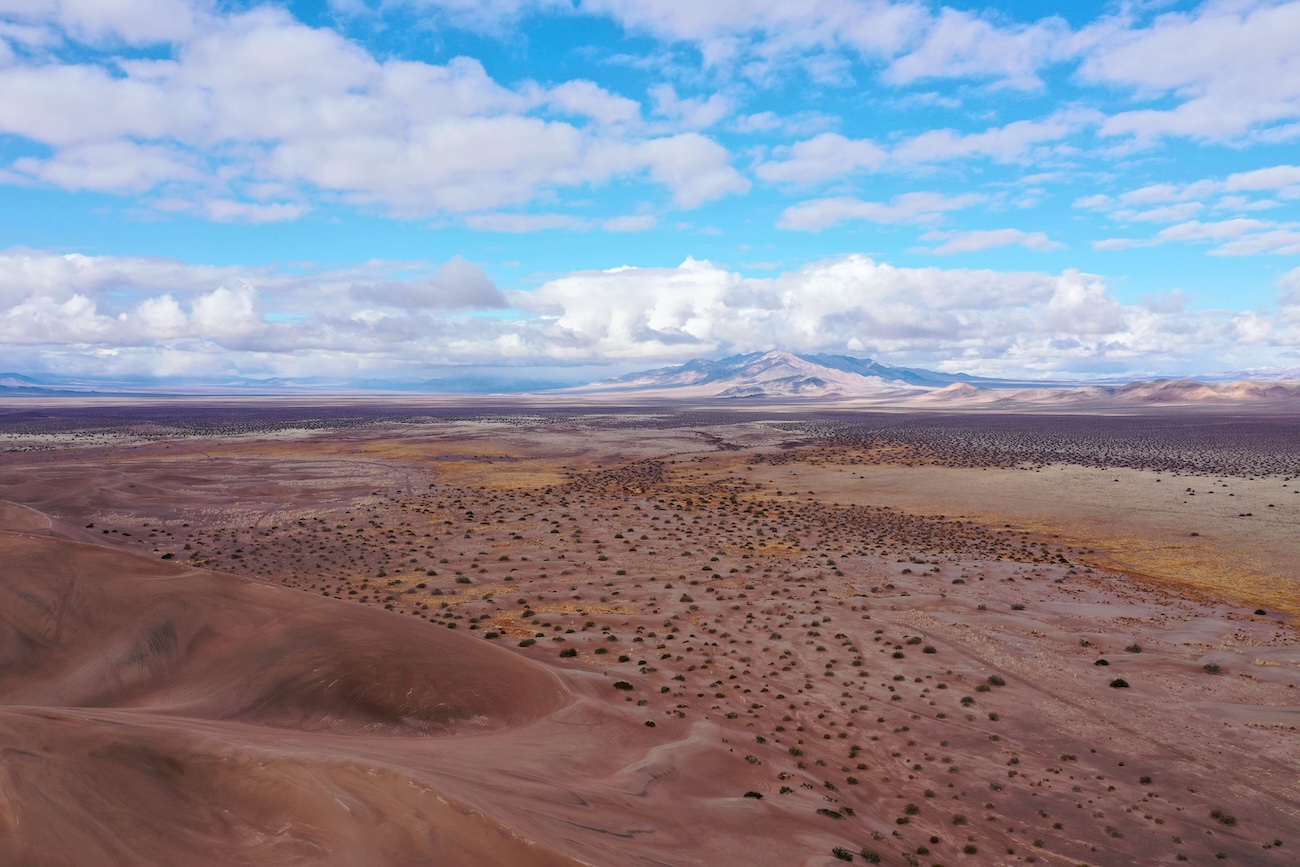
The geography made the arrangement work. The Tonopah Test Range covers roughly 625 square miles of the Nevada Test and Training Range, ringed by mountains and restricted airspace, far from any public road with a sightline. A pilot flying a classified jet out of Tonopah could operate over hundreds of empty miles without a single civilian ever glimpsing the aircraft. Area 51 had the mystique. Area 52 had the space and the quiet to actually fly.
Constant Peg: The Secret Squadron That Flew Soviet MiGs Over Nevada
How America Got Its Hands on the Enemy's Fighters
America flew the enemy's own fighter jets over Nevada, and it acquired them by methods it still will not fully explain. Through the 1960s and 1970s, the United States quietly collected genuine Soviet-built MiGs — a MiG-21 handed over after a defecting Iraqi pilot flew his to Israel in 1966, others obtained through swaps and shifting allegiances in places like Egypt and Indonesia, some simply "acquired." The standard line from the men involved was a shrug: we don't want to talk about how we got them.
The first evaluations happened at Groom Lake, where engineers took the machines apart to learn their limits. The training mission that grew out of it moved to Tonopah. On April 1, 1977, the Air Force stood up a unit with a deliberately dull name — the 4477th Test and Evaluation Squadron — and a far better nickname: the Red Eagles. Their program was called Constant Peg, a name with a quiet human origin. The general who backed the effort, Hoyt Vandenberg Jr., lent his callsign "Constant"; the officer who built it, Gail Peck, added his wife Peggy's nickname. Peck later said the whole airfield started as a sketch he drew in ballpoint pen on a napkin aboard an airliner.
By 1979 the Red Eagles were flying MiG-17s, MiG-21s, and MiG-23s out of Tonopah, their red stars repainted with U.S. markings, hidden hangars keeping them out of satellite view.
Dogfighting the Real Thing
Constant Peg was born from a body count. Over Vietnam, American crews in big, missile-heavy jets like the F-4 Phantom had been shredded by small, nimble MiG-17s and MiG-21s flown by pilots who knew how to turn inside them. The Air Force had convinced itself that dogfighting was obsolete in the missile age. Vietnam proved it fatally wrong. The Red Eagles existed to cure a specific terror the instructors called "buck fever" — the paralyzing shock of seeing a real MiG for the first time in combat, when hesitation gets a pilot killed.
The fix was to let American pilots meet the MiG first over friendly desert. In roughly a decade, the Red Eagles flew more than 15,000 sorties and put nearly 6,000 U.S. Air Force, Navy, and Marine aircrew nose-to-nose with genuine Soviet fighters. A young pilot would climb over the Nevada range and suddenly find a Fishbed or a Flogger boring in on him, flown by an American who had spent years learning exactly how the thing moved. By the time that pilot met a MiG for real, it was an old acquaintance.
The training was dangerous because the aircraft were dangerous. The MiGs were foreign, aging, and cannibalized for parts, and the desert was unforgiving. One day Hawk Carlisle — a future four-star general — put a MiG-23 into a flat spin and had to eject. The jet's Soviet-designed seat used a barometer to time the parachute, and Carlisle fell well below the surrounding ridgelines before his canopy finally cracked open. He lived. Two other men did not.
Only one of the dead was ever named. Captain Mark Postai was killed flying a MiG in the early 1980s, and because the program did not exist, neither did the truth of his death. His family was not told what aircraft he was in, or why, until 2007 — a year after the Air Force finally declassified Constant Peg in November 2006, nearly three decades after Peck sketched the base on a napkin. The payoff came in the skies over Iraq in 1991, where American pilots downed Iraqi MiG-21s and MiG-23s with almost no losses, a lopsided slaughter that veterans credit in part to the men who had spent the 1980s secretly flying the enemy's planes over Tonopah.
The Black Jet: How the F-117 Nighthawk Was Hidden at Tonopah
The 4450th Tactical Group and the Double Lives of the "Bandits"
The F-117 Nighthawk lived at Tonopah for seven years while the government swore it did not exist. The Air Force activated the 4450th Tactical Group in 1979 to turn the radar-invisible prototype developed at Area 51 into a real fighting squadron, and it based the operation at Tonopah, where the surrounding emptiness could swallow an entire fleet of aircraft. The jets began flying combat-ready missions in the early 1980s. They flew almost exclusively at night.
The secrecy shaped every hour of the pilots' lives. Officially, the 4450th was a nondescript unit flying A-7 Corsair attack jets, and the pilots did fly A-7s by day as a cover story and to keep their flying hours legitimate on paper. The real work started after dark. Crews commuted to the base from Nellis Air Force Base near Las Vegas aboard unmarked contractor Boeing 727s, disappearing for the workweek into a place their families could not name. A pilot might tell his wife he flew A-7s at a test range. He actually flew a machine so classified that its shape alone was a state secret, and he flew it in darkness so total that a mechanical failure gave him almost no margin.
Everything about the arrangement was designed to keep the jet off the record. The aircraft returned to their hangars before dawn. Maintenance happened behind closed doors. The whole rhythm of Tonopah inverted — a base most active in the hours when no satellite pass or stray civilian could catch a black wedge crossing the moon.
Death in the Desert and the 1988 Reveal
Secrecy has a cost, and at Tonopah it was paid in the dark. Flying a demanding, first-of-its-kind aircraft at night, over mountains, under a security regime that discouraged questions, killed men. Ross Mulhare's fatal crash near Bakersfield in July 1986 was followed on October 14, 1987, by the death of Michael Stewart, whose F-117 went down on the Nellis range at night. He was killed. Both times, the Air Force controlled the wreckage and the narrative, and both times the jet officially remained a rumor.
The lie could not last forever, if only because the F-117 was about to be useful in a war. On November 10, 1988, the Pentagon released a single grainy photograph and admitted that the stealth fighter was real. The men who had flown it for years in secret could finally, partly, explain where they had been. The Nighthawk went to war in Panama the next year and over Baghdad in 1991, where it struck the most heavily defended targets in the country and came home. It had been forged in the dark at Tonopah, by pilots who had spent years pretending to fly something else. The same secrecy that killed Mulhare and Stewart is what made the weapon possible — the central, uncomfortable bargain of the black world, written into the Nevada desert.
Area 52 Today: What the Tonopah Test Range Still Hides
The Nighthawk Afterlife
The F-117 was supposedly retired in 2008, and Tonopah is where its ghosts live. When the fleet was stood down, many of the jets were not scrapped or sent to museums. They were flown back to Tonopah, sealed into climate-controlled hangars, and kept in a condition that would let them fly again. That was not a metaphor. In the years since "retirement," plane-spotters and pilots have repeatedly photographed F-117s aloft over the Nevada ranges, still black, still flying, decades after the Air Force declared them gone. The world's first stealth fighter refuses to fully disappear, and Tonopah is where it hides between resurrections.
The base's original job never stopped either. Tonopah remains a working nuclear-weapons site, run in part by the Department of Energy, where the reliability of the American stockpile is still tested with the same inert, non-exploding rigor that justified the range in the 1950s. The nuclear mission that gave the base its cover is also, quietly, its most enduring purpose.
Still Dark
Tonopah is still doing exactly what it was built to do, which is why it stays out of the news. The base is a documented home for classified aircraft that graduate from Area 51's laboratories into operational secrecy — the stealthy RQ-170 Sentinel drone, the one later photographed after it went down in Iran, is widely reported to have flown from Tonopah. Whatever the black world is currently building, some of it almost certainly lives and flies here now, in hangars no camera reaches.
The arrangement that defined the Cold War still holds. Area 51 absorbs the fame, the tourists, the "Storm Area 51" memes, and the endless UFO speculation. It functions, whether by accident or design, as a lightning rod. Tonopah stays quiet and keeps working. This is the deeper truth beneath the "Area 52" nickname — the genuinely secret facility is rarely the famous one. Secrecy and celebrity cannot coexist, and the desert has enough room to keep them 70 miles apart.
Visiting Area 52: What You Can and Can't See of the Tonopah Test Range
You cannot visit Area 52, and the signs mean what they say. The Tonopah Test Range sits deep inside the Nevada Test and Training Range, behind miles of restricted land posted with warnings that authorize the use of deadly force. There is no tour, no visitor center, no legal way to approach the airfield. Anyone who drives out looking for the base will find empty highway, distant fences, and, before long, security that has been watching them for miles. The threat here is not folklore. It is federal, armed, and real.
What a traveler can actually experience is the town of Tonopah itself, a former silver-mining outpost on U.S. Route 6 that markets its dark, wide-open skies to stargazers who have no idea what shares the horizon. From public ground, patient plane-spotters occasionally catch distant black shapes maneuvering over the ranges at dusk — the same pastime that first exposed the secrets of Groom Lake. The base's clandestine cousins are worth knowing to understand what kind of place this is: the CIA's own hidden training ground at Camp Peary in Virginia, and the silent surveillance station at Pine Gap in the Australian outback, both built on the same logic — that the most important work of a superpower happens where the public is not permitted to look.
Standing on the highway outside Tonopah means standing at the edge of the visible country and staring at the invisible one. There is no monument here, no marker, no plaque for Mark Postai or Ross Mulhare or Michael Stewart, who died flying secrets over this ground. There is only the desert, the fence, and the knowledge that somewhere beyond it, jets that officially do not exist are still lifting off into the dark — exactly as they were designed to, in the one place nobody thinks to watch.
FAQ
What is Area 52?
Area 52 is an unofficial nickname for the Tonopah Test Range (TTR), a secret U.S. military base in the Nevada desert about 30 miles southeast of the town of Tonopah and roughly 70 miles northwest of Area 51. It covers around 625 square miles inside the larger Nevada Test and Training Range and is run jointly by the Department of Defense and the Department of Energy. The base began in the 1950s as a site for testing the non-nuclear components of atomic weapons and later became the operational home for some of the Cold War's most classified aircraft programs. Much of what happens there remains classified today.
Is Area 52 real, and how is it different from Area 51?
Area 52 is real, though "Area 52" is a popular nickname rather than an official designation — the base is properly called the Tonopah Test Range. The two facilities worked as a pair during the Cold War: Area 51 at Groom Lake was where secret aircraft were invented and first tested in extreme isolation, while Tonopah was where those programs became full operational squadrons with more room to fly. Area 51 attracted global fame, tourism, and UFO speculation; Tonopah stayed comparatively unknown, which made it useful for genuinely secret work. Unlike Area 51, Tonopah has never been strongly linked to alien folklore.
Did the U.S. really fly Soviet MiGs at Tonopah?
Yes. Under a classified program called Constant Peg, the Air Force's 4477th Test and Evaluation Squadron — the "Red Eagles" — flew genuine Soviet-built MiG-17, MiG-21, and MiG-23 fighters out of Tonopah from 1979 to 1988. The aircraft were acquired through defectors, swaps, and other means the government still declines to detail fully. The squadron flew over 15,000 sorties and exposed nearly 6,000 American aircrew to real MiGs so they would not freeze the first time they saw one in combat. The program was declassified in November 2006.
What is the F-117 connection to Area 52?
The F-117 Nighthawk, the world's first operational stealth aircraft, was secretly based at Tonopah from the early 1980s until 1989. The 4450th Tactical Group flew the jets almost exclusively at night to avoid detection, using A-7 Corsair attack planes as a daytime cover story, while pilots commuted from Nellis Air Force Base on unmarked contractor jets. The program stayed secret even after two pilots, Ross Mulhare (1986) and Michael Stewart (1987), died in crashes. The Air Force did not publicly acknowledge the F-117's existence until November 10, 1988.
Can you visit Area 52 or the Tonopah Test Range?
No. The Tonopah Test Range is a restricted military installation with no public access, no tours, and warning signs authorizing the use of deadly force against intruders. The nearest place a visitor can legally go is the town of Tonopah on U.S. Route 6, which promotes its dark night skies for stargazing. Determined plane-spotters sometimes glimpse distant aircraft over the ranges from public land, but the base itself cannot be approached.
Are F-117 stealth fighters still flying at Tonopah?
Officially, the F-117 was retired in 2008, but many of the jets were flown back to Tonopah and kept in storage rather than scrapped. Since then, plane-spotters and pilots have repeatedly documented F-117s flying over the Nevada ranges, indicating the aircraft are still used for training and testing well over a decade after their supposed retirement. The base is also reported to host other classified aircraft, including the RQ-170 Sentinel stealth drone.



%2C%20Konjic%2C%20Bosnia.jpg)


