
Mauerwald, 3 July 1941: Halder Declares the War Won
Franz Halder, chief of the German general staff, sat in a wooden barrack in a pine forest beside a Masurian lake and wrote in his diary that it was probably not too much to say the campaign against Russia had been won in the space of two weeks.
It was the eleventh day of the invasion. Three million German soldiers were driving east on a front 1,600 kilometres long. The Soviet air force had been destroyed on its airfields on the first morning. Białystok and Minsk had fallen and the panzers were closing on Smolensk. Halder, 57, a precise Bavarian with pince-nez who had spent his career preparing for exactly this, allowed himself one sentence of triumph and returned to the day's logistics. Outside the window, Organisation Todt was still pouring concrete for bunkers he did not expect to need.
He needed them for three years. The war he declared won in a fortnight ran for another 1,400 days, and the men who ran it did so from this forest.
The Wolf's Lair was the stage. Mauerwald was the machine. Twenty kilometres of lake country between Rastenburg and Angerburg held the entire nervous system of the eastern war: the Army High Command here, Himmler's SS headquarters fifteen kilometres north, the Reich Chancellery's field office five kilometres away, the Foreign Minister across the lake, the Luftwaffe at the far end of the province. Everything was arranged so that any of them could be at Hitler's map table within half an hour. When the front came in January 1945 the Germans dynamited the compounds that held secrets and left the one that held paperwork, and so the most complete Nazi command complex in Europe survived because nobody thought it worth destroying. The treasure hunters who arrive today are looking for a room that was never here.
Why the Army High Command Built Mauerwald Beside the Wolf's Lair
Fritz and Quelle: The Layout of the OKH Headquarters at Mamerki
Hitler's own headquarters went into the Görlitz forest near Rastenburg in the autumn of 1940, under the cover story of a chemical works, and the army followed the logic of proximity. The Oberkommando des Heeres needed to be near the Führer and out of reach of Soviet bombers, and it chose a wooded tongue of land eighteen kilometres north-east, on the Masurian Canal where it enters Lake Mamry, with a railway spur from Angerburg and the lake as a moat on one side. The name of the estate was Mauerwald.
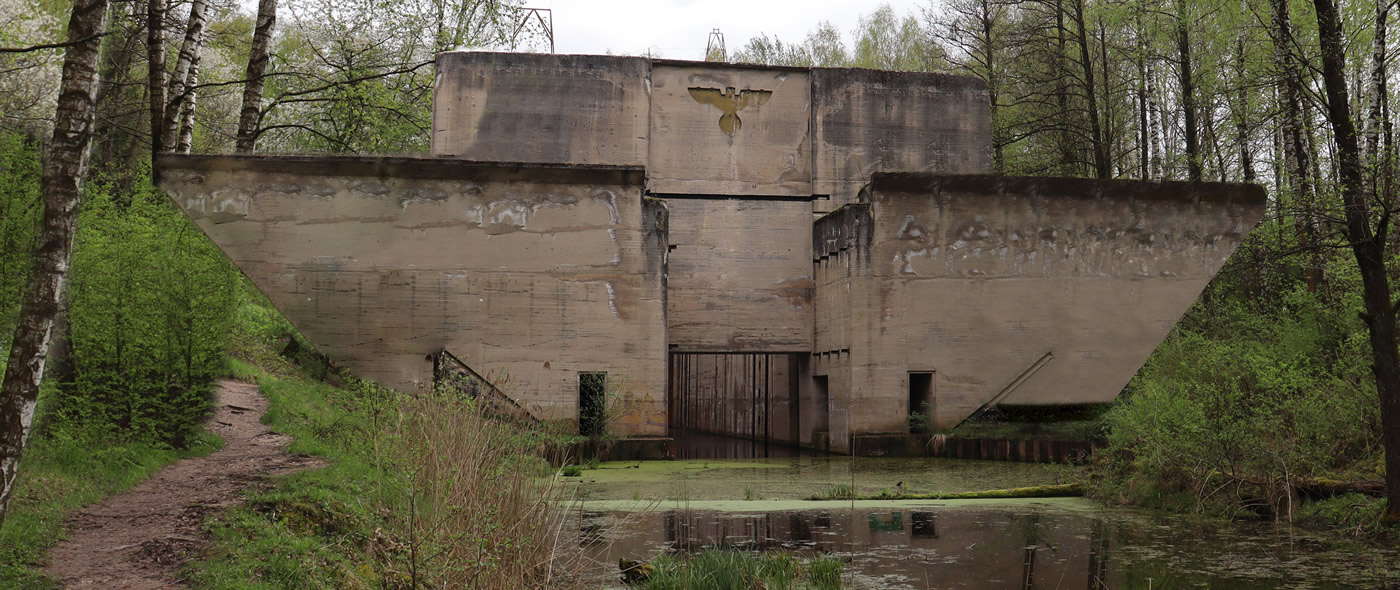
Organisation Todt built it through the winter of 1940–41 and was still building when the staff moved in around 23 June 1941, the day after the invasion began. The compound ran to some 250 structures and was divided in two. The northern zone, code-named Fritz, held the general staff: the chief, his operations, intelligence and organisation departments, the map rooms and teleprinters. The southern zone, Quelle, held the Quartermaster General, whose department fed, fuelled and moved an army of three million. Between and around them stood about thirty heavy shelters of reinforced concrete, the largest with walls and roofs seven metres thick, a smaller number of lighter bunkers, and timber barracks for the rest. At its peak Mauerwald housed some forty generals and 1,500 officers and men. A cluster of bunkers at the southern end carried the name Brigittenstadt, after nobody now remembers whom.
The Ring of Headquarters: Hochwald, Wendula, Steinort and Robinson
The map of Masuria in 1941 reads like a seating plan. Hitler at the Wolf's Lair. The army at Mauerwald, eighteen kilometres north-east. Heinrich Himmler at Hochwald, a compound in the forest outside Pozezdrze, fifteen kilometres further north, with his special train on a siding. Hans Lammers, head of the Reich Chancellery and the man who turned Hitler's instructions into law, at Wendula, two bunkers and seven barracks in the woods above Radzieje, ten kilometres from the Wolf's Lair and five from Mauerwald. Joachim von Ribbentrop across Lake Mamry in the west wing of the Lehndorff palace at Steinort. Hermann Göring and the Luftwaffe staff at the edge of the ring, a hundred kilometres away at Robinson outside Gołdap, because the Reichsmarschall wanted his stags more than he wanted the Führer.
Every road between them carried staff cars all day. A general leaving Mauerwald for the noon situation conference at the Wolf's Lair had a twenty-minute drive. Himmler's people could be at either in half an hour. The arrangement gave the Third Reich, for three years, a government that worked out of a forest the size of a small English county, and the concentration of power in that forest is why a resistance cell at Steinort could plan a coup over dinner without anyone noticing one more staff car in the drive.
Inside Mauerwald: The Generals Who Ran the Eastern Front
Halder's War Diary and the Fourteen-Day Delusion
Halder kept his diary at Mauerwald from the summer of 1941 to the autumn of 1942, and it is the record of a professional discovering that his profession has failed. The July confidence lasted weeks. By August he was writing that the Russian colossus had been underestimated, that the Germans had counted on 200 enemy divisions and had identified 360, that the enemy kept filling the gaps. By December the panzers were frozen outside Moscow and Hitler was sacking field marshals. Halder stayed. He argued with Hitler over the map table about where the next summer's offensive should go, and lost, and the offensive went to Stalingrad.
On 24 September 1942 Hitler dismissed him. The Führer told him, according to Halder's own account, that he needed a chief of staff with National Socialist ardour rather than professional knowledge. Halder packed his diary and left the forest. He was arrested after the July plot two years later, on suspicion rather than evidence, and spent the end of the war in Dachau and Flossenbürg, and the rest of his life as a paid historian for the United States Army, explaining what had gone wrong at the desk he had sat at here.
Zeitzler, Stalingrad and the Twenty-Minute Drive
His replacement was Kurt Zeitzler, a bull-necked organiser Hitler liked for his energy. Zeitzler arrived at Mauerwald in September 1942 as the Sixth Army was fighting its way into Stalingrad, and spent November and December driving the twenty minutes to the Wolf's Lair to ask Hitler to let it out. The Soviets had closed the ring around Paulus on 23 November. Zeitzler had the figures for what 250,000 men needed to eat and what the Luftwaffe could fly in, and the two numbers did not meet. Hitler said the Sixth Army would hold.
Zeitzler's protest was the only kind a general staff officer had left. He cut his own rations at Mauerwald to what the men in Stalingrad were receiving, and lost twelve kilograms in a fortnight. Hitler was told, and ordered him to stop. The Sixth Army surrendered on 2 February 1943. Zeitzler stayed on as chief of staff for another seventeen months, running the retreat from the same bunkers, until he reported himself sick in July 1944 and Hitler struck him from the army list with no pension and no right to wear the uniform.
Stauffenberg, Stieff and Wagner: The Twentieth of July's Base at Mauerwald
The Organisation Department of the general staff, in the Fritz zone, was where the army worked out how many divisions it had and where they could be. From 1940 to early 1943 one of its officers was a Swabian cavalry captain named Claus von Stauffenberg. He was good at the work and increasingly frank about what he saw in the reports crossing his desk from the east, the shootings, the starving prisoners, the orders that made the army complicit. He left Mauerwald for a staff posting in Tunisia in early 1943, lost an eye, a hand and two fingers there, and came back to Berlin a conspirator.
The department's head from October 1942 was Helmuth Stieff, a small, sharp major general who had written home from Poland in 1939 that he was ashamed to be a German. Stieff joined the resistance through Tresckow and used his position at Mauerwald to hold the explosives. The bomb Stauffenberg carried into the Wolf's Lair on 20 July 1944 had been in Stieff's keeping. He was arrested the same night, tried before Freisler on 7 August and hanged at Plötzensee the next day, one of the first of the plotters to die.
In the Quelle zone the Quartermaster General, Eduard Wagner, had spent three years supplying the army and negotiating with Himmler's police over the killing in the rear areas. He too was in the conspiracy. It was Wagner who arranged the aircraft that flew Stauffenberg from the Wolf's Lair back to Berlin on the afternoon of 20 July, and who waited in Zossen for news of a coup that had already failed. On 23 July, with the arrests spreading, he shot himself. Heinz Guderian, who had spent 20 July on his estate not far away, arrived at Mauerwald on the 21st as the new chief of staff and ordered every officer to give the Hitler salute.
Hochwald: Himmler's Headquarters in the Same Forest
The Sonderzug Heinrich and Himmler's Bunker at Pozezdrze
Fifteen kilometres north of Mauerwald, in the woods a kilometre outside the village of Pozezdrze, Himmler built a compound of nine structures he called Hochwald, with a heavy bunker for himself, quarters for his staff, and a siding for his train, the Sonderzug Heinrich, in which he preferred to work. He ran the SS, the police, the concentration camps and the murder of European Jewry from here whenever Hitler was at the Wolf's Lair, which after June 1941 was most of the time.
Himmler's stomach cramps were treated at Hochwald by his Finnish masseur Felix Kersten, who left a self-serving memoir of what the Reichsführer said on the massage table. His letters to his mistress, Hedwig Potthast, went out from here, gossip and endearments and complaints about the weather from a man who spent his working hours on the arithmetic of extermination. On 18 December 1941 he drove the twenty-five kilometres to the Wolf's Lair for a private meeting with Hitler, and wrote in his appointments diary afterwards, against the words Jewish question, four more: to be exterminated as partisans. Historians read it as the closest surviving record of Hitler ordering the Holocaust. He wrote it in a notebook and drove back to the forest.
Wendula: Lammers's Two Bunkers and the Paperwork of the Reich
Wendula was the smallest of the ring and the most bureaucratic. Hans Lammers, a career civil servant who had run the Reich Chancellery since 1933 and drafted the decrees that made the dictatorship legal, needed to be near Hitler to keep the paper moving. His compound above Radzieje, on the Rastenburg–Angerburg railway, had two heavy bunkers and seven barracks and no drama. Lammers signed here and drove to the Wolf's Lair to have things signed. By 1944 he had been outmanoeuvred by Bormann, who controlled access to Hitler in a way a chancellery chief with an office five kilometres away could not, and he left Wendula in August 1944 as the front closed on East Prussia. The Luftwaffe's operations staff, driven out of Robinson at Gołdap by the Soviet advance, moved in behind him. The paperwork of the Reich gave way to an air force with almost no aircraft.
January 1945: Why Mauerwald Survived and Hochwald Did Not
Hitler left the Wolf's Lair for the last time on 20 November 1944. The Army High Command had already begun moving back to its permanent bunkers at Zossen, south of Berlin, and Mauerwald emptied through the autumn. When the Red Army broke into East Prussia in the second week of January 1945 the ring was a shell.
The demolition orders went out on 24 January. Engineers blew the Wolf's Lair over two days, using tonnes of explosive per bunker and still failing to level the largest. They blew Hochwald, all nine structures, so thoroughly that only fragments stand. They blew the two bunkers at Wendula. They did not blow Mauerwald. Whether the engineers ran out of time, explosives or interest, the Army High Command's headquarters was left standing, and the Red Army walked into thirty intact bunkers on the shore of Lake Mamry without a shot. Hitler's compound held the Führer, and Himmler's held the SS, and both had to be erased. Mauerwald had held generals and their filing cabinets. Nobody thought it needed destroying, and so it is the one that survived.
Mamerki Today: Intact Bunkers, a Lookout Tower and the Amber Room Hunt
The 2016 Amber Room Search at Mamerki
The Amber Room, six tonnes of carved Baltic amber and gold leaf given by the King of Prussia to Peter the Great in 1716, was stripped from the Catherine Palace by the Wehrmacht in 1941 and installed in Königsberg Castle, a hundred kilometres north of here. It was last seen there in January 1945. Everything after that is claim.
In September 2016 Bartłomiej Plebańczyk, historian and director of the private museum at Mamerki, announced that ground-penetrating radar had found a chamber roughly three metres by two at the base of one of the bunkers, in a place where no room should be. Elderly villagers, he said, remembered a German convoy unloading heavy crates into the compound early in 1945. Erich Koch, the Gauleiter of East Prussia who was believed to know what had happened to the room, had been brought to Mamerki from his Polish prison cell in the 1960s to look. Plebańczyk told television he was almost certain. The deputy mayor of Węgorzewo said that if it was not the Amber Room it might be some other treasure.
The museum drilled into the concrete that autumn and put a camera through the hole. There was no chamber. There was concrete, and behind it earth. The radar had read a void that turned out to be the ordinary geometry of a bunker foundation, and the Amber Room went back to being wherever it has been since 1945, which is most probably ash in the ruins of Königsberg Castle. Plebańczyk has kept looking, in other bunkers, with other instruments. The site is large. The hunt is now part of what it is.
Walking the Mauerwald Bunkers: Fritz, Quelle and Brigittenstadt
The heart of the compound is a museum, run privately since the 1990s, which has taken over the Brigittenstadt bunkers at the southern end and fitted them out with wartime scenes, a mock-up of Hitler's map room, a reconstruction of a U-boat interior for reasons of its own, and a lookout tower on the roof of one shelter with a view over the canal and the lake. A thirty-metre tunnel connecting two of the bunkers is open, and so are the drains. The largest shelter, the giant, has walls seven metres thick and an interior the temperature of a cellar in August.
Most of the compound is not the museum. Beyond the fence the Fritz and Quelle zones run north through the trees for a kilometre, and the bunkers there are as the Germans left them: doors gone, walls green, floors under water in spring, camouflage netting anchors still in the concrete, a Polish army stencil here and there from the years after the war when the site was a training area. The barracks have rotted to their foundations. The paths are the German roads. It is possible to walk for an hour among thirty structures where the staff of three million men worked, and meet nobody.
Visiting Mamerki, Hochwald and Wendula: The Masurian Headquarters Route
Mamerki lies eight kilometres south-west of Węgorzewo on the road to Giżycko, beside the Masurian Canal where it meets Lake Mamry, and eighteen kilometres north-east of the Wolf's Lair at Gierłoż. The museum is signed from the road. It opens daily in season, with shorter hours in winter, and charges admission for the bunkers it has fitted out; the rest of the forest is free and open at all hours, and a torch is worth more than a ticket. Allow two hours for the museum and tower, and as long again for the wider compound. Boots are essential from autumn to spring.
Hochwald is a kilometre outside Pozezdrze, fifteen kilometres north, reached by a forest track from the village; the blown bunkers are heaps of reinforced concrete with rebar teeth, marked by a board, and take half an hour. Wendula is in the woods above Radzieje, ten kilometres south-west of Mamerki towards Kętrzyn, with the wreckage of Lammers's two bunkers visible from the path. Steinort, with its palace and marina, is across the lake and best reached by road round the northern shore. Combined with the Wolf's Lair, the four sites make a full day's driving in a ring of about eighty kilometres, and the drive is the point: this is how the men who ran the war saw the country, through a windscreen, between one headquarters and the next.
The canal locks at Leśniewo, a few minutes from Mamerki, are the other thing to see. They belong to the Masurian Canal, begun in 1911 to connect the lakes to the Baltic and abandoned in 1942 when the army needed the labour elsewhere, a concrete waterway to nowhere that the Wehrmacht's engineers left in the same state as everything else here.
The lookout tower at Mamerki stands on a bunker built to keep a general staff alive under bombardment that never came. From the top the view is water and pine and, on a clear day, the line of the far shore where the Foreign Minister slept. The Wolf's Lair is rubble. Hochwald is rubble. Mauerwald is thirty rooms of poured concrete with the dates still legible on the walls, standing in a Polish forest because no German in January 1945 thought paperwork was worth a fuse.
Frequently Asked Questions About Mamerki and the Mauerwald Bunkers
What was Mauerwald and why are the Mamerki bunkers so well preserved?
Mauerwald was the field headquarters of the Oberkommando des Heeres, the German Army High Command, built by Organisation Todt in 1940–41 in a forest on the shore of Lake Mamry near Węgorzewo, eighteen kilometres from Hitler's Wolf's Lair. It held around 250 structures including some thirty heavy concrete bunkers, and housed up to forty generals and 1,500 staff who directed the war on the Eastern Front from June 1941 to late 1944. When German engineers demolished the Wolf's Lair and Himmler's Hochwald headquarters in January 1945, they left Mauerwald untouched, so its bunkers survive largely intact and are among the best-preserved German command structures in Europe.
Who worked at the Mauerwald headquarters?
The Army High Command's chiefs of staff Franz Halder and Kurt Zeitzler ran the Eastern Front from Mauerwald, along with the general staff's operations, intelligence and organisation departments and the Quartermaster General's office. Claus von Stauffenberg served in the Organisation Department there from 1940 to early 1943. Helmuth Stieff, who headed that department from 1942 and stored the explosives for the 20 July 1944 bomb plot, and Eduard Wagner, the Quartermaster General who arranged Stauffenberg's aircraft, both worked from Mauerwald and died in the aftermath of the plot. Heinz Guderian took over as chief of staff at Mauerwald on 21 July 1944.
Where were Himmler's Hochwald and Lammers's Wendula headquarters?
Hochwald, Heinrich Himmler's field headquarters, stood in the forest a kilometre outside Pozezdrze, about fifteen kilometres north of Mauerwald, and consisted of nine structures including a heavy bunker and a siding for his special train. It was completely demolished by German engineers in January 1945 and survives as fragments. Wendula, the field office of Reich Chancellery chief Hans Lammers, lay in the woods above Radzieje on the Kętrzyn–Węgorzewo railway, about five kilometres from Mauerwald, and had two heavy bunkers and seven barracks; its bunkers were blown in January 1945 and stand as ruins. Both sites are reachable by forest track and free to visit.
Is the Amber Room hidden at Mamerki?
No evidence has been found that it is. In September 2016 the director of the Mamerki museum, Bartłomiej Plebańczyk, announced that ground-penetrating radar had detected a chamber about three by two metres at the base of a bunker, and cited villagers' accounts of German trucks unloading crates in early 1945. The museum drilled into the concrete and inserted a camera, and found no chamber and no contents. The Amber Room, looted from the Catherine Palace in 1941 and installed in Königsberg Castle, was last recorded there in January 1945 and is most widely believed to have been destroyed in the castle's ruins. Searches at Mamerki have continued without result.
How far is Mamerki from the Wolf's Lair and can you visit both in one day?
Mamerki lies about eighteen kilometres north-east of the Wolf's Lair at Gierłoż, eight kilometres south-west of Węgorzewo on the road to Giżycko. The two sites are around twenty-five minutes apart by car. Combined with Himmler's Hochwald at Pozezdrze, Lammers's Wendula at Radzieje and the Lehndorff palace at Sztynort across the lake, the former headquarters ring forms a driving circuit of roughly eighty kilometres that can be completed in a day, with the Wolf's Lair and Mamerki each needing two to three hours.
What can visitors see at the Mamerki bunker museum?
The private museum occupies the Brigittenstadt group of bunkers at the southern end of the complex. It includes furnished wartime interiors, a reconstruction of Hitler's map room, a thirty-metre underground tunnel connecting two bunkers, accessible drainage passages, a full-size U-boat interior reconstruction, and a lookout tower on a bunker roof with views over the Masurian Canal and Lake Mamry. The largest shelter has walls and roof seven metres thick. Beyond the museum fence, the remaining bunkers of the Fritz and Quelle zones stand unfenced in the forest and can be explored freely with a torch; the museum charges admission and opens daily in season with reduced winter hours.
Sources
The Halder War Diary, 1939–1942 — Franz Halder, edited by Charles Burdick and Hans-Adolf Jacobsen, Presidio Press (1988)
Hitler's Headquarters 1939–1945 — Neil Short, Osprey (2011)
Wolfsschanze i inne kwatery Hitlera w Prusach Wschodnich — Jan Miłosz Zarzycki, Wydawnictwo Kengraf (2009)
Mamerki: Kwatera Naczelnego Dowództwa Wojsk Lądowych OKH — Muzeum Mamerki, official site
Polish Historian Hopes Crumbling Bunker Hides Amber Room — Associated Press (2016)
Could Long-Lost Amber Room Be Stashed in a Nazi Bunker in Poland? — The Boston Globe (2016)
Stauffenberg: A Family History, 1905–1944 — Peter Hoffmann, Cambridge University Press (1995)
The History of the German Resistance, 1933–1945 — Peter Hoffmann, McGill-Queen's University Press (1996)
Der Dienstkalender Heinrich Himmlers 1941/42 — Peter Witte et al. (eds.), Christians Verlag (1999)
Heinrich Himmler: A Life — Peter Longerich, Oxford University Press (2012)
Stalingrad — Antony Beevor, Viking (1998)
Bunkeranlage Mauerwald / Mamerki, Hochwald, Wendula — Zielony Gaj regional guide (Masuria)


%2C%20Konjic%2C%20Bosnia.jpg)


