
Soviet soldiers at Wünsdorf watched the Berlin Wall come down on television. They were forty kilometres away, inside a city enclosed by seventeen kilometres of wall of their own, in a garrison where the order that came down through the ranks in November 1989 was to stay calm and stay put. They did. They remained another five years, holding the headquarters of an occupying army in a country that had stopped existing, on behalf of a state that was about to.
The same patch of pine forest served the Kaiser’s army, the Weimar Republic, the Third Reich and the Soviet Union in an unbroken run of eighty-four years. The buildings did not change function across any of those transitions. The great hall in the Haus der Offiziere was a dining room for Imperial officers, a casino for the Wehrmacht, and a concert hall for Soviet officers’ families, and it is the same room with the same stage.
Nothing about Wünsdorf’s end resembled a defeat. It was not stormed, liberated or shut down. The state that garrisoned it dissolved, and the garrison went home by train, and the forest began closing over a city that had been off every map for forty years.
Wünsdorf Before the Wars: The Kaiser’s Garrison in the Brandenburg Pines
The 1910 Military Complex and the Haus der Offiziere
Construction started in 1910 on sandy heathland that the Prussian army had been using as a shooting range. Barracks, riding halls, a rail connection and an officers’ building went up across a site that eventually covered tens of thousands of acres, and by the outbreak of war in 1914 the complex was among the largest military installations in Europe.
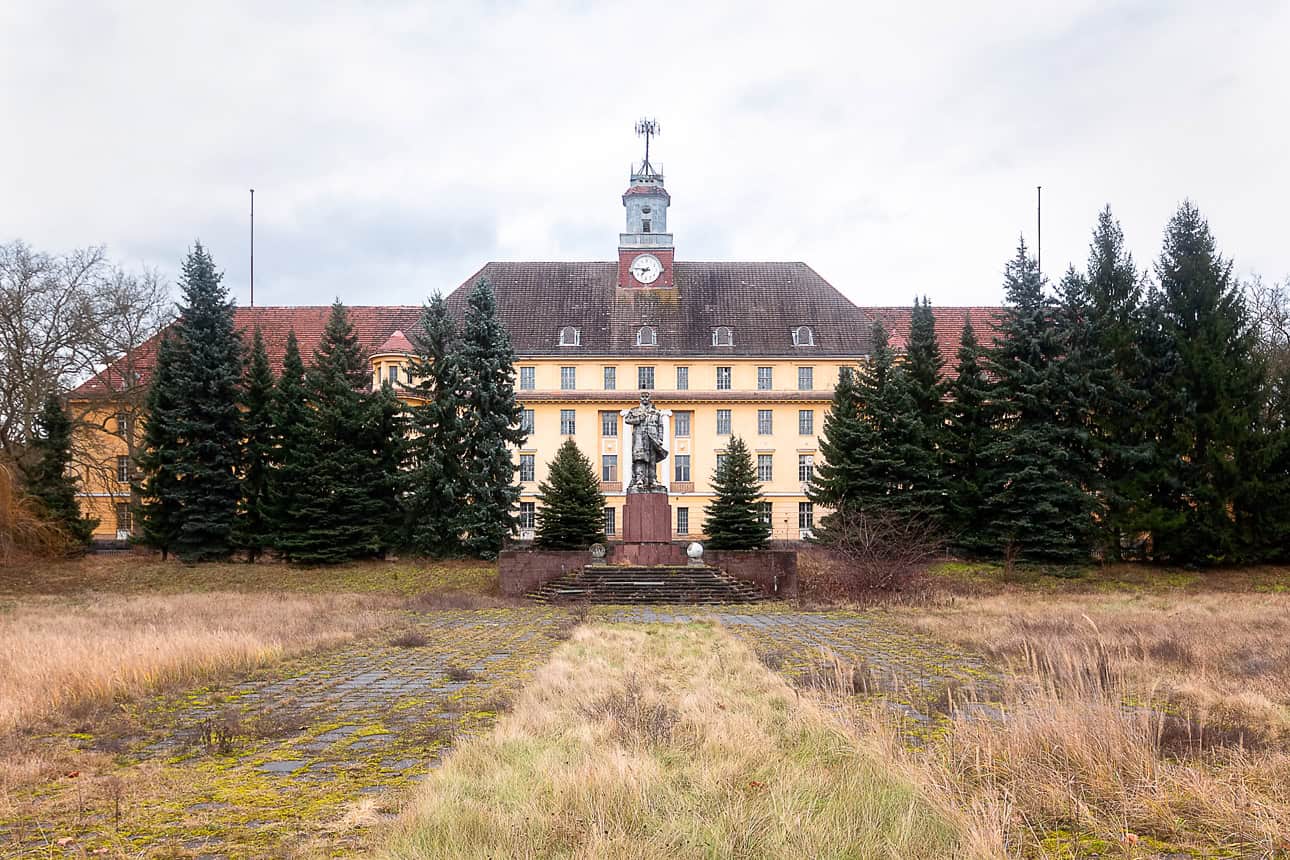
The Haus der Offiziere is the building everything else orbits. Yellow, long-fronted and grand in the way that Imperial military architecture insisted on, it has outlasted four governments and is still standing.
Wünsdorf collected the century’s business in odd ways. When Rosa Luxemburg’s body was recovered from a Berlin canal in 1919, months after her murder, it was brought out to the garrison hospital here for the autopsy.
The Half Moon Camp and Germany’s First Mosque
The strangest thing that ever happened at Wünsdorf happened in 1915, and almost nobody has heard of it. Germany built a prisoner-of-war camp on the site specifically for Muslim soldiers captured from the French, British and Russian armies — North Africans, Indians, Tatars — and called it the Halbmondlager, the Half Moon Camp.
The camp existed to run an experiment in religious warfare. Berlin had persuaded the Ottoman Sultan to declare a jihad against the Entente powers, and the theory was that Muslim colonial troops could be turned against the empires that had conscripted them. Wünsdorf was the demonstration site. The prisoners were fed properly, given religious instruction, supplied with newspapers in Arabic and Tatar, and in July 1915 given a wooden mosque — the first mosque ever built on German soil, modelled on the Dome of the Rock, with a minaret standing over a Brandenburg pine forest.
The recruitment worked poorly. A few thousand men volunteered for Ottoman service and most of those who went did not stay. What the camp produced instead was an archive: German linguists recorded the prisoners speaking, singing and reciting in dozens of languages, and those wax cylinders survive as some of the earliest recordings of speech from across the Islamic world, made by captives for scholars who were studying them.
The mosque stood until 1930, when it was demolished as unsafe.
Zossen-Wünsdorf and the German Army High Command
Maybach I and Maybach II: Bunkers Disguised as Country Houses
Rearmament turned Wünsdorf into the brain of the German army. Panzer regiments and the army’s motor school were based here through the 1930s, which makes the site something close to the birthplace of German armoured warfare, and from 1939 it held the Oberkommando des Heeres — the Army High Command.
The command bunkers were built to be invisible from the air. Maybach I consisted of twelve structures that looked, from above, like an ordinary cluster of gabled country houses with tiled roofs and shuttered windows. The houses were concrete shells. Underneath each one sat a multi-storey bunker with roofs eighty centimetres thick, and the twelve were linked by a ring tunnel so that staff could move between them without surfacing. Maybach I became operational one week before the invasion of Poland. Maybach II followed for the armed forces high command.
Nineteen pointed concrete air-raid shelters went up around the site as well, each designed to deflect a direct hit down its sloping sides, each holding 315 people.
The Zeppelin Bunker and the Wehrmacht’s Communications Hub
Zeppelin was the largest of them and the one that still exists. Built as the central communications facility for the German armed forces, with walls up to 3.2 metres thick, it handled the signal traffic that connected Berlin to every front. Teleprinters, switchboards and cipher equipment filled it. Orders for campaigns from Norway to North Africa passed through this building.
Commanding a War From a Pine Forest
The planning for the invasion of the Soviet Union was done here, in offices in a Brandenburg wood, by staff officers who commuted from married quarters. That ordinariness is the part worth holding. Wünsdorf was not a fortress in any romantic sense; it was a headquarters campus with a canteen, a cinema and a bakery, and the men in it produced the operational orders for the deadliest campaign in human history.
Hitler ran the war from elsewhere, first from Berlin and then from the forward complex at the Wolf’s Lair in East Prussia, and the split between the Führer’s headquarters and the army’s permanent staff at Zossen was a source of friction throughout the war. The professional soldiers were in Brandenburg with the maps and the files. The decisions were made eight hundred kilometres east.
On 15 March 1945 the United States Eighth Air Force sent more than 580 aircraft over Wünsdorf and bombed it heavily.
The Red Army arrived five weeks later. On 20 and 21 April 1945 the 3rd Guards Tank Army took the complex essentially without a fight. The high command had already gone, and the handful of soldiers still present offered nothing. Local accounts hold that one of them was too drunk to understand what was happening around him.
1945: The Red Army Takes the Complex
Marshal Georgy Zhukov made Wünsdorf his headquarters, and the Soviet Union kept the site for the next forty-nine years.
Demolition came first. The Potsdam Agreement required German military installations to be destroyed, and Soviet engineers blew up most of the Maybach complex in 1947 along with the air-raid shelters. The work was thorough enough that Maybach today is a field of broken concrete and open shafts.
Zeppelin survived, because Zeppelin was useful. The bunker was pumped out, dried, extensively rebuilt, fitted with airlocks to convert it from gas-proof to nuclear-hardened, and put back into service as the protected command centre for the Soviet high command in Germany. The building the Wehrmacht used to run its war was used by the Red Army to prepare for the next one.
The Forbidden City: Soviet Headquarters in East Germany
1953: Evicting the Germans and Sealing the Perimeter
Wünsdorf became the headquarters of all Soviet forces in Germany in 1953, and the arrangement required the removal of the Germans still living there. Around 800 residents were resettled. The main highway was closed. A perimeter went up — seventeen kilometres of wall and fence, with guard posts and controlled gates.
Roughly half a million Soviet troops were stationed across East Germany at the height of the Cold War, and this was where they were commanded from. The population inside the wire reached around 75,000 including families, making it the largest Soviet military settlement anywhere outside the Soviet Union.
Life Inside Little Moscow
The town inside the wall was Soviet in every practical respect. Shops stocked Soviet goods and Soviet magazines. Schools and kindergartens taught a Moscow curriculum. There were cinemas, a theatre, sports halls, a swimming pool and hospitals, and there was a train that ran to Moscow every day, which is the detail that best captures what the place was: a piece of the Soviet Union with a scheduled service to the rest of it.
The soldiers were conscripts, posted two or three years at a stretch. They had no leave, no visits from family, and no permission to go beyond the wire. Men in their late teens spent their entire service inside a walled town in a foreign country, seeing nothing of that country except the trees over the fence.
A mural inside one of the halls made the point without meaning to. On one wall a panorama of Moscow; on the other, a panorama of Alexanderplatz. The two cities the men here were living between, painted facing each other, in a building neither city’s civilians could enter.
What East Germans Could and Could Not See
East Germans knew Wünsdorf existed and knew what it meant, and could not go near it. Die Verbotene Stadt was a phrase in ordinary use for a place they were forbidden to enter in their own country, garrisoned by an army whose presence was the ultimate guarantor of their government.
The GDR maintained its own machinery for watching its citizens, most visible now in the preserved cells at the Stasi prison at Hohenschönhausen, where the state’s attention to its own population was total. Wünsdorf was the other half of the arrangement. A country under permanent internal surveillance also hosted a foreign command centre it had no access to and no authority over, and the second fact was what made the first one enforceable.
The medical infrastructure gives the scale away. The Soviet forces ran their own hospital at Beelitz-Heilstätten, the enormous sanatorium complex west of here, and held it until 1995 — a year after Wünsdorf emptied, five years after German reunification.
1989 to 1994: Watching the Wall Fall From Inside a Walled City
The Withdrawal and the Speed of the Departure
The Berlin Wall opened in November 1989 and the garrison at Wünsdorf did nothing, on orders. Nothing was the correct answer and everyone involved understood how narrow the margin was; a Soviet army of half a million men sat inside a country that was reorganising itself around them.
The withdrawal was agreed as part of the reunification settlement and executed between 1991 and 1994. Dismantling of the Zeppelin command centre began in 1992. The last troops left Germany in the summer of 1994, and the daily train to Moscow was discontinued that year.
Around 40,000 Soviet personnel and family members were still at Wünsdorf when the departure began. Moving them was one of the largest peacetime military relocations ever attempted, and it was carried out by a state that had itself ceased to exist in 1991, on behalf of a successor with no housing ready at the other end.
The same withdrawal ran across the former bloc on different terms and produced opposite results. Latvia signed a deal in 1994 that let Russia go on operating the early-warning radar at Skrunda-1 for another four years, and the following spring an American demolition firm brought the unfinished tower there down on live television at American expense, as a public statement about sovereignty. Germany moved 40,000 people off its territory in three years and turned the barracks into flats.
What the Russians Left Behind
They went quickly and they did not tidy up. Ammunition was abandoned in quantity. Fuel, vehicles, equipment and general waste were left where they stood, and the site required years of clearance before anything could be done with it.
Some of them left animals. Behind the stage in the Soviet theatre, the dried remains of a dog lay for years afterward, which is the detail visitors on the tours tend to remember longest.
What they did not remove was Lenin. The statue outside the Haus der Offiziere stayed where it was and is still standing, weather-beaten, facing a car park in Brandenburg, thirty-two years after the country that erected it dissolved.
Wünsdorf Today: Book Town, Bunker Tours and 1,700 Apartments
The Haus der Offiziere Still Waiting for a Buyer
Ownership passed to Brandenburg and the site was split between redevelopment and abandonment. Roughly 1,700 apartments have been converted out of the former barracks and are lived in, with several hundred more planned. Wünsdorf reinvented part of itself as a Bücherstadt — a book town, with antiquarian bookshops in former military buildings — and it now draws around 20,000 visitors a year.
The Haus der Offiziere has found no buyer. The building at the centre of everything, with the theatre and the murals and the Space Age nightclub the Soviets bolted onto the back of it, sits empty behind a locked gate while the rest of the site fills up with tenants.
For years the person who knew the complex best was its caretaker, Jürgen Naumann, who held the keys to every building in the restricted zone on a set of bunches and could name what each room had been under each successive army.
Redevelopment, Contamination and the Lenin That Stayed
The restricted zone is still restricted, fenced and guarded, more than thirty years after the last soldier left. Munitions clearance, structural decay and open bunker shafts keep it closed, and the buildings inside are failing faster than any plan to save them.
The redevelopment produced a genuinely strange settlement. Families live in renovated Soviet barracks, a few hundred metres from a sealed compound containing a Wehrmacht communications bunker, a Soviet theatre and a statue of Lenin, on ground where an Imperial German army built a mosque for prisoners it hoped to turn into allies.
Visiting Wünsdorf: Bunker Tours, the Forbidden City and Getting There
Wünsdorf can be visited, which makes it unusual among sites of this kind, but only on a guided tour. The Forbidden City and the bunker park are fenced and patrolled, and independent entry is trespassing on ground with genuine hazards. Tours are run by the local Bücherstadt-Tourismus operation and cover the Zeppelin bunker, the Maybach ruins and parts of the Soviet complex including the theatre. They fill up on Sundays and are worth booking ahead.
Getting there from Berlin is straightforward. Wünsdorf-Waldstadt has its own station on the regional line south from the city, and the journey takes under an hour; by car it is about forty minutes down the B96.
The Zeppelin bunker is the centrepiece and it delivers. Entry is through a steel door weighing two and a half tonnes, into a facility built to keep functioning with no contact whatsoever with the outside world — its own power, air, water and communications, on the assumption that everything above ground would be gone. The corridors are long, cold and unlit except by the guide’s lamp.
Above ground the Maybach site reads differently. Little remains beyond concrete stumps and the openings of the ring tunnel among the trees, and the imagination has to supply the twelve fake houses that stood over it looking like a quiet village.
The book town is the part that makes the visit strange rather than solemn. Second-hand bookshops occupy the old military buildings a short walk from the sealed zone, and the same afternoon can hold a browse through German paperbacks and a descent into the command bunker for Operation Barbarossa.
The most useful thing to understand at Wünsdorf is how little was ever wasted here. Every army that took the site kept what the previous one built and put it back to work. Imperial barracks became Wehrmacht barracks became Soviet barracks became apartments. The gas-proof bunker became a nuclear bunker. The officers’ dining room became a casino became a concert hall. Four regimes, one of them foreign, running the same buildings for the same purpose across eighty-four years, and the only thing that ever interrupted the sequence was a country ceasing to exist.
Lenin is still outside, and the pines are still coming in from the edges, and somewhere under the trees there is a field of broken concrete where twelve houses that were never houses used to stand.
Frequently Asked Questions About Wünsdorf
What was Wünsdorf?
Wünsdorf is a district of Zossen in Brandenburg, about forty kilometres south of Berlin, that functioned as a military headquarters without interruption from 1910 to 1994. It began as a Prussian shooting range and grew into one of Europe’s largest military installations before the First World War. From 1939 it housed the German Army High Command, and after 1945 it became the headquarters of Soviet forces in East Germany. Roughly 1,700 apartments have since been converted from the former barracks, while the core compound remains fenced and closed.
Why was Wünsdorf called the Forbidden City?
Wünsdorf became the headquarters of all Soviet forces in Germany in 1953, and the arrangement required removing the Germans who still lived there. Around 800 residents were resettled, the main highway was closed, and a perimeter of roughly seventeen kilometres of wall and fence went up with guard posts and controlled gates. East German citizens were not permitted to enter and needed special authorisation to go near it. The name they used for it, Die Verbotene Stadt, described a place inside their own country that was closed to them.
What are the Maybach and Zeppelin bunkers at Wünsdorf?
Maybach I was a complex of twelve command bunkers built for the German Army High Command and disguised from the air as an ordinary cluster of gabled country houses; the houses were concrete shells over multi-storey bunkers linked by a ring tunnel. It became operational one week before the invasion of Poland in 1939, and Maybach II followed for the armed forces high command. Zeppelin was the central communications bunker, with walls up to 3.2 metres thick. Soviet engineers demolished most of Maybach in 1947 under the Potsdam Agreement, but Zeppelin was rebuilt as a nuclear-hardened Soviet command centre and survives today.
How many Soviet soldiers were stationed at Wünsdorf?
The population inside the perimeter reached around 75,000 including soldiers, officers, civilian staff and their families, making it the largest Soviet military settlement outside the Soviet Union. Roughly half a million Soviet troops were stationed across East Germany at the height of the Cold War, and Wünsdorf was where they were commanded from. Around 40,000 personnel and family members were still present when the withdrawal began in the early 1990s. Conscripts served two to three years with no leave, no family visits and no permission to leave the compound.
When did the Soviets leave Wünsdorf?
The withdrawal was agreed as part of the German reunification settlement and carried out between 1991 and 1994. Dismantling of the Zeppelin command centre began in 1992, the last troops left Germany in the summer of 1994, and the daily train service between Wünsdorf and Moscow was discontinued that year. The departure was rapid and left behind ammunition, fuel, vehicles and general waste that required years of clearance. The statue of Lenin outside the Haus der Offiziere was not removed and still stands.
Can visitors go to Wünsdorf today?
Wünsdorf can be visited on a guided tour only. The Forbidden City and the bunker park remain fenced and patrolled more than thirty years after the last soldier left, because of munitions clearance, structural decay and open bunker shafts. Tours run by the local Bücherstadt-Tourismus operation cover the Zeppelin bunker, the Maybach ruins and parts of the Soviet complex including the theatre, and they fill quickly on Sundays. Wünsdorf-Waldstadt has its own station on the regional line from Berlin, under an hour from the city.
Sources
The Forbidden City: Inside the Abandoned Soviet Camp of Wünsdorf — Ciarán Fahey, The Guardian (2017)
Abandoned Berlin — Ciarán Fahey (2015)
The Berlin-Baghdad Express: The Ottoman Empire and Germany’s Bid for World Power — Sean McMeekin (2010)
Jihad Made in Germany: Ottoman and German Propaganda and Intelligence Operations in the First World War — Tilman Lüdke (2005)
The Halfmoon Files — Philip Scheffner (2007)
Lautarchiv: Prisoner of War Recordings 1915–1918 — Humboldt-Universität zu Berlin
Soviet Military Activities in the Zossen-Wünsdorf Area — Central Intelligence Agency, declassified intelligence reports (1950s)
Treaty on the Final Settlement with Respect to Germany — Federal Republic of Germany and signatory powers (1990)
Wünsdorf Military Base — Subterranea Britannica (2020)
‘Forbidden City’ Tells Germany’s Complex Military History — Associated Press (2019)
In Wünsdorf, Germany, the ‘Forbidden City’ Is an Echo of the Soviet Era — CNN (2019)
Bücher- und Bunkerstadt Wünsdorf: Site History and Tour Information — Bücherstadt Tourismus GmbH (2024)

%2C%20Konjic%2C%20Bosnia.jpg)


